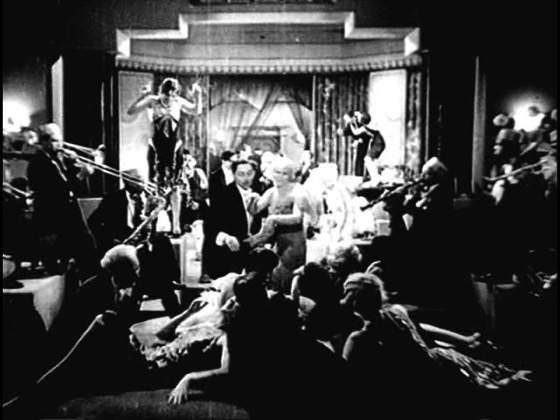
When Women Wrote Hollywood – 3 in a series – The Ten Commandments (1923), Wr: Jeanie Macpherson, Dirs: Cecil B. DeMille, USA 136 mins

To highlight the wonderful yet largely forgotten work of a collection of female screenwriters from the early years of Hollywood (and as a companion to the book, When Women Wrote Hollywood) we will be posting quick bits about the many films they wrote along with links to further information and clips from their works which are still accessible online. Take a few moments once or twice a week to become familiar with their names and their stories. I think you’ll be surprised at how much bold material these writers tackled at the birth of this new medium. — Rosanne Welch


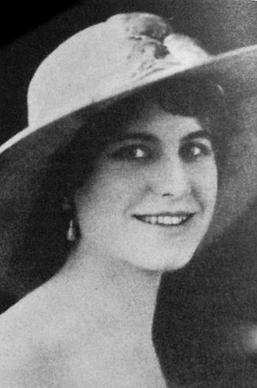
Jeanie MacPherson
Jeanie Macpherson

The Ten Commandments (1923), Wr: Jeanie Macpherson, Dirs: Cecil B. DeMille, USA 136 mins

Segments from The Ten Commandments (1923)

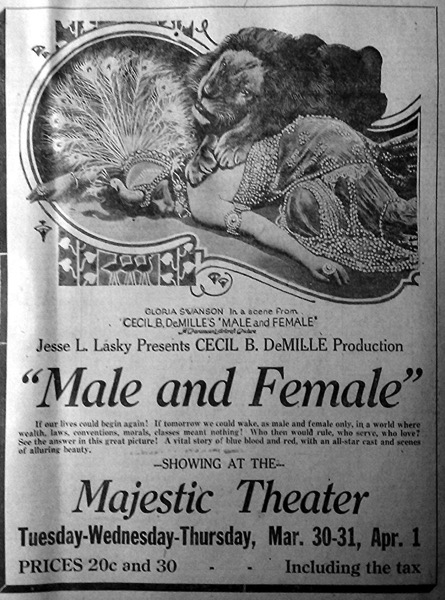
Original Poster Art

When Women Wrote Hollywood  - 3 in a series - The Ten Commandments (1923), Wr: Jeanie Macpherson, Dirs: Cecil B. DeMille, USA 136 minsWhen Women Wrote Hollywood  - 3 in a series - The Ten Commandments (1923), Wr: Jeanie Macpherson, Dirs: Cecil B. DeMille, USA 136 mins

The Ten Commandments is a 1923 American silent religious, epic film and produced and directed by Cecil B. DeMille. Written by Jeanie MacPherson, the film is divided into two parts: a prologue recreating the biblical story of the Exodus and a modern story concerning two brothers and their respective views of the Ten Commandments.

Lauded for its “immense and stupendous” scenes, use of Technicolor process 2, and parting of the Red Sea sequence,[3] the expensive film proved to be a box-office hit upon release.[4] It is the first in DeMille’s biblical trilogy, followed by The King of Kings (1927) and The Sign of the Cross (1932).

Despite its epic scale, the Moses story takes up only about the first third of the film. After that, the story changes to a modern setting involving living by the lessons of the commandments. Two brothers make opposite decisions, one, John, to follow his mother’s teaching of the Ten Commandments and become a poor carpenter, and the other, Danny, to break every one of them and rise to the top. The film shows his unchecked immorality to be momentarily gainful, but ultimately disastrous. Wikipedia

More information on The Ten Commandments (1923)

* A portion of each sale from Amazon.com directly supports our blogs
** Many of these books may be available from your local library. Check it out!
† Available from the LA Public Library

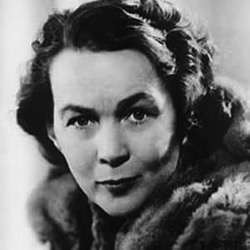
When Women Wrote Hollywood – 2 in a series – Adela Rogers St. Johns

To highlight the wonderful yet largely forgotten work of a collection of female screenwriters from the early years of Hollywood (and as a companion to the book, When Women Wrote Hollywood) we will be posting quick bits about the many films they wrote along with links to further information and clips from their works which are still accessible online. Take a few moments once or twice a week to become familiar with their names and their stories. I think you’ll be surprised at how much bold material these writers tackled at the birth of this new medium. — Rosanne Welch


When Women Wrote Hollywood – 2 in a series – Adela Rogers St. Johns

Adela rogers st johnsAdela rogers st john 9469593 1 402

When Women Wrote Hollywood  - 2 in a series - Adela Rogers St. Johns

Adela Nora Rogers St. Johns (May 20, 1894 – August 10, 1988) was an American journalist, novelist, and screenwriter. She wrote a number of screenplays for silent movies but is best remembered for her groundbreaking exploits as “The World’s Greatest Girl Reporter” during the 1920s and 1930s and her celebrity interviews for Photoplay magazine.

She obtained her first job in 1912 working as a reporter for Hearst’s San Francisco Examiner. She reported on crime, politics, society, and sports news before transferring to the Los Angeles Herald in 1913.[1]

 After seeing her work for that newspaper, James R. Quirk offered her a job writing for his new fan magazine  Photoplay. St. Johns accepted the job so she could spend more time with her husband and children. Her celebrity interviews helped the magazine become a success through her numerous revealing interviews with Hollywood film stars.[3]

She also wrote short stories for CosmopolitanThe Saturday Evening Post, and other magazines and finished nine of her thirteen screenplays before returning to reporting for Hearst newspapers. Wikipedia

More information on Adela Rogers St. Johns

* A portion of each sale from Amazon.com directly supports our blogs
** Many of these books may be available from your local library. Check it out!
† Available from the LA Public Library

When Women Wrote Hollywood – 1 in a series – “The Red Kimono” – Story by Adela Rogers St. Johns, Directed and Starring Dorothy Davenport

To highlight the wonderful yet largely forgotten work of a collection of female screenwriters from the early years of Hollywood (and as a companion to the book, When Women Wrote Hollywood) we will be posting quick bits about the many films they wrote along with links to further information and clips from their works which are still accessible online. Take a few moments once or twice a week to become familiar with their names and their stories. I think you’ll be surprised at how much bold material these writers tackled at the birth of this new medium. — Rosanne Welch


“The Red Kimono” – Story by Adela Rogers St. Johns, Directed and Starring Dorothy Davenport

A clip from The Red Kimono

Original Poster Art

When Women Wrote Hollywood -

The Red Kimono is a 1925 American silent film drama about prostitution produced by Dorothy Davenport (billed as Mrs. Wallace Reid) and starring Priscilla Bonner.

The film is notable today for being one of the few independent productions produced and written by women. This is the third of Davenport’s “social conscience” releases, preceded by Human Wreckage (1923) on the topic of drug addiction (released five months after Wallace Reid‘s death from morphine), and Broken Laws (1924) about excessive mother-love.

The film is based on a real case of prostitution that took place in New Orleans in 1917. This film, billing itself as a true story, used the real name of the woman played by Priscilla Bonner who as a consequence sued producer Dorothy Davenport for a hefty sum in court and won.[1] The case, Melvin v Reid has been cited recently in the emerging “right to be forgotten” cases around the world as an early example of one’s right to leave a past one wishes to forget. In the ruling of the California Appellate Court (Melvin v. Reid, 112 Cal.App. 285, 297 P. 91 (1931)) the Court stated, “any person living a life of rectitude has that right to happiness which includes a freedom from unnecessary attacks on his character, social standing or reputation.”[citation needed]

As with Davenport’s earlier Human Wreckage in 1924, this film was banned in the United Kingdom by the British Board of Film Censors in 1926.[2] In the 1920s, the film was also banned in the city of Chicago[3][4]. — Wikipedia

More information on Red Kimono

* A portion of each sale from Amazon.com directly supports our blogs
** Many of these books may be available from your local library. Check it out!
† Available from the LA Public Library

When Women Wrote Hollywood: Essays on Female Screenwriters in the Early Film Industry — Now Available!

When Women Wrote Hollywood: Essays on Female Screenwriters in the Early Film Industry 

I’m so excited to see that we’re now publishing on this collection of essays written by the original cohort of students in our first Stephens College MFA in Screenwriting which I edited and for which author Cari Beauchamp wrote a wonderful forward covering the life and influence of Frances Marion.

These 23 essays cover a range of female screenwriters from the early years of film through the 1940s, women whose work helped create the unforgettable stories and characters beloved generations of audiences but whose names have been left out of most film histories.  Not this one. This collection is dedicated to those women and written by a group of women grateful to stand on the shoulders of those who came before – as a beacon to those who will come after.

Rosanne Welch

When Women Write Hollywood Cover

Paperback Edition | Kindle Edition | Google Play Edition

Use “When Women Wrote Hollywood” in your classroom! — Contact McFarland directly for library and academic purchases. 


Like Us on Facebook!


Table Of Contents

Acknowledgments

Foreword: Finding Frances Marion
Cari Beauchamp

Introduction
Rosanne Welch 5

Adela Rogers St. Johns: Survival Of The Feisty
Sarah Amble Whorton

Jeanie Macpherson: A Life Unknown
Amelia Phillips

Anita Loos: A Girl Like Her
Toni Anita Hull

The Nature And Genius Of Alice Guy Blaché
Khanisha Foster

“You’d Better Learn To Hold Your Liquor”: Bess Meredyth And A Career In Early Hollywood
Sydney Haven

The Best Revenge Is Outliving Them All: The Life And Heartbreak Of Frederica Sagor Maas
Mikayla Daniels

Silent Screenwriter, Producer And Director: Marion Fairfax
Sarah Phillips

Smart Girl In Charge: Eve Unsell
Laura Kirk

The Glorious Ms. Glyn
Amy L. Banks

Fearless And Fierce: June Mathis
Lauren Elizabeth Smith

Writing Around Lois Weber
Chase Thompson

Gene Gauntier: Ascending By Drowning
Yasser Omar Shahin

Lorna Moon: A Woman Of A Certain Influence
Elizabeth Dwyer Sandlin

Clara Beranger: The Unseen Laborer
Amanda R. Stockwell

Ida May Park: Prolific Pioneer
Jackie Perez

Frances Goodrich And Albert Hackett: The Most Beloved Couple In Hollywood
Julie Berkobien

In Defense Of Lillian Hellman
Kelley C. Zinge

The Intimately Unknowable Dorothy Parker: A Study Of Her Life And Art
Elizabeth Dwyer Sandlin

Joan Harrison: Redefining Femininity In Film Noir And Hollywood
Chelsea Andes

The Six Degrees Of Sarah Y. Mason And Victor Heerman
Pamela L. Scott

Zoë Akins: A Quiet Rebellion
Sarah Amble Whorton

Marriage Of Words: Bella And Sam Spewack
Laura Kirk

The Forgettable Ms. Murfin
Amy L. Banks

A Team In Passionate Action: Ruth Gordon And Garson Kanin
Rosanne Welch

About The Contributors

Today I Became a Citation: Little Women, Feminism and Me!

I usually use Google Alerts to find mentions of The Monkees but this weekend something interesting happened. Google Alerts found my name in an essay on the JSTOR Daily about the new BBC miniseries version of Little Women, adapted by Heidi Thomas of “Call the Midwife”) from a novel by a female writer (Louisa May Alcott, as if you didn’t know) and directed by a woman (Vanessa Caswill). 

My Summer of Watching Little Women by Benjamin Winterhalter

Little women movie 1050x700

The writer of the essay was a male, JSTOR Daily’s features editor Benjamin Winterhalter and he was reminiscing about a summer in his elementary years when his mother and friends dissected all the filmed adaptations of the novel  in preparation for writing an article —  “A Feminist Romance: Adapting Little Women to the Screen”  for Tulsa Studies in Women’s Literature. 

Read the Journal Article


Join the Rosanne Welch Mailing List for future book and event announcements!
 

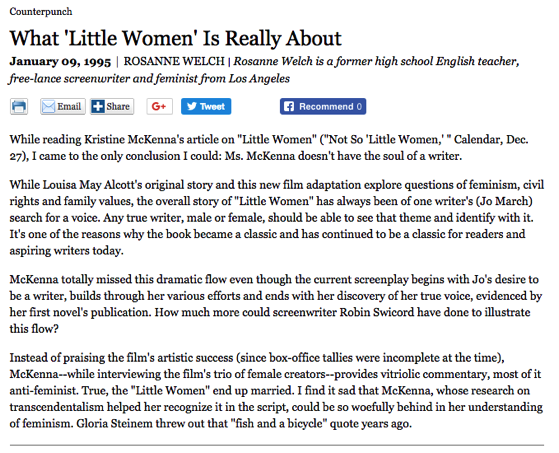
Winterhalter’s article came up because along his research way he came across an Op-Ed I had written for the Los Angeles Times, “What ‘Little Women’ Is Really About” about the 1995 Robin Schiff adaptation (starring Winona Ryder) which I had framed as both a more deeply feminist interpretation but, more importantly, accessible to all as the story of a writer finding their voice.

Today I Became a Citation: Little Women. Feminism and Me!

How fun to be reminded of that Op-Ed and to see how accessible my earlier work can be with archives going digital.  It’s also good timing as I often recommend to screenwriting students that they write for various local publications in order to get their names out there and to fill out their writing CVs.  Here’s an example of a piece I wrote when I had a passionate idea ( the one about how this is more the story of a writer finding their voice than merely a bunch of sisters surviving the Civil War). Since I did not see that idea represented in the mainstream press, I brought it to their attention and they noticed it and presented it to their readers.

A History of Screenwriting 60 – The General Starring Buster Keaton

A History of Screenwriting 60 – The General Starring Buster Keaton

A History of Screenwriting 60 - The General Starring Buster Keaton

Screenplay by Al Boasberg, Clyde Bruckman, Buster Keaton, Charles Henry Smith, Paul Girard Smith
Based on The Great Locomotive Chase by William Pittenger

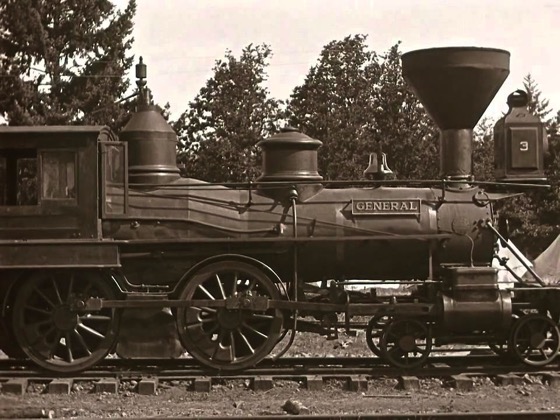
The General is a 1926 American silent comedy film released by United Artists. It was inspired by the Great Locomotive Chase, a true story of an event that occurred during the American Civil War. The story was adapted from the memoir The Great Locomotive Chase by William Pittenger. The film stars Buster Keaton who co-directed it with Clyde Bruckman.

At the time of its initial release, The General, an action-adventure-comedy made toward the end of the silent era, was not well received by critics and audiences, resulting in mediocre box office returns (about half a million dollars domestically, and approximately one million worldwide). Because of its then-huge budget ($750,000 supplied by Metro chief Joseph Schenck) and failure to turn a significant profit, Keaton lost his independence as a filmmaker and was forced into a restrictive deal with MGM. In 1954 the film entered the public domain (in the USA), owing to the claimant’s failure to renew its copyright registration in the 28th year after publication.[2]

The General has since been reevaluated, and is now often ranked among the greatest American films ever made.[3] — Wikipedia


Learn more about Buster Keaton with these books

* A portion of each sale from Amazon.com directly supports our blogs
** Many of these books may be available from your local library. Check it out!
† Available at the LA Public Library

A History of Screenwriting 59 – Screenwriting (Behind the Silver Screen Series) by Andrew Horton (Editor), Julian Hoxter

A History of Screenwriting 59 – Screenwriting (Behind the Silver Screen Series) by Andrew Horton (Editor), Julian Hoxter

Screenwriters often joke that “no one ever paid a dollar at a movie theater to watch a screenplay.” Yet the screenplay is where a movie begins, determining whether a production gets the “green light” from its financial backers and wins approval from its audience. This innovative volume gives readers a comprehensive portrait of the art and business of screenwriting, while showing how the role of the screenwriter has evolved over the years.

Reaching back to the early days of Hollywood, when moonlighting novelists, playwrights, and journalists were first hired to write scenarios and photoplays, Screenwriting illuminates the profound ways that screenwriters have contributed to the films we love. This book explores the social, political, and economic implications of the changing craft of American screenwriting from the silent screen through the classical Hollywood years, the rise of independent cinema, and on to the contemporary global multi-media marketplace. From The Birth of a Nation (1915), Gone With the Wind (1939), and Gentleman’s Agreement (1947) to Chinatown (1974), American Beauty (1999), and Lost in Translation (2003), each project began as writers with pen and ink, typewriters, or computers captured the hopes and dreams, the nightmares and concerns of the periods in which they were writing.

As the contributors take us behind the silver screen to chronicle the history of screenwriting, they spotlight a range of key screenplays that changed the game in Hollywood and beyond. With original essays from both distinguished film scholars and accomplished screenwriters, Screenwriting is sure to fascinate anyone with an interest in Hollywood, from movie buffs to industry professionals.  — Amazon.com


* A portion of each sale from Amazon.com directly supports our blogs
** Many of these books may be available from your local library. Check it out!
† Available at the LA Public Library

A History of Screenwriting 58 – Smilin’ Through starring Norma Talmadge, Written by Alan Langdon Martin (aka Jane Murfin and Jane Cowl) (original play), James Ashmore Creelman (scenario), Sidney Franklin (scenario) – 1922

A History of Screenwriting 58 – Smilin’ Through starring Norma Talmadge, Written by Alan Langdon Martin (aka Jane Murfin and Jane Cowl) (original play),
James Ashmore Creelman (scenario), Sidney Franklin (scenario) – 1922

A History of Screenwriting 58 - Smilin' Through starring Norma Talmadge, Written by Alan Langdon Martin (aka Jane Murfin and Jane Cowl) (original play), 
James Ashmore Creelman (scenario), Sidney Franklin (scenario) - 1922

Smilin’ Through is a 1922 silent film based on the 1919 play of the same name, written by Jane Cowl and Jane Murfin (together under the pseudonym Alan Langdon Martin). The film starred Norma Talmadge, Harrison Ford, and Wyndham Standing. It was co-written and directed by Sidney Franklin, who also directed the more famous 1932 remake at MGM. The film was produced by Talmadge and her husband Joseph M. Schenck for her company, the Norma Talmadge Film Corporation. It was released by First National Pictures. Popular character actor Gene Lockhart made his screen debut in this film.[3][4]

The story is essentially the same as the popular Jane Cowl play, with Talmadge in the dual role of Kathleen and Moonyean. Kathleen, a young Irish woman, is in love with Kenneth Wayne but is prevented from marrying him by her guardian John Carteret. John is haunted by memories of his thwarted love for Kathleen’s aunt, Moonyean.

The story was an especially popular one and was filmed twice more by MGM: in 1932 with Norma Shearer and 1941 with Jeanette MacDonald. – Wikipedia


Learn More About Norma Talmadge with these books

* A portion of each sale from Amazon.com directly supports our blogs
** Many of these books may be available from your local library. Check it out!
† Available at the LA Public Library

A History of Screenwriting 57 – New York Nights starring Norma Talmadge, Written by Hugh Stanislaus Stange and Jules Furthman – 1929

A History of Screenwriting 57 – New York Nights starring Norma Talmadge, Written by Hugh Stanislaus Stange and Jules Furthman – 1929

A History of Screenwriting 57 - New York Nights starring Norma Talmadge, Written by Hugh Stanislaus Stange and Jules Furthman - 1929

Poster - New York Nights (1929) 01.jpg
By Employee(s) of United Artists – http://doctormacro.com/Movie%20Summaries/N/New%20York%20Nights%20%281929%29.htm, Public Domain, Link

New York Nights is a 1929 American pre-Code crime film, directed by Lewis Milestone, and based on 1928 play Tin Pan Alley by Hugh Stanislaus Stange.[2] The film is known for being leading actress Norma Talmadge’s first sound film.

Jill Deverne is a chorus girl married to alcoholic composer Fred. She wants to show Fred’s latest song, A Year From Today, to racketeer Joe Prividi. Prividi is the producer of the musical show in which she is working, and agrees to use his song. Fred, however, refuses any favors and rejects Prividi’s offer. When Prividi uses the song anyway, Fred and his friend Johnny Dolan become drunk and show up at a nightclub.

In a raid, the police discover Fred with chorus girl Ruthie. Jill is disgusted with his behavior and dumps him. She is soon courted by Prividi, who is very overprotective. At a private party, a gambler forces himself on her and is shot by Prividi. Prividi is arrested and sent to jail. Jill does not want to be left behind, and plans a future with Fred. Prividi becomes jealous and sends gunmen to shoot and kill Fred. He is eventually stopped and put in jail, while Jill and Fred ride off in a train to start a new life. – Wikipedia


Learn More About Norma Talmadge with these books

* A portion of each sale from Amazon.com directly supports our blogs
** Many of these books may be available from your local library. Check it out!
† Available at the LA Public Library

A History of Screenwriting 56 – Male and Female starring Gloria Swanson – Written by Jeanie Macpherson – 1919

A History of Screenwriting 56 – Male and Female starring Gloria Swanson – Written by Jeanie Macpherson – 1919

A History of Screenwriting 56 - Male and Female starring Gloria Swanson - Written by Jeanie Macpherson - 1919

A History of Screenwriting 56 - Male and Female starring Gloria Swanson - Written by Jeanie Macpherson - 1919


Male and Female is a 1919 American silent adventure/drama film directed by Cecil B. DeMille and starring Gloria Swanson and Thomas Meighan.[2] Its main themes are gender relations and social class. The film is based on the J. M. Barrie play The Admirable Crichton.[1]

A previous version was filmed the year before in England as The Admirable Crichton

The film centers on the relationship between Lady Mary Loam (Swanson), a British aristocrat, and her butler, Crichton (Meighan). Crichton fancies a romance with Mary, but she disdains him because of his lower social class. When the two and some others are shipwrecked on a deserted island, they are left to fend for themselves in a state of nature.

The aristocrats’ abilities to survive are far worse than those of Crichton, and a role reversal ensues, with the butler becoming a king among the stranded group. Crichton and Mary are about to wed on the island when the group is rescued. Upon returning to Britain, Crichton chooses not to marry Mary; instead, he asks a maid, Tweeny (who was attracted to Crichton throughout the film), to marry him, and the two move to the United States– Wikipedia


Learn More About Gloria Swanson with these books


* A portion of each sale from Amazon.com directly supports our blogs
** Many of these books may be available from your local library. Check it out!
† Available at the LA Public Library