I teach several classes for the Stephens College Low-Residency MFA in Screenwriting, including History of Screenwriting. In fact, I created the curriculum for that course from scratch and customized it to this particular MFA in that it covers ‘Screenwriting’ (not directors) and even more specifically, the class has a female-centric focus. As part History of Screenwriting I, the first course in the four-class series, we focus on the early women screenwriters of the silent film era who male historians have, for the most part, quietly forgotten in their books. In this series, I share with you some of the screenwriters and films that should be part of any screenwriters education. I believe that in order to become a great screenwriter, you need to understand the deep history of screenwriting and the amazing people who created the career. — Dr. Rosanne Welch
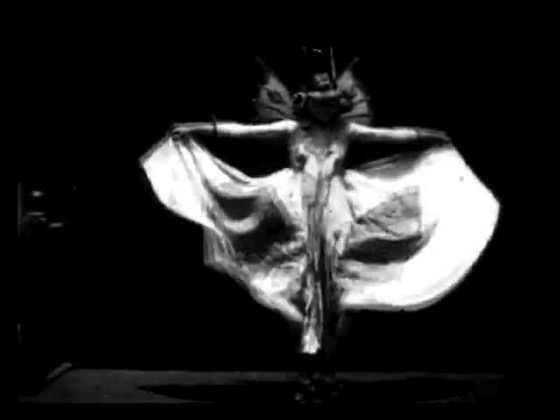
Annabelle (Whitford) Moore performs one of her popular dances. For this performance, her costume has a pair of wings attached to her back, to suggest a butterfly. As she dances, she uses her long, flowing skirts to create visual patterns.
You Can Please Some of the People Some of the Time… None of the People All of the Time: A History of the Art of Adaptation in Movies like Dune, The Godfather, Harry Potter and More!
Dr. Rosanne Welch speaks on A History of the Art of Adaptation in Movies like Dune, The Godfather, Harry Potter and More! at the California State University, Fullerton Library
Part of the program series for Dune by Frank Herbert: A 50th Anniversary Celebration.
This is a huge thing to adapt and what I think is fascinating is This guy over here, Steve Kloves, he did 6 of the 7 Harry Potter movies. He actually quit after the 3rd movie. He’s like “Well I have to go focus on my own work” and his son said — his son was 10-years-old — “Dad, there’s no cachet in being the son of the guy who used to write the Harry Potter movies.” So he took on the next one and he did all the rest of them. He created a great friendship with J. K. Rowling to the point where they could talk often about things she hadn’t released yet. He was privy to new things coming up and books that had yet to be published and it was a very deep secret — you can’t tell anybody, blah, blah, blah. Really kind of fascinating, but to study the work they did — and one of the great things he said in several interviews — was that they had to look at these giant books and think of the theme. Which is what we teach people to do when their writing films. It’s all about theme. Start with a theme and any storyline that is tangential to that theme has to be thrown away. We can’t waste our time on that.
About this talk
Dr. Rosanne Welch (RTVF) speaks on the craft of history of film adaptations from the controversy of the silent film Birth of a Nation (protested by the National Association for the Advancement of Colored People in 1915) to Breakfast at Tiffany’s (to which author Truman Capote famously said, “The only thing left from the book is the title”) to The Godfather . Naturally, the behemoth in adaptation – Harry Potter (which depended on the relationship created by adapter Steve Kloves and author J.K. Rowling) will be discussed, as will the subject of this month’s celebration: Dune.
Date: Wednesday, October 14, 2015 Time: 1:00pm – 2:00pm
About Dr. Rosanne Welch
Dr. Rosanne Welch is a professor in the Low Residency MFA in Screenwriting Program from Stephens College, California State University, Fullerton, Mount San Antonio Community College and Cal Poly Pomona. In 2007, she graduated with her Ph.D. in 20th Century U.S./Film History from Claremont Graduate University. She graduated with her M.A. in 20th Century United States History from California State University, Northridge in 2004.
Welch is also a television writer/producer with credits for Beverly Hills 90210 , CBS’s Emmy winning Picket Fences and Touched By An Angel . She also writes and hosts her own podcasts on 3rdPass.media, her first one titled “Mindful(I) Media with Dr. Rosanne Welch.”
I teach several classes for the Stephens College Low-Residency MFA in Screenwriting, including History of Screenwriting. In fact, I created the curriculum for that course from scratch and customized it to this particular MFA in that it covers ‘Screenwriting’ (not directors) and even more specifically, the class has a female-centric focus. As part History of Screenwriting I, the first course in the four-class series, we focus on the early women screenwriters of the silent film era who male historians have, for the most part, quietly forgotten in their books. In this series, I share with you some of the screenwriters and films that should be part of any screenwriters education. I believe that in order to become a great screenwriter, you need to understand the deep history of screenwriting and the amazing people who created the career. — Dr. Rosanne Welch
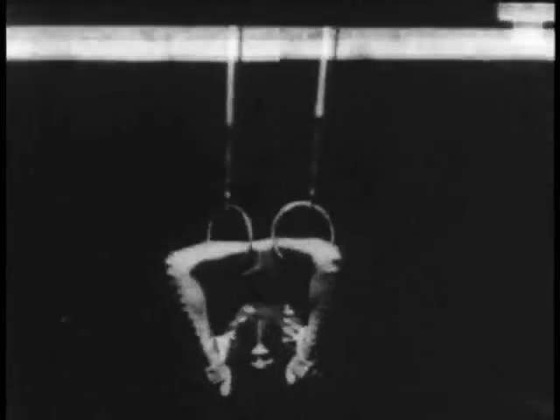
Luis Martinetti, Contortionist is an 1894 short film produced by the Edison Manufacturing Company. The film, which runs 12.5 seconds, consists of a contortionist act performed by Luis Martinetti of the Martinetti Brothers trapeze act. Martinetti wears tiger-striped tights and performs contortionist poses on a pair of trapeze rings.[1]
You Can Please Some of the People Some of the Time… None of the People All of the Time: A History of the Art of Adaptation in Movies like Dune, The Godfather, Harry Potter and More!
Dr. Rosanne Welch speaks on A History of the Art of Adaptation in Movies like Dune, The Godfather, Harry Potter and More! at the California State University, Fullerton Library
Part of the program series for Dune by Frank Herbert: A 50th Anniversary Celebration.
Of course, I mentioned that we would talk about Harry Potter briefly. We could be here for a whole hours, 2, 3, 6 talking about all the Harry Potter adaptations. What I think is important to notice is, as you know, the book in England was called “Harry Potter and the Philosopher’s Stone.” When it came to be published in America, they were afraid American children would look at the word philosopher and walk away, because that’s old and boring. That’s for old people. Of course, in America, what did we call it? The Sorcerer’s Stone, because a sorcerer is kind of cool — Mickey with hat — so we like sorcerers. We’re good. I mean that’s and adaptation made our publication people just to sell more books.
About this talk
Dr. Rosanne Welch (RTVF) speaks on the craft of history of film adaptations from the controversy of the silent film Birth of a Nation (protested by the National Association for the Advancement of Colored People in 1915) to Breakfast at Tiffany’s (to which author Truman Capote famously said, “The only thing left from the book is the title”) to The Godfather . Naturally, the behemoth in adaptation – Harry Potter (which depended on the relationship created by adapter Steve Kloves and author J.K. Rowling) will be discussed, as will the subject of this month’s celebration: Dune.
Date: Wednesday, October 14, 2015 Time: 1:00pm – 2:00pm
About Dr. Rosanne Welch
Dr. Rosanne Welch is a professor in the Low Residency MFA in Screenwriting Program from Stephens College, California State University, Fullerton, Mount San Antonio Community College and Cal Poly Pomona. In 2007, she graduated with her Ph.D. in 20th Century U.S./Film History from Claremont Graduate University. She graduated with her M.A. in 20th Century United States History from California State University, Northridge in 2004.
Welch is also a television writer/producer with credits for Beverly Hills 90210 , CBS’s Emmy winning Picket Fences and Touched By An Angel . She also writes and hosts her own podcasts on 3rdPass.media, her first one titled “Mindful(I) Media with Dr. Rosanne Welch.”
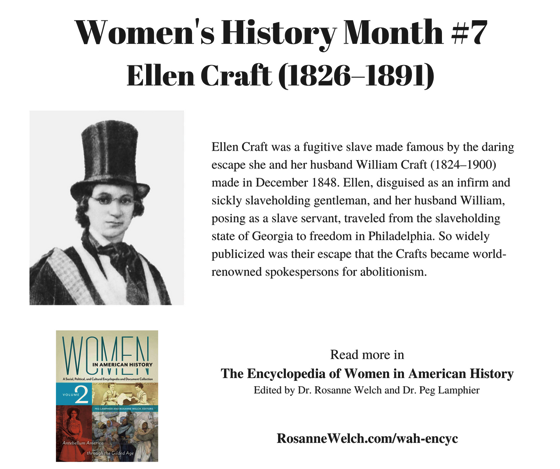
Ellen Craft was a fugitive slave made famous by the daring escape she and her husband William Craft (1824–1900) made in December 1848. Ellen, disguised as an infirm and sickly slaveholding gentleman, and her husband William, posing as a slave servant, traveled from the slaveholding state of Georgia to freedom in Philadelphia. So widely publicized was their escape that the Crafts became world- renowned spokespersons for abolitionism.
I teach several classes for the Stephens College Low-Residency MFA in Screenwriting, including History of Screenwriting. In fact, I created the curriculum for that course from scratch and customized it to this particular MFA in that it covers ‘Screenwriting’ (not directors) and even more specifically, the class has a female-centric focus. As part History of Screenwriting I, the first course in the four-class series, we focus on the early women screenwriters of the silent film era who male historians have, for the most part, quietly forgotten in their books. In this series, I share with you some of the screenwriters and films that should be part of any screenwriters education. I believe that in order to become a great screenwriter, you need to understand the deep history of screenwriting and the amazing people who created the career. — Dr. Rosanne Welch
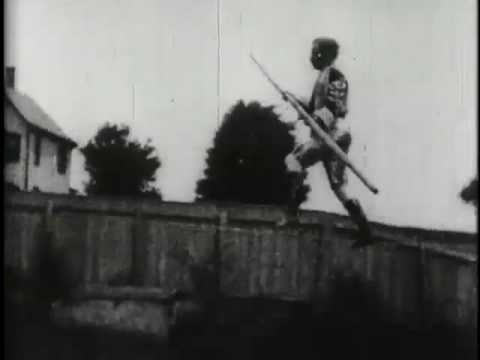
According to Edison film historian C. Musser, Venezuelan rope and slack wire walker Juan Caicedo performed in the U.S. during 1894 and again at the end of the century. From May 14 to Sept. 8, 1894, he appeared at Koster & Bial’s Music Hall in New York City.
From Raff & Gammon price list: The “King of the Wire” in his marvelous slack wire performance. $10.00.
OTHER TITLES Title in Raff & Gammon price list: Caicedo
Caicedo. No. 1
CREATED/PUBLISHED United States : Edison Manufacturing Co., [1894]
NOTES Copyright: no reg.
Performer: Juan A. Caicedo.
Camera, William Heise.
Filmed July 25, 1894, at the Edison Laboratory in West Orange, N.J.
SUBJECTS Aerialists–United States. Vaudeville–United States. Wire rope–United States. Venezuelans–United States. Variety
RELATED NAMES Dickson, W. K.-L. (William Kennedy-Laurie), 1860-1935, production. Heise, William, camera. Caicedo, Juan A., performer. Thomas A. Edison, Inc. Hendricks (Gordon) Collection (Library of Congress)
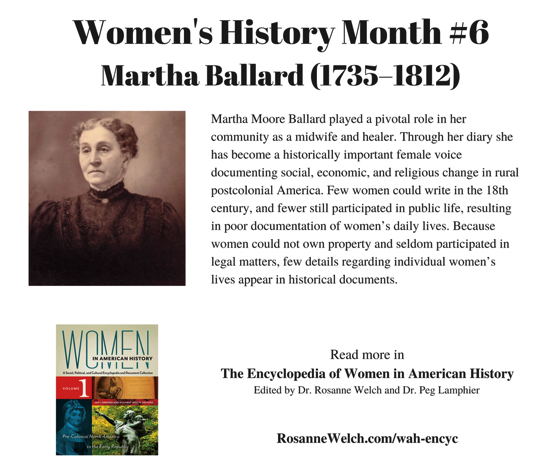
Martha Moore Ballard played a pivotal role in her community as a midwife and healer. Through her diary she has become a historically important female voice documenting social, economic, and religious change in rural postcolonial America. Few women could write in the 18th century, and fewer still participated in public life, resulting in poor documentation of women’s daily lives. Because women could not own property and seldom participated in legal matters, few details regarding individual women’s lives appear in historical documents.
You Can Please Some of the People Some of the Time… None of the People All of the Time: A History of the Art of Adaptation in Movies like Dune, The Godfather, Harry Potter and More!
Dr. Rosanne Welch speaks on A History of the Art of Adaptation in Movies like Dune, The Godfather, Harry Potter and More! at the California State University, Fullerton Library
Part of the program series for Dune by Frank Herbert: A 50th Anniversary Celebration.
Lots of true Tolkien fans – deeply angry that such a thing should happen and there should be focus on a character when other stuff was being thrown out. This is a choice for screenwriters and directors as they try to decide to bring something to film. The Hobbit had been made in animation several years earlier — 1977 — and it’s only 77 minutes long. So, would you rather have that version or the new version with an extra elf that doesn’t really exist. Now make up your mind. What I love about this is that made by Rankin-Bass the same company that gave us Rudolph the Red-Nosed Reindeer. Who himself was an adaptation of a song. A song turned into a beloved Christmas story. So, you can adapt from anything.
About this talk
Dr. Rosanne Welch (RTVF) speaks on the craft of history of film adaptations from the controversy of the silent film Birth of a Nation (protested by the National Association for the Advancement of Colored People in 1915) to Breakfast at Tiffany’s (to which author Truman Capote famously said, “The only thing left from the book is the title”) to The Godfather . Naturally, the behemoth in adaptation – Harry Potter (which depended on the relationship created by adapter Steve Kloves and author J.K. Rowling) will be discussed, as will the subject of this month’s celebration: Dune.
Date: Wednesday, October 14, 2015 Time: 1:00pm – 2:00pm
About Dr. Rosanne Welch
Dr. Rosanne Welch is a professor in the Low Residency MFA in Screenwriting Program from Stephens College, California State University, Fullerton, Mount San Antonio Community College and Cal Poly Pomona. In 2007, she graduated with her Ph.D. in 20th Century U.S./Film History from Claremont Graduate University. She graduated with her M.A. in 20th Century United States History from California State University, Northridge in 2004.
Welch is also a television writer/producer with credits for Beverly Hills 90210 , CBS’s Emmy winning Picket Fences and Touched By An Angel . She also writes and hosts her own podcasts on 3rdPass.media, her first one titled “Mindful(I) Media with Dr. Rosanne Welch.”
I teach several classes for the Stephens College Low-Residency MFA in Screenwriting, including History of Screenwriting. In fact, I created the curriculum for that course from scratch and customized it to this particular MFA in that it covers ‘Screenwriting’ (not directors) and even more specifically, the class has a female-centric focus. As part History of Screenwriting I, the first course in the four-class series, we focus on the early women screenwriters of the silent film era who male historians have, for the most part, quietly forgotten in their books. In this series, I share with you some of the screenwriters and films that should be part of any screenwriters education. I believe that in order to become a great screenwriter, you need to understand the deep history of screenwriting and the amazing people who created the career. — Dr. Rosanne Welch
Edison Kinetoscopic Record of a Sneeze (1894)
The earliest surviving copyrighted motion picture, the Edison Kinetoscopic Record of a Sneeze is a short film made by W. K. L. Dickson in January 1894 for advertising purposes. Often referred to as “Fred Ott’s Sneeze,” this is is one of the world’s earliest motion pictures and America’s best known early film production. The star is Fred Ott, an Edison employee known to his fellow workers in the laboratory for his comic sneezing and other gags. This item was received in the Library of Congress on January 9, 1894, as a copyright deposit from Dickson.
Two other Edison experimental films on the Library’s YouTube site – DICKSON GREETING (May 1891) and NEWARK ATHLETE (May or June 1891), predate The Sneeze. The Sneeze was submitted for copyright as 45 frames from the motion picture printed as positive prints on paper rather than as a reel of film. The prints were mounted on cardboard and submitted to the Copyright Office in this form. The video of the Sneeze on loc.gov and YouTube was later rephotographed and turned into a moving image from these mounted frames.
SUMMARY Film made for publicity purposes, as a series of still photographs to accompany an article in Harper’s weekly.
OTHER TITLES Sneeze Fred Ott’s sneeze
CREATED/PUBLISHED United States : Edison Manufacturing Co., 1894.
NOTES Copyright: W. K. L. Dickson; 9Jan1894; 2887.
Performer: Fred Ott.
Camera, William Heise.
Filmed ca. January 2-7, 1894, in Edison’s Black Maria studio.
SUBJECTS Sneezing. Publicity. Motion picture industry–Public relations–United States. Actuality
RELATED NAMES Dickson, W. K.-L. (William Kennedy-Laurie), 1860-1935, production. Ott, Frederic P., performer. Heise, William, camera. Thomas A. Edison, Inc. Hendricks (Gordon) Collection (Library of Congress) Paper Print Collection (Library of Congress)
You Can Please Some of the People Some of the Time… None of the People All of the Time: A History of the Art of Adaptation in Movies like Dune, The Godfather, Harry Potter and More!
Dr. Rosanne Welch speaks on A History of the Art of Adaptation in Movies like Dune, The Godfather, Harry Potter and More! at the California State University, Fullerton Library
Part of the program series for Dune by Frank Herbert: A 50th Anniversary Celebration.
Of course, we all know, gee whiz, the biggest adaptation of the last ten years has been the whole set of Tolkien books. I’m just going to look at The Hobbit for a minute because when it became a movie they invented an entire character who doesn’t appear in the book at all. Just made her up, because there weren’t enough chicks involved in this story, right? They thought “Oh no, we need to do something about that.” So Tauriel doesn’t exist in the books, but they wanted to have a little bit of a love story. They wanted to have a female character largely because one of the more popular female characters in The Lord of The Rings adaptation is Eowyn, right? Everybody — well that’s Tauriel. Excuse me. She’s so important she got on one of the posters. It’s Eowyn, right? And she stood out in the whole Lord of the Rings saga because of what line? (Laughs) “I am no man!” Wham. What a great moment, right? That’a a moment everybody…so, they knew in making The Hobbit a film, they had to have some sort of female character who could bring that to the new production.
About this talk
Dr. Rosanne Welch (RTVF) speaks on the craft of history of film adaptations from the controversy of the silent film Birth of a Nation (protested by the National Association for the Advancement of Colored People in 1915) to Breakfast at Tiffany’s (to which author Truman Capote famously said, “The only thing left from the book is the title”) to The Godfather . Naturally, the behemoth in adaptation – Harry Potter (which depended on the relationship created by adapter Steve Kloves and author J.K. Rowling) will be discussed, as will the subject of this month’s celebration: Dune.
Date: Wednesday, October 14, 2015 Time: 1:00pm – 2:00pm
About Dr. Rosanne Welch
Dr. Rosanne Welch is a professor in the Low Residency MFA in Screenwriting Program from Stephens College, California State University, Fullerton, Mount San Antonio Community College and Cal Poly Pomona. In 2007, she graduated with her Ph.D. in 20th Century U.S./Film History from Claremont Graduate University. She graduated with her M.A. in 20th Century United States History from California State University, Northridge in 2004.
Welch is also a television writer/producer with credits for Beverly Hills 90210 , CBS’s Emmy winning Picket Fences and Touched By An Angel . She also writes and hosts her own podcasts on 3rdPass.media, her first one titled “Mindful(I) Media with Dr. Rosanne Welch.”