If viewers saw only the ten or so light comedy style episodes, The Monkees look much like the precursor to The Big Bang Theory as those episodes center around the friendship of four young adult males learning to live and love in a changing relationship landscape while pursuing their dream careers. In each show main characters both work and live together, something not normal in classic workplace comedies such as The Mary Tyler Moore Show or 30 Rock.
Jean Powergirl takes the host reigns and welcomes her guest Rosanne Welch, PhD to the show! They’ll be discussing Roseanne’s book, “Why The Monkees Matter: Teenagers, Television and American Pop Culture.”
Transcript:
Jean: So The Monkees are going strong now did they evolve in their message over these 52 episode?
Rosanne: 58 Episodes
Jean: 58 Episodes. All right. So they start out, did they change up what they were doing? I mean you’re the connoisseur of all the episodes.
Rosanne: They had a variety of messages and these come form the writers experiences. One of the things I push in my class is that we have to remember that we tend, in American, because the French taught us, to correlate the author of the piece with the director, but, in fact, the director can’t direct a bunch of blank pages. It’s the writer who comes up with the theme and the idea. The director enhances that through the visuals. So, for me, it was important to meet the various writers who I still could and it’s their thoughts and messages.
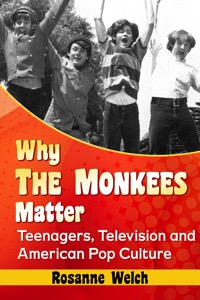
A hit television show about a fictitious rock band, The Monkees (1966-1968) earned two Emmys–Outstanding Comedy Series and Outstanding Directorial Achievement in Comedy. Capitalizing on the show’s success, the actual band formed by the actors, at their peak, sold more albums than The Beatles and The Rolling Stones combined and set the stage for other musical TV characters from The Partridge Family to Hannah Montana. In the late 1980s, the Monkees began a series of reunion tours that continued into their 50th anniversary.
This book tells the story of The Monkees and how the show changed television, introducing a new generation to the fourth-wall-breaking slapstick created by Laurel and Hardy and the Marx Brothers. Its creators contributed to the innovative film and television of 1970s with projects like Bob & Carol & Ted & Alice, The Mary Tyler Moore Show, Laugh-In and Welcome Back, Kotter. Immense profits from the show, its music and its merchandising funded the producers’ move into films such as Head, Easy Rider and Five Easy Pieces.
Rosanne Welch, PhD has written for television (Touched by an Angel, Picket Fences) and print (Three Ring Circus: How Real Couples Balance Marriage, Work and Kids and The Encyclopedia of Women in Aviation and Space). In the documentary world she has written and produced Bill Clinton and the Boys Nation Class of 1963 for ABC NEWS/Nightline and consulted on PBS’s A Prince Among Slaves, the story of a prince from West Africa who was enslaved in the 1780s, freed by order of President John Quincy Adams in the 1820s and returned to his homeland.
Jean Powergirl takes the host reigns and welcomes her guest Rosanne Welch, PhD to the show! They’ll be discussing Roseanne’s book, “Why The Monkees Matter: Teenagers, Television and American Pop Culture.”
Transcript:
Jean: So how many season did The Monkees run?
Rosanne: You know it only ran for 2 seasons. Back in the day, you had more shows — nowadays you do 13 or maybe 20 episodes — so they did 58 episodes in total in 2 seasons. They were going to come back for a 3rd season after a very successful couple of years of concert tours, but they had decided that — the actors has decided — that they were tired of the formula of the show, which was a sitcom and it was usually some crazy adventure going on. They felt that they wanted to do a variety show ala The Carol Burnett Show, but there were no rock and roll groups hosting variety shows yet, so the network said, “no. We don’t believe that will work.” They said, “Look, we’ll do little sketches in between and will do music and have musical guests,” The network said no and they said, “If that’s the case we’ll just cancel it.”
Jean: Even though Donnie and Marie did do that, right?
Rosanne: But later in the 70’s and the next year Sonny and Cher will do that a and they were a rock and roll group of the day and, in fact, Coslough Johnson, who’s one of my favorite writers for the show who I got to interview. He moved from The Monkees to Sonny and Cher and so that style was going to work, but the network didn’t — I think it was a big mistake monetarily. If they had morphed the show it would have brought that audience along with them.
A hit television show about a fictitious rock band, The Monkees (1966-1968) earned two Emmys–Outstanding Comedy Series and Outstanding Directorial Achievement in Comedy. Capitalizing on the show’s success, the actual band formed by the actors, at their peak, sold more albums than The Beatles and The Rolling Stones combined and set the stage for other musical TV characters from The Partridge Family to Hannah Montana. In the late 1980s, the Monkees began a series of reunion tours that continued into their 50th anniversary.
This book tells the story of The Monkees and how the show changed television, introducing a new generation to the fourth-wall-breaking slapstick created by Laurel and Hardy and the Marx Brothers. Its creators contributed to the innovative film and television of 1970s with projects like Bob & Carol & Ted & Alice, The Mary Tyler Moore Show, Laugh-In and Welcome Back, Kotter. Immense profits from the show, its music and its merchandising funded the producers’ move into films such as Head, Easy Rider and Five Easy Pieces.
Rosanne Welch, PhD has written for television (Touched by an Angel, Picket Fences) and print (Three Ring Circus: How Real Couples Balance Marriage, Work and Kids and The Encyclopedia of Women in Aviation and Space). In the documentary world she has written and produced Bill Clinton and the Boys Nation Class of 1963 for ABC NEWS/Nightline and consulted on PBS’s A Prince Among Slaves, the story of a prince from West Africa who was enslaved in the 1780s, freed by order of President John Quincy Adams in the 1820s and returned to his homeland.
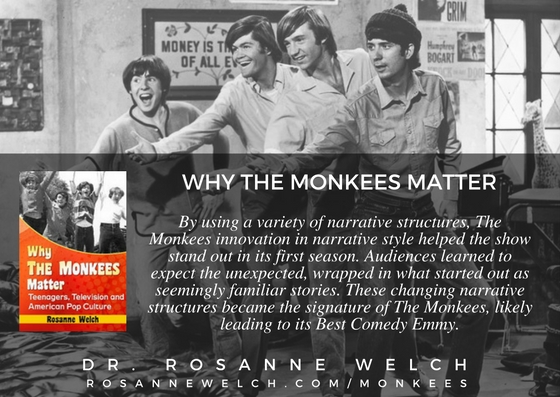
By using a variety of narrative structures, The Monkees innovation in narrative style helped the show stand out in its first season. Audiences learned to expect the unexpected, wrapped in what started out as seemingly familiar stories. These changing narrative structures became the signature of The Monkees, likely leading to its Best Comedy Emmy.
Jean Powergirl takes the host reigns and welcomes her guest Rosanne Welch, PhD to the show! They’ll be discussing Roseanne’s book, “Why The Monkees Matter: Teenagers, Television and American Pop Culture.”
Transcript:
Jean: So here we finally have television trying to deal with these difficult issues, but in a way that made a difference to people.
Rosanne: I think so. It made people start talking about those things in their own lives and that’s what TV’s always done. We credit Will & Grace with giving us a weekly gay character who came into people’s homes and it made people start talking about issues like gay marriage and gay adoption and things like that. So it’s really — people don’t realize — we think movies are influential, but you choose what movies you’re going to go see. You choose with your money to pay for those messages. So, often movies are preaching to a choir. TV comes into your home uninvited. You don’t know what you’re going to stumble upon when you change the channel and so there’s more of an ability to find things you didn’t think you wanted to know about.
Jean: Right, because it was there and it was free. So everyone’s going to sit down that evening — you’re not going out to a movie to watch something controversial and go “Let’s start flipping the channels. Oh look at these kids running around. That’s pretty funny”
Rosanne: Exactly. It attracted — the energetic feel of the show and that they were cute young boys made them pay attention.
A hit television show about a fictitious rock band, The Monkees (1966-1968) earned two Emmys–Outstanding Comedy Series and Outstanding Directorial Achievement in Comedy. Capitalizing on the show’s success, the actual band formed by the actors, at their peak, sold more albums than The Beatles and The Rolling Stones combined and set the stage for other musical TV characters from The Partridge Family to Hannah Montana. In the late 1980s, the Monkees began a series of reunion tours that continued into their 50th anniversary.
This book tells the story of The Monkees and how the show changed television, introducing a new generation to the fourth-wall-breaking slapstick created by Laurel and Hardy and the Marx Brothers. Its creators contributed to the innovative film and television of 1970s with projects like Bob & Carol & Ted & Alice, The Mary Tyler Moore Show, Laugh-In and Welcome Back, Kotter. Immense profits from the show, its music and its merchandising funded the producers’ move into films such as Head, Easy Rider and Five Easy Pieces.
Rosanne Welch, PhD has written for television (Touched by an Angel, Picket Fences) and print (Three Ring Circus: How Real Couples Balance Marriage, Work and Kids and The Encyclopedia of Women in Aviation and Space). In the documentary world she has written and produced Bill Clinton and the Boys Nation Class of 1963 for ABC NEWS/Nightline and consulted on PBS’s A Prince Among Slaves, the story of a prince from West Africa who was enslaved in the 1780s, freed by order of President John Quincy Adams in the 1820s and returned to his homeland.
Jean Powergirl takes the host reigns and welcomes her guest Rosanne Welch, PhD to the show! They’ll be discussing Roseanne’s book, “Why The Monkees Matter: Teenagers, Television and American Pop Culture.”
Transcript:
Rosanne: So, in fact, because we just lost Mary Tyler Moore a couple weeks ago there was a lot of discussion
Jean: God rest her soul
Rosanne:…about here show. Exactly and how she introduced a gay character on her show. She talked about birth control pills.
Jean: She was the working woman by herself. That’s why I watched it.
Rosanne: Exactly. Exactly.
Jean: I was shocked. She got a real job on her own.
Rosanne:…and she spent the night with boys without them coming to her apartment. We would see her come home wearing the same clothes she wore on the day before.
Jean: Oooo….Where’s my fainting couch?
Rosanne: So we were moving into that area where these things were going to be more open and so The Monkees couldn’t quite be blatant about it, but they could be subtle about the things they were saying.
Jean; Right and actually I do like the subtlety. I think it is an artistic thing that I appreciate.
A hit television show about a fictitious rock band, The Monkees (1966-1968) earned two Emmys–Outstanding Comedy Series and Outstanding Directorial Achievement in Comedy. Capitalizing on the show’s success, the actual band formed by the actors, at their peak, sold more albums than The Beatles and The Rolling Stones combined and set the stage for other musical TV characters from The Partridge Family to Hannah Montana. In the late 1980s, the Monkees began a series of reunion tours that continued into their 50th anniversary.
This book tells the story of The Monkees and how the show changed television, introducing a new generation to the fourth-wall-breaking slapstick created by Laurel and Hardy and the Marx Brothers. Its creators contributed to the innovative film and television of 1970s with projects like Bob & Carol & Ted & Alice, The Mary Tyler Moore Show, Laugh-In and Welcome Back, Kotter. Immense profits from the show, its music and its merchandising funded the producers’ move into films such as Head, Easy Rider and Five Easy Pieces.
Rosanne Welch, PhD has written for television (Touched by an Angel, Picket Fences) and print (Three Ring Circus: How Real Couples Balance Marriage, Work and Kids and The Encyclopedia of Women in Aviation and Space). In the documentary world she has written and produced Bill Clinton and the Boys Nation Class of 1963 for ABC NEWS/Nightline and consulted on PBS’s A Prince Among Slaves, the story of a prince from West Africa who was enslaved in the 1780s, freed by order of President John Quincy Adams in the 1820s and returned to his homeland.
Jean Powergirl takes the host reigns and welcomes her guest Rosanne Welch, PhD to the show! They’ll be discussing Roseanne’s book, “Why The Monkees Matter: Teenagers, Television and American Pop Culture.”
Transcript:
Jean:Your saying that part of thing was that this was just this era was the dawn of trying to show people more real life situations as opposed to fantasy like, for example, you cited in your book, the “Look Who’s Coming to Dinner” film about an interracial couple, which is this huge production back then and this was already happening in film, but not so much in TV, right?
Rosanne: Now, TV is interesting. I have to give credit, of all things, afternoon soap operas are some of the places where controversial stuff happened first. AIDS stories were first done. Gay characters were first introduced. People didn’t take the soaps seriously because they were just for housewives to watch.
Jean: Right.
Rosanne: … bit as those things seeped into daytime TV then they slowly can seep into nighttime television and usually in the hipper, younger, new programming.
A hit television show about a fictitious rock band, The Monkees (1966-1968) earned two Emmys–Outstanding Comedy Series and Outstanding Directorial Achievement in Comedy. Capitalizing on the show’s success, the actual band formed by the actors, at their peak, sold more albums than The Beatles and The Rolling Stones combined and set the stage for other musical TV characters from The Partridge Family to Hannah Montana. In the late 1980s, the Monkees began a series of reunion tours that continued into their 50th anniversary.
This book tells the story of The Monkees and how the show changed television, introducing a new generation to the fourth-wall-breaking slapstick created by Laurel and Hardy and the Marx Brothers. Its creators contributed to the innovative film and television of 1970s with projects like Bob & Carol & Ted & Alice, The Mary Tyler Moore Show, Laugh-In and Welcome Back, Kotter. Immense profits from the show, its music and its merchandising funded the producers’ move into films such as Head, Easy Rider and Five Easy Pieces.
Rosanne Welch, PhD has written for television (Touched by an Angel, Picket Fences) and print (Three Ring Circus: How Real Couples Balance Marriage, Work and Kids and The Encyclopedia of Women in Aviation and Space). In the documentary world she has written and produced Bill Clinton and the Boys Nation Class of 1963 for ABC NEWS/Nightline and consulted on PBS’s A Prince Among Slaves, the story of a prince from West Africa who was enslaved in the 1780s, freed by order of President John Quincy Adams in the 1820s and returned to his homeland.
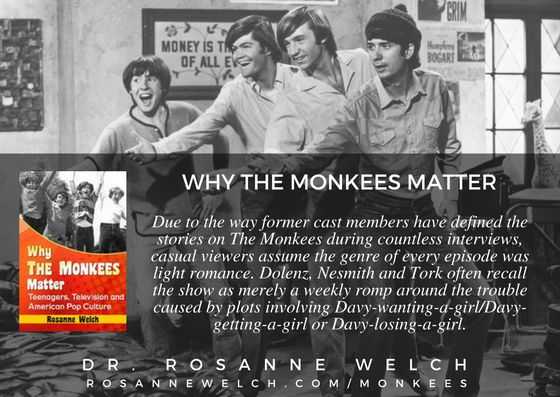
Due to the way former cast members have defined the stories on The Monkees during countless interviews, casual viewers assume the genre of every episode was light romance. Dolenz, Nesmith and Tork often recall the show as merely a weekly romp around the trouble caused by plots involving Davy-wanting-a-girl/Davy-getting-a-girl or Davy-losing-a-girl.
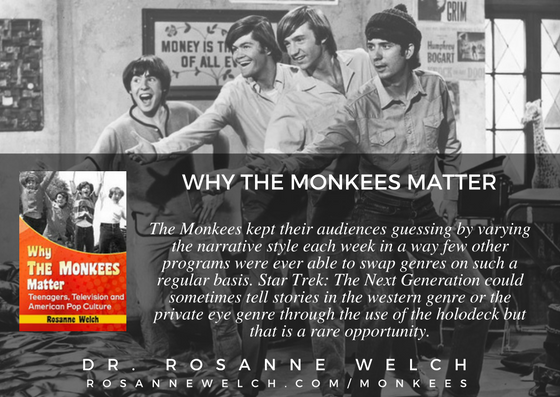
The Monkees kept their audiences guessing by varying the narrative style each week in a way few other programs were ever able to swap genres on such a regular basis. Star Trek: The Next Generation could sometimes tell stories in the western genre or the private eye genre through the use of the holodeck but that is a rare opportunity.
Jean Powergirl takes the host reigns and welcomes her guest Rosanne Welch, PhD to the show! They’ll be discussing Roseanne’s book, “Why The Monkees Matter: Teenagers, Television and American Pop Culture.”
Transcript:
Jean: So they had this beach house and this was cool and there are these single boys now, but they did kind of keep it kind of wholesome. Now did they have girls spending the night over at the beach house or anything like that?
Rosanne: They did not. When I came to study the show because I loved it as a kid and when I decided to study it I thought, “Oh, well a show about rock-and-rollers. It’s going to be every week about who’s have sex with which girl and maybe as a kid, I didn’t remember that. And then I watched all 58 episodes in an era when I’m also watching The Big Bang Theory because that’s the number one comedy of our day and that’s of course about 4 scientists who spend their days discussing who they’re going to have sex with and it turned out, of course, because of the rules of what you could and couldn’t do on television at the time that The Monkees couldn’t do that. So when they had girlfriends we always saw that the girls left before the boys had time in their beach house. They never spent the night.
Jean: So it wouldn’t offend the sensibilities of the parents that are watching this television show with their teenagers and things like that.
A hit television show about a fictitious rock band, The Monkees (1966-1968) earned two Emmys–Outstanding Comedy Series and Outstanding Directorial Achievement in Comedy. Capitalizing on the show’s success, the actual band formed by the actors, at their peak, sold more albums than The Beatles and The Rolling Stones combined and set the stage for other musical TV characters from The Partridge Family to Hannah Montana. In the late 1980s, the Monkees began a series of reunion tours that continued into their 50th anniversary.
This book tells the story of The Monkees and how the show changed television, introducing a new generation to the fourth-wall-breaking slapstick created by Laurel and Hardy and the Marx Brothers. Its creators contributed to the innovative film and television of 1970s with projects like Bob & Carol & Ted & Alice, The Mary Tyler Moore Show, Laugh-In and Welcome Back, Kotter. Immense profits from the show, its music and its merchandising funded the producers’ move into films such as Head, Easy Rider and Five Easy Pieces.
Rosanne Welch, PhD has written for television (Touched by an Angel, Picket Fences) and print (Three Ring Circus: How Real Couples Balance Marriage, Work and Kids and The Encyclopedia of Women in Aviation and Space). In the documentary world she has written and produced Bill Clinton and the Boys Nation Class of 1963 for ABC NEWS/Nightline and consulted on PBS’s A Prince Among Slaves, the story of a prince from West Africa who was enslaved in the 1780s, freed by order of President John Quincy Adams in the 1820s and returned to his homeland.


![10 : Writers and The Monkees : “Why The Monkees Matter” Interview with Jean Power [Video] (0:44)](https://rosannewelch.com/wp-content/uploads/2017/07/rmw-power-10-writers.jpeg)
![09 : Only 2 Seasons : “Why The Monkees Matter” Interview with Jean Power [Video] (1:11)](https://rosannewelch.com/wp-content/uploads/2017/06/rmw-power-09-only-2-seasons.jpeg)
![08 : TV vs. Movies : “Why The Monkees Matter” Interview with Jean Power [Video] (1:03)](https://rosannewelch.com/wp-content/uploads/2017/06/rmw-power-08-tv-movies.jpeg)
![07 : Mary Tyler Moore and The Monkees : “Why The Monkees Matter” Interview [Video] (0:40)](https://rosannewelch.com/wp-content/uploads/2017/06/rmw-power-07-mary-tyler-moore.jpeg)
![06 : From Soap Operas to Primetime : “Why The Monkees Matter” Interview [Video] (0:51)](https://rosannewelch.com/wp-content/uploads/2017/06/rmw-power-06-soaps-primetime.jpeg)