21: Peter Tork and The Monkees : “Why The Monkees Matter” Interview with Jean Power [Video] (0:55)

Rosanne Welch talks about “Why The Monkees Matter” with Jean Hopkins Power

Watch this entire presentation (45 mins)

Jean Powergirl takes the host reigns and welcomes her guest Rosanne Welch, PhD to the show! They’ll be discussing Roseanne’s book, “Why The Monkees Matter: Teenagers, Television and American Pop Culture.”

21: Peter Tork and The Monkees : “Why The Monkees Matter” Interview with Jean Power


Transcript:

Jean: All right, we have one more Monkee to discuss. Who is this gentleman here — the guy right there.

Rosanne: This is Peter Tork and he has quite a following. He is, I would say, as cute as Davy and had Davy not shown up he himself might have been a teen idol.

Jean: He might have been singing the love ballads, right?

Rosanne: Seriously and he said in his later career that he wasn’t pushy enough. When they offered up songs he kind of stood in the background and didn’t jump on them.

Jean: I noticed in this town, in this industry, you’ve got to, you cannot be bashful, right? or you will lose.

Rosanne: No, That is very true and yet he was considered, he was quite polite and he was quite the true hippie of the day. He really believed in the message of peace. He also believed in the message of Buddhism, actually, so he wasn’t a pushy guy. Now as they have toured in later years he tends to sing all of the songs Davy sang in concert and he is quite proficient at them. So it’s kind of sad that he didn’t get into the mix more deeply himself.
Get your copy today!


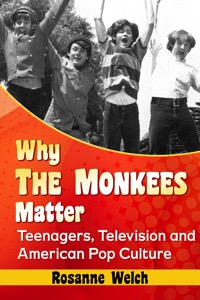
A hit television show about a fictitious rock band, The Monkees (1966-1968) earned two Emmys–Outstanding Comedy Series and Outstanding Directorial Achievement in Comedy. Capitalizing on the show’s success, the actual band formed by the actors, at their peak, sold more albums than The Beatles and The Rolling Stones combined and set the stage for other musical TV characters from The Partridge Family to Hannah Montana. In the late 1980s, the Monkees began a series of reunion tours that continued into their 50th anniversary.

This book tells the story of The Monkees and how the show changed television, introducing a new generation to the fourth-wall-breaking slapstick created by Laurel and Hardy and the Marx Brothers. Its creators contributed to the innovative film and television of 1970s with projects like Bob & Carol & Ted & Alice, The Mary Tyler Moore Show, Laugh-In and Welcome Back, Kotter. Immense profits from the show, its music and its merchandising funded the producers’ move into films such as Head, Easy Rider and Five Easy Pieces.

Rosanne Welch, PhD has written for television (Touched by an Angel, Picket Fences) and print (Three Ring Circus: How Real Couples Balance Marriage, Work and Kids and The Encyclopedia of Women in Aviation and Space). In the documentary world she has written and produced Bill Clinton and the Boys Nation Class of 1963 for ABC NEWS/Nightline and consulted on PBS’s A Prince Among Slaves, the story of a prince from West Africa who was enslaved in the 1780s, freed by order of President John Quincy Adams in the 1820s and returned to his homeland.

20: Even More on Davy Jones and The Monkees : “Why The Monkees Matter” Interview with Jean Power [Video] (0:57)

Rosanne Welch talks about “Why The Monkees Matter” with Jean Hopkins Power

Watch this entire presentation (45 mins)

Jean Powergirl takes the host reigns and welcomes her guest Rosanne Welch, PhD to the show! They’ll be discussing Roseanne’s book, “Why The Monkees Matter: Teenagers, Television and American Pop Culture.”

20: Even More on Davy Jones and The Monkees : “Why The Monkees Matter” Interview with Jean Power [Video] (0:57)


Transcript:


Rosanne: Sadly, he passed away of a heart attack in about 4 years ago and the band had been talking about having a 50th Anniversary Tour. So after he died, the three of them did get together and do a short tour and it went well, so they did actually a longer tour the next year and actually they did a big 50th Anniversary Tour last year that was only Micky Dolenz and Peter Tork.

Jean:…but they won’t replace Davy right?

Rosanne: No, they chose never to replace him because he was unreplacable. When he died it was announced on television that the episode — he did a guest spot on The Brady Bunch, which was a big sitcom — a couple of years after the movie and that turns out to be — according to ABC News — the most rerun episode of television ever of any show in the years of reruns. He was that popular.

Jean: I remember that like when Davy Jones shows up on The Brady Bunch.

Rosannne: Marsha wanted him to sing at her prom because she was the president of the Davy Jones Fan Club and he shows up.


Get your copy today!


A hit television show about a fictitious rock band, The Monkees (1966-1968) earned two Emmys–Outstanding Comedy Series and Outstanding Directorial Achievement in Comedy. Capitalizing on the show’s success, the actual band formed by the actors, at their peak, sold more albums than The Beatles and The Rolling Stones combined and set the stage for other musical TV characters from The Partridge Family to Hannah Montana. In the late 1980s, the Monkees began a series of reunion tours that continued into their 50th anniversary.

This book tells the story of The Monkees and how the show changed television, introducing a new generation to the fourth-wall-breaking slapstick created by Laurel and Hardy and the Marx Brothers. Its creators contributed to the innovative film and television of 1970s with projects like Bob & Carol & Ted & Alice, The Mary Tyler Moore Show, Laugh-In and Welcome Back, Kotter. Immense profits from the show, its music and its merchandising funded the producers’ move into films such as Head, Easy Rider and Five Easy Pieces.

Rosanne Welch, PhD has written for television (Touched by an Angel, Picket Fences) and print (Three Ring Circus: How Real Couples Balance Marriage, Work and Kids and The Encyclopedia of Women in Aviation and Space). In the documentary world she has written and produced Bill Clinton and the Boys Nation Class of 1963 for ABC NEWS/Nightline and consulted on PBS’s A Prince Among Slaves, the story of a prince from West Africa who was enslaved in the 1780s, freed by order of President John Quincy Adams in the 1820s and returned to his homeland.

19: More on Davy Jones and The Monkees : “Why The Monkees Matter” Interview with Jean Power [Video] (0:44)

Rosanne Welch talks about “Why The Monkees Matter” with Jean Hopkins Power

Watch this entire presentation (45 mins)

Jean Powergirl takes the host reigns and welcomes her guest Rosanne Welch, PhD to the show! They’ll be discussing Roseanne’s book, “Why The Monkees Matter: Teenagers, Television and American Pop Culture.”

19: More on Davy Jones and The Monkees : “Why The Monkees Matter” Interview with Jean Power


Transcript:


Rosanne: So between the two of them — Micky Dolenz sang most of the leads on the rock songs and Davy sang most all the ballads the girls remember and anything that had a girls name in it because that’s why the girls would by it because Davy was singing to them.

Jean: Singing to them personally.

Rosanne. Exactly. So he was — and it was funny in driving to your house today I didn’t realize that the exit off the freeway is 7a and that’s the phrase at the beginning of Daydream Believer which is his big hit. They have a little snippet of conversation on the album and he says ‘What number is this?” 7a is the number that they are recording at the time which is Daydream Believer so that’s known in Monkee circles as a very important number. I thought that was very — it said something about destiny of doing this recording.

Jean: It was meant to be.


Get your copy today!

A hit television show about a fictitious rock band, The Monkees (1966-1968) earned two Emmys–Outstanding Comedy Series and Outstanding Directorial Achievement in Comedy. Capitalizing on the show’s success, the actual band formed by the actors, at their peak, sold more albums than The Beatles and The Rolling Stones combined and set the stage for other musical TV characters from The Partridge Family to Hannah Montana. In the late 1980s, the Monkees began a series of reunion tours that continued into their 50th anniversary.

This book tells the story of The Monkees and how the show changed television, introducing a new generation to the fourth-wall-breaking slapstick created by Laurel and Hardy and the Marx Brothers. Its creators contributed to the innovative film and television of 1970s with projects like Bob & Carol & Ted & Alice, The Mary Tyler Moore Show, Laugh-In and Welcome Back, Kotter. Immense profits from the show, its music and its merchandising funded the producers’ move into films such as Head, Easy Rider and Five Easy Pieces.

Rosanne Welch, PhD has written for television (Touched by an Angel, Picket Fences) and print (Three Ring Circus: How Real Couples Balance Marriage, Work and Kids and The Encyclopedia of Women in Aviation and Space). In the documentary world she has written and produced Bill Clinton and the Boys Nation Class of 1963 for ABC NEWS/Nightline and consulted on PBS’s A Prince Among Slaves, the story of a prince from West Africa who was enslaved in the 1780s, freed by order of President John Quincy Adams in the 1820s and returned to his homeland.

18: Davy Jones and The Monkees : “Why The Monkees Matter” Interview with Jean Power [Video] (1:00)

Rosanne Welch talks about “Why The Monkees Matter” with Jean Hopkins Power

Watch this entire presentation (45 mins)

Jean Powergirl takes the host reigns and welcomes her guest Rosanne Welch, PhD to the show! They’ll be discussing Roseanne’s book, “Why The Monkees Matter: Teenagers, Television and American Pop Culture.”

18: Davy Jones and The Monkees : “Why The Monkees Matter” Interview with Jean Power


Transcript:

 Jean: So we have this gentleman here. This is the one I remember and I also noticed that I see Davy Jones’s name autographed on here. the late Davy Jones. God reset his soul. Tell us about him.

Rosanne: Davy Jones was quite talented. He came to this piece as an Englishman and he was an actor who traveled with the stage company of Oliver! He played The Artful Dodger and he did that on Broadway. It is very well known that you can see on YouTube the Ed Sullivan Show the night that that cast performed was the same night The Beatles perfomed and you can see Davy Jones singing as The Artful Dodger. So, he came and then people saw him in town in LA. he looked like the makings of a teen idol so they were grooming him. They put him on some TV shows as a guest character and then when the show was created he was the first person cast because it was a great vehicle for him. So he could sing. he did not play fully instruments. He learned to play the guitar and he plays the tambourine.

Jean:…but he was the singing guy. I remember Davy Jones a lot.

Rosanne: He sang all the ballads.

Get your copy today!

A hit television show about a fictitious rock band, The Monkees (1966-1968) earned two Emmys–Outstanding Comedy Series and Outstanding Directorial Achievement in Comedy. Capitalizing on the show’s success, the actual band formed by the actors, at their peak, sold more albums than The Beatles and The Rolling Stones combined and set the stage for other musical TV characters from The Partridge Family to Hannah Montana. In the late 1980s, the Monkees began a series of reunion tours that continued into their 50th anniversary.

This book tells the story of The Monkees and how the show changed television, introducing a new generation to the fourth-wall-breaking slapstick created by Laurel and Hardy and the Marx Brothers. Its creators contributed to the innovative film and television of 1970s with projects like Bob & Carol & Ted & Alice, The Mary Tyler Moore Show, Laugh-In and Welcome Back, Kotter. Immense profits from the show, its music and its merchandising funded the producers’ move into films such as Head, Easy Rider and Five Easy Pieces.

Rosanne Welch, PhD has written for television (Touched by an Angel, Picket Fences) and print (Three Ring Circus: How Real Couples Balance Marriage, Work and Kids and The Encyclopedia of Women in Aviation and Space). In the documentary world she has written and produced Bill Clinton and the Boys Nation Class of 1963 for ABC NEWS/Nightline and consulted on PBS’s A Prince Among Slaves, the story of a prince from West Africa who was enslaved in the 1780s, freed by order of President John Quincy Adams in the 1820s and returned to his homeland.

Giving Voice to Silent Films and the Far From Silent Women Who Wrote Them with Dr. Rosanne Welch [Video] (17:44)

Giving Voice to Silent Films and the Far From Silent Women Who Wrote Them with Dr. Rosanne Welch

Giving Voice to Silent Films and the Far From Silent Women Who Wrote Them with Dr. Rosanne Welch


A recording of my presentation at this year’s University Film and Video Association (UFVA) 2017 conference.

I was pleased to be asked to participate in a panel designed by former student (and current kick-ass professor) Warren Lewis. The panel included two other former students from the MFA in Screenwriting program at CSUF: David Morgassen and Lucas Cuny. For the panel’s theme — “What Else Do We Teach When We Teach Screenwriting: Context And Controversy: Strategies For Teaching Film And Television History And Current Events To Screenwriters” — I chose to present on: “Giving Voice to Silent Films and the Far From Silent Women Who Wrote Them”.

It involves the fact that when teaching screenwriting history, I begin chronologically. In essence I force students to watch the classic films of the silent era (happily accessible for free on YouTube) first because that is when women ran the town as evidenced in Cari Beachamp’s Without Lying Down: Frances Marion and the Powerful Women of Early Hollywood”.) Beauchamp’s book is on my reading list so that they can encounter the careers of Frances Marion, Anita Loos, Lois Weber, Adela Rogers St. Johns, Eve Unsell and a host of other women who ran their own production companies for many years.

Secondly, knowing women once ran Hollywood makes it harder for today’s executives to wonder if today’s women can do the same.
Third, I have learned that teaching silent films reminds modern students that in screenwriting the visual is as important as the verbal.

Fourth, recognizing the birth of major iconic archetypes helps them recognize those archetypes in modern films and develop their own characters more three-dimensionally.
Fifth, I had to embarrassingly realize that in my zest to focus on forgotten females, I forgot to cover the careers of forgotten men and women of color and so expanded my viewing list to include the work of Oscar Mischeaux and other artists of color from the era.

Finally, I stretch back to the silents as a reminder that all artists stand of the shoulders of those who came before them – be they women or men.

Books Mentioned In This Presentation

Follow Dr. Rosanne Welch

Twitter: https://twitter.com/rosannewelch
Instagram: https://www.instagram.com/drrosannewelch/

About Dr. Rosanne Welch

Rosanne Welch, PhD has written for television (Touched by an Angel, Picket Fences) and print (Three Ring Circus: How Real Couples Balance Marriage, Work and Kids and The Encyclopedia of Women in Aviation and Space). In the documentary world she has written and produced Bill Clinton and the Boys Nation Class of 1963 for ABC NEWS/Nightline and consulted on PBS’s A Prince Among Slaves, the story of a prince from West Africa who was enslaved in the 1780s, freed by order of President John Quincy Adams in the 1820s and returned to his homeland.

17: Even More on Micky Dolenz and The Monkees : “Why The Monkees Matter” Interview with Jean Power [Video] (0:38)

Rosanne Welch talks about “Why The Monkees Matter” with Jean Hopkins Power

Watch this entire presentation (45 mins)

Jean Powergirl takes the host reigns and welcomes her guest Rosanne Welch, PhD to the show! They’ll be discussing Roseanne’s book, “Why The Monkees Matter: Teenagers, Television and American Pop Culture.”

17: Even More on Micky Dolenz and The Monkees : “Why The Monkees Matter” Interview with Jean Power


Transcript:


Rosanne: …and Micky Dolenz, being an actor said, sure, my character plays the drums, I’ll learn to play the drums. I will do that and he is considered by many people nowadays a very proficient drummer. He might not be the greatest drummer of all time, but he has been a drummer for 50 years in concert and people do appreciate the style. So, also what is interesting about him that I mentioned in the show — this ethnic quotient of the show — he had naturally sort of afro curly hair which they flattened for the first season because they felt that that was inappropriate for a young man in America.

Jean: Because they wanted to keep the whiteness that TV shows need to have at the time.

Rosanne: Exactly. Exactly. It is definitely that story.


Get your copy today!

A hit television show about a fictitious rock band, The Monkees (1966-1968) earned two Emmys–Outstanding Comedy Series and Outstanding Directorial Achievement in Comedy. Capitalizing on the show’s success, the actual band formed by the actors, at their peak, sold more albums than The Beatles and The Rolling Stones combined and set the stage for other musical TV characters from The Partridge Family to Hannah Montana. In the late 1980s, the Monkees began a series of reunion tours that continued into their 50th anniversary.

This book tells the story of The Monkees and how the show changed television, introducing a new generation to the fourth-wall-breaking slapstick created by Laurel and Hardy and the Marx Brothers. Its creators contributed to the innovative film and television of 1970s with projects like Bob & Carol & Ted & Alice, The Mary Tyler Moore Show, Laugh-In and Welcome Back, Kotter. Immense profits from the show, its music and its merchandising funded the producers’ move into films such as Head, Easy Rider and Five Easy Pieces.

Rosanne Welch, PhD has written for television (Touched by an Angel, Picket Fences) and print (Three Ring Circus: How Real Couples Balance Marriage, Work and Kids and The Encyclopedia of Women in Aviation and Space). In the documentary world she has written and produced Bill Clinton and the Boys Nation Class of 1963 for ABC NEWS/Nightline and consulted on PBS’s A Prince Among Slaves, the story of a prince from West Africa who was enslaved in the 1780s, freed by order of President John Quincy Adams in the 1820s and returned to his homeland.

A History of Screenwriting – 36 in a series – Intolerance (1916) – D.W. Griffith

A History of Screenwriting – 36 in a series – Intolerance (1916) – D.W. Griffith

A History of Screenwriting - 36 in a series - Intolerance (1916) - D.W. Griffith

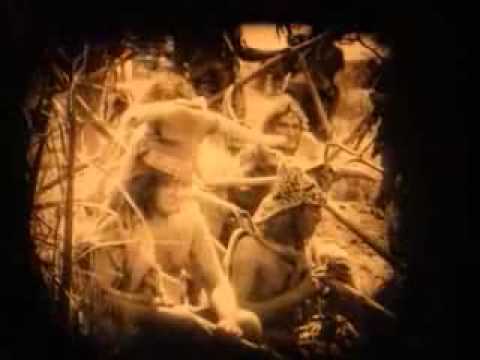
Intolerance is a 1916 epic silent film directed by D. W. Griffith. Subtitles include Love’s Struggle Throughout the Ages and A Sun-Play of the Ages.[2][3]

Widely regarded as one of the great masterpieces of the silent era, as well as one of the first art films,[3] the three-and-a-half-hour epic intercuts four parallel storylines, each separated by several centuries: (1) a contemporary melodrama of crime and redemption, (2) a Judean story: Christ‘s mission and death, (3) a French story: the events surrounding the St. Bartholomew’s Day massacre of 1572, and (4) a Babylonian story: the fall of the Babylonian Empire to Persia in 539 BC. Each story had its own distinctive color tint in the original print.[3] The scenes are linked by shots of a figure representing Eternal Motherhood, rocking a cradle.[3]

Intolerance was made partly in response to criticism of Griffith’s previous film, The Birth of a Nation (1915),[4] which was criticized by the NAACP and other groups as perpetuating racial stereotypes and glorifying the Ku Klux Klan.[5] It was not—as is commonly implied—an apology for the racism of his earlier film;[6]in numerous interviews, Griffith made clear that the film’s title and overriding themes were meant as a response to those who he felt had been intolerant of him in condemning The Birth of a Nation.[7] In the years following its release, Intolerance would strongly influence European film movements despite its lack of commercial success domestically. —Wikipedia


* A portion of each sale from Amazon.com directly supports our blogs ** Many of these books may be available from your local library. Check it out! 


I teach several classes for the Stephens College Low-Residency MFA in Screenwriting, including History of Screenwriting. In fact, I created the curriculum for that course from scratch and customized it to this particular MFA in that it covers ‘Screenwriting’ (not directors) and even more specifically, the class has a female-centric focus.  As part History of Screenwriting I, the first course in the four-class series, we focus on the early women screenwriters of the silent film era  who male historians have, for the most part, quietly forgotten in their books. In this series, I share with you some of the screenwriters and films that should be part of any screenwriters education. I believe that in order  to become a great screenwriter, you need to understand the deep history of screenwriting and the amazing people who created the career. — Dr. Rosanne Welch

A History of Screenwriting – 35 in a series – Gertie the Dinosaur (1914)

A History of Screenwriting – 35 in a series – Gertie the Dinosaur (1914)

A History of Screenwriting - 35 in a series - Gertie the Dinosaur (1914)

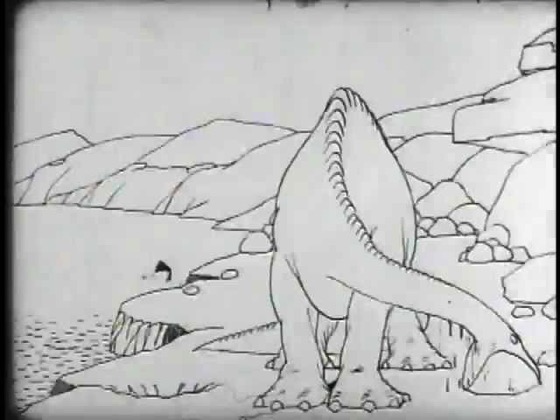
Gertie the Dinosaur is a 1914 animated short film by American cartoonist and animator Winsor McCay. It is the earliest animated film to feature a dinosaur. McCay first used the film before live audiences as an interactive part of his vaudeville act; the frisky, childlike Gertie did tricks at the command of her master. McCay’s employer William Randolph Hearst later curtailed McCay’s vaudeville activities, so McCay added a live-action introductory sequence to the film for its theatrical release. McCay abandoned a sequel, Gertie on Tour (c. 1921), after producing about a minute of footage.

Although Gertie is popularly thought to be the earliest animated film, McCay had earlier made Little Nemo (1911) and How a Mosquito Operates (1912). The American J. Stuart Blacktonand the French Émile Cohl had experimented with animation even earlier; Gertie being a character with an appealing personality distinguished McCay’s film from these earlier “trick films”. Gertie was the first film to use animation techniques such as keyframesregistration marks, tracing paper, the Mutoscope action viewer, and animation loops. It influenced the next generation of animators such as the Fleischer brothersOtto MessmerPaul Terry, and Walt DisneyJohn Randolph Bray unsuccessfully tried to patent many of McCay’s animation techniques and is said to have been behind a plagiarized version of Gertie that appeared a year or two after the original. Gertie is the best preserved of McCay’s films—some of which have been lost or survive only in fragments—and has been preserved in the U.S. Library of Congress‘ National Film Registry as being “culturally, historically, or aesthetically significant”. — Wikipedia


* A portion of each sale from Amazon.com directly supports our blogs ** Many of these books may be available from your local library. Check it out! 


I teach several classes for the Stephens College Low-Residency MFA in Screenwriting, including History of Screenwriting. In fact, I created the curriculum for that course from scratch and customized it to this particular MFA in that it covers ‘Screenwriting’ (not directors) and even more specifically, the class has a female-centric focus.  As part History of Screenwriting I, the first course in the four-class series, we focus on the early women screenwriters of the silent film era  who male historians have, for the most part, quietly forgotten in their books. In this series, I share with you some of the screenwriters and films that should be part of any screenwriters education. I believe that in order  to become a great screenwriter, you need to understand the deep history of screenwriting and the amazing people who created the career. — Dr. Rosanne Welch

16: More on Micky Dolenz and The Monkees : “Why The Monkees Matter” Interview with Jean Power [Video] (0:56)

Rosanne Welch talks about “Why The Monkees Matter” with Jean Hopkins Power

Watch this entire presentation (45 mins)

Jean Powergirl takes the host reigns and welcomes her guest Rosanne Welch, PhD to the show! They’ll be discussing Roseanne’s book, “Why The Monkees Matter: Teenagers, Television and American Pop Culture.”

16: More on Micky Dolenz and The Monkees : “Why The Monkees Matter” Interview with Jean Power


Transcript:


So he had been a child star, but as a child star he didn’t go by the name Dolenz — he used Braddock, which was a fake last name. It sounds very much more American and they dyed his dark hair blond. So if you look that up on YouTube you’ll see this little blond kid, but you can see, in the face, that in 8 years he is going to grow up to be the kid on The Monkees.

So he was already a known actor. He had been in and out of the business going to school but also doing some shows here and there — Peyton Place and what not as a guest actor and then he auditioned for this because, you now, it is what actors do. You audition for pilots and see if they get picked up. The joke about it is that he played guitar when people talk about who did or didn’t play instruments. He played guitar. Actually played classical Spanish guitar and he had gone on a tour around the country as th star of Circus Boy playing classical Spanish music, but when they came to film the show, they needed a “character” who would be the drummer and they originally thought is might be Davy Jones, but he was very short and they thought he would get lost behind the drums.


Get your copy today!

A hit television show about a fictitious rock band, The Monkees (1966-1968) earned two Emmys–Outstanding Comedy Series and Outstanding Directorial Achievement in Comedy. Capitalizing on the show’s success, the actual band formed by the actors, at their peak, sold more albums than The Beatles and The Rolling Stones combined and set the stage for other musical TV characters from The Partridge Family to Hannah Montana. In the late 1980s, the Monkees began a series of reunion tours that continued into their 50th anniversary.

This book tells the story of The Monkees and how the show changed television, introducing a new generation to the fourth-wall-breaking slapstick created by Laurel and Hardy and the Marx Brothers. Its creators contributed to the innovative film and television of 1970s with projects like Bob & Carol & Ted & Alice, The Mary Tyler Moore Show, Laugh-In and Welcome Back, Kotter. Immense profits from the show, its music and its merchandising funded the producers’ move into films such as Head, Easy Rider and Five Easy Pieces.

Rosanne Welch, PhD has written for television (Touched by an Angel, Picket Fences) and print (Three Ring Circus: How Real Couples Balance Marriage, Work and Kids and The Encyclopedia of Women in Aviation and Space). In the documentary world she has written and produced Bill Clinton and the Boys Nation Class of 1963 for ABC NEWS/Nightline and consulted on PBS’s A Prince Among Slaves, the story of a prince from West Africa who was enslaved in the 1780s, freed by order of President John Quincy Adams in the 1820s and returned to his homeland.

A History of Screenwriting – 34 in a series – The Squaw Man (1914)

A History of Screenwriting – 34 in a series – The Squaw Man (1914)

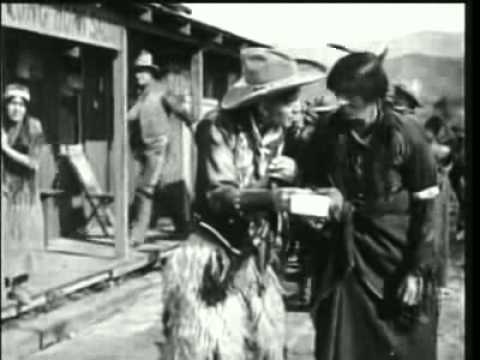
Directed by Oscar Apfel and Cecil B. DeMille and produced by DeMille and Jesse L. Lasky, the screenplay was adapted by Beulah Marie Dix from the 1905 stage play, of the same name, written by Edwin Milton Royle.

This first screen version of the story was the legendary DeMille’s first movie assignment. It also holds the distinction of being the first feature-length movie filmed specifically in Hollywood. DeMille wanted to emphasize the outdoors and wanted to shoot the movie in a place that had exotic scenery and great vistas. Initially he traveled to Flagstaff, Arizona to film the movie.[3] After seeing the vast amount of mountains near Flagstaff; the filming was moved to the Los Angeles area. It was not the first film to be made in the Los Angeles area, and film historians agree that shorts had previously been filmed in Hollywood, with In Old California considered the earliest. Harbor scenes were shot in San Pedro, California and the western saloon set was built beside railroad tracks in the San Fernando Valley. Footage of cattle on the open range were shot at Keen Camp near Idyllwild, California, while snow scenes were shot at Mount Palomar.[4] Cecil B. DeMille felt that lighting in a movie was extremely important and viewed it as the visual and emotional foundation to build his image. He believed that lighting was to a film as “music is to an opera”.[1]

The Squaw Man went on to become the only movie successfully filmed three times by the same director/producer, DeMille. He filmed a silent remake in 1918, and a talkie version in 1931The Squaw Man was 74 minutes long and generated $244,700 in profit.[1] Wikipedia


* A portion of each sale from Amazon.com directly supports our blogs
** Many of these books may be available from your local library. Check it out! 


I teach several classes for the Stephens College Low-Residency MFA in Screenwriting, including History of Screenwriting. In fact, I created the curriculum for that course from scratch and customized it to this particular MFA in that it covers ‘Screenwriting’ (not directors) and even more specifically, the class has a female-centric focus.  As part History of Screenwriting I, the first course in the four-class series, we focus on the early women screenwriters of the silent film era  who male historians have, for the most part, quietly forgotten in their books. In this series, I share with you some of the screenwriters and films that should be part of any screenwriters education. I believe that in order  to become a great screenwriter, you need to understand the deep history of screenwriting and the amazing people who created the career. — Dr. Rosanne Welch