Henrietta de Beaulieu Dering Johnston was the first American artist of either sex to work in pastel and the first recorded professional American women artist. Though she did her work in colonial South Carolina, Johnston was born in Rennes, France, to Francis and Suzanna de Beaulieu. Her parents were French Huguenots who migrated to London in 1687 because of religious persecution.
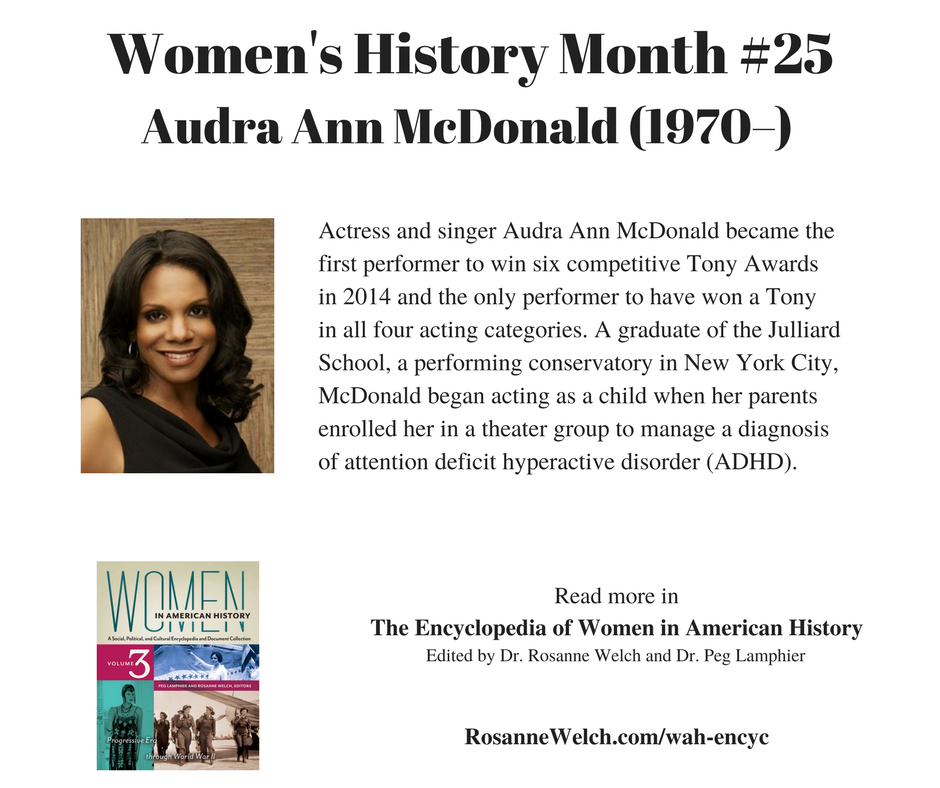
Actress and singer Audra Ann McDonald became the first performer to win six competitive Tony Awards in 2014 and the only performer to have won a Tony in all four acting categories. A graduate of the Julliard School, a performing conservatory in New York City, McDonald began acting as a child when her parents enrolled her in a theater group to manage a diagnosis of attention deficit hyperactive disorder (ADHD).
A woman of mixed racial heritage, Betty Charbonnet Reid Soskin is a living repository of African American history, a social reformer, and a voice for marginalized people. In her late 80s, she became a special consultant to the Rosie the Riveter/World War II Home Front National Historic Park, and at age 94 she became the country’s oldest full-time National Park Service ranger.
You Can Please Some of the People Some of the Time… None of the People All of the Time: A History of the Art of Adaptation in Movies like Dune, The Godfather, Harry Potter and More!
Dr. Rosanne Welch speaks on A History of the Art of Adaptation in Movies like Dune, The Godfather, Harry Potter and More! at the California State University, Fullerton Library
Part of the program series for Dune by Frank Herbert: A 50th Anniversary Celebration.
So, when we come around to Harry Potter coming of age, that’s the same book that has all the elf stuff going on with Hermoine and she’s going to unionize the elves and all that stuff. That doesn’t appear in the movie at all. That has nothing to do with Harry Potter and his growing. So that storyline disappears. So, it’s and interesting choice. it’s a difficult choice. it’s why they then chose to split the last book in two, not just to make a lot more money, but because they did, but because they didn’t want to throw too much away and they had gained enough power and enough cache at that point that they could do that. It’s one of the more successful adaptations really of all time and in contrast little tiny things change like, for instance, you have to remember — you have to read the books again — when it’s time to get the gilly weed in the movie it gets given to him by Neville because we have to keep the Neville character alive. In the book, Dobby gives it to him, but Dobby is — we can’t waste time on him. Also, he costs money to put on-screen because he’s all fake, right? Little things like that along the way and generally fans weren’t too upset because they understood the reasons for it.
About this talk
Dr. Rosanne Welch (RTVF) speaks on the craft of history of film adaptations from the controversy of the silent film Birth of a Nation (protested by the National Association for the Advancement of Colored People in 1915) to Breakfast at Tiffany’s (to which author Truman Capote famously said, “The only thing left from the book is the title”) to The Godfather . Naturally, the behemoth in adaptation – Harry Potter (which depended on the relationship created by adapter Steve Kloves and author J.K. Rowling) will be discussed, as will the subject of this month’s celebration: Dune.
Date: Wednesday, October 14, 2015 Time: 1:00pm – 2:00pm
About Dr. Rosanne Welch
Dr. Rosanne Welch is a professor in the Low Residency MFA in Screenwriting Program from Stephens College, California State University, Fullerton, Mount San Antonio Community College and Cal Poly Pomona. In 2007, she graduated with her Ph.D. in 20th Century U.S./Film History from Claremont Graduate University. She graduated with her M.A. in 20th Century United States History from California State University, Northridge in 2004.
Welch is also a television writer/producer with credits for Beverly Hills 90210 , CBS’s Emmy winning Picket Fences and Touched By An Angel . She also writes and hosts her own podcasts on 3rdPass.media, her first one titled “Mindful(I) Media with Dr. Rosanne Welch.”
Perhaps the show’s boldest comment concerning television came near the end of their run in episode 52 “The Devil and Peter Tork” (Kaufman and Gardner and Caruso). In visualizing hell as the place Peter may be sent since he sold his soul for the ability to play the harp, every time they say “Hell” they are bleeped. This elicits the comment from Micky, “You know what’s even more scary? You can’t say (bleep) on television.”
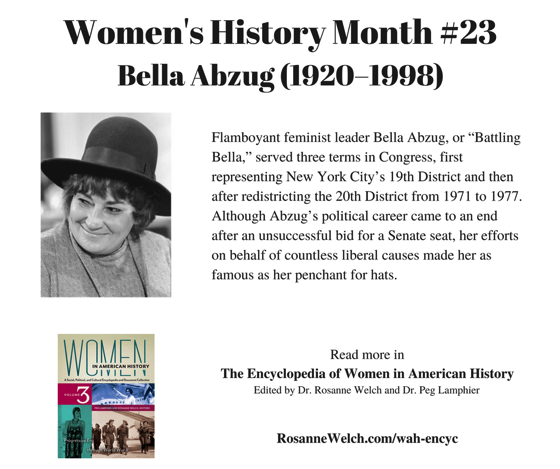
Flamboyant feminist leader Bella Abzug, or “Battling Bella,” served three terms in Congress, first representing New York City’s 19th District and then after redistricting the 20th District from 1971 to 1977. Although Abzug’s political career came to an end after an unsuccessful bid for a Senate seat, her efforts on behalf of countless liberal causes made her as famous as her penchant for hats.
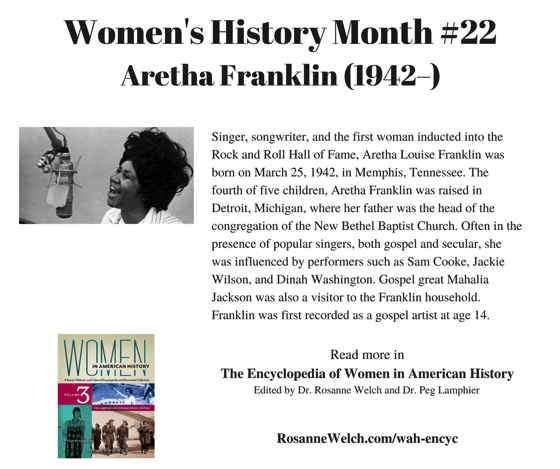
Singer, songwriter, and the first woman inducted into the Rock and Roll Hall of Fame, Aretha Louise Franklin was born on March 25, 1942, in Memphis, Tennessee. The fourth of five children, Aretha Franklin was raised in Detroit, Michigan, where her father was the head of the congregation of the New Bethel Baptist Church. Often in the presence of popular singers, both gospel and secular, she was influenced by performers such as Sam Cooke, Jackie Wilson, and Dinah Washington. Gospel great Mahalia Jackson was also a visitor to the Franklin household. Franklin was first recorded as a gospel artist at age 14.
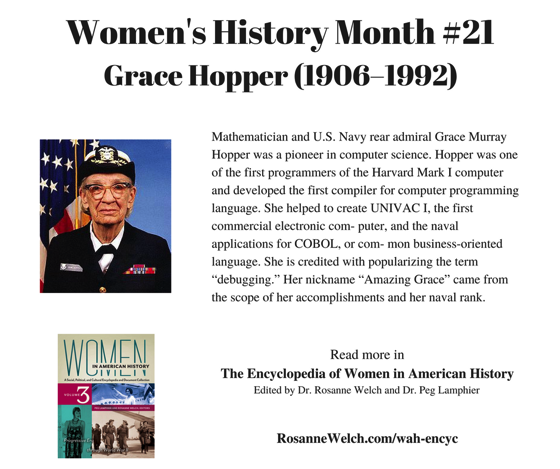
Mathematician and U.S. Navy rear admiral Grace Murray Hopper was a pioneer in computer science. Hopper was one of the first programmers of the Harvard Mark I computer and developed the first compiler for computer programming language. She helped to create UNIVAC I, the first commercial electronic computer, and the naval applications for COBOL, or com- mon business-oriented language. She is credited with popularizing the term “debugging.” Her nickname “Amazing Grace” came from the scope of her accomplishments and her naval rank.
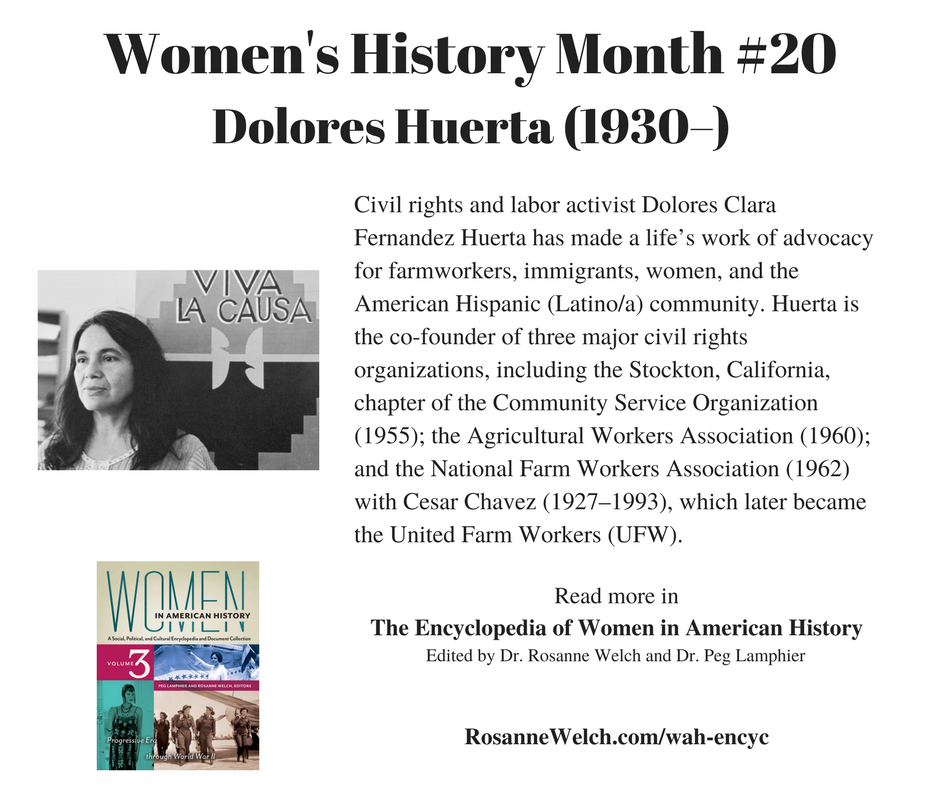
Civil rights and labor activist Dolores Clara Fernandez Huerta has made a life’s work of advocacy for farmworkers, immigrants, women, and the American Hispanic (Latino/a) community. Huerta is the co-founder of three major civil rights organizations, including the Stockton, California, chapter of the Community Service Organization (1955); the Agricultural Workers Association (1960); and the National Farm Workers Association (1962) with Cesar Chavez (1927–1993), which later became the United Farm Workers (UFW).
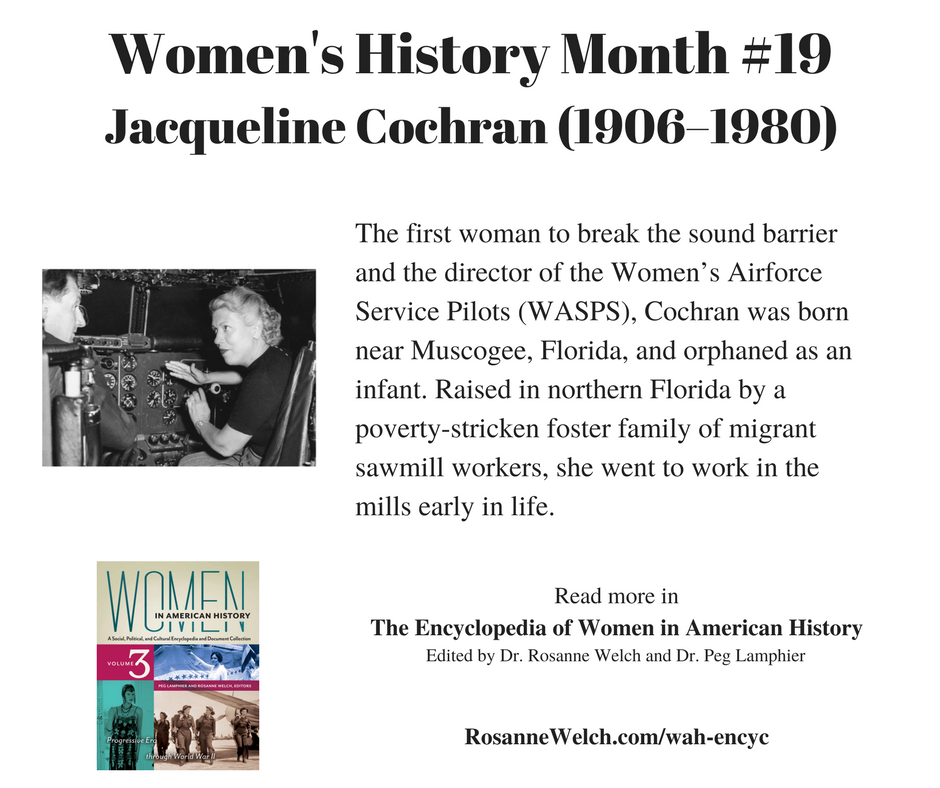
The first woman to break the sound barrier and the director of the Women’s Airforce Service Pilots (WASPS), Cochran was born near Muscogee, Florida, and orphaned as an infant. Raised in northern Florida by a poverty-stricken foster family of migrant sawmill workers, she went to work in the mills early in life.


![Harry Potter and What To Leave Out from A History of the Art of Adaptation [Video] (1:02)](https://rosannewelch.com/wp-content/uploads/2017/03/adapt-42-harry-potter-leave-out.jpeg)