So why are we studying this? Because I believe and we can prove that writers have been lost in the history of film. If you look at this, what do we call know? We all know this movies is by who? Frank Capra! Right? Right. Look at this — no, no, no, — Screenplay by Frank Capra. You can’t read this from there. I can barely read this from here. This movie which plays perennially at Christmas a million times was written by them. Frances Goodrich and Albert Hackett. A married screenwriting time that worked for 35 years together until she died. They were the highest paid screenwriting team and they’re nothing to sneeze at because they got a Pulitzer for the play, The Diary of Anne Frank and then they adapted it into a film and it kills me that children — they know Anne Frank. They know It’s a Wonderful Life and they know Frank Capra.
Hi everybody! It’s so wonderful to have you here. I’m going to be talking about a book and a film and a television series and I think the trajectory from serious to bubblegum back to slightly serious is what’s interesting to me and it’s all about the adaptation of something and how the true person’s story can get lost along the way and I believe TV allows a chance to tell longer stories — you can tell a hundred hours in the life of a person instead of two hours and so I think we’re going to end up discovering that TV was the better place for this story to house itself.
“How Gidget Got Into the Girl Ghetto by Accident (and How We Can Get Her Out of it): Demoting Gidget: The Little Girl with Big Ideas from Edgy Coming of Age Novel to Babe on the Beach Genre Film via Choices made in the Adaptation Process.”
It’ a long title, as I joke up front, but covers the process of adapting the true life story of Kathy Kohner (nicknamed ‘Gidget’ by the group of male surfers who she spent the summers with in Malibu in the 1950s) into the film and television series that are better remembered than the novel. The novel had been well-received upon publication, even compared to A Catcher in the Rye, but has mistakenly been relegated to the ‘girl ghetto’ of films. Some of the adaptations turned the focus away from the coming of age story of a young woman who gained respect for her talent at a male craft – surfing – and instead turned the focus far too much on Kathy being boy crazy.
Along the way I found interesting comparisons between how female writers treated the main character while adapting the novel and how male writers treated the character.
Dr. Rosanne Welch teaches the History of Screenwriting and One-Hour Drama for the Stephens College MFA in Screenwriting.
Writing/producing credits include Beverly Hills 90210, Picket Fences, ABCNEWS: Nightline and Touched by an Angel. In 2016 she published the book Why The Monkees Matter: Teenagers, Television and American Pop; co-edited Women in American History: A Social, Political, and Cultural Encyclopedia; and placed “Transmitting Culture Transnationally Via the Characterization of Parents in Police Procedurals” in the New Review of Film and Television Studies. Essays appear in Torchwood Declassified: Investigating Mainstream Cult Television and Doctor Who and Race: An Anthology. Welch serves as Book Reviews editor for Journal of Screenwriting and on the Editorial Advisory Board for Written By magazine, the magazine of the Writers Guild.
The Screenwriting Research Network is a research group consisting of scholars, reflective practitioners and practice-based researchers interested in research on screenwriting. The aim is to rethink the screenplay in relation to its histories, theories, values and creative practices.
I think when you teach slient films and early films of course your teaching character because that is where all these archetypes came from. Yes, we can go back to France and we can go back to Aristophanes. They came from way back then, but on the film they came from this time period and we find all these characters in these early films.Sometimes in more simplistic ways which helps students understand how to back to the simple part of their story — who wants what and what’s getting in their way and you see that in this sort of film. You can teach structure in teaching silent films because we all know the purpose of having 3 acts is because you had reels and you had 1 reel and then 2 reels and then 3 reels and began to write in terms of that. It was also Paul Gulino’s sequence approach which is just about each reel. You have 8 reels, 8 sequences. They visualize, ‘Oh, this is why they do it this way because they had to to — oh, I get it!” It helps students understand the history of this profession. I love that Warren calls it a profession because that is what it is.
Teaching Silent Films allows you to teach diversity again because there were filmmakers of all colors and ethnic backgrounds. Much of that work has been lost. Some of it is findable. Oscar Micheaux was one of the people I found for my students. He was a hugely successful African-American writer/director and he also wrote novels and he translated his novels into films. One of them is called Within Our Gates and it’s free on YouTube as well and he looked at middle class African-Americans talking in the 1910’s and presented them to the audience in ways that other movies were not and I thin kit’s important for them to know his work in line with Cecil B. DeMille and D. W. Griffith and all those other guys because they’re not the only men – they’re not the only people who are around but if you look at film history classes that’s all they’ve learned and that really bothers me.
So, I think it’s really important to teach silent films because we’re teaching the screenwriters that the visual is important. Much as I love the words more, you do have to think about how they’re shown and, of course, these are visuals that show is the emotion of the moment and I think that they are really beautiful. So, it’s fun for the students — I totally agree with Warren — to have this heritage in their life, to understand that this all came before them. That’s very, very important.
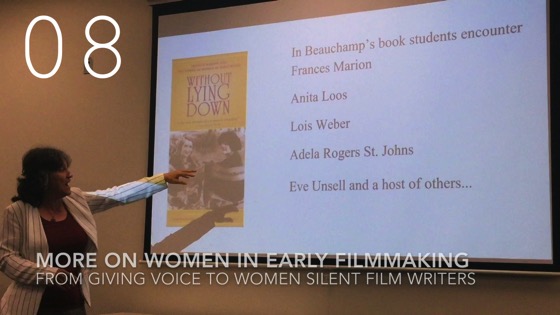
In Beauchamp’s book, you’ll see all these famous women. My great joy is that one of my students, who teaches directing, found Lois Weber in my class who wrote and directed her films back in the day and now incorporates her into the set of directors that he teaches as examples because she had that kind of career back in the day. Eve Unsell ran her own production company for Universal for 10 years. Made a ton of movies that are very very successful in the day. She also allows us to go into the place where we discuss the problems with films whether it is back them or today because she was involved in what, back then, were yellow race films which were anti-Asian-American films and so that’s something students should understand about. So, again that goes back to to the title of what we are talking about and I talk fast because I’m Sicilian. I also don’t want to eat up all the time.
So I teach history and I start in the silent film world, so I disagree with Warren. I go chronologically. This is a period they have never heard of and all the movies are free on YouTube. Nothing like telling them they can watch whatever they have to watch for free. That works, right? And so here they meet Anita Loos, Gene Gauntier — the first women — the first person to do filming on location. She went to Jerusalem to film the story of Jesus Christ — the first time it was put on film and it’s a really beautiful film you can see, for free, on YouTube. Then Jeanie MacPherson who wrote all of Cecil B. DeMille’s early movies that were successes. When she stopped working for him all his stuff failed. Nobody knows her name and she’s quite brilliant. So I thinks it’s important for women students today to know that women once ran Hollywood so all this discussion about “I don’t know if women should direct a movie” is not worth having, because they did and they were. They were the highest paid people in this town, so I think that’s important an important think for them to remember.
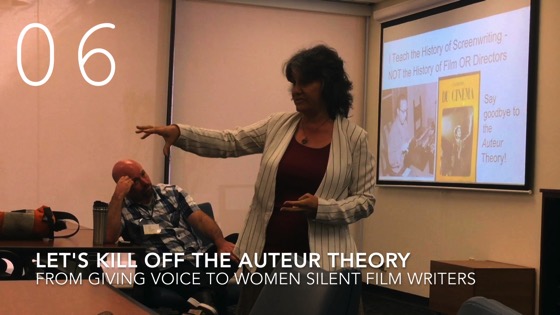
You got to the next question which is my first exercise in class — Name the writer. Lucky if they can. If it’s a writer/director, they can. Otherwise, they can’t and they suddenly are embarrassed because they adore the words of a person whose name they can’t tell you. If they have a favorite book they can tell you who wrote it, but they don’t know who wrote their favorite film. So it’s my goal to make them know that. I can’t stand the Auteur Theory because I think it’s bullshit. Directors aren’t the authors of their film. I don’t want to insult any directors in the class but you can’t direct something that doesn’t exist on the page first. It’s a collaborative thing and directors have lovely, but they’ve been given all the credit for far too long because, as we know, it goes back to all the book reviews in Cahiers and they came up with that theory. It’s nonsense.
This is about strategies in teaching film and television history and current events — which is what David will do when I am done — and so, gee, I’m all about the chicks so we have Dorothy Parker and we have Tina Fey. There is a direct line between those women and if you love Tina Fey then you had better study a little bit of Dorothy Parker or you don’t understand why Tina Fey works today. So, why study screenwriting history? That’s actually the first screen of a lecture that I give on this very topic to my students on opening day because when you mention movies nobody says, “You know I love that shot in… ” They say, “My name is Inigo Montoya.You killed my father. Prepare to Die.” They remember the words in the movies. They remember the screenwriting, but when we look at the history of tv and film, we’re not doing that. We’re teaching directors. Everyone can name their favorite films and they can normally name the director of those films.
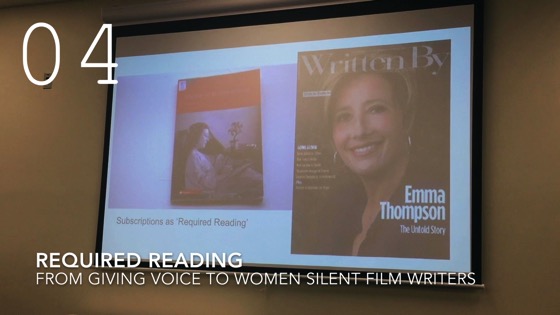
I am also on the editorial board for Written By Magazine and the book review editor of the Journal of Screenwriting so if anyone’s interested in writing book reviews for the Journal of Screenwriting which publishes out of the UK, please let me know because I am always looking for book reviewers and you get the book for free, but also I have — the schools that I teach at have subscription to the journal. I have students read journal articles because I want them — it is a Masters Program — I want them to have a comfort level with that, but I have my undergrads at least do one journal article reading as well to have an accessibility to that. And then I get the schools and/or the kids to read Written By Magazine every month. We do a different screenwriter or television writer on the front cover. It’s a wonderful inside look at how the process of writing is done. The subscription is not that expensive, rather than a textbook for undergrads, but we also publish most of that online for free at the Written By web site, so they can read these articles on their own as assignments and learn about these writers. So I think all that stuff is valid for the class.
![Writers Have Been Lost In Film History from Giving Voice to Silent Films and the Far From Silent Women Who Wrote Them with Dr. Rosanne Welch [Video]](https://rosannewelch.com/wp-content/uploads/2017/12/ufva-12-forgotten-writers.jpeg)


![01 Introduction from How Gidget Got Into the Girl Ghetto – Dr. Rosanne Welch – SRN Conference 2017 [Video]](https://rosannewelch.com/wp-content/uploads/2017/10/gidget-srn.png)
![Teaching Character and Structure from Giving Voice to Silent Films and the Far From Silent Women Who Wrote Them with Dr. Rosanne Welch [Video]](https://rosannewelch.com/wp-content/uploads/2017/12/ufva-11-character-structure.jpeg)
![Silent Films and Diversity from Giving Voice to Silent Films and the Far From Silent Women Who Wrote Them with Dr. Rosanne Welch [Video]](https://rosannewelch.com/wp-content/uploads/2017/12/ufva-10-diversity.jpeg)