This book signing at Book Soup was wonderful – good people, good conversation (before and after the signing). Just another example of the kind of quality positive people who have been drawn to The Monkees across generations – I even met a former head of publicity for ScreenGems who had some fun stories to tell. — Rosanne
And she won Emmys for writing the episode where Lou Grant wife asks him for a divorce, which was huge in the early 70’s. That was a crazy idea and James Burrows, who was the producer of The Mary Tyler More Show in several book son the show has said that Treva was the feminist heart of that show. So, she had that idea on Mary Tyler More or course she had that on The Monkees, too. So in those rooms when they talked about the girl friends, she made sure they were 3-dimensional, interesting women.
Jean Powergirl takes the host reigns and welcomes her guest Rosanne Welch, PhD to the show! They’ll be discussing Roseanne’s book, “Why The Monkees Matter: Teenagers, Television and American Pop Culture.”
Transcript:
Jean: So they had this beach house and this was cool and there are these single boys now, but they did kind of keep it kind of wholesome. Now did they have girls spending the night over at the beach house or anything like that?
Rosanne: They did not. When I came to study the show because I loved it as a kid and when I decided to study it I thought, “Oh, well a show about rock-and-rollers. It’s going to be every week about who’s have sex with which girl and maybe as a kid, I didn’t remember that. And then I watched all 58 episodes in an era when I’m also watching The Big Bang Theory because that’s the number one comedy of our day and that’s of course about 4 scientists who spend their days discussing who they’re going to have sex with and it turned out, of course, because of the rules of what you could and couldn’t do on television at the time that The Monkees couldn’t do that. So when they had girlfriends we always saw that the girls left before the boys had time in their beach house. They never spent the night.
Jean: So it wouldn’t offend the sensibilities of the parents that are watching this television show with their teenagers and things like that.
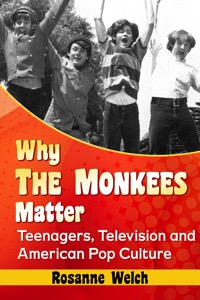
A hit television show about a fictitious rock band, The Monkees (1966-1968) earned two Emmys–Outstanding Comedy Series and Outstanding Directorial Achievement in Comedy. Capitalizing on the show’s success, the actual band formed by the actors, at their peak, sold more albums than The Beatles and The Rolling Stones combined and set the stage for other musical TV characters from The Partridge Family to Hannah Montana. In the late 1980s, the Monkees began a series of reunion tours that continued into their 50th anniversary.
This book tells the story of The Monkees and how the show changed television, introducing a new generation to the fourth-wall-breaking slapstick created by Laurel and Hardy and the Marx Brothers. Its creators contributed to the innovative film and television of 1970s with projects like Bob & Carol & Ted & Alice, The Mary Tyler Moore Show, Laugh-In and Welcome Back, Kotter. Immense profits from the show, its music and its merchandising funded the producers’ move into films such as Head, Easy Rider and Five Easy Pieces.
Rosanne Welch, PhD has written for television (Touched by an Angel, Picket Fences) and print (Three Ring Circus: How Real Couples Balance Marriage, Work and Kids and The Encyclopedia of Women in Aviation and Space). In the documentary world she has written and produced Bill Clinton and the Boys Nation Class of 1963 for ABC NEWS/Nightline and consulted on PBS’s A Prince Among Slaves, the story of a prince from West Africa who was enslaved in the 1780s, freed by order of President John Quincy Adams in the 1820s and returned to his homeland.
This book signing at Book Soup was wonderful – good people, good conversation (before and after the signing). Just another example of the kind of quality positive people who have been drawn to The Monkees across generations – I even met a former head of publicity for ScreenGems who had some fun stories to tell. — Rosanne
And my theory is, watching those women as a child made me want to grow up to be somebody of value because that’s how you caught yourself a Monkee, not by being a dizzy-headed cheerleader. All right? But who knows if that what’s your looking at when your six, seven or eight, that’s when you’re deciding who you want to be. So, I think that’s a really important message that the show carried and might not have known they were carrying it except if you credit writers, which is what Ido a lot of in the book. I interviewed all the writers on the show and to me, that was really interesting. One of them is Treva Silverman. She was the first female writer in television to write alone on a comedy. Other women had male partners. So the fact that she came onto the show and had these ideas about being a feminist. She was from New York. She had come out to LA to be a TV writer. That’s a crazy idea even back then and it’s a crazy idea today and she left The Monkees when the show went off the air. She joined The Mary Tyler Moore Show.
Jean Powergirl takes the host reigns and welcomes her guest Rosanne Welch, PhD to the show! They’ll be discussing Roseanne’s book, “Why The Monkees Matter: Teenagers, Television and American Pop Culture.”
Transcript:
Rosanne: These techniques weren’t necessarily being used by shows like George Burns and Gracie Allen Show. They would eventually be in things like Dream On and many other shows later would use those kinds of old footage, but now that I bring up George and Gracie. What they did is that they spoke to the audience, which is another thing these guys did.They broke the 4th wall of theater by speaking to the audience and admitting to the audience that we know we’re a show and you’re watching us, which is meta-narrative if you want to get all professorial about it, but it made them — it gave them a chance to get closer to the audience and it connected the kids to them.
Jean: So, by doing that there’s a lot of current shows — and I’m going to kind of nerd out with you on this — like The Office for example or these mockumentary type things where they say they’re aware that we’re going to be watching them the Monkees had already been doing that.
Rosanne: They’d already been doing that. Exactly and it made them very hip and cute to the children watching because they were the generation who hadn’t been paid much attention to yet and now these boys were paying attention to them.
A hit television show about a fictitious rock band, The Monkees (1966-1968) earned two Emmys–Outstanding Comedy Series and Outstanding Directorial Achievement in Comedy. Capitalizing on the show’s success, the actual band formed by the actors, at their peak, sold more albums than The Beatles and The Rolling Stones combined and set the stage for other musical TV characters from The Partridge Family to Hannah Montana. In the late 1980s, the Monkees began a series of reunion tours that continued into their 50th anniversary.
This book tells the story of The Monkees and how the show changed television, introducing a new generation to the fourth-wall-breaking slapstick created by Laurel and Hardy and the Marx Brothers. Its creators contributed to the innovative film and television of 1970s with projects like Bob & Carol & Ted & Alice, The Mary Tyler Moore Show, Laugh-In and Welcome Back, Kotter. Immense profits from the show, its music and its merchandising funded the producers’ move into films such as Head, Easy Rider and Five Easy Pieces.
Rosanne Welch, PhD has written for television (Touched by an Angel, Picket Fences) and print (Three Ring Circus: How Real Couples Balance Marriage, Work and Kids and The Encyclopedia of Women in Aviation and Space). In the documentary world she has written and produced Bill Clinton and the Boys Nation Class of 1963 for ABC NEWS/Nightline and consulted on PBS’s A Prince Among Slaves, the story of a prince from West Africa who was enslaved in the 1780s, freed by order of President John Quincy Adams in the 1820s and returned to his homeland.
This book signing at Book Soup was wonderful – good people, good conversation (before and after the signing). Just another example of the kind of quality positive people who have been drawn to The Monkees across generations – I even met a former head of publicity for ScreenGems who had some fun stories to tell. — Rosanne
I would like to get more people to focus on The Monkees because when I look at textbooks about this time, they don’t talk about them at all. People thought they were this bubble gum group and they think only about that aspect and they don’t think about the messages that came from the program. When I think about that I think about episodes that had to do with feminism and that sounds odd for a show about 4 kids who were playing rock and roll, but in fact if you look at all 58 episodes — which I obviously did, you will find that never do they date the girl who didn’t have her own job and was taking care of herself in the world. She was either a student who was worried about her grades or she was a woman with a job. They were journalists. They were girls that worked at record companies or record stores. Yes, they were princesses, but the princesses rather than them wanting to wear pretty dresses and marry Davy Jones — which everyone in the audience wanted to do — the princesses gave that up in order to go back to their countries and life out there obligations to their people. They were women of purpose.
Jean Powergirl takes the host reigns and welcomes her guest Rosanne Welch, PhD to the show! They’ll be discussing Roseanne’s book, “Why The Monkees Matter: Teenagers, Television and American Pop Culture.”
Transcript:
Rosanne: The adults that did take it seriously are the adults who were in the business because they won an Emmy for best Comedy Series in their first season.
Jean: They won 2 Emmys, right?
Rosanne: Yes. They won one for Best Directing as well, And James Frawley who won that had begun his directing career on The Monkees and he grew up to direct The Muppet Movie.
Jean: Awesome. And we love our Muppets. So, in terms of the production and everything The Monkees did some interesting things that — and these are the things that I remember. I remember a lot of little chase scenes that were so cute. Kind of zany. Kind of Groucho Marx-y kind of things, but also they employed the use of what, flashbacks and things like that. Let’s talk about the tools that they used.
Rosanne: They used flashbacks. They would use a lot of old footage whenever they would say something funny, they’d cut to — if I’d say, “The Sky’s falling” they’d cut to a building being dynamited down and that sort of thing and that helps because it saved them money, because they’re using old footage, but it also gave a very frenetic, energetic feel to the show.
A hit television show about a fictitious rock band, The Monkees (1966-1968) earned two Emmys–Outstanding Comedy Series and Outstanding Directorial Achievement in Comedy. Capitalizing on the show’s success, the actual band formed by the actors, at their peak, sold more albums than The Beatles and The Rolling Stones combined and set the stage for other musical TV characters from The Partridge Family to Hannah Montana. In the late 1980s, the Monkees began a series of reunion tours that continued into their 50th anniversary.
This book tells the story of The Monkees and how the show changed television, introducing a new generation to the fourth-wall-breaking slapstick created by Laurel and Hardy and the Marx Brothers. Its creators contributed to the innovative film and television of 1970s with projects like Bob & Carol & Ted & Alice, The Mary Tyler Moore Show, Laugh-In and Welcome Back, Kotter. Immense profits from the show, its music and its merchandising funded the producers’ move into films such as Head, Easy Rider and Five Easy Pieces.
Rosanne Welch, PhD has written for television (Touched by an Angel, Picket Fences) and print (Three Ring Circus: How Real Couples Balance Marriage, Work and Kids and The Encyclopedia of Women in Aviation and Space). In the documentary world she has written and produced Bill Clinton and the Boys Nation Class of 1963 for ABC NEWS/Nightline and consulted on PBS’s A Prince Among Slaves, the story of a prince from West Africa who was enslaved in the 1780s, freed by order of President John Quincy Adams in the 1820s and returned to his homeland.
This book signing at Book Soup was wonderful – good people, good conversation (before and after the signing). Just another example of the kind of quality positive people who have been drawn to The Monkees across generations – I even met a former head of publicity for ScreenGems who had some fun stories to tell. — Rosanne
I think when we think about the intimacy of what we get from television we learn a lot about why isn’t important and why we should pay attention to the kind of television we’re watching and supporting. For me, obviously, that’s going backward to The Monkees and showing that to students today, so that they can think about what ideas were prevalent in the 60s. I think all the things that we credit to All in the Family and the whole Norman Lear empire, those things appeared on The Monkees long before it happened on those programs. Studying The Monkees, for me, illustrates the history and the evolution of the medium of television and it provides a time capsule of American society at that moment when youth culture was becoming everything and if you think about it, we still look at it that way. Everyone’s still trying to pretend with the botox and whatever that they are still 22. It’s an interesting point. But it was the beginning of teenagers in America in many ways and the films and the television were showing us what teenagers were all about.
Jean Powergirl takes the host reigns and welcomes her guest Rosanne Welch, PhD to the show! They’ll be discussing Roseanne’s book, “Why The Monkees Matter: Teenagers, Television and American Pop Culture.”
Transcript:
Jean: Why The Monkees Matter. Cute kids. Mop Tops. Allowed to talk about controversial things that adults didn’t like talking about back in the 50’s, right? Rosanne is a busy woman. She does it all and actually one of the exciting things about me living here in Los Angeles — I’m a Texan if up can’t tell – is I love people like Rosanne. It’s a different world and it’s a fascinating one that’s I’ve always been interested in. So here we have The Monkees/They introduce touchy subjects like the Vietnam War just by playing a domino game. Things like that. They don’t put it in your face like that. So, The Monkees start to be a popular show among teenagers obviously. Now, Were adults starting to like it, as well?
Rosanne: A little bit, I mean, you know. it did all right but it never made the top 10 for lots of reasons, including that it didn’t air all over the country because there were some southern stations that didn’t take because their long hair — which we would laugh at today, because we wouldn’t consider it long — was so strange and anti-establishment that they immediately dismissed the show for their purposes.
A hit television show about a fictitious rock band, The Monkees (1966-1968) earned two Emmys–Outstanding Comedy Series and Outstanding Directorial Achievement in Comedy. Capitalizing on the show’s success, the actual band formed by the actors, at their peak, sold more albums than The Beatles and The Rolling Stones combined and set the stage for other musical TV characters from The Partridge Family to Hannah Montana. In the late 1980s, the Monkees began a series of reunion tours that continued into their 50th anniversary.
This book tells the story of The Monkees and how the show changed television, introducing a new generation to the fourth-wall-breaking slapstick created by Laurel and Hardy and the Marx Brothers. Its creators contributed to the innovative film and television of 1970s with projects like Bob & Carol & Ted & Alice, The Mary Tyler Moore Show, Laugh-In and Welcome Back, Kotter. Immense profits from the show, its music and its merchandising funded the producers’ move into films such as Head, Easy Rider and Five Easy Pieces.
Rosanne Welch, PhD has written for television (Touched by an Angel, Picket Fences) and print (Three Ring Circus: How Real Couples Balance Marriage, Work and Kids and The Encyclopedia of Women in Aviation and Space). In the documentary world she has written and produced Bill Clinton and the Boys Nation Class of 1963 for ABC NEWS/Nightline and consulted on PBS’s A Prince Among Slaves, the story of a prince from West Africa who was enslaved in the 1780s, freed by order of President John Quincy Adams in the 1820s and returned to his homeland.
Many Thanks to Sarah Clark for inviting me along on this book group discussion of Mike Nesmith’s new “Infinite Tuesday” – which due to his eclectic writing style and his honest look at his life’s successes and failures, turns out to be an interesting testament to how to survive having been young and famous in the 1960s.
Sarah Clark is joined by Rosanne Welch, Ghosty Tmrs, and Music Biographer Andrew Vaughan to dig deep into Infinite Tuesday: an Autobiographical Riff! Hear the panel’s thoughts, some of Sarah’s favorite Nez Songs (not featured on the Infinite Tuesday soundtrack), Then Melanie Mitchell talks Peter Tork “SSB” Pics surface, Monkees News & More!
This book signing at Book Soup was wonderful – good people, good conversation (before and after the signing). Just another example of the kind of quality positive people who have been drawn to The Monkees across generations – I even met a former head of publicity for ScreenGems who had some fun stories to tell. — Rosanne
The thing that I think is special about TV is that if you go to a film, you’ve chosen to pay your money for that message. So, you’re not likely to learn anything new. You’re not likely to believe you’re going to pay for something you don’t wan to be told, but television is intimate. It sneaks into your house when you’re not thinking. When you kid switches the channel and suddenly new messages come to them that you might never have wanted them to hear and that’s what The Monkees were doing. They were embedding some new political ideas into the 13 and 14-year-olds who were watching the show at that time and if you think about it, we’re in 1966, give those kids 5 or 6 years and they’re the ones protesting the Vietnam War in the 70’s. That’s when the big protests hit. So, this is a period that The Monkees falls into.


![Women Writers and The Monkees from Why The Monkees Matter Book Signing [Video] (0:54)](https://rosannewelch.com/wp-content/uploads/2017/05/wtmm-reading-10-women-writers.jpeg)
![04 – Monkee Metatexutality: “Why The Monkees Matter” Interview with Jean Hopkins Power [Video] (1:02)](https://rosannewelch.com/wp-content/uploads/2017/05/rmw-power-04-metatextuality.jpeg)
![Women of Purpose and The Monkees from Why The Monkees Matter Book Signing [Video] (1:00)](https://rosannewelch.com/wp-content/uploads/2017/05/wtmm-reading-09-women-purpose.jpeg)
![03 – Monkee Emmys and “Romps”: “Why The Monkees Matter” Interview with Jean Hopkins Power [Video] (0:55)](https://rosannewelch.com/wp-content/uploads/2017/05/rmw-power-03-emmys-romps.jpeg)
![Why Study The Television We Watch? from Why The Monkees Matter Book Signing [Video] (0:58)](https://rosannewelch.com/wp-content/uploads/2017/05/wtmm-reading-08-study-tv.jpeg)
![02 – Why DID The Monkees Matter?: “Why The Monkees Matter” Interview with Jean Hopkins Power [Video] (1:00)](https://rosannewelch.com/wp-content/uploads/2017/05/rmw-power-02-why.jpeg)


![Television is Intimate from Why The Monkees Matter Book Signing [Video] (0:47)](https://rosannewelch.com/wp-content/uploads/2017/05/wtmm-reading-07-tv-intimate.jpeg)