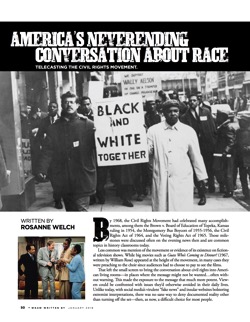
America’s Never-ending Conversation About Race: Telecasting The Civil Rights Movement by Rosanne Welch, Written By, January 2018

America’s Never-ending Conversation About Race: Telecasting The Civil Rights Movement by Rosanne Welch
Written By Magazine, January 2018

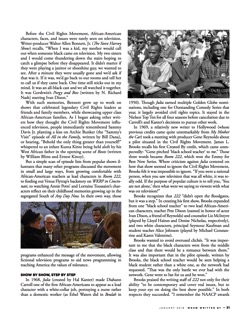
I have an article about how the Civil Rights Movement was reflected on the TV shows of the 1960s and 70s – “America’s Neverending Conversation” in the current issue (January 2018) of Written By which is out today with revolving covers (like TV Guide does with special issues) featuring Lena Waite and/or Jordan Peele. 

I had the wonderful experience of interviewing Jim Brooks about Room 222, a show I watched incessantly in my childhood before I knew what an ‘ideology’ was and that I was being offered one – and I spoke at length with Nancy Miller at length about Any Day Now – a show that relished highlighting the brave men and women who worked in the Civil Rights Movement – and still do.

You can read the whole issue digitally at this link.
Rmw written by race 1Rmw written by race 2

Rmw written by race 3Rmw written by race 4


By 1968, the Civil Rights Movement had celebrated many accomplishments, among them the Brown v. Board of Education of Topeka, Kansas ruling in 1954, the Montgomery Bus Boycott of 1955-1956, the Civil Rights Act of 1964, and the Voting Rights Act of 1965. Those milestones were discussed often on the evening news then and are common topics in history classrooms today.

Less common was mention of the movement or evidence of its existence on fictional television shows. While big movies such as Guess Who’s Coming to Dinner? (1967, written by William Rose) appeared at the height of the movement, in many cases they were preaching to the choir since audiences had to choose to pay to see the films.

That left the small screen to bring the conversation about civil rights into American living rooms—in places where the message might not be wanted…often without warning. This made the exposure to the message that much more potent. Viewers could be confronted with issues they’d otherwise avoided in their daily lives. Unlike today, with social media’s virulent “fake news” and insular websites bolstering extremist interpretations, there was no sane way to deny documented reality other than turning off the set—then, as now, a difficult choice for most people.

 

Read the entire article — America’s Never-ending Conversation About Race: Telecasting The Civil Rights Movement by Rosanne Welch

From The Research Vault: Transformations: Identity Construction in Contemporary Culture by Grant David McCracken

Self reinvention has become a preoccupation of contemporary culture. In the last decade, Hollywood made a 500-million-dollar bet on this idea with movies such as Multiplicity, Fight Club, eXistenZ, and Catch Me If You Can. Self reinvention marks the careers of Madonna, Ani DiFranco, Martha Stewart, and Robin Williams. The Nike ads of LeBron James, the experiments of New Age spirituality, the mores of contemporary teen culture, and the obsession with “extreme makeovers” are all examples of our culture’s fixation with change. In a time marked by plenitude, transformation is one of the few things these parties have in common.

Although transformation is widely acknowledged as a defining characteristic of our culture, we have almost no studies on what it is or how it works. Transformations offers the first comprehensive and systematic view. It is an ethnography of the contemporary world. — Amazon


Why The Monkees Matter: Teenagers, Television and American Pop Culture


Order Your Copy Now!

Quotes from “Why The Monkees Matter” by Dr. Rosanne Welch – 83 in a series – Greatest Teen Idol?

** Buy “Why The Monkees Matter” Today **

Monkees quote 83

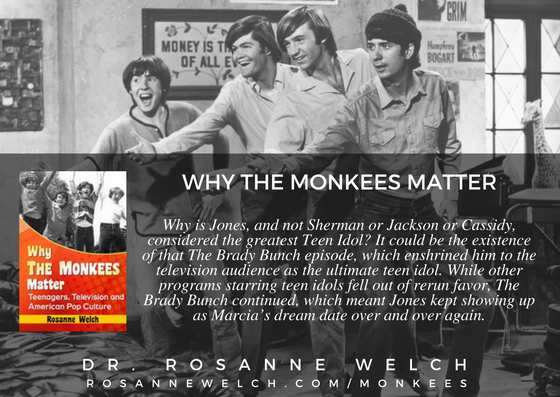
Why is Jones, and not Sherman or Jackson or Cassidy, considered the greatest Teen Idol? It could be the existence of that The Brady Bunch episode, which enshrined him to the television audience as the ultimate teen idol. While other programs starring teen idols fell out of rerun favor, The Brady Bunch continued, which meant Jones kept showing up as Marcia’s dream date over and over again. 

from Why The Monkees Matter by Dr. Rosanne Welch —  Buy your Copy today!

 Why The Monkees Matter: Teenagers, Television and American Pop Culture


McFarland (Direct from Publisher) | Amazon | Kindle Edition | Nook Edition

From The Research Vault: The Monkees still have plenty to say. by Jeff Marcus, Goldmine:  The Music Collector’s Magazine.

 
The Monkees still have plenty to say. by Jeff Marcus, Goldmine:  The Music Collector’s Magazine.
 

There’s a great scene from the sitcom “Married … With Children” that illustrates the prejudice against The Monkees perfectly.

Bud and Kelly Bundy have won a performance by the speed-metal band Anthrax in a radio contest. Square-peg neighbor Marcy Rhoades digs a tunnel to check on the kids (they are trapped in a snow storm while Al and Peg are vacationing in Sweatbucket, Fla., with Edd “Kookie” Byrnes) and eyes a group of “killers.” In learning that they are musicians, Marcy bursts with nerdy glee, “I don’t want you to think I’m un-hip. I chased The Monkees like everyone else.”

Since debuting in 1966, The Monkees, a rock group made-to-order for TV, have been fighting the “un-hip” stigma.

Forty-five years later, it looks as if The Monkees now are winning that fight. My Facebook page lit up like a Christmas tree at Rockefeller Center when I posted that I would be interviewing the four members of the group. The posts generated more responses and “likes” than anything I’ve submitted to date. A recent plea in Goldmine to induct The Monkees into the Rock and Roll Hall of Fame was embraced with a unanimous YES!

Read the complete article – The Monkees still have plenty to say. by Jeff Marcus


Why The Monkees Matter: Teenagers, Television and American Pop Culture


Order Your Copy Now!

From The Research Vault: Blacks and White TV: African Americans in Television Since 1948 by Fred J. MacDonald


* A portion of each sale from Amazon.com directly supports our blogs
** Many of these books may be available from your local library. Check it out!
† Available from the LA Public Library

The second edition of this powerful analysis of African-Americans in the television insudtry since 1948 is completely updated. The increased visibility of blacks in television, the success of the Cosby Show and other sitcoms featuring black actors, and the impact of cable TV on programming are described in detail. Professor MacDonald traces the stereotyping, tokenism, and unfair treatment of blacks from the early days of the indsutry, but expresses his hope and belief that a new video order is materializing that will finally fulfill the bright promise of television. — Amazon


Why The Monkees Matter: Teenagers, Television and American Pop Culture


Order Your Copy Now!

Writing the Pilot by William Rabkin | Gifts for the Screenwriter #6

Writing the Pilot by William Rabkin | Gifts for the Screenwriter #6

Writing the Pilot by William Rabkin | Gifts for the Screenwriter #6

Bill Rabkin understands what makes writing a pilots different from writing  regular episodes of a continuing series and explains that all in this clear, concise book. Having worked in television for a solid couple of decades on many fan favorites, Rabkin should know. – Rosanne

* A portion of each sale from Amazon.com directly supports our blogs
** Many of these books may be available from your local library. Check it out!

Quotes from “Why The Monkees Matter” by Dr. Rosanne Welch – 82 in a series – Davy Remembered

** Buy “Why The Monkees Matter” Today **

Quotes from

A measure of Jones’ standing also comes from considering the massive amount of international news outlets, from Australia to Japan that covered his death in 2012. The evening news on all three American broadcast channels covered the story, with Diane Sawyer announcing that a “startling bulletin came across in the newsroom”.  She then proclaimed “He is still that forever young and sunny singer from The Monkees who made more than one generation want to sing along.”  

from Why The Monkees Matter by Dr. Rosanne Welch —  Buy your Copy today!

 Why The Monkees Matter: Teenagers, Television and American Pop Culture


McFarland (Direct from Publisher) | Amazon | Kindle Edition | Nook Edition

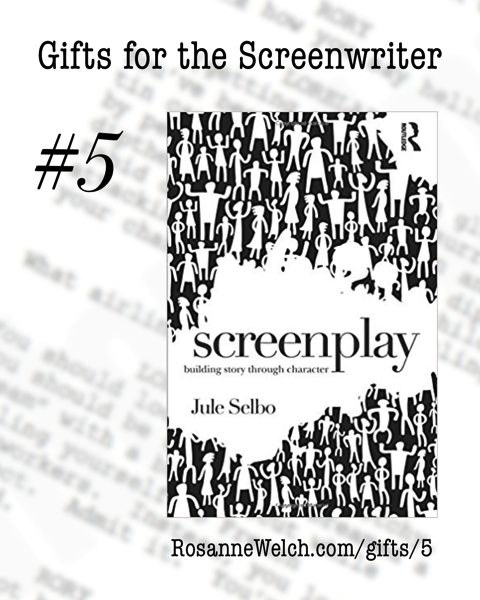
Screenplay: Building Story Through Character | Gifts for the Screenwriter #5

Screenplay: Building Story Through Character | Gifts for the Screenwriter #5

Screenplay: Building Story Through Character | Gifts for the Screenwriter #5

Screenwriter Jule Selbo created  Building Story Through Character after years of writing on successful television shows and films and then creating the MFA in Screenwriting at California State University, Fullerton where she teaches those skills to up and coming writers. Her focus on character and her 11 Steps of Story Structure streamlines ideas from other screenwriting gurus whose lists are longer and (to my mind) more contrived. You can take Selbo’s 11 Steps and apply them to stories as old as Gilgamesh and as modern as  Wonder Woman – as she does in the book so that the reader can see the pattern repeat itself over and over again.- Rosanne

From The Research Vault: “When Four Nice Boys Go Ape!” – The Saturday Evening Post

Why The Monkees Matter: Teenagers, Television and American Pop Culture


Order Your Copy Now!

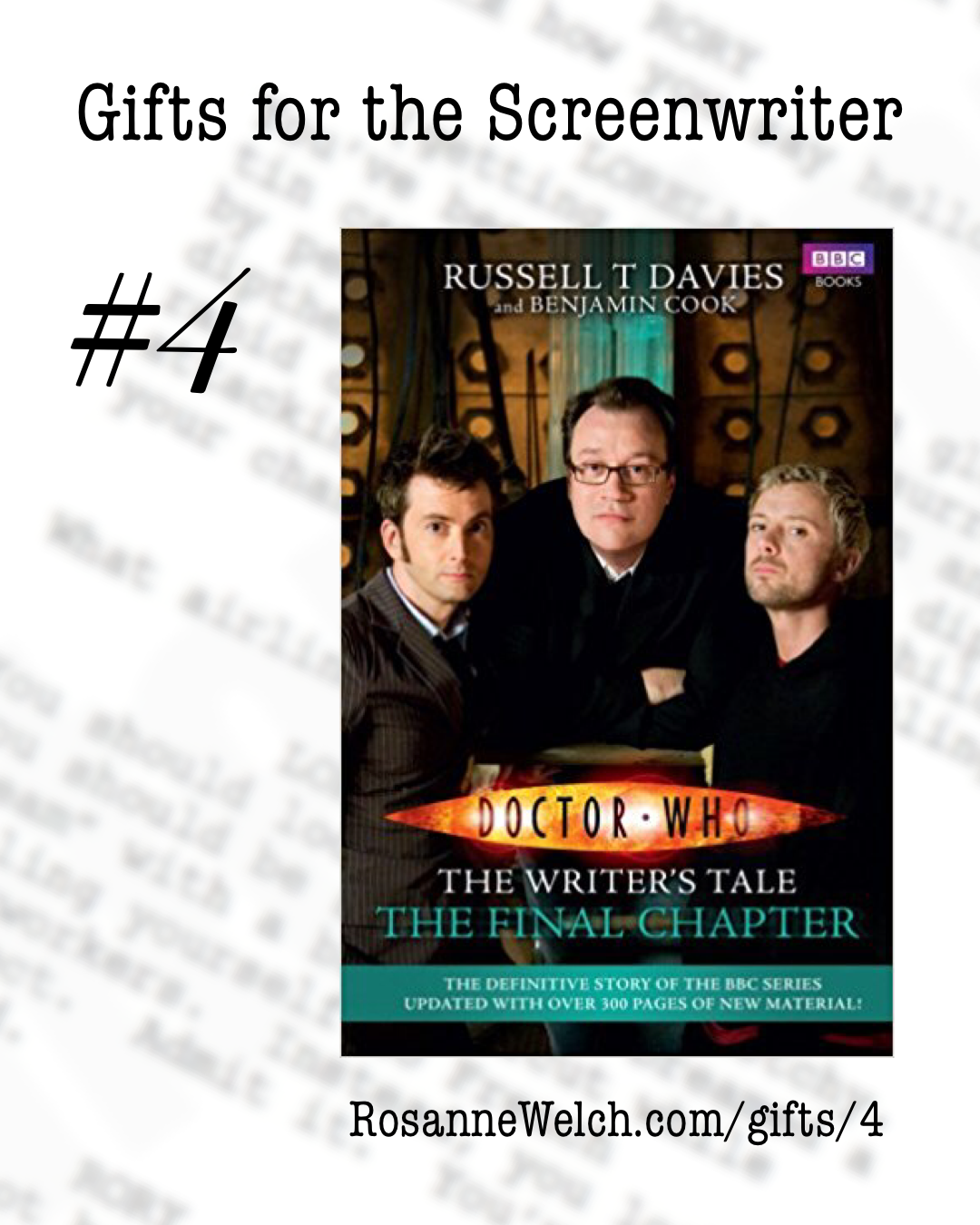
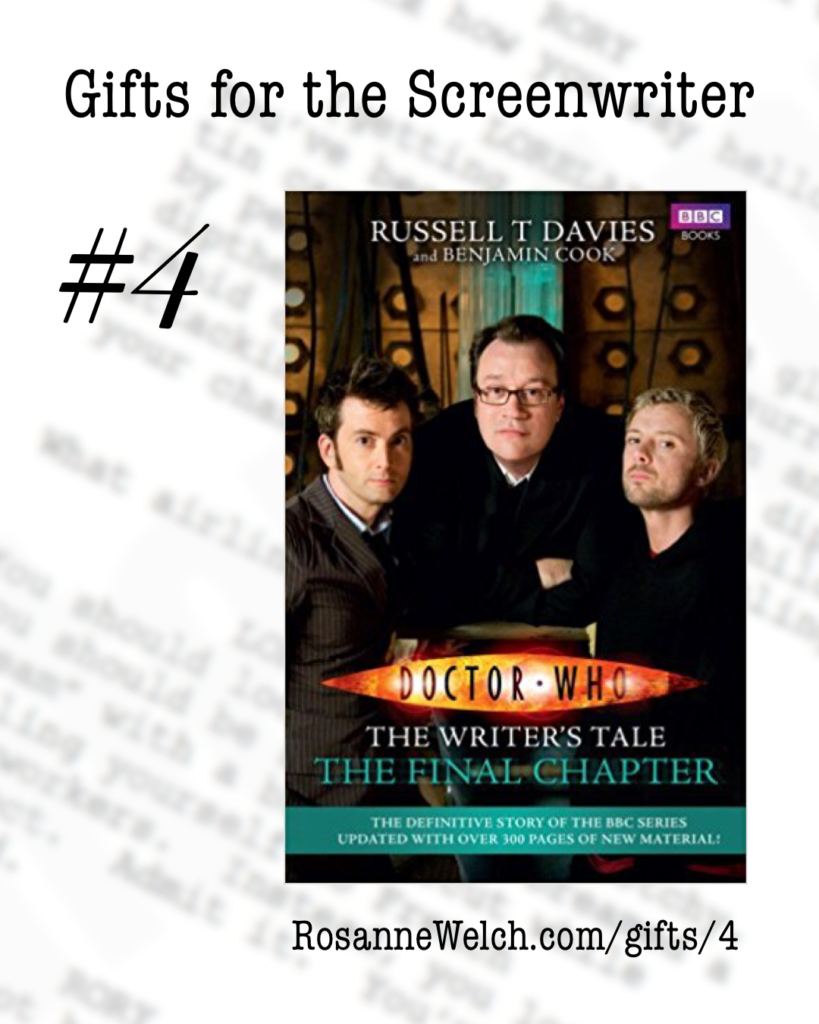
Doctor Who: The Writer’s Tale by Russell T. Davies | Gifts for the Screenwriter #4

Doctor Who: The Writer’s Tale by Russell T. Davies | Gifts for the Screenwriter #4 It is nearly impossible to ‘teach’ a student how to become an executive producer/head writer but this collection of emails between Russell T. Davies and reporter, Benjamin Cook encapsulates a year in the life of Davies as he wrapped out the Doctor Who tenure of David Tennant . One watches a story idea go from a simple sentence about ‘water being dangerous’ to a full-fledged script called “Waters of Mars” in a matter of weeks while also reading the difficulty in planning characters for guest stars who end up changing their schedules and dropping out of a project. Those kinds of real moments make this book a must-read for aspiring television writers on either side of the pond. – Rosanne