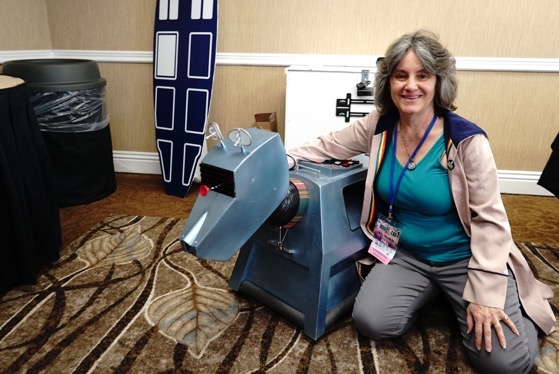
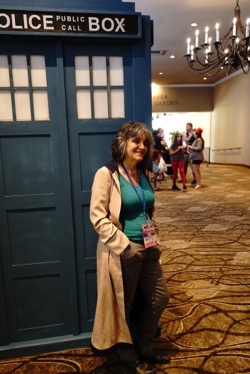
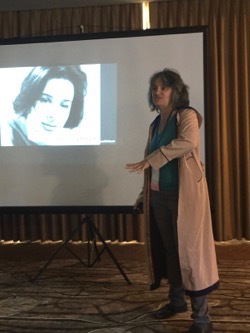
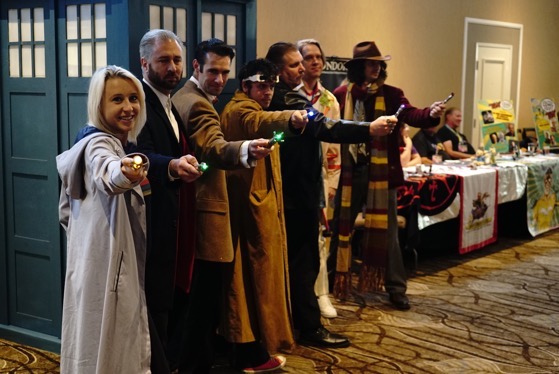
We spent the weekend down in San Diego attending WhoCon 2018. Rosanne was speaking on “Feminism in the Who-niverse in the Era of a Lady Doctor” (video coming soon).
Here are 50 photos from the presentation and the overall event.
I’ll also soon have a video interview with Dalek Builder Steve Roberts who kept us entertained all weekend with this fully functional Dalek!
Learn more about Doctor Who with these books and videos!
††
* A portion of each sale from Amazon.com directly supports our blogs ** Many of these books may be available from your local library. Check it out! † Available from the LA Public Library
Hailed around the world as one of the greatest movies ever made, the Academy Award-winning Bicycle Thieves, directed by Vittorio De Sica, defined an era in cinema. In poverty-stricken postwar Rome, a man is on his first day of a new job that offers hope of salvation for his desperate family when his bicycle, which he needs for work, is stolen.
When an open-minded Jewish librarian and his son become victims of the Holocaust, he uses a perfect mixture of will, humor, and imagination to protect his son from the dangers around their camp.
A CELEBRATION OF YOUTH, FRIENDSHIP, AND THE EVERLASTING MAGIC OF THE MOVIES
A winner of awards across the world including Best Foreign Language Film Oscar, five BAFTA Awards including Best Actor, Original Screenplay and Score, the Grand Prize of the Jury at the Cannes Film Festival and many more.
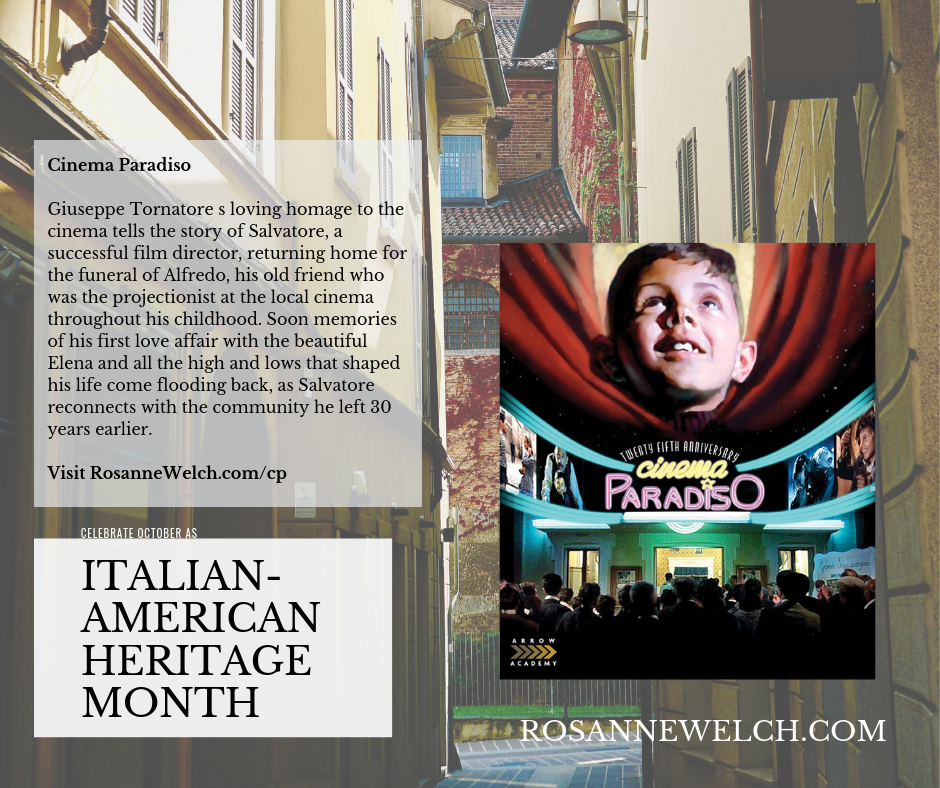
Giuseppe Tornatore s loving homage to the cinema tells the story of Salvatore, a successful film director, returning home for the funeral of Alfredo, his old friend who was the projectionist at the local cinema throughout his childhood. Soon memories of his first love affair with the beautiful Elena and all the high and lows that shaped his life come flooding back, as Salvatore reconnects with the community he left 30 years earlier.
“The Lost World was an adaptation of Arthur Conan Doyle’s famous dinosaur novel, and the film itself did the story justice. Fairfax both wrote the adaptation and directed the editing.
After the massive success of The Lost World, which broke records, Fairfax was more in demand than ever.”
Silent Screenwriter, Producer and Director: Marion Fairfax Sarah Phillips
* A portion of each sale from Amazon.com directly supports our blogs ** Many of these books may be available from your local library. Check it out! † Available from the LA Public Library
To highlight the wonderful yet largely forgotten work of a collection of female screenwriters from the early years of Hollywood (and as a companion to the book, When Women Wrote Hollywood) we will be posting quick bits about the many films they wrote along with links to further information and clips from their works which are still accessible online. Take a few moments once or twice a week to become familiar with their names and their stories. I think you’ll be surprised at how much bold material these writers tackled at the birth of this new medium. — Rosanne Welch
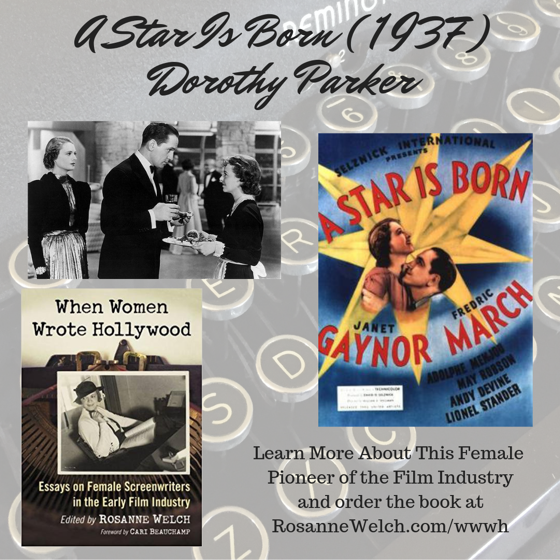
A Star Is Born is a 1937 American Technicolor romantic drama film produced by David O. Selznick, directed by William A. Wellman from a script by Wellman, Robert Carson, Dorothy Parker, and Alan Campbell, and starring Janet Gaynor (in her only Technicolor film) as an aspiring Hollywood actress, and Fredric March(in his Technicolor debut) as a fading movie star who helps launch her career. The supporting cast features Adolphe Menjou, May Robson, Andy Devine, Lionel Stander, and Owen Moore.
It was originally made in 1937 with Janet Gaynor and Fredric March, and then remade three times: 1954 (starring Judy Garland and James Mason), in 1976(starring Barbra Streisand and Kris Kristofferson), and in 2018 (starring Lady Gaga and Bradley Cooper).
North Dakota farm girl Esther Victoria Blodgett yearns to become a Hollywood actress. Although her aunt and father discourage such thoughts, Esther’s grandmother gives Esther her savings to follow her dream.
Esther goes to Hollywood and tries to land a job as an extra, but so many others have had the same idea that the casting agency has stopped accepting applications. Esther is told that her chances of becoming a star are one in 100,000. She befriends a new resident at her boarding house, assistant director Danny McGuire, himself out of work. When Danny and Esther go to a concert to celebrate Danny’s employment, Esther has her first encounter with Norman Maine, an actor she admires greatly. Norman has been a major star for years, but his alcoholism has sent his career into a downward spiral. — Wikipedia
* A portion of each sale from Amazon.com directly supports our blogs ** Many of these books may be available from your local library. Check it out! † Available from the LA Public Library
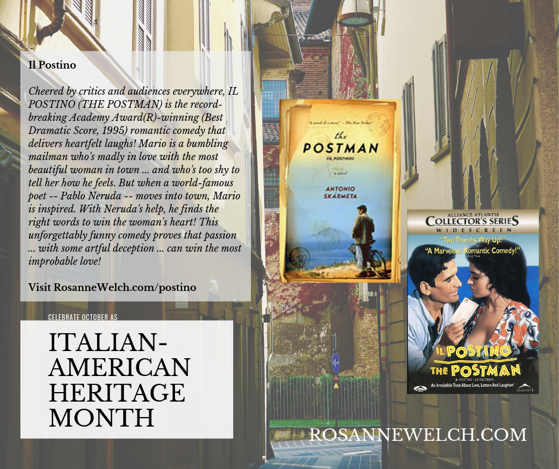
Cheered by critics and audiences everywhere, IL POSTINO (THE POSTMAN) is the record-breaking Academy Award(R)-winning (Best Dramatic Score, 1995) romantic comedy that delivers heartfelt laughs! Mario is a bumbling mailman who’s madly in love with the most beautiful woman in town … and who’s too shy to tell her how he feels. But when a world-famous poet — Pablo Neruda — moves into town, Mario is inspired. With Neruda’s help, he finds the right words to win the woman’s heart! This unforgettably funny comedy proves that passion … with some artful deception … can win the most improbable love!
Rosanne Welch, PhD, Author of Why The Monkees Matter, presents “How The Monkees Changed Television” at a Cal State Fullerton Lunch Lecture on May 8, 2018.
In this talk, she shows how The Monkees, and specifically their presence on television, set the stage for large changes to come in the late 1960s.
Transcript
In this episode, which I’m sorry the still is dark, that’s Micky and he’s confronting the werewolf and the first thing he says to the werewolf is, “You know they won’t et you into Disneyland with hair that long.” Because at the time Disneyland had a dress policy and men with long hair were not allowed in the park as guests. So they were literally putting down a major American corporation in the middle of their program and they got away with it and he did that 2 or 3 times across — I would find it in two or three other episodes there’d be a joke about “Long hair’s going to keep you out of Disneyland.” So it made me wonder if at any time any of them had attempted to go to Disneyland with their children and not been allowed in. I have not found proof of that, but I wonder why they were particularly made at Disneyland. I don’t know. Of course, often they would do things like this — Micky said, “Peter! I’ve got an idea!” and then the light bulb and Peter would say, “Wait! Let’s hear Micky’s idea.” So often they were speaking to the audience which was a particular thing that was talked about — Seinfeld gets credit for and whatnot, but these guys did it very early on.
A hit television show about a fictitious rock band, The Monkees (1966-1968) earned two Emmys–Outstanding Comedy Series and Outstanding Directorial Acheivement in Comedy.
Capitalizing on the show’s success, the actual band formed by the actors, at their peak, sold more albums than The Beatles and The Rolling Stones combined, and set the stage for other musical TV characters from The Partridge Family to Hannah Montana. In the late 1980s, the Monkees began a series of reunion tours that continued into their 50th anniversary.
This book tells the story of The Monkees and how the show changed television, introducing a new generation to the fourth-wall-breaking slapstick created by Laurel and Hardy and the Marx Brothers.
Its creators contributed to the innovative film and television of 1970s with projects like Bob & Carol & Ted & Alice, The Mary Tyler Moore Show, Laugh-In and Welcome Back, Kotter. Immense profits from the show, its music and its merchandising funded the producers’ move into films such as Head, Easy Riderand Five Easy Pieces.
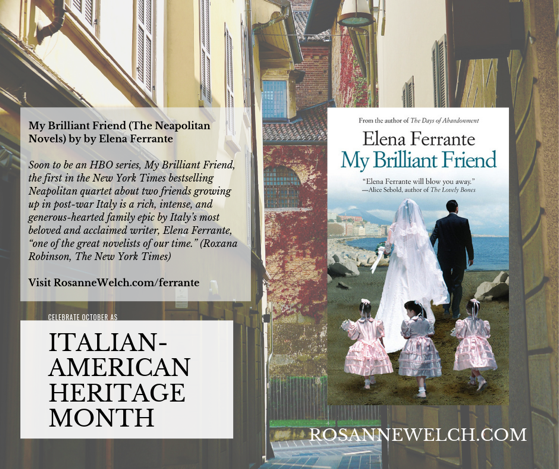
Soon to be an HBO series, My Brilliant Friend, first in the New York Times bestselling Neapolitan quartet about two friends growing up in post-war Italy is a rich, intense, and generous-hearted family epic by Italy’s most beloved and acclaimed writer, Elena Ferrante, “one of the great novelists of our time.” (Roxana Robinson, The New York Times)
To highlight the wonderful yet largely forgotten work of a collection of female screenwriters from the early years of Hollywood (and as a companion to the book, When Women Wrote Hollywood) we will be posting quick bits about the many films they wrote along with links to further information and clips from their works which are still accessible online. Take a few moments once or twice a week to become familiar with their names and their stories. I think you’ll be surprised at how much bold material these writers tackled at the birth of this new medium. — Rosanne Welch
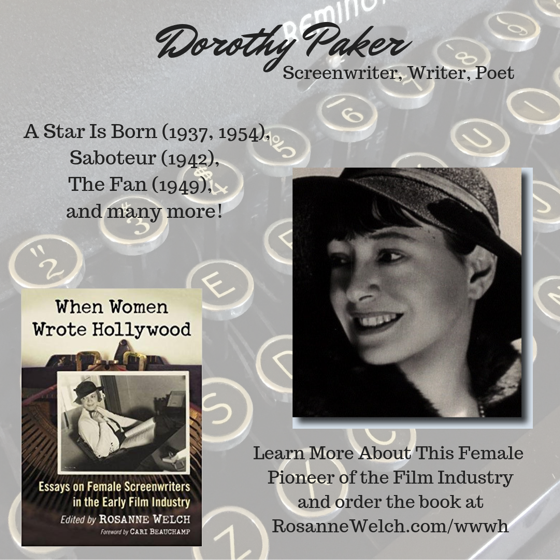
Dorothy Parker (née Rothschild; August 22, 1893 – June 7, 1967) was an American poet, writer, critic, and satirist based in New York; she was best known for her wit, wisecracks, and eye for 20th-century urban foibles.
From a conflicted and unhappy childhood, Parker rose to acclaim, both for her literary works published in such magazines as The New Yorker and as a founding member of the Algonquin Round Table. Following the breakup of the circle, Parker traveled to Hollywood to pursue screenwriting. Her successes there, including two Academy Award nominations, were curtailed when her involvement in left-wing politics resulted in the being placed on the Hollywood blacklist.
Dismissive of her own talents, she deplored her reputation as a “wisecracker.” Nevertheless, both her literary output and reputation for sharp wit have endured. — Wikipedia
* A portion of each sale from Amazon.com directly supports our blogs ** Many of these books may be available from your local library. Check it out! † Available from the LA Public Library




![21 More Metatextuality and The Monkees from How The Monkees Changed Television [Video] (0:58)](https://rosannewelch.com/wp-content/uploads/2018/10/monkees-tv-21-metatextuality-2.jpeg)