Unlike Get Smart where the only genre they parodied was spy thriller, on The Monkees the writers were free to parody them all, again keeping the audience guessing. Across the run of the show they would parody Hollywood films, gangster movies, monster movies, racing films, motorcycle sagas and a slew of other styles.
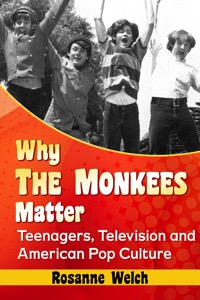
Jean Powergirl takes the host reigns and welcomes her guest Rosanne Welch, PhD to the show! They’ll be discussing Roseanne’s book, “Why The Monkees Matter: Teenagers, Television and American Pop Culture.”
Transcript:
Jean: So let’s talk about the individual Monkees, all right. Again, here they are again. So tell us — who is this guy right here.
Rosanne: On the end there you see Michael Nesmith. he was from Texas and had come to Los Angeles to be a rock and roll singer. He hosted at a couple of clubs in town. He would host open mic nights and whatnot for local rock bands and he had written Different Drum which is the song Linda Ronstadt msde famous. So he was looking for a job and a career as a singer-songwriter.
Jean: …and already had the talent obviously.
Rosanne: Exactly….when the audition came up and basically hey, who doesn’t want extra cash. So he auditioned and he was cast.
A hit television show about a fictitious rock band, The Monkees (1966-1968) earned two Emmys–Outstanding Comedy Series and Outstanding Directorial Achievement in Comedy. Capitalizing on the show’s success, the actual band formed by the actors, at their peak, sold more albums than The Beatles and The Rolling Stones combined and set the stage for other musical TV characters from The Partridge Family to Hannah Montana. In the late 1980s, the Monkees began a series of reunion tours that continued into their 50th anniversary.
This book tells the story of The Monkees and how the show changed television, introducing a new generation to the fourth-wall-breaking slapstick created by Laurel and Hardy and the Marx Brothers. Its creators contributed to the innovative film and television of 1970s with projects like Bob & Carol & Ted & Alice, The Mary Tyler Moore Show, Laugh-In and Welcome Back, Kotter. Immense profits from the show, its music and its merchandising funded the producers’ move into films such as Head, Easy Rider and Five Easy Pieces.
Rosanne Welch, PhD has written for television (Touched by an Angel, Picket Fences) and print (Three Ring Circus: How Real Couples Balance Marriage, Work and Kids and The Encyclopedia of Women in Aviation and Space). In the documentary world she has written and produced Bill Clinton and the Boys Nation Class of 1963 for ABC NEWS/Nightline and consulted on PBS’s A Prince Among Slaves, the story of a prince from West Africa who was enslaved in the 1780s, freed by order of President John Quincy Adams in the 1820s and returned to his homeland.
The only flat out farce ever attempted, “Fairy Tale” involved Mike in the challenging dual role of both Mike the cobbler and in drag as the Queen that Peter’s character worships. As part of the farcical element of the episode, Davy later played Little Red Riding Hood and Gretl while Micky played Goldilocks. No other episode breaks the fourth wall nearly as much from the cardboard sets to the stumbling delivery of dialogue to the anachronistic props that keep popping up.
Jean Powergirl takes the host reigns and welcomes her guest Rosanne Welch, PhD to the show! They’ll be discussing Roseanne’s book, “Why The Monkees Matter: Teenagers, Television and American Pop Culture.”
Transcript:
Rosanne: Even in the very first episode of the series, called “Royal Flush”, Davy, of course, falls in love with a princess from an unknown country and you think princes that’s silly and non-sensical, but near the end of the episode he asks her to stay in America with him and she says no because she has an obligation to her people. Of course, every girl’s dream was to have Davy Jones ask them to do that, but she didn’t pick the boy. She picked her — and she didn’t pick “I’m a princess . I want to wear pretty dresses and go do that.” She picked a duty. A job that had been given to her that she was going to do well.
Jean: Like Princess Leia from Star Wars. It ties back!
Rosanne: …or even The Crown is very big on Netflix now. You know that’s all what Queen Elizabeth was about. I have an obligation. So, I thought it was hilarious that I found no girl who was useless among all the girls that ended up guesting on the show so my theory, if you will, that as a 6-year-old and 8-year-old watching the show, learned that if I wanted to marry a Monkee I had to be a woman of substance.
A hit television show about a fictitious rock band, The Monkees (1966-1968) earned two Emmys–Outstanding Comedy Series and Outstanding Directorial Achievement in Comedy. Capitalizing on the show’s success, the actual band formed by the actors, at their peak, sold more albums than The Beatles and The Rolling Stones combined and set the stage for other musical TV characters from The Partridge Family to Hannah Montana. In the late 1980s, the Monkees began a series of reunion tours that continued into their 50th anniversary.
This book tells the story of The Monkees and how the show changed television, introducing a new generation to the fourth-wall-breaking slapstick created by Laurel and Hardy and the Marx Brothers. Its creators contributed to the innovative film and television of 1970s with projects like Bob & Carol & Ted & Alice, The Mary Tyler Moore Show, Laugh-In and Welcome Back, Kotter. Immense profits from the show, its music and its merchandising funded the producers’ move into films such as Head, Easy Rider and Five Easy Pieces.
Rosanne Welch, PhD has written for television (Touched by an Angel, Picket Fences) and print (Three Ring Circus: How Real Couples Balance Marriage, Work and Kids and The Encyclopedia of Women in Aviation and Space). In the documentary world she has written and produced Bill Clinton and the Boys Nation Class of 1963 for ABC NEWS/Nightline and consulted on PBS’s A Prince Among Slaves, the story of a prince from West Africa who was enslaved in the 1780s, freed by order of President John Quincy Adams in the 1820s and returned to his homeland.
I had quite a good time when Ken Mills interviewed me about the ‘invention’ of the teenager – something I teach in my classes and spent a whole chapter on in my book, Why The Monkees Matter!
Marketers created teenagers in the same way The Disney Channel and Nickelodeon helped spread the term Tweeners for their shows.
The whole episode is fun – I really like the coverage of Anne Moses and her time editing Tiger Beat Magazine (but if you’re pressed for time my interview starts at 18:22).
While beautiful young women were often provided for Davy in many episodes, few storylines focused mainly on his pursuit of a particular female, and those that did hit all the plot points of proper rom-coms. There would be what modern television and film writing manuals have designated the ‘cute meet’, followed by a series of obstacles that kept the couple apart, and a miscommunication that threatened their reuniting.
Jean Powergirl takes the host reigns and welcomes her guest Rosanne Welch, PhD to the show! They’ll be discussing Roseanne’s book, “Why The Monkees Matter: Teenagers, Television and American Pop Culture.”
Transcript:
Rosanne: Treva Silverman was one of the first women to write comedy without a male partner on television and she worked on the The Monkees first and then she would move onto The Mary Tyler Moore Show and she would win 2 Emmys for that show. So I noted that if you were watching The Monkees, there is definitely the feminist perspective that she is going to bring to Mary Tyler Moore exists in The Monkees the best that it can in a show that doesn’t a female character.
Jean: Ok. So give us some examples of that. How is this feminist we’ll call is point of view or issue suggested.
Rosanne: When they met girls — again, I assume a group of rock and roll boys would go out with the cheerleaders, , airheads, groupies, the fan girls — and instead — as I clocked each episode — every time they liked a girl she was a girl with a purpose. There were girls who were going to college. There were girls who had jobs and were supporting themselves as young women. There were journalists.
A hit television show about a fictitious rock band, The Monkees (1966-1968) earned two Emmys–Outstanding Comedy Series and Outstanding Directorial Achievement in Comedy. Capitalizing on the show’s success, the actual band formed by the actors, at their peak, sold more albums than The Beatles and The Rolling Stones combined and set the stage for other musical TV characters from The Partridge Family to Hannah Montana. In the late 1980s, the Monkees began a series of reunion tours that continued into their 50th anniversary.
This book tells the story of The Monkees and how the show changed television, introducing a new generation to the fourth-wall-breaking slapstick created by Laurel and Hardy and the Marx Brothers. Its creators contributed to the innovative film and television of 1970s with projects like Bob & Carol & Ted & Alice, The Mary Tyler Moore Show, Laugh-In and Welcome Back, Kotter. Immense profits from the show, its music and its merchandising funded the producers’ move into films such as Head, Easy Rider and Five Easy Pieces.
Rosanne Welch, PhD has written for television (Touched by an Angel, Picket Fences) and print (Three Ring Circus: How Real Couples Balance Marriage, Work and Kids and The Encyclopedia of Women in Aviation and Space). In the documentary world she has written and produced Bill Clinton and the Boys Nation Class of 1963 for ABC NEWS/Nightline and consulted on PBS’s A Prince Among Slaves, the story of a prince from West Africa who was enslaved in the 1780s, freed by order of President John Quincy Adams in the 1820s and returned to his homeland.
If viewers saw only the ten or so light comedy style episodes, The Monkees look much like the precursor to The Big Bang Theory as those episodes center around the friendship of four young adult males learning to live and love in a changing relationship landscape while pursuing their dream careers. In each show main characters both work and live together, something not normal in classic workplace comedies such as The Mary Tyler Moore Show or 30 Rock.
Jean Powergirl takes the host reigns and welcomes her guest Rosanne Welch, PhD to the show! They’ll be discussing Roseanne’s book, “Why The Monkees Matter: Teenagers, Television and American Pop Culture.”
Transcript:
Jean: So The Monkees are going strong now did they evolve in their message over these 52 episode?
Rosanne: 58 Episodes
Jean: 58 Episodes. All right. So they start out, did they change up what they were doing? I mean you’re the connoisseur of all the episodes.
Rosanne: They had a variety of messages and these come form the writers experiences. One of the things I push in my class is that we have to remember that we tend, in American, because the French taught us, to correlate the author of the piece with the director, but, in fact, the director can’t direct a bunch of blank pages. It’s the writer who comes up with the theme and the idea. The director enhances that through the visuals. So, for me, it was important to meet the various writers who I still could and it’s their thoughts and messages.
A hit television show about a fictitious rock band, The Monkees (1966-1968) earned two Emmys–Outstanding Comedy Series and Outstanding Directorial Achievement in Comedy. Capitalizing on the show’s success, the actual band formed by the actors, at their peak, sold more albums than The Beatles and The Rolling Stones combined and set the stage for other musical TV characters from The Partridge Family to Hannah Montana. In the late 1980s, the Monkees began a series of reunion tours that continued into their 50th anniversary.
This book tells the story of The Monkees and how the show changed television, introducing a new generation to the fourth-wall-breaking slapstick created by Laurel and Hardy and the Marx Brothers. Its creators contributed to the innovative film and television of 1970s with projects like Bob & Carol & Ted & Alice, The Mary Tyler Moore Show, Laugh-In and Welcome Back, Kotter. Immense profits from the show, its music and its merchandising funded the producers’ move into films such as Head, Easy Rider and Five Easy Pieces.
Rosanne Welch, PhD has written for television (Touched by an Angel, Picket Fences) and print (Three Ring Circus: How Real Couples Balance Marriage, Work and Kids and The Encyclopedia of Women in Aviation and Space). In the documentary world she has written and produced Bill Clinton and the Boys Nation Class of 1963 for ABC NEWS/Nightline and consulted on PBS’s A Prince Among Slaves, the story of a prince from West Africa who was enslaved in the 1780s, freed by order of President John Quincy Adams in the 1820s and returned to his homeland.
Jean Powergirl takes the host reigns and welcomes her guest Rosanne Welch, PhD to the show! They’ll be discussing Roseanne’s book, “Why The Monkees Matter: Teenagers, Television and American Pop Culture.”
Transcript:
Jean: So how many season did The Monkees run?
Rosanne: You know it only ran for 2 seasons. Back in the day, you had more shows — nowadays you do 13 or maybe 20 episodes — so they did 58 episodes in total in 2 seasons. They were going to come back for a 3rd season after a very successful couple of years of concert tours, but they had decided that — the actors has decided — that they were tired of the formula of the show, which was a sitcom and it was usually some crazy adventure going on. They felt that they wanted to do a variety show ala The Carol Burnett Show, but there were no rock and roll groups hosting variety shows yet, so the network said, “no. We don’t believe that will work.” They said, “Look, we’ll do little sketches in between and will do music and have musical guests,” The network said no and they said, “If that’s the case we’ll just cancel it.”
Jean: Even though Donnie and Marie did do that, right?
Rosanne: But later in the 70’s and the next year Sonny and Cher will do that a and they were a rock and roll group of the day and, in fact, Coslough Johnson, who’s one of my favorite writers for the show who I got to interview. He moved from The Monkees to Sonny and Cher and so that style was going to work, but the network didn’t — I think it was a big mistake monetarily. If they had morphed the show it would have brought that audience along with them.
A hit television show about a fictitious rock band, The Monkees (1966-1968) earned two Emmys–Outstanding Comedy Series and Outstanding Directorial Achievement in Comedy. Capitalizing on the show’s success, the actual band formed by the actors, at their peak, sold more albums than The Beatles and The Rolling Stones combined and set the stage for other musical TV characters from The Partridge Family to Hannah Montana. In the late 1980s, the Monkees began a series of reunion tours that continued into their 50th anniversary.
This book tells the story of The Monkees and how the show changed television, introducing a new generation to the fourth-wall-breaking slapstick created by Laurel and Hardy and the Marx Brothers. Its creators contributed to the innovative film and television of 1970s with projects like Bob & Carol & Ted & Alice, The Mary Tyler Moore Show, Laugh-In and Welcome Back, Kotter. Immense profits from the show, its music and its merchandising funded the producers’ move into films such as Head, Easy Rider and Five Easy Pieces.
Rosanne Welch, PhD has written for television (Touched by an Angel, Picket Fences) and print (Three Ring Circus: How Real Couples Balance Marriage, Work and Kids and The Encyclopedia of Women in Aviation and Space). In the documentary world she has written and produced Bill Clinton and the Boys Nation Class of 1963 for ABC NEWS/Nightline and consulted on PBS’s A Prince Among Slaves, the story of a prince from West Africa who was enslaved in the 1780s, freed by order of President John Quincy Adams in the 1820s and returned to his homeland.


![13 : Michael Nesmith and The Monkees : “Why The Monkees Matter” Interview with Jean Power [Video] (0:35)](https://rosannewelch.com/wp-content/uploads/2017/07/rmw-power-13-nesmith.jpeg)

![12 : Women and The Monkees : “Why The Monkees Matter” Interview with Jean Power [Video] (1:04)](https://rosannewelch.com/wp-content/uploads/2017/07/rmw-power-12-women.jpeg)


![11 : Feminism and The Monkees : “Why The Monkees Matter” Interview with Jean Power [Video] (0:53)](https://rosannewelch.com/wp-content/uploads/2017/07/rmw-power-11-feminism.jpeg)

![10 : Writers and The Monkees : “Why The Monkees Matter” Interview with Jean Power [Video] (0:44)](https://rosannewelch.com/wp-content/uploads/2017/07/rmw-power-10-writers.jpeg)
![09 : Only 2 Seasons : “Why The Monkees Matter” Interview with Jean Power [Video] (1:11)](https://rosannewelch.com/wp-content/uploads/2017/06/rmw-power-09-only-2-seasons.jpeg)