Why The Monkees Matter: Teenagers, Television and American Pop Culture

On Screenwriting and Media with Dr. Rosanne Welch
Writing, Film, Television and More!
** Buy “Why The Monkees Matter” Today **
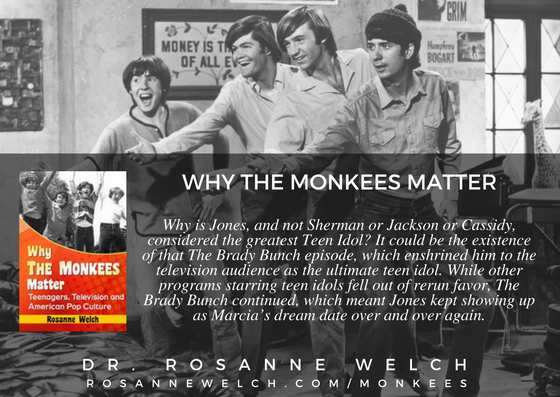
Why is Jones, and not Sherman or Jackson or Cassidy, considered the greatest Teen Idol? It could be the existence of that The Brady Bunch episode, which enshrined him to the television audience as the ultimate teen idol. While other programs starring teen idols fell out of rerun favor, The Brady Bunch continued, which meant Jones kept showing up as Marcia’s dream date over and over again.
from Why The Monkees Matter by Dr. Rosanne Welch — Buy your Copy today!
Why The Monkees Matter: Teenagers, Television and American Pop Culture
McFarland (Direct from Publisher) | Amazon | Kindle Edition | Nook Edition
Rosanne Welch talks about “Why The Monkees Matter” with Jean Hopkins Power
Watch this entire presentation (45 mins)
Jean Powergirl takes the host reigns and welcomes her guest Rosanne Welch, PhD to the show! They’ll be discussing Roseanne’s book, “Why The Monkees Matter: Teenagers, Television and American Pop Culture.”
![30: International Fame and The Monkees : “Why The Monkees Matter” Interview with Jean Power [Video] (0:58)](https://rosannewelch.com/wp-content/uploads/2017/12/rmw-power-30-international.jpeg)
Transcript:
Jean: Did The Monkees have, their show, did they also ultimately have some international appeal?
Rosanne: They did and they still do. Goodness. There are, there are still fan clubs in Japan. They were huge in Japan and, in fact, after the show ended and the group actually broke up they came to a point where individually sometimes they would tour and you could go to Japan. Just huge crowds would come to them. They were pretty big in England because of Davy Jones and, of course, the funny thing was that in America they were considered sort of a secondhand Beatles, but in England, they were “The Monkees” and they were their own American pop band.
Jean: And as we discussed on a previous video that didn’t work out so well, isn’t it true that, at their zenith, The Monkees sold more records than The Rolling Stones and The Beatles at that time?
Rosanne: Yes, in 1967 they beat both their sales of both of those combined. So they were worldwide huge. and they could still tour in other countries. They’re going to go, excuse me, they just did tour in Australia and New Zealand. They toured South America at their height. It was pretty amazing. They were all over.
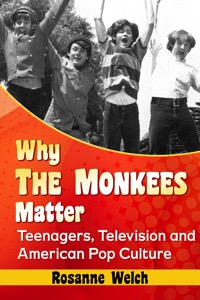
A hit television show about a fictitious rock band, The Monkees (1966-1968) earned two Emmys–Outstanding Comedy Series and Outstanding Directorial Achievement in Comedy. Capitalizing on the show’s success, the actual band formed by the actors, at their peak, sold more albums than The Beatles and The Rolling Stones combined and set the stage for other musical TV characters from The Partridge Family to Hannah Montana. In the late 1980s, the Monkees began a series of reunion tours that continued into their 50th anniversary.
This book tells the story of The Monkees and how the show changed television, introducing a new generation to the fourth-wall-breaking slapstick created by Laurel and Hardy and the Marx Brothers. Its creators contributed to the innovative film and television of 1970s with projects like Bob & Carol & Ted & Alice, The Mary Tyler Moore Show, Laugh-In and Welcome Back, Kotter. Immense profits from the show, its music and its merchandising funded the producers’ move into films such as Head, Easy Rider and Five Easy Pieces.
Rosanne Welch, PhD has written for television (Touched by an Angel, Picket Fences) and print (Three Ring Circus: How Real Couples Balance Marriage, Work and Kids and The Encyclopedia of Women in Aviation and Space). In the documentary world she has written and produced Bill Clinton and the Boys Nation Class of 1963 for ABC NEWS/Nightline and consulted on PBS’s A Prince Among Slaves, the story of a prince from West Africa who was enslaved in the 1780s, freed by order of President John Quincy Adams in the 1820s and returned to his homeland.
Podcast: Play in new window | Download
Subscribe: RSS
Rosanne Welch talks about “Why The Monkees Matter” with Jean Hopkins Power
Watch this entire presentation (45 mins)
Jean Powergirl takes the host reigns and welcomes her guest Rosanne Welch, PhD to the show! They’ll be discussing Roseanne’s book, “Why The Monkees Matter: Teenagers, Television and American Pop Culture.”
![29: Writers, Producers, and The Monkees : “Why The Monkees Matter” Interview with Jean Power [Video]](https://rosannewelch.com/wp-content/uploads/2017/12/rmw-power-29-writers-producers.jpeg)
Transcript:
Jean: So here they are like this so at least the sho, I want some edgy leading edge because they, I guess, the producers or whoever set up the show were committed to having this newer show to appeal to this new demographic.
Rosanne: In fact, they went and hired the two show runners, so the people who ran all the stories on the show, was Gerald Gardner and Dee Caruso and they’d come off of Get Smart.
Jean: I love that show.
Rosanne: New hip writers from Get Smart. There was a show very much like what we’re used to today, The Daily Show, the comic news. It was called That Was The Week That Was and they had written on that so kind of the SNL of its day and previous to that, Mr Gardener had a been a speechwriter for Robert Kennedy in his senatorial campaign in New York.
Jean: I love RFK.
Rosanne: He’s written a book about that experience. So after doing television for several more years Mr. Gardner went off and he’s written about 80 books.
A hit television show about a fictitious rock band, The Monkees (1966-1968) earned two Emmys–Outstanding Comedy Series and Outstanding Directorial Achievement in Comedy. Capitalizing on the show’s success, the actual band formed by the actors, at their peak, sold more albums than The Beatles and The Rolling Stones combined and set the stage for other musical TV characters from The Partridge Family to Hannah Montana. In the late 1980s, the Monkees began a series of reunion tours that continued into their 50th anniversary.
This book tells the story of The Monkees and how the show changed television, introducing a new generation to the fourth-wall-breaking slapstick created by Laurel and Hardy and the Marx Brothers. Its creators contributed to the innovative film and television of 1970s with projects like Bob & Carol & Ted & Alice, The Mary Tyler Moore Show, Laugh-In and Welcome Back, Kotter. Immense profits from the show, its music and its merchandising funded the producers’ move into films such as Head, Easy Rider and Five Easy Pieces.
Rosanne Welch, PhD has written for television (Touched by an Angel, Picket Fences) and print (Three Ring Circus: How Real Couples Balance Marriage, Work and Kids and The Encyclopedia of Women in Aviation and Space). In the documentary world she has written and produced Bill Clinton and the Boys Nation Class of 1963 for ABC NEWS/Nightline and consulted on PBS’s A Prince Among Slaves, the story of a prince from West Africa who was enslaved in the 1780s, freed by order of President John Quincy Adams in the 1820s and returned to his homeland.
Writers in Hollywood, 1915-1951 Hardcover by Ian Hamilton | Gifts for the Screenwriter #7

I found Ian Hamilton’s book long before I had any inkling that I would ever be involved in creating a course on The History of Screenwriting (as opposed to History of Film, which always means History of Directors). I enjoyed his look into the personalities that made up the earlier eras of the screenwriting colony here in Los Angeles, many of them transplanted New Yorkers from the journalism or playwright world drawn to the other coast for the fast money – and sometimes faster lifestyles – Hollywood was known for back then. Hamilton’s coverage of the era from 1915-1951 is both entertaining and educational. – Rosanne
* A portion of each sale from Amazon.com directly supports our blogs
** Many of these books may be available from your local library. Check it out!
Writing the Pilot by William Rabkin | Gifts for the Screenwriter #6

Bill Rabkin understands what makes writing a pilots different from writing regular episodes of a continuing series and explains that all in this clear, concise book. Having worked in television for a solid couple of decades on many fan favorites, Rabkin should know. – Rosanne
* A portion of each sale from Amazon.com directly supports our blogs
** Many of these books may be available from your local library. Check it out!
** Buy “Why The Monkees Matter” Today **

A measure of Jones’ standing also comes from considering the massive amount of international news outlets, from Australia to Japan that covered his death in 2012. The evening news on all three American broadcast channels covered the story, with Diane Sawyer announcing that a “startling bulletin came across in the newsroom”. She then proclaimed “He is still that forever young and sunny singer from The Monkees who made more than one generation want to sing along.”
from Why The Monkees Matter by Dr. Rosanne Welch — Buy your Copy today!
Why The Monkees Matter: Teenagers, Television and American Pop Culture
McFarland (Direct from Publisher) | Amazon | Kindle Edition | Nook Edition
Rosanne Welch talks about “Why The Monkees Matter” with Jean Hopkins Power
Watch this entire presentation (45 mins)
Jean Powergirl takes the host reigns and welcomes her guest Rosanne Welch, PhD to the show! They’ll be discussing Roseanne’s book, “Why The Monkees Matter: Teenagers, Television and American Pop Culture.”

Transcript:
Rosanne: And then Coslough Johnson is the nicest man. He is the brother of Artie Johnson from Laugh-In and he, in fact, went on to work on Laugh-In and won 2 Emmys for being part of that.
Jean: It’s a great show. My parents love that show.
Rosanne: Everybody got started on that show. And so Coslough was great. He was a freelancer and he wasn’t on staff but he did several episodes. He wrote the episode some people will remember where Liberace guest starred and he bashed a piano to pieces with a sledgehammer. Very silly. Unexpectedly adorable and I asked him did someone recommend that and he said “No. I was just thinking one day about funny things to have happen and what musicians could do and he came to mind.” And they took that Idea to Liberace and he agreed to do it.
Jean: I’m glad he was game to do that.
Rosanne: Partially he knew it was smart to appear on a show that appealed to teenagers because he wanted that audience. So Coslough is quite marvelous and wonderful.
A hit television show about a fictitious rock band, The Monkees (1966-1968) earned two Emmys–Outstanding Comedy Series and Outstanding Directorial Achievement in Comedy. Capitalizing on the show’s success, the actual band formed by the actors, at their peak, sold more albums than The Beatles and The Rolling Stones combined and set the stage for other musical TV characters from The Partridge Family to Hannah Montana. In the late 1980s, the Monkees began a series of reunion tours that continued into their 50th anniversary.
This book tells the story of The Monkees and how the show changed television, introducing a new generation to the fourth-wall-breaking slapstick created by Laurel and Hardy and the Marx Brothers. Its creators contributed to the innovative film and television of 1970s with projects like Bob & Carol & Ted & Alice, The Mary Tyler Moore Show, Laugh-In and Welcome Back, Kotter. Immense profits from the show, its music and its merchandising funded the producers’ move into films such as Head, Easy Rider and Five Easy Pieces.
Rosanne Welch, PhD has written for television (Touched by an Angel, Picket Fences) and print (Three Ring Circus: How Real Couples Balance Marriage, Work and Kids and The Encyclopedia of Women in Aviation and Space). In the documentary world she has written and produced Bill Clinton and the Boys Nation Class of 1963 for ABC NEWS/Nightline and consulted on PBS’s A Prince Among Slaves, the story of a prince from West Africa who was enslaved in the 1780s, freed by order of President John Quincy Adams in the 1820s and returned to his homeland.
Podcast: Play in new window | Download
Subscribe: RSS
