Quotes from “Why The Monkees Matter” by Dr. Rosanne Welch – 95 in a series – TV and The Monkees

** Buy “Why The Monkees Matter” Today **

Quotes from

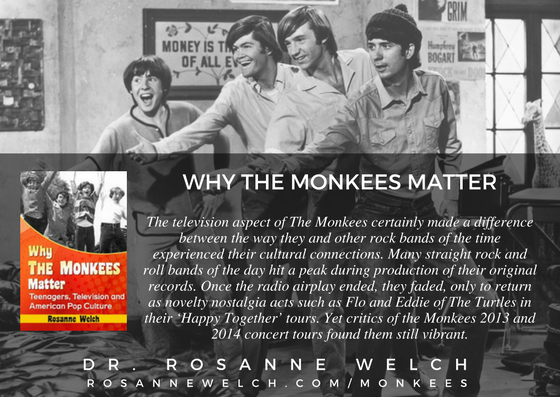
The television aspect of The Monkees certainly made a difference between the way they and other rock bands of the time experienced their cultural connections. Many straight rock and roll bands of the day hit a peak during production of their original records. Once the radio airplay ended, they faded, only to return as novelty nostalgia acts such as Flo and Eddie of The Turtles in their ‘Happy Together’ tours. Yet critics of the Monkees 2013 and 2014 concert tours found them still vibrant. 

from Why The Monkees Matter by Dr. Rosanne Welch —  Buy your Copy today!

 Why The Monkees Matter: Teenagers, Television and American Pop Culture


McFarland (Direct from Publisher) | Amazon | Kindle Edition | Nook Edition

From The Research Vault: Teen Television: Davy Jones Fans Return Love, Support His Horses by Susan Salk

From The Research Vault: Teen Television: Davy Jones Fans Return Love, Support His Horses by Susan Salk

From The Research Vault: Teen Television: Davy Jones Fans Return Love, Support His Horses by Susan Salk

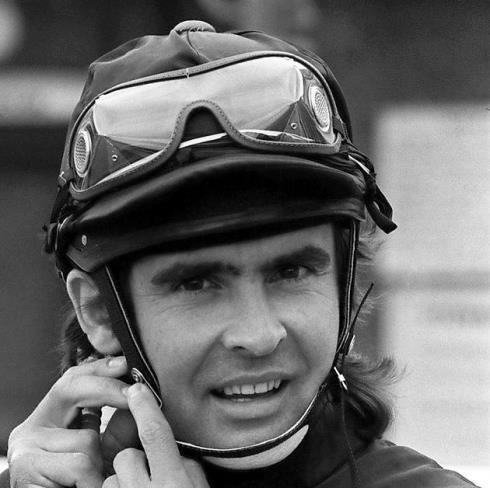
Long before Davy Jones became a Monkee, he was a horseman.

It was in the company of racehorses that he sought to make a career as a young jockey. Until, that is, his trainer lovingly kicked him out of the racing stables for his own good, with the admonishment that he shouldn’t have to be picking up after horses his whole life, says Jones’ daughter Jessica Cramer Jones.

 “My father was a broken boy when he first discovered horses,” Jones says in a telephone interview with Off-TrackThoroughbreds.com. “He was 12 when he lost his mother, and he turned to horses in his grief. They are what gave him his confidence back … horses kept him together his whole life.”


Why The Monkees Matter: Teenagers, Television and American Pop Culture


Order Your Copy Now!

Quote from “America’s Forgotten Founding Father” by Dr Rosanne Welch – 5 in a series – I will wait forever

Quote from

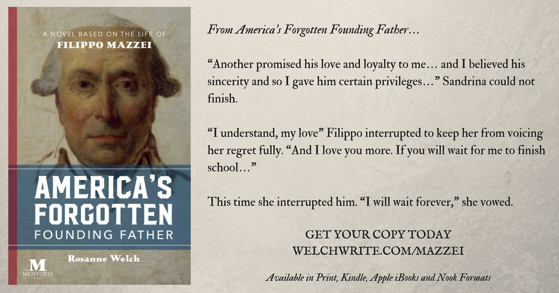
“Another promised his love and loyalty to me… and I believed his sincerity and so I gave him certain privileges…” Sandrina could not finish. 

“I understand, my love” Filippo interrupted to keep her from voicing her regret fully. “And I love you more. If you will wait for me to finish school…”

This time she interrupted him. “I will wait forever,” she vowed.

 From America’s Forgotten Founding Father — Get Your Copy Today!


Join the Rosanne Welch Mailing List for future book and event announcements!
 

Print Edition | Kindle Edition | Apple iBooks Edition | Nook Edition

On the passing of Steven Bochco…

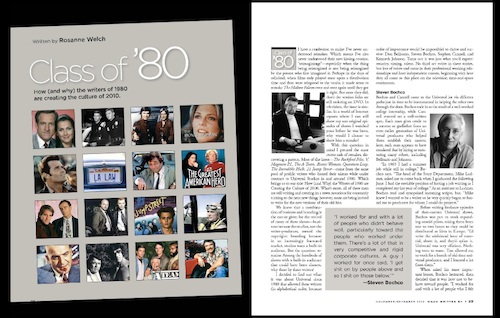
On the passing of Steven Bochco I was reminded of the wonderful opportunity I had to interview him for Written By Magazine back in 2010 thanks to the aide of my former boss, Kenny Johnson, who was a former college buddy and lifetime friend of Mr. Bochco. That was the year of the (deservedly) failed re-imagining of The Bionic Woman and talk of film versions of 21 Jump Street  and The A Team so I had come up with an article idea to interview the creative geniuses behind the originals. 

I emailed Kenny to see if he would sit for the interview, and if he thought his friends the two Steves (Bochco and Cannel) would do the same. He called around and they all said yes. I had only to approach Don Bellisario on my own to fill out the foursome and I was on my way. Funny thing was I had told Kenny about the story idea but admitted I was swamped finishing my PhD so I might not get to it for another few months. Kenny encouraged me to go for it “now” – so I did – and in the course of seeing the article through to publication, Mr. Cannell passed away of cancer only his family and friends knew about – including Kenny. So Kenny had urged me to work in the piece knowing I wouldn’t be able to include Mr. Cannell if I waited too long. The magazine was able to collect letters from writers who had been given their start at the Cannell company and publish a tribute to him alongside my article.
On the passing of Steven Bochco...

Now we’ve lost Mr. Bochco as well – a man I never had the chance to work with, but whom I have always admired. Even today I rave to my one-hour drama students about “Hearts and Souls” – the NYPD BLUE episode where Jimmy Smits’ character Bobby Simone dies (story by Bochco, David Milch and Bill Clark, teleplay by Nicholas Wootton- and I get tears in my eyes just recounting the story to them all these years later.  He truly created what we now call the 2nd Golden Age of Television Drama from Hill Street Blues forward, though NYPD BLUE will always be my favorite. 

I still have the book about the making of the show on a list for my MFA students to review — True Blue: The Real Stories Behind NYPD Blue Hardcover by David Milch and Bill Clark. Do yourself a favor and binge watch some of his work this weekend.

Read the entire article – The Class of ‘80

†

* A portion of each sale from Amazon.com directly supports our blogs
** Many of these books may be available from your local library. Check it out!
† Available from the LA Public Library
A History of Screenwriting 58 – Smilin’ Through starring Norma Talmadge, Written by Alan Langdon Martin (aka Jane Murfin and Jane Cowl) (original play), James Ashmore Creelman (scenario), Sidney Franklin (scenario) – 1922

A History of Screenwriting 58 – Smilin’ Through starring Norma Talmadge, Written by Alan Langdon Martin (aka Jane Murfin and Jane Cowl) (original play),
James Ashmore Creelman (scenario), Sidney Franklin (scenario) – 1922

A History of Screenwriting 58 - Smilin' Through starring Norma Talmadge, Written by Alan Langdon Martin (aka Jane Murfin and Jane Cowl) (original play), 
James Ashmore Creelman (scenario), Sidney Franklin (scenario) - 1922

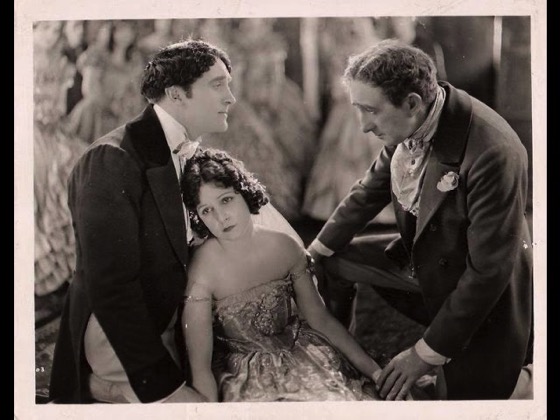
Smilin’ Through is a 1922 silent film based on the 1919 play of the same name, written by Jane Cowl and Jane Murfin (together under the pseudonym Alan Langdon Martin). The film starred Norma Talmadge, Harrison Ford, and Wyndham Standing. It was co-written and directed by Sidney Franklin, who also directed the more famous 1932 remake at MGM. The film was produced by Talmadge and her husband Joseph M. Schenck for her company, the Norma Talmadge Film Corporation. It was released by First National Pictures. Popular character actor Gene Lockhart made his screen debut in this film.[3][4]

The story is essentially the same as the popular Jane Cowl play, with Talmadge in the dual role of Kathleen and Moonyean. Kathleen, a young Irish woman, is in love with Kenneth Wayne but is prevented from marrying him by her guardian John Carteret. John is haunted by memories of his thwarted love for Kathleen’s aunt, Moonyean.

The story was an especially popular one and was filmed twice more by MGM: in 1932 with Norma Shearer and 1941 with Jeanette MacDonald. – Wikipedia


Learn More About Norma Talmadge with these books

†

* A portion of each sale from Amazon.com directly supports our blogs
** Many of these books may be available from your local library. Check it out!
† Available at the LA Public Library

From The Research Vault: Teen Television: Essays on Programming and Fandom by Sharon Marie Ross,‎ Louisa Stein

From The Research Vault: Teen Television: Essays on Programming and Fandom by Sharon Marie Ross, Louisa Stein

This essay collection explores the phenomenon of “teen TV” in the United States, analyzing the meanings and manifestations of this category of programming from a variety of perspectives. Part One views teen television through an industrial perspective, examining how networks such as WB, UPN, The CW, and The N have created a unique economic framework based on demographic niches and teen-focused narrowcasting. Part Two focuses on popular teen programs from a cultural context, evaluating how such programs reflect and at times stretch the envelope of the cultural contexts in which they are created. Finally, Part Three explores the cultures of reception (including the realms of teen consumerism, fan discourse, and unofficial production) through which teens and consumers of teen media have become authors of the teenage experience in their own right. — Amazon.com


Why The Monkees Matter: Teenagers, Television and American Pop Culture


Order Your Copy Now!

Quote from “America’s Forgotten Founding Father” by Dr Rosanne Welch – 4 in a series – To Medical School

Quote from

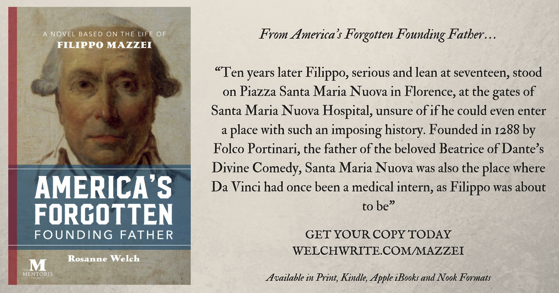
“Ten years later Filippo, serious and lean at seventeen, stood on Piazza Santa Maria Nuova in Florence, at the gates of Santa Maria Nuova Hospital, unsure of if he could even enter a place with such an imposing history. Founded in 1288 by Folco Portinari, the father of the beloved Beatrice of Dante’s Divine Comedy, Santa Maria Nuova was also the place where Da Vinci had once been a medical intern, as Filippo was about to be.”

 From America’s Forgotten Founding Father — Get Your Copy Today!


Join the Rosanne Welch Mailing List for future book and event announcements!
 

Print Edition | Kindle Edition | Apple iBooks Edition | Nook Edition

Quote from “America’s Forgotten Founding Father” by Dr Rosanne Welch – 3 in a series – Dreaming of travel…and America

Quote from

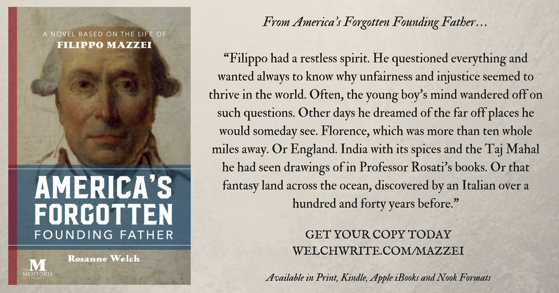
“Filippo had a restless spirit. He questioned everything and wanted always to know why unfairness and injustice seemed to thrive in the world. Often, the young boy’s mind wandered off on such questions. Other days he dreamed of the far off places he would someday see. Florence, which was more than ten whole miles away. Or England. India with its spices and the Taj Mahal he had seen drawings of in Professor Rosati’s books. Or that fantasy land across the ocean, discovered by an Italian over a hundred and forty years before.”

 From America’s Forgotten Founding Father — Get Your Copy Today!


Join the Rosanne Welch Mailing List for future book and event announcements!
 

Print Edition | Kindle Edition | Apple iBooks Edition | Nook Edition

A History of Screenwriting 57 – New York Nights starring Norma Talmadge, Written by Hugh Stanislaus Stange and Jules Furthman – 1929

A History of Screenwriting 57 – New York Nights starring Norma Talmadge, Written by Hugh Stanislaus Stange and Jules Furthman – 1929

A History of Screenwriting 57 - New York Nights starring Norma Talmadge, Written by Hugh Stanislaus Stange and Jules Furthman - 1929

Poster - New York Nights (1929) 01.jpg
By Employee(s) of United Artists – http://doctormacro.com/Movie%20Summaries/N/New%20York%20Nights%20%281929%29.htm, Public Domain, Link

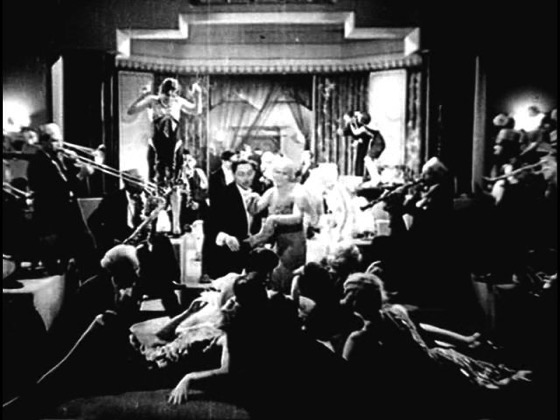
New York Nights is a 1929 American pre-Code crime film, directed by Lewis Milestone, and based on 1928 play Tin Pan Alley by Hugh Stanislaus Stange.[2] The film is known for being leading actress Norma Talmadge’s first sound film.

Jill Deverne is a chorus girl married to alcoholic composer Fred. She wants to show Fred’s latest song, A Year From Today, to racketeer Joe Prividi. Prividi is the producer of the musical show in which she is working, and agrees to use his song. Fred, however, refuses any favors and rejects Prividi’s offer. When Prividi uses the song anyway, Fred and his friend Johnny Dolan become drunk and show up at a nightclub.

In a raid, the police discover Fred with chorus girl Ruthie. Jill is disgusted with his behavior and dumps him. She is soon courted by Prividi, who is very overprotective. At a private party, a gambler forces himself on her and is shot by Prividi. Prividi is arrested and sent to jail. Jill does not want to be left behind, and plans a future with Fred. Prividi becomes jealous and sends gunmen to shoot and kill Fred. He is eventually stopped and put in jail, while Jill and Fred ride off in a train to start a new life. – Wikipedia


Learn More About Norma Talmadge with these books

†

* A portion of each sale from Amazon.com directly supports our blogs
** Many of these books may be available from your local library. Check it out!
† Available at the LA Public Library

Quotes from “Why The Monkees Matter” by Dr. Rosanne Welch – 94 in a series – Corporate Control

** Buy “Why The Monkees Matter” Today **

Quotes from

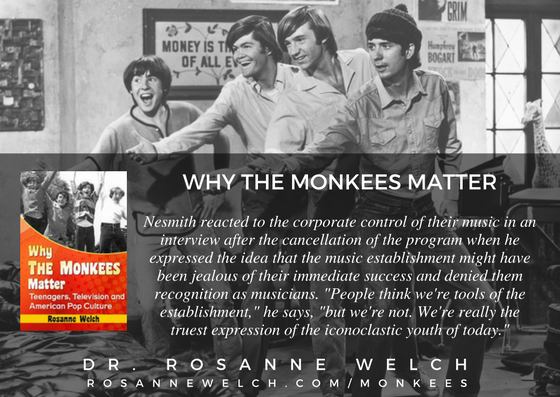
Nesmith reacted to the corporate control of their music in an interview after the cancellation of the program when he expressed the idea that the music establishment might have been jealous of their immediate success and denied them recognition as musicians. “People think we’re tools of the establishment,” he says, “but we’re not. We’re really the truest expression of the iconoclastic youth of today.”

from Why The Monkees Matter by Dr. Rosanne Welch —  Buy your Copy today!

 Why The Monkees Matter: Teenagers, Television and American Pop Culture


McFarland (Direct from Publisher) | Amazon | Kindle Edition | Nook Edition