From The Research Vault: Feeling Italian: The Art of Ethnicity in America by Thomas J. Ferraro
Why The Monkees Matter: Teenagers, Television and American Pop Culture
On Screenwriting and Media with Dr. Rosanne Welch
Writing, Film, Television and More!

A professor of astronomy gives a lecture instructing on an impending solar eclipse. The class rushes to an observation tower to witness the event, which features an anthropomorphic Sun and Moon coming together. The Moon and the Sun lick their lips in anticipation as the eclipse arrives, culminating in a romantic encounter between the two celestial bodies. Various heavenly bodies, including planets and moons, hang in the night sky; a meteor shower is depicted using the ghostly figures of girls. The professor of astronomy, shocked by all he has witnessed, topples from the observation tower.
The Eclipse has been remarked upon for its overt sexual symbolism.[1][2] Christine Cornea posits that the film’s primary theme, the clash of scientific logic with sexual desire, was also evident in Méliès’ earlier films A Trip to the Moon and The Impossible Voyage, and would become a prominent in many subsequent science-fiction films.[1]
Some scholars, interpreting the Sun and the Moon to be both male, have described the erotic “eclipse” as an early depiction of homosexuality in cinema,[2][3] with an “effeminate” Moon being seduced by an “devilishly masculine” Sun.[1] By contrast, Méliès’s film catalogue describes the liaison in heterosexual terms, referring to the participants as “the man in the sun” and “dainty Diana” and using pronouns to match.[4] — Wikipedia
* A portion of each sale from Amazon.com directly supports our blogs
** Many of these books may be available from your local library. Check it out!
I teach several classes for the Stephens College Low-Residency MFA in Screenwriting, including History of Screenwriting. In fact, I created the curriculum for that course from scratch and customized it to this particular MFA in that it covers ‘Screenwriting’ (not directors) and even more specifically, the class has a female-centric focus. As part History of Screenwriting I, the first course in the four-class series, we focus on the early women screenwriters of the silent film era who male historians have, for the most part, quietly forgotten in their books. In this series, I share with you some of the screenwriters and films that should be part of any screenwriters education. I believe that in order to become a great screenwriter, you need to understand the deep history of screenwriting and the amazing people who created the career. — Dr. Rosanne Welch
Rosanne Welch talks “The Invention of the Teenager” on Pop!: The Pop Culture Podcast
I had quite a good time when Ken Mills interviewed me about the ‘invention’ of the teenager – something I teach in my classes and spent a whole chapter on in my book, Why The Monkees Matter!
Marketers created teenagers in the same way The Disney Channel and Nickelodeon helped spread the term Tweeners for their shows.
The whole episode is fun – I really like the coverage of Anne Moses and her time editing Tiger Beat Magazine (but if you’re pressed for time my interview starts at 18:22).

Podcast: Play in new window | Download
Subscribe: RSS
Buy “Why The Monkees Matter” Today!
Why The Monkees Matter: Teenagers, Television and American Pop Culture
McFarland (Direct from Publisher) | Amazon | Kindle Edition | Nook Edition
Rosanne Welch talks about “Why The Monkees Matter” with Jean Hopkins Power
Watch this entire presentation (45 mins)
Jean Powergirl takes the host reigns and welcomes her guest Rosanne Welch, PhD to the show! They’ll be discussing Roseanne’s book, “Why The Monkees Matter: Teenagers, Television and American Pop Culture.”

Transcript:
Rosanne: Treva Silverman was one of the first women to write comedy without a male partner on television and she worked on the The Monkees first and then she would move onto The Mary Tyler Moore Show and she would win 2 Emmys for that show. So I noted that if you were watching The Monkees, there is definitely the feminist perspective that she is going to bring to Mary Tyler Moore exists in The Monkees the best that it can in a show that doesn’t a female character.
Jean: Ok. So give us some examples of that. How is this feminist we’ll call is point of view or issue suggested.
Rosanne: When they met girls — again, I assume a group of rock and roll boys would go out with the cheerleaders, , airheads, groupies, the fan girls — and instead — as I clocked each episode — every time they liked a girl she was a girl with a purpose. There were girls who were going to college. There were girls who had jobs and were supporting themselves as young women. There were journalists.
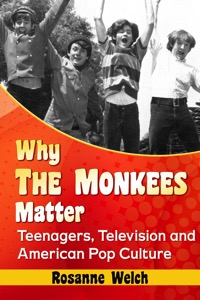
A hit television show about a fictitious rock band, The Monkees (1966-1968) earned two Emmys–Outstanding Comedy Series and Outstanding Directorial Achievement in Comedy. Capitalizing on the show’s success, the actual band formed by the actors, at their peak, sold more albums than The Beatles and The Rolling Stones combined and set the stage for other musical TV characters from The Partridge Family to Hannah Montana. In the late 1980s, the Monkees began a series of reunion tours that continued into their 50th anniversary.
This book tells the story of The Monkees and how the show changed television, introducing a new generation to the fourth-wall-breaking slapstick created by Laurel and Hardy and the Marx Brothers. Its creators contributed to the innovative film and television of 1970s with projects like Bob & Carol & Ted & Alice, The Mary Tyler Moore Show, Laugh-In and Welcome Back, Kotter. Immense profits from the show, its music and its merchandising funded the producers’ move into films such as Head, Easy Rider and Five Easy Pieces.
Rosanne Welch, PhD has written for television (Touched by an Angel, Picket Fences) and print (Three Ring Circus: How Real Couples Balance Marriage, Work and Kids and The Encyclopedia of Women in Aviation and Space). In the documentary world she has written and produced Bill Clinton and the Boys Nation Class of 1963 for ABC NEWS/Nightline and consulted on PBS’s A Prince Among Slaves, the story of a prince from West Africa who was enslaved in the 1780s, freed by order of President John Quincy Adams in the 1820s and returned to his homeland.
Podcast: Play in new window | Download
Subscribe: RSS
In honor of the 50th Anniversary of Rowan and Martin’s Laugh-In, here’s the full episode (2.19 – the Valentine’s Day Special from 1969) when Davy Jones guest starred. He first appears at 19:54, then in a sketch at 20:03 and 30:07, 34:46, and with Goldie Hawn at 41:16, and at 57:06 – but the whole episode is a hilarious time capsule of the era so watch when you can.

Another fun Monkees connection to make is that the Emmy Award-wining Laugh-In writing staff included The Monkees alumni Coslough Johnson and David Panich.
Final trivia fun, the writing staff also included a young writer who has done much for comedy since then….Lorne Michaels.
Why The Monkees Matter: Teenagers, Television and American Pop Culture
A History of Screenwriting – 29 in a series – Living Playing Cards (George Méliès, France, 1905)

A bearded magician holds up a large playing card and makes it larger. He tears up a card of a queen, burns the torn bits, and a life-size Queen of Hearts card appears; then, it becomes alive. The magician puts her back into the card. The same thing happens with the King of Clubs: the card becomes alive. The king removes his costume, and there’s something very familiar about him – A Room with a Past on YouTube
* A portion of each sale from Amazon.com directly supports our blogs
** Many of these books may be available from your local library. Check it out!
I teach several classes for the Stephens College Low-Residency MFA in Screenwriting, including History of Screenwriting. In fact, I created the curriculum for that course from scratch and customized it to this particular MFA in that it covers ‘Screenwriting’ (not directors) and even more specifically, the class has a female-centric focus. As part History of Screenwriting I, the first course in the four-class series, we focus on the early women screenwriters of the silent film era who male historians have, for the most part, quietly forgotten in their books. In this series, I share with you some of the screenwriters and films that should be part of any screenwriters education. I believe that in order to become a great screenwriter, you need to understand the deep history of screenwriting and the amazing people who created the career. — Dr. Rosanne Welch
Rosanne Welch talks about “Why The Monkees Matter” with Jean Hopkins Power
Watch this entire presentation (45 mins)
Jean Powergirl takes the host reigns and welcomes her guest Rosanne Welch, PhD to the show! They’ll be discussing Roseanne’s book, “Why The Monkees Matter: Teenagers, Television and American Pop Culture.”
Transcript:
Jean: So The Monkees are going strong now did they evolve in their message over these 52 episode?
Rosanne: 58 Episodes
Jean: 58 Episodes. All right. So they start out, did they change up what they were doing? I mean you’re the connoisseur of all the episodes.
Rosanne: They had a variety of messages and these come form the writers experiences. One of the things I push in my class is that we have to remember that we tend, in American, because the French taught us, to correlate the author of the piece with the director, but, in fact, the director can’t direct a bunch of blank pages. It’s the writer who comes up with the theme and the idea. The director enhances that through the visuals. So, for me, it was important to meet the various writers who I still could and it’s their thoughts and messages.
A hit television show about a fictitious rock band, The Monkees (1966-1968) earned two Emmys–Outstanding Comedy Series and Outstanding Directorial Achievement in Comedy. Capitalizing on the show’s success, the actual band formed by the actors, at their peak, sold more albums than The Beatles and The Rolling Stones combined and set the stage for other musical TV characters from The Partridge Family to Hannah Montana. In the late 1980s, the Monkees began a series of reunion tours that continued into their 50th anniversary.
This book tells the story of The Monkees and how the show changed television, introducing a new generation to the fourth-wall-breaking slapstick created by Laurel and Hardy and the Marx Brothers. Its creators contributed to the innovative film and television of 1970s with projects like Bob & Carol & Ted & Alice, The Mary Tyler Moore Show, Laugh-In and Welcome Back, Kotter. Immense profits from the show, its music and its merchandising funded the producers’ move into films such as Head, Easy Rider and Five Easy Pieces.
Rosanne Welch, PhD has written for television (Touched by an Angel, Picket Fences) and print (Three Ring Circus: How Real Couples Balance Marriage, Work and Kids and The Encyclopedia of Women in Aviation and Space). In the documentary world she has written and produced Bill Clinton and the Boys Nation Class of 1963 for ABC NEWS/Nightline and consulted on PBS’s A Prince Among Slaves, the story of a prince from West Africa who was enslaved in the 1780s, freed by order of President John Quincy Adams in the 1820s and returned to his homeland.
Podcast: Play in new window | Download
Subscribe: RSS

MESA – Monkees concerts have been intergenerational affairs for some time now. Friday’s performance at the Mesa Arts Center was no exception.
Sitting in the top row of the balcony, for example, was a mom and dad, and their two daughters, ages 17 and 21. All clearly enjoying a healthy two-hour dose of Monkeemania.
“This was awesome,” the 17-year-old said of the show. Asked what it was about the Monkees that appealed to her, she responded, “Their music is so different from what we have to listen to. It’s more fun! We love it.”
Read Review: Monkees’ Appeal Spans Generations. Florence Reminder & Blade Tribune
Why The Monkees Matter: Teenagers, Television and American Pop Culture
A History of Screenwriting – 28 in a series – The Black Imp (George Méliès, France, 1905)

The jump cut was the key element in early movie conjurer Georges Méliès bag of tricks, and as he grew more experienced in the production of films so his use of this trick grew more sophisticated. This ingenious little movie shows off Méliès’ adeptness to good effect, and it’s clear that a lot of imagination has been used in a simple tale. – A Room with a View on YouTube
* A portion of each sale from Amazon.com directly supports our blogs
** Many of these books may be available from your local library. Check it out!
I teach several classes for the Stephens College Low-Residency MFA in Screenwriting, including History of Screenwriting. In fact, I created the curriculum for that course from scratch and customized it to this particular MFA in that it covers ‘Screenwriting’ (not directors) and even more specifically, the class has a female-centric focus. As part History of Screenwriting I, the first course in the four-class series, we focus on the early women screenwriters of the silent film era who male historians have, for the most part, quietly forgotten in their books. In this series, I share with you some of the screenwriters and films that should be part of any screenwriters education. I believe that in order to become a great screenwriter, you need to understand the deep history of screenwriting and the amazing people who created the career. — Dr. Rosanne Welch
Rosanne Welch talks about “Why The Monkees Matter” with Jean Hopkins Power
Watch this entire presentation (45 mins)
Jean Powergirl takes the host reigns and welcomes her guest Rosanne Welch, PhD to the show! They’ll be discussing Roseanne’s book, “Why The Monkees Matter: Teenagers, Television and American Pop Culture.”

Transcript:
Jean: So how many season did The Monkees run?
Rosanne: You know it only ran for 2 seasons. Back in the day, you had more shows — nowadays you do 13 or maybe 20 episodes — so they did 58 episodes in total in 2 seasons. They were going to come back for a 3rd season after a very successful couple of years of concert tours, but they had decided that — the actors has decided — that they were tired of the formula of the show, which was a sitcom and it was usually some crazy adventure going on. They felt that they wanted to do a variety show ala The Carol Burnett Show, but there were no rock and roll groups hosting variety shows yet, so the network said, “no. We don’t believe that will work.” They said, “Look, we’ll do little sketches in between and will do music and have musical guests,” The network said no and they said, “If that’s the case we’ll just cancel it.”
Jean: Even though Donnie and Marie did do that, right?
Rosanne: But later in the 70’s and the next year Sonny and Cher will do that a and they were a rock and roll group of the day and, in fact, Coslough Johnson, who’s one of my favorite writers for the show who I got to interview. He moved from The Monkees to Sonny and Cher and so that style was going to work, but the network didn’t — I think it was a big mistake monetarily. If they had morphed the show it would have brought that audience along with them.
A hit television show about a fictitious rock band, The Monkees (1966-1968) earned two Emmys–Outstanding Comedy Series and Outstanding Directorial Achievement in Comedy. Capitalizing on the show’s success, the actual band formed by the actors, at their peak, sold more albums than The Beatles and The Rolling Stones combined and set the stage for other musical TV characters from The Partridge Family to Hannah Montana. In the late 1980s, the Monkees began a series of reunion tours that continued into their 50th anniversary.
This book tells the story of The Monkees and how the show changed television, introducing a new generation to the fourth-wall-breaking slapstick created by Laurel and Hardy and the Marx Brothers. Its creators contributed to the innovative film and television of 1970s with projects like Bob & Carol & Ted & Alice, The Mary Tyler Moore Show, Laugh-In and Welcome Back, Kotter. Immense profits from the show, its music and its merchandising funded the producers’ move into films such as Head, Easy Rider and Five Easy Pieces.
Rosanne Welch, PhD has written for television (Touched by an Angel, Picket Fences) and print (Three Ring Circus: How Real Couples Balance Marriage, Work and Kids and The Encyclopedia of Women in Aviation and Space). In the documentary world she has written and produced Bill Clinton and the Boys Nation Class of 1963 for ABC NEWS/Nightline and consulted on PBS’s A Prince Among Slaves, the story of a prince from West Africa who was enslaved in the 1780s, freed by order of President John Quincy Adams in the 1820s and returned to his homeland.
Podcast: Play in new window | Download
Subscribe: RSS


