
Douglas, Rosanne, Lexi and Linda at Paradise Cove
Family visiting from Ohio gave us an excuse to head to the beach.
Writing, Film, Television and More!
Douglas, Rosanne, Lexi and Linda at Paradise Cove
Family visiting from Ohio gave us an excuse to head to the beach.
Check out comedian (and friend to the Stephens College MFA in TV and Screenwriting program) Paula Poundstone’s new podcast Nobody Listens to Paula Poundstone. She’ll be holding entertaining and engaging conversations as she interviews experts in various interesting fields.
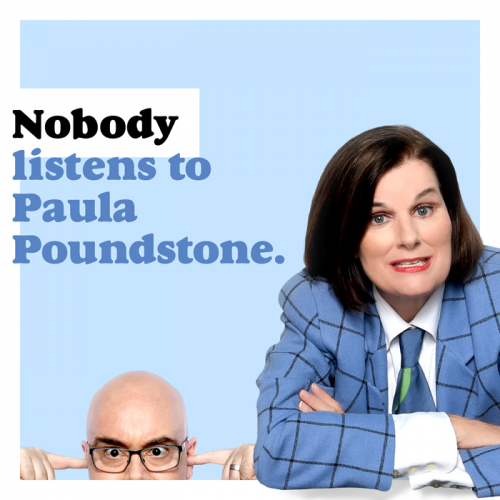
GUESTS
Mario Soto- Sports Psychologist
@mariosportsdoc
Melissa Brandzel – Grammarian
@MediaChickEdits
John Grab – Trombone
John doesn’t have a large social media footprint, but he often plays with The Orchestre Surreal
Podcast: Play in new window | Download
Subscribe: RSS
During this inaugural episode at 19:45 you’ll hear a great add for our Stephens College MFA in TV and Screenwriting – between funny conversations first with sports psychiatrist Mario Soto followed by grammarian Melissa Brandzel. In Paula’s typical style she’s funny off the cuff, finding different comic ways to interpret the helpful tips offered by her experts.
I also noticed this fun request on their website…
“We need a theme song! We launched this show without a theme song, and are turning to YOU, dear listener, to find one. If you have a tune in your head that you think should kick off our show each week, please reach out to us via our website.” So if you’re a local musician, check it out – and leave them a comment if you happen to be an expert in some fun field. Maybe they’ll have you on the show!
Visit the Nobody Listens to Paula Poundstone Web Site to subcribe via iTunes or your favorite Podcast program
Find out more about the Stephens College MFA in TV and Screenwriting
More on the Monkees: Davy Jones Audition (GIF)
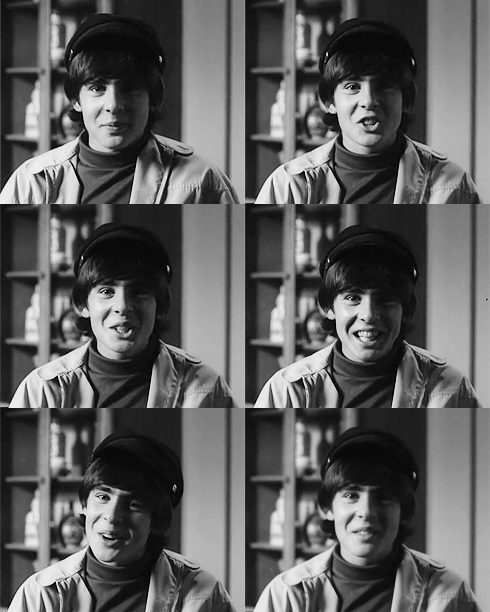
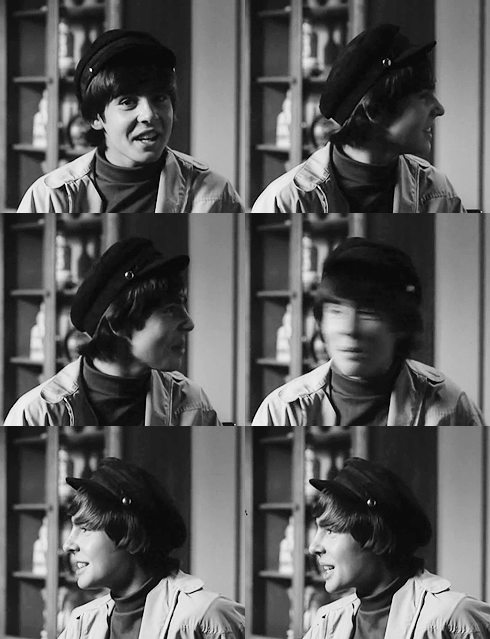
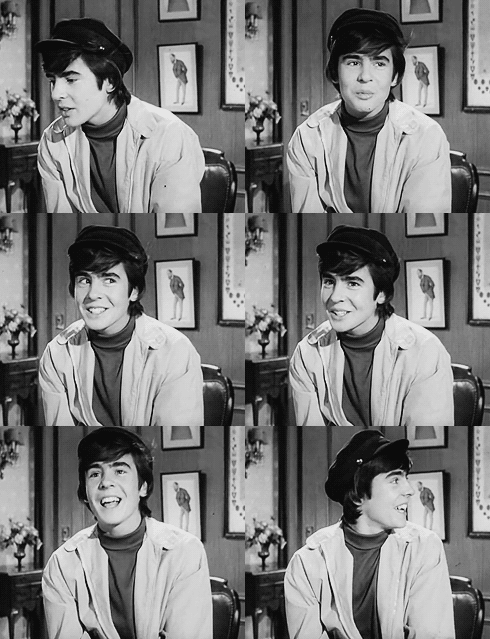
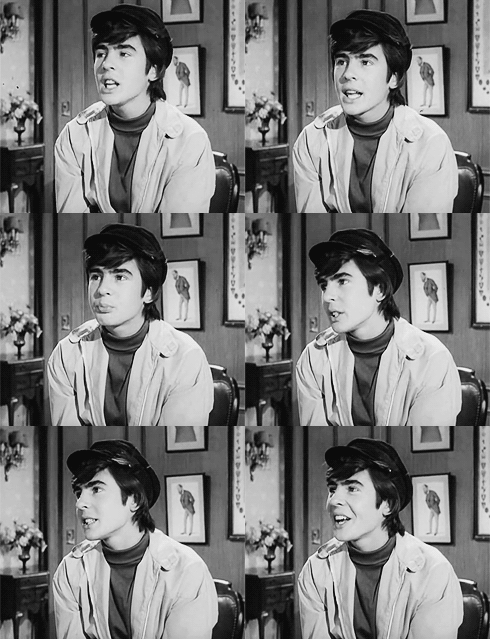
Via Little Horror Shop on Tumblr
Why The Monkees Matter: Teenagers, Television and American Pop Culture

McFarland (Direct from Publisher) | Amazon | Kindle Edition | Nook Edition
Want to use “Why The Monkees Matter” in your classroom?
Order Examination Copies, Library and Campus Bookstore orders directly from McFarland


Douglas & Rosanne Chiilin’ at Paradise Cove
Family visiting from Ohio gave us an excuse to head to the beach.
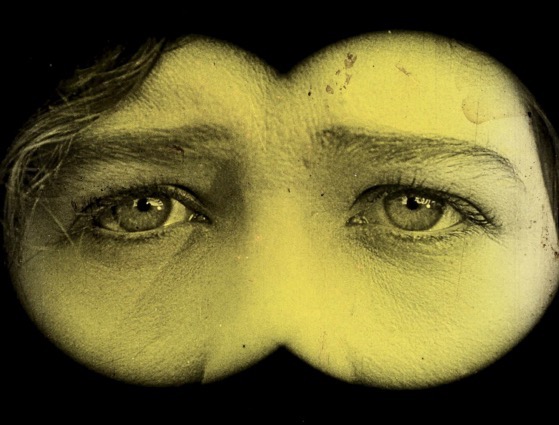
This is a great article supporting everything I have been trying to teach in my female-centric MFA History of Screenwriting course, including the idea that these female screenwriters and directors of Early Hollywood were left out of the history books as most of those were written by male historians.
I attempt to correct this in every class and with every research paper I assign – and with our new book of essays When Women Wrote Hollywood: Essays on Female Screenwriters in the Early Film Industry. The article even opens with a quote by Ida May Park taken from the Careers for Women book which essayist Jackie Perez quotes in her full piece on Ida May in our book.
The article concerns “Pioneers: First Women Filmmakers,” a wonderful series that opens Friday in New York City at BAM (Brooklyn Academy of Music) which is being presented with Kino Lorber and the Library of Congress.
“There are tear-splashed melodramas like Alice Guy Blaché’s “The Ocean Waif” (1916), but also slapstick comedies like Mabel Normand’s “Caught in a Cabaret,” starring Charlie Chaplin (1914), and Lois Weber and Phillips Smalley’s thriller “Suspense” (1913). The stories take on love and war as well as poverty (Ida May Park’s 1918 “Bread”); birth control (Weber’s 1916 “Where Are My Children?”); and prostitution (Dorothy Davenport and Walter Lang’s 1925 “The Red Kimona”). One must-see is Marion E. Wong’s “Curse of Quon Gwon: When the Far East Mingles With the West” (1916), thought to be the first feature by a Chinese-American filmmaker. (A chunk is missing but it’s still worth watching.)”
Even if you don’t live in New York to attend the series, you can read all about it – and these marvelous women and their movie-making careers – here:
Thrills, Tears and the Real Gone Girls of Cinema via The New York Times
In the Wild West days of early filmmaking—before Hollywood hardened into an assembly-line behemoth and boys’ club—talented women worked regularly as writers, producers, and directors, instrumental in shaping the very language of cinema as we know it. Nevertheless, figures like Alice Guy Blaché and Lois Weber are known today primarily by aficionados, and artists like Nell Shipman, Grace Cunard, and Marion E. Wong remain woefully obscure. Bringing together dozens of essential new restorations, this series spotlights the daring, innovative, and trailblazing work of the first female filmmakers and restores their centrality to the creation of cinema itself.
Read the entire article – Thrills, Tears and the Real Gone Girls of Cinema via The New York Times
And then order our book here…

Given their advancing years, you’d be forgiven for doubting whether there’ll be much monkeying around.
Yesterday The Monkees announced they would be reforming for a 45th anniversary tour of the UK.
The band, who broke up in 1971, were put together by music executives in 1966 to star in a TV comedy and to be the U.S. answer to The Beatles.
Why The Monkees Matter: Teenagers, Television and American Pop Culture
* A portion of each sale from Amazon.com directly supports our blogs
** Many of these books may be available from your local library. Check it out!
† Available from the LA Public Library

When Women Wrote Hollywood – 13 in a series – The Lying Truth & The Lost World, Wr: Marion Fairfax
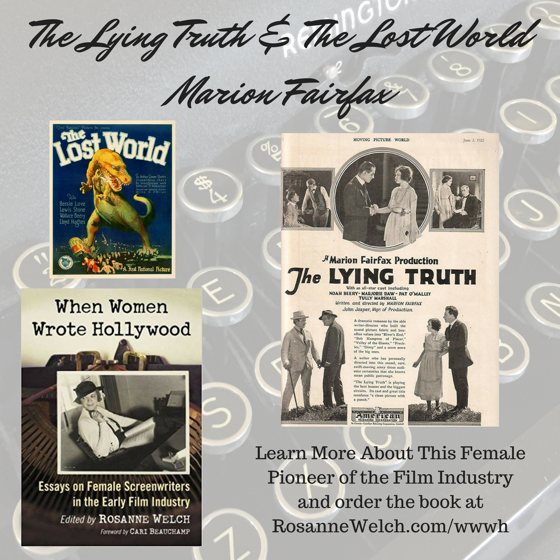
Marion Fairfax (October 24, 1875 – October 2, 1970) was an American screenwriter and playwright. Born as Marion Neiswanger in Richmond, Virginia, After she graduated from Chicago’s South Division High School, she enrolled in Emerson College in Boston, Massachusetts. She was married to actor Tully Marshallfor forty-three years. Fairfax worked as a company director, director, editor, editorial director, playwright, producer, screenwriter and theatre actress.
Fairfax first started her career as a stage actress, just like many other women did in that era. By 1901 she was appearing on Broadway and soon after that her own plays started appearing on Broadway. Before she went into pictures she was known for being one of the most distinguished stage authors in the United States, writing Broadway hits such as The Builders (1907), The Chaperon (1908), The Talker (1912), A Modern Girl (1914), In 1915 The Lasky Feature Play Company entered into a contract with Fairfax. This opportunity gave Fairfax the chance to work under William C. DeMille who is known as the author for many successful plays such as “The Warrens of Virginia” and “The Woman.” The success of Fairfax comes through wide knowledge of dramatic values, not only from an author’s perspective but also from that of the artist.[1] — Wikipedia
More about Marion Fairfax
Buy a signed copy of when Women Write Hollywood
* A portion of each sale from Amazon.com directly supports our blogs
** Many of these books may be available from your local library. Check it out!
† Available from the LA Public Library
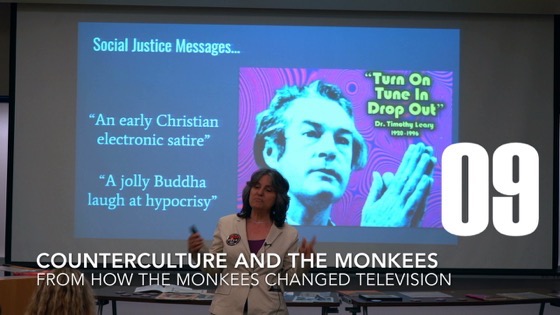
Rosanne Welch, PhD, Author of Why The Monkees Matter, presents “How The Monkees Changed Television” at a Cal State Fullerton Lunch Lecture on May 8, 2018.
In this talk, she shows how The Monkees, and specifically their presence on television, set the stage for large changes to come in the late 1960s.
Transcript
Back in the day — I just mentioned the war — they did have many moments where they referenced the war — the war on poverty — and President Lyndon Johnson and they mentioned particularly — there was a great episode where they were playing dominoes and they dropped all the dominoes and then Davy Jones said to Peter Tork “what do you call this game?” and Peter Tork said “Southeast Asia” and nobody cut that, right, because nobody who is a censor at the network understood what it meant which is pretty shocking if you ask me.
This is Dr. Timothy Leary who was famous back in the day for dropping LSD and whatnot and taking experiments with the psyche and he was watching the program and defining it and recognizing that it was far deeper than anyone else had given it the thought before. So already in the 60s people in the know knew that this was something different and worth paying attention to.
Why The Monkees Matter: Teenagers, Television and American Pop Culture
McFarland (Direct from Publisher) | Amazon | Kindle Edition | Nook Edition
Want to use “Why The Monkees Matter” in your classroom?
Order Examination Copies, Library and Campus Bookstore orders directly from McFarland
About Rosanne Welch, PhD
Rosanne Welch, PhD is a writer, producer and university professor with credits that include Beverly Hills 90210, Picket Fences, Touched by an Angel and ABC NEWS/Nightline. Other books include Why The Monkees Matter: Teenagers, Television and American Pop Culture (McFarland, 2017) and Women in American History: A Social, Political, and Cultural Encyclopedia and Document Collection (ABC-CLIO, 2017), named to the 2018 Outstanding References Sources List, by the Reference and User Services Association (RUSA), a division of the American Library Association. Welch has also published chapters in Torchwood Declassified: Investigating Mainstream Cult Television (I.B.Tauris) and The American Civil War on Film and TV: Blue and Gray in Black and White and Color (Lexington Books, 2018) and essays in Doctor Who and Race: An Anthology and Outside In Makes it So, and Outside in Boldly Goes (both edited by Robert Smith). By day she teaches courses on the history of screenwriting and on television writing for the Stephens College MFA in Screenwriting programs. Her talk “The Importance of Having a Female Voice in the Room” at the 2016 TEDxCPP is available on YouTube.
Podcast: Play in new window | Download
Subscribe: RSS
Among the many films I have my History of Screenwriting students watch as we march through the chronological eras of that history from Silents to (what I call) Superhero Saturation, I include a couple of musicals to illustrate that genre. Among those musicals I include Show Boat for many reasons.
First, because they ought to know about Edna Ferber, who wrote the novel on which the show is based, had an interesting history with Hollywood in that she did not approve of selling off her IP (intellectual property) completely – so she leased novels to Hollywood (including the Pulitzer Prize-winning So Big, and the popular Giant (starring Elizabeth Taylor, Rock Hudson and James Dean and adapted by Fred Guiol and Ivan Moffat).
Second, because they ought to know Paul Robeson who starred in the 1936 film adaptation after having played “Joe” in the London production and became synonymous with the song “Ol’ Man River”.
Third, because it was one of the earliest musicals to take a social justice stance and even handle the subject of miscegenation.
Fourth, because it’s a classic.
But, I recognize even being socially conscious for their times that there are moments in the portrayals of the African American characters that aren’t always comfortable for my students of color so I’m always on the lookout for ways to teach this. That’s why I was happy to come across this 2013 book by Todd Decker Show Boat: Performing Race in an American Musical where he focuses on how the story is really the story of how a white girl singer becomes famous on the riverboat by using a ‘black’ voice, making the story more a study of cultural appropriation. I’ve only begun reading it out of order (movie section first, stage play section second) but have found what I’ve read fascinating.
Check it out at your local library or find it here

* A portion of each sale from Amazon.com directly supports our blogs
** Many of these books may be available from your local library. Check it out!
† Available from the LA Public Library


 and Follow