I teach several classes for the Stephens College Low-Residency MFA in Screenwriting, including History of Screenwriting. In fact, I created the curriculum for that course from scratch and customized it to this particular MFA in that it covers ‘Screenwriting’ (not directors) and even more specifically, the class has a female-centric focus. As part History of Screenwriting I, the first course in the four-class series, we focus on the early women screenwriters of the silent film era who male historians have, for the most part, quietly forgotten in their books. In this series, I share with you some of the screenwriters and films that should be part of any screenwriters education. I believe that in order to become a great screenwriter, you need to understand the deep history of screenwriting and the amazing people who created the career. — Dr. Rosanne Welch
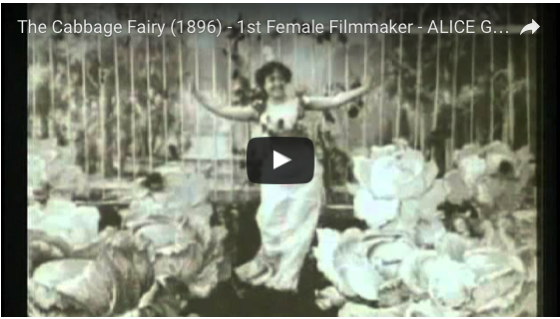
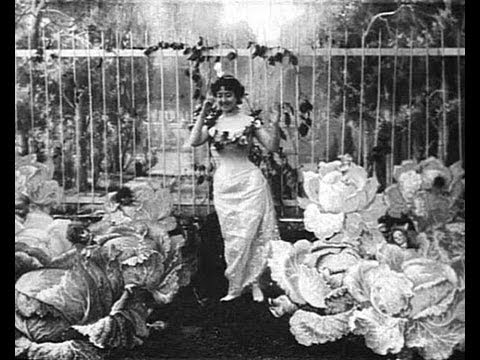
The Cabbage Dairy (La Fée aux Choux) – Alice Guy Blaché
“Alice Guy’s first film, and arguably the world’s first narrative film, was called La Fée aux Choux (The Cabbage Fairy) in 1896. It is a humorous story of a woman growing children in a cabbage patch. There is speculation surrounding the actual date of the film and different historians have argued about the dating and the labeling of it as ‘the first narrative film’ because of its extremely close release to another catalogued Gaumont film and other narrative-esque films from Méliès.[8]— Wikipedia
Books on Alice Guy Blaché
* A portion of each sale from Amazon.com directly supports our blogs ** Many of these books may be available from your local library. Check it out!
Okay – so I’m odd. I read the obituaries – because I figure if you make it in the obituaries you had to have done something interesting in your life and I ought to know about you. But it also tends to serve as a sad reminder of writers we have lost and books I need to have read. So when I read the obituary for E.R. Braithwaite, author or “To Sir, With Love” (which most people only recognize as a Sidney Poitier movie) I thought – hey, I just graded a bunch of student work. I need a good book to read for a day and I’ve always liked the “teacher” genre of books, so why not?
So I just finished the book (borrowed from my local library as an ebook to my Kindle) and very much enjoyed it. The story of the Guyanese gentleman leaving World War II military service and becoming a teacher to low income children in London’s East End — teaching them to respect him in order to learn to respect themselves — was quite beautiful. He also discusses his mixed race romance (which later becomes a marriage) with another teacher in a frank and honest manner. But mostly he talks about the students and what they lack, what they need, how to reach them — and teach them — and eventually befriend them – always by keeping respect at the front of every encounter.
The book reminded me of all the teacher genre books I’ve enjoyed over the years – from the later Anne of Green Gables books (by Lucy Maude Montgomery) to Up the Down Staircase by Bel Kaufman (which I both performed in in high school theatre and directed when I taught high school drama) to My Posse Don’t Do Homework (by LouAnne Johnson) to ‘Tis: A Memoir by Frank McCourt. What I find funny reading them nowadays is how obvious successful teaching is and yet how few can actually do it well.
Sadly, I remember the film never mentioned his romance as mixed race relationships were taboo by the Hays Code — yet Guess Who’s Coming to Dinner, also from 1967 (and also starring Sidney Poitier) made it the focal point of their film. Perhaps if they had waited to make To Sir a few years later, it could have been included. That, of course, proves the point I tried to instill in my son years ago – always read the book that goes to a film because that is the only way to get the full story.
From Amazon.com…
With opportunities for black men limited in post–World War II London, Rick Braithwaite, a former Royal Air Force pilot and Cambridge-educated engineer, accepts a teaching position that puts him in charge of a class of angry, unmotivated, bigoted white teenagers whom the system has mostly abandoned. When his efforts to reach these troubled students are met with threats, suspicion, and derision, Braithwaite takes a radical new approach. He will treat his students as people poised to enter the adult world. He will teach them to respect themselves and to call him “Sir.” He will open up vistas before them that they never knew existed. And over the course of a remarkable year, he will touch the lives of his students in extraordinary ways, even as they in turn, unexpectedly and profoundly, touch his.
You Can Please Some of the People Some of the Time… None of the People All of the Time: A History of the Art of Adaptation in Movies like Dune, The Godfather, Harry Potter and More!
Dr. Rosanne Welch speaks on A History of the Art of Adaptation in Movies like Dune, The Godfather, Harry Potter and More! at the California State University, Fullerton Library
Part of the program series for Dune by Frank Herbert: A 50th Anniversary Celebration.
The Godfather leads us to The Outsiders which was also done by Francis Ford Coppola and that’s because — this is probably, along with In Cold Blood, one of the most faithful adaptions of a novel ever into a film and that’s because — I love this too, because it’s the power of the audience — a group of fourth graders who loved The Godfather — I don’t know how they quite saw it – but they understood that Francis Ford Coppola was a very important director — they sent him a copy of The Outsiders with a not asking him to direct the movie version and he was like, “Well, I’ve never heard of this book. I suppose I’ll read it.” He read it. HR thought, “Wow this is pretty good. I can do that” and he made sure, because of what the children had written him– he made sure to be as faithful to that book as he could. If you watch that movie with the novel in your hand, nothing happens that doesn’t happen in the novel and he uses almost everything in the novel. There’s nothing that gets left behind. Now it’s a small — it’s a slim little novel, but it’s an amazing piece of adaptation. It is a perfect copy of that novel and it’s funny because people dismiss it because it’s a teen book — a pre-teen book at this stage — but it’s really, really and excellent example of how to do an adaptation properly. So audiences for this are hugely popular.
About this talk
Dr. Rosanne Welch (RTVF) speaks on the craft of history of film adaptations from the controversy of the silent film Birth of a Nation (protested by the National Association for the Advancement of Colored People in 1915) to Breakfast at Tiffany’s (to which author Truman Capote famously said, “The only thing left from the book is the title”) to The Godfather . Naturally, the behemoth in adaptation – Harry Potter (which depended on the relationship created by adapter Steve Kloves and author J.K. Rowling) will be discussed, as will the subject of this month’s celebration: Dune.
Date: Wednesday, October 14, 2015 Time: 1:00pm – 2:00pm
About Dr. Rosanne Welch
Dr. Rosanne Welch is a professor in the Low Residency MFA in Screenwriting Program from Stephens College, California State University, Fullerton, Mount San Antonio Community College and Cal Poly Pomona. In 2007, she graduated with her Ph.D. in 20th Century U.S./Film History from Claremont Graduate University. She graduated with her M.A. in 20th Century United States History from California State University, Northridge in 2004.
Welch is also a television writer/producer with credits for Beverly Hills 90210 , CBS’s Emmy winning Picket Fences and Touched By An Angel . She also writes and hosts her own podcasts on 3rdPass.media, her first one titled “Mindful(I) Media with Dr. Rosanne Welch.”
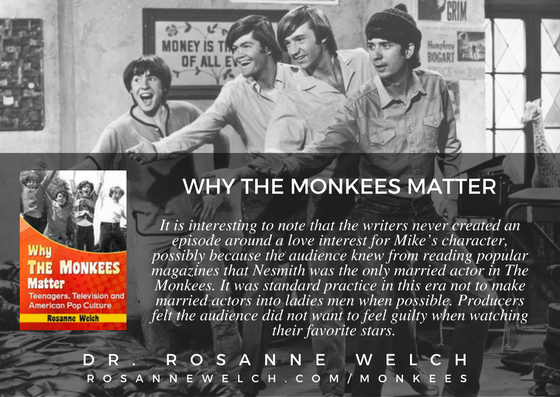
It is interesting to note that the writers never created an episode around a love interest for Mike’s character, possibly because the audience knew from reading popular magazines that Nesmith was the only married actor in The Monkees. It was standard practice in this era not to make married actors into ladies men when possible. Producers felt the audience did not want to feel guilty when watching their favorite stars.


![Adapting The Outsiders from A History of the Art of Adaptation [Video] (1:14)](https://rosannewelch.com/wp-content/uploads/2016/12/adapt-29-the-outsiders.jpeg)


![Why are we still talking about The Monkees? from An Interview with Dr. Rosanne Welch, Author of “Why The Monkees Matter” on the Zilch Podcast [Audio]](https://rosannewelch.com/wp-content/uploads/2016/02/Zilch48-940x198.jpg)