During the second season of The Monkees, after “A Coffin Too Frequent,” the actors requested the laugh track be eliminated because they felt since their younger, hipper audience had grown up with television, they were in fact the first generation to do so, they were indoctrinated into the style and understood when to laugh.
Jean Powergirl takes the host reigns and welcomes her guest Rosanne Welch, PhD to the show! They’ll be discussing Roseanne’s book, “Why The Monkees Matter: Teenagers, Television and American Pop Culture.”
Transcript:
Rosanne: The adults that did take it seriously are the adults who were in the business because they won an Emmy for best Comedy Series in their first season.
Jean: They won 2 Emmys, right?
Rosanne: Yes. They won one for Best Directing as well, And James Frawley who won that had begun his directing career on The Monkees and he grew up to direct The Muppet Movie.
Jean: Awesome. And we love our Muppets. So, in terms of the production and everything The Monkees did some interesting things that — and these are the things that I remember. I remember a lot of little chase scenes that were so cute. Kind of zany. Kind of Groucho Marx-y kind of things, but also they employed the use of what, flashbacks and things like that. Let’s talk about the tools that they used.
Rosanne: They used flashbacks. They would use a lot of old footage whenever they would say something funny, they’d cut to — if I’d say, “The Sky’s falling” they’d cut to a building being dynamited down and that sort of thing and that helps because it saved them money, because they’re using old footage, but it also gave a very frenetic, energetic feel to the show.
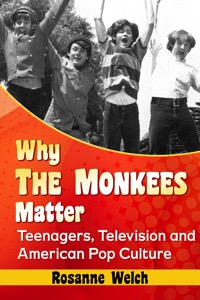
A hit television show about a fictitious rock band, The Monkees (1966-1968) earned two Emmys–Outstanding Comedy Series and Outstanding Directorial Achievement in Comedy. Capitalizing on the show’s success, the actual band formed by the actors, at their peak, sold more albums than The Beatles and The Rolling Stones combined and set the stage for other musical TV characters from The Partridge Family to Hannah Montana. In the late 1980s, the Monkees began a series of reunion tours that continued into their 50th anniversary.
This book tells the story of The Monkees and how the show changed television, introducing a new generation to the fourth-wall-breaking slapstick created by Laurel and Hardy and the Marx Brothers. Its creators contributed to the innovative film and television of 1970s with projects like Bob & Carol & Ted & Alice, The Mary Tyler Moore Show, Laugh-In and Welcome Back, Kotter. Immense profits from the show, its music and its merchandising funded the producers’ move into films such as Head, Easy Rider and Five Easy Pieces.
Rosanne Welch, PhD has written for television (Touched by an Angel, Picket Fences) and print (Three Ring Circus: How Real Couples Balance Marriage, Work and Kids and The Encyclopedia of Women in Aviation and Space). In the documentary world she has written and produced Bill Clinton and the Boys Nation Class of 1963 for ABC NEWS/Nightline and consulted on PBS’s A Prince Among Slaves, the story of a prince from West Africa who was enslaved in the 1780s, freed by order of President John Quincy Adams in the 1820s and returned to his homeland.
The man who coined the phrase “Don’t trust anyone over 30” turned 60 years old Tuesday. Jack Weinberg uttered the phrase – which became one of the most memorable expressions of the turbulent 1960s era – during the height of the Free Speech Movement at UC Berkeley. The Free Speech Movement was a struggle by students over the right to engage in political speech on campus, which helped to catalyze broader political activism on campuses around the country over student rights, civil rights and the Vietnam War.
In a news release recently distributed by a Chicago public relations agency – owned by his wife, it should be noted – Weinberg says he made the statement primarily to get rid of a reporter who was bothering him. He doesn’t even regard the statement as the most important thing he’s ever said.
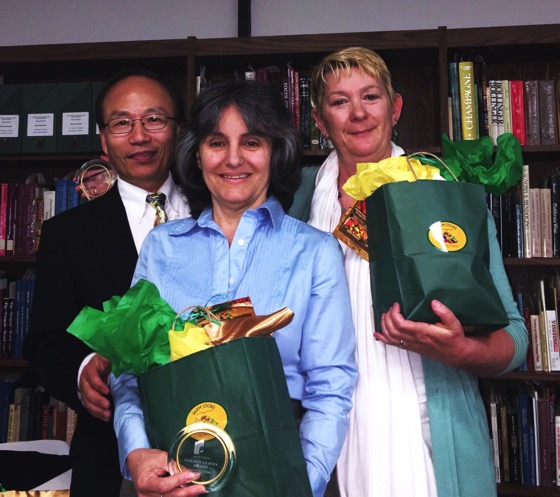
Here my co-editor (and the funnest office mate ever) Dr. Peg Lamphier are smiling besideLibrary Dean Dr. Ray Wang at the Cal Poly Pomona Golden Leaves Award ceremony celebrating professors who have published in the past year.
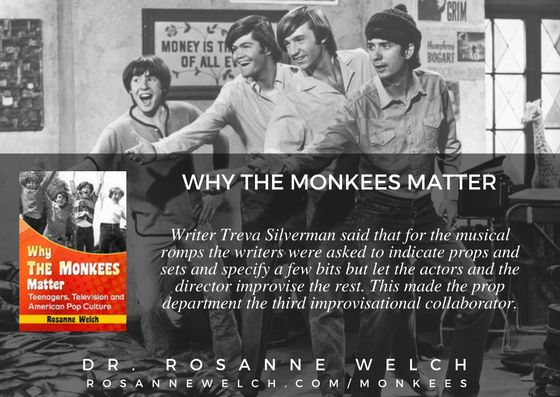
Writer Treva Silverman said that for the musical romps the writers were asked to indicate props and sets and specify a few bits but let the actors and the director improvise the rest. This made the prop department the third improvisational collaborator.
Jean Powergirl takes the host reigns and welcomes her guest Rosanne Welch, PhD to the show! They’ll be discussing Roseanne’s book, “Why The Monkees Matter: Teenagers, Television and American Pop Culture.”
Transcript:
Jean: Why The Monkees Matter. Cute kids. Mop Tops. Allowed to talk about controversial things that adults didn’t like talking about back in the 50’s, right? Rosanne is a busy woman. She does it all and actually one of the exciting things about me living here in Los Angeles — I’m a Texan if up can’t tell – is I love people like Rosanne. It’s a different world and it’s a fascinating one that’s I’ve always been interested in. So here we have The Monkees/They introduce touchy subjects like the Vietnam War just by playing a domino game. Things like that. They don’t put it in your face like that. So, The Monkees start to be a popular show among teenagers obviously. Now, Were adults starting to like it, as well?
Rosanne: A little bit, I mean, you know. it did all right but it never made the top 10 for lots of reasons, including that it didn’t air all over the country because there were some southern stations that didn’t take because their long hair — which we would laugh at today, because we wouldn’t consider it long — was so strange and anti-establishment that they immediately dismissed the show for their purposes.
A hit television show about a fictitious rock band, The Monkees (1966-1968) earned two Emmys–Outstanding Comedy Series and Outstanding Directorial Achievement in Comedy. Capitalizing on the show’s success, the actual band formed by the actors, at their peak, sold more albums than The Beatles and The Rolling Stones combined and set the stage for other musical TV characters from The Partridge Family to Hannah Montana. In the late 1980s, the Monkees began a series of reunion tours that continued into their 50th anniversary.
This book tells the story of The Monkees and how the show changed television, introducing a new generation to the fourth-wall-breaking slapstick created by Laurel and Hardy and the Marx Brothers. Its creators contributed to the innovative film and television of 1970s with projects like Bob & Carol & Ted & Alice, The Mary Tyler Moore Show, Laugh-In and Welcome Back, Kotter. Immense profits from the show, its music and its merchandising funded the producers’ move into films such as Head, Easy Rider and Five Easy Pieces.
Rosanne Welch, PhD has written for television (Touched by an Angel, Picket Fences) and print (Three Ring Circus: How Real Couples Balance Marriage, Work and Kids and The Encyclopedia of Women in Aviation and Space). In the documentary world she has written and produced Bill Clinton and the Boys Nation Class of 1963 for ABC NEWS/Nightline and consulted on PBS’s A Prince Among Slaves, the story of a prince from West Africa who was enslaved in the 1780s, freed by order of President John Quincy Adams in the 1820s and returned to his homeland.
Many Thanks to Sarah Clark for inviting me along on this book group discussion of Mike Nesmith’s new “Infinite Tuesday” – which due to his eclectic writing style and his honest look at his life’s successes and failures, turns out to be an interesting testament to how to survive having been young and famous in the 1960s.
Sarah Clark is joined by Rosanne Welch, Ghosty Tmrs, and Music Biographer Andrew Vaughan to dig deep into Infinite Tuesday: an Autobiographical Riff! Hear the panel’s thoughts, some of Sarah’s favorite Nez Songs (not featured on the Infinite Tuesday soundtrack), Then Melanie Mitchell talks Peter Tork “SSB” Pics surface, Monkees News & More!
Carol McAlice Currie and Michael Davis, Statesman Journal
With apologies to the songwriting duo of Tommy Boyce and Bobby Hart:
“Here she comes. Walkin’ down the street. She could get the funniest looks from. Ev’ryone she meets.”
But she doesn’t. In fact, rather than monkeying around, Salem author Jerri Keele has been busy writing a book to benefit the Davy Jones Equine Memorial Foundation. (Yes, that Davy Jones, the lead-singing, television heartthrob of ’60s boy band The Monkees).
On a side note, there are many connections between The Dean Martin Show and The Monkees, beginning with the connection between his daughter, Deana Martin, and The Monkees. She guest starred in “Some Like it Lukewarm” which aired as the next episode after “Mind Their Manor”.
Jean Powergirl takes the host reigns and welcomes her guest Rosanne Welch, PhD to the show! They’ll be discussing Roseanne’s book, “Why The Monkees Matter: Teenagers, Television and American Pop Culture.”
Transcript:
Hello again, I’m here with Dr. Rosanne Welch. She’s a professor She’s a screenwriter. She’s a producer. She’s this Hollywood lady and she has lots of interesting things to tell us about and I am fascinated. Here’s her book we’re going to talk about today — “Why The Monkees Matter: Teenagers, Television and American Pop Culture.” You can go to Amazon.com to get this book and yea, we have lift off now. Let me go ahead and tell you er credentials again because I’m going to have this memorized. I know all about my friend, Rosanne. Alright, she’s a professor at Cal State Fullerton, Mount San Antonio Community College, and Cal Poly Pomona. She has a Ph.D. in 20th Century United States Film History from Claremont Graduate University and she has a Master of Arts in 20th Century US History from California State University Northridge in 2004. She’s a writer. She’s a producer with credits for Beverly Hills 90210, CBS’ Emmy-winning Picket Fences and Touched by and Angel.
A hit television show about a fictitious rock band, The Monkees (1966-1968) earned two Emmys–Outstanding Comedy Series and Outstanding Directorial Achievement in Comedy. Capitalizing on the show’s success, the actual band formed by the actors, at their peak, sold more albums than The Beatles and The Rolling Stones combined and set the stage for other musical TV characters from The Partridge Family to Hannah Montana. In the late 1980s, the Monkees began a series of reunion tours that continued into their 50th anniversary.
This book tells the story of The Monkees and how the show changed television, introducing a new generation to the fourth-wall-breaking slapstick created by Laurel and Hardy and the Marx Brothers. Its creators contributed to the innovative film and television of 1970s with projects like Bob & Carol & Ted & Alice, The Mary Tyler Moore Show, Laugh-In and Welcome Back, Kotter. Immense profits from the show, its music and its merchandising funded the producers’ move into films such as Head, Easy Rider and Five Easy Pieces.
Rosanne Welch, PhD has written for television (Touched by an Angel, Picket Fences) and print (Three Ring Circus: How Real Couples Balance Marriage, Work and Kids and The Encyclopedia of Women in Aviation and Space). In the documentary world she has written and produced Bill Clinton and the Boys Nation Class of 1963 for ABC NEWS/Nightline and consulted on PBS’s A Prince Among Slaves, the story of a prince from West Africa who was enslaved in the 1780s, freed by order of President John Quincy Adams in the 1820s and returned to his homeland.


![03 – Monkee Emmys and “Romps”: “Why The Monkees Matter” Interview with Jean Hopkins Power [Video] (0:55)](https://rosannewelch.com/wp-content/uploads/2017/05/rmw-power-03-emmys-romps.jpeg)

![02 – Why DID The Monkees Matter?: “Why The Monkees Matter” Interview with Jean Hopkins Power [Video] (1:00)](https://rosannewelch.com/wp-content/uploads/2017/05/rmw-power-02-why.jpeg)


![01 – Introduction: “Why The Monkees Matter” Interview with Jean Hopkins Power [Video] (1:02)](https://rosannewelch.com/wp-content/uploads/2017/05/rmw-power-01-intro.jpeg)