Updated and expanded for the third edition, this volume combines scholarship with movie lore to present a comprehensive account of the development and influence of the American screenwriter. The text is written in an informal style and includes anecdotes and stories that spotlight writer’s creative work and their struggle to achieve recognition.— Amazon
* A portion of each sale from Amazon.com directly supports our blogs *
I teach several classes for the Stephens College Low-Residency MFA in Screenwriting, including History of Screenwriting. In fact, I created the curriculum for that course from scratch and customized it to this particular MFA in that it covers ‘Screenwriting’ (not directors) and even more specifically, the class has a female-centric focus. As part History of Screenwriting I, the first course in the four-class series, we focus on the early women screenwriters of the silent film era who male historians have, for the most part, quietly forgotten in their books. In this series, I share with you some of the screenwriters and films that should be part of any screenwriters education. I believe that in order to become a great screenwriter, you need to understand the deep history of screenwriting and the amazing people who created the career. — Dr. Rosanne Welch
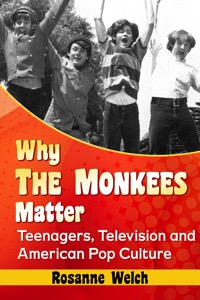
Jean Powergirl takes the host reigns and welcomes her guest Rosanne Welch, PhD to the show! They’ll be discussing Roseanne’s book, “Why The Monkees Matter: Teenagers, Television and American Pop Culture.”
Transcript:
Rosanne: So you couldn’t be as improv’d as you might think they were. Much of the improvisation was written into the script or, if they made something up on the set, and the directors approved it, it would have to fit it…
Jean: They would work it in. There would be discussion — you’re going to say this. You’re going to say that.
Rosanne: Exactly and so Micky admitted that most of it was scripted and that they did a good job memorizing it and delivering it in a spontaneous way that seemed like they were making it up. So it was really interesting to get his perspective int hat respect and to, of course, credit the writers. One of my missions as a professor of television
Jean:…and a writer…
Rosanne: …is to make sure more credit is given to the writers because if you like a particular writer on a show, you should look at their career on IMDB and look at their previous work. You might find that you like the themes that they bring out and you’re a fan of their writing not necessarily of the person who produces that show.
A hit television show about a fictitious rock band, The Monkees (1966-1968) earned two Emmys–Outstanding Comedy Series and Outstanding Directorial Achievement in Comedy. Capitalizing on the show’s success, the actual band formed by the actors, at their peak, sold more albums than The Beatles and The Rolling Stones combined and set the stage for other musical TV characters from The Partridge Family to Hannah Montana. In the late 1980s, the Monkees began a series of reunion tours that continued into their 50th anniversary.
This book tells the story of The Monkees and how the show changed television, introducing a new generation to the fourth-wall-breaking slapstick created by Laurel and Hardy and the Marx Brothers. Its creators contributed to the innovative film and television of 1970s with projects like Bob & Carol & Ted & Alice, The Mary Tyler Moore Show, Laugh-In and Welcome Back, Kotter. Immense profits from the show, its music and its merchandising funded the producers’ move into films such as Head, Easy Rider and Five Easy Pieces.
Rosanne Welch, PhD has written for television (Touched by an Angel, Picket Fences) and print (Three Ring Circus: How Real Couples Balance Marriage, Work and Kids and The Encyclopedia of Women in Aviation and Space). In the documentary world she has written and produced Bill Clinton and the Boys Nation Class of 1963 for ABC NEWS/Nightline and consulted on PBS’s A Prince Among Slaves, the story of a prince from West Africa who was enslaved in the 1780s, freed by order of President John Quincy Adams in the 1820s and returned to his homeland.
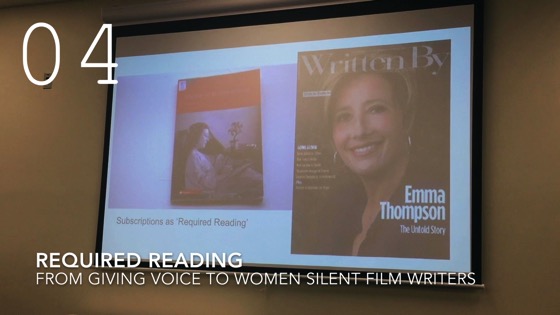
I am also on the editorial board for Written By Magazine and the book review editor of the Journal of Screenwriting so if anyone’s interested in writing book reviews for the Journal of Screenwriting which publishes out of the UK, please let me know because I am always looking for book reviewers and you get the book for free, but also I have — the schools that I teach at have subscription to the journal. I have students read journal articles because I want them — it is a Masters Program — I want them to have a comfort level with that, but I have my undergrads at least do one journal article reading as well to have an accessibility to that. And then I get the schools and/or the kids to read Written By Magazine every month. We do a different screenwriter or television writer on the front cover. It’s a wonderful inside look at how the process of writing is done. The subscription is not that expensive, rather than a textbook for undergrads, but we also publish most of that online for free at the Written By web site, so they can read these articles on their own as assignments and learn about these writers. So I think all that stuff is valid for the class.


![25: Improv, Writers and The Monkees : “Why The Monkees Matter” Interview with Jean Power [Video] (0:53)](https://rosannewelch.com/wp-content/uploads/2017/11/rmw-power-25-improv.jpeg)