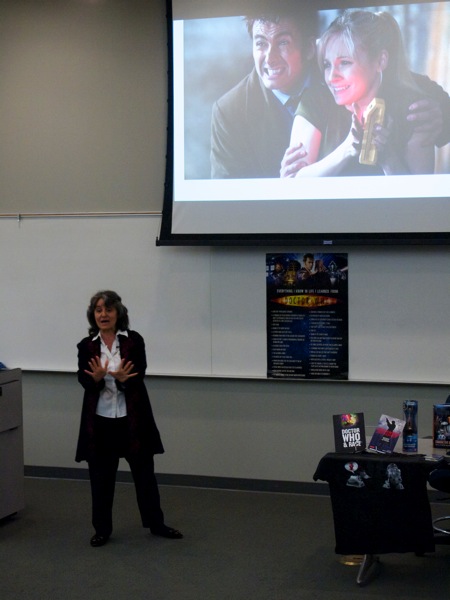
This one was too easy for fans of the Monkees! And served as a reminder of how many ways the show connected to fans long before the explosion of fandom that created today’s convention and cosplay event lifestyle. As always, The Monkees lead the way!
What us it? – August Chronicle – November 7, 2014
Many of you knew right away that last week’s photo showed the Monkeemobile, the highly customized 1966 Pontiac GTO that many of us saw on television in the 1960s. The Monkees were put together to push the show, but the car was the real McCoy.
The Monkeemobile was a customized Pontiac GTO (actually, two versions were used in the 1966-68 series about the pop group), and was designed by Dean Jeffries. Despite heavy modifications, it was easy to tell the car as based on the 1966 Pontiac GTO.
Our clue last week was that the car “hey, hey, might have been comin’ to your town,” a reference to the theme song for the TV show.
Chosen randomly from the correct entries was the name Jeff Keevil, of Martinez, who wrote:
“One glance is all it took for me to recognize the Monkeemobile designed and built by Dean Jeffries for The Monkees television show. Yes, I used to watch that silly show. The car is some kind of very weird cross between a stretched-out 1966 Pontiac GTO convertible and I’m guessing something like a 1927 LaSalle Dual Cowl Phaeton.
“Although they never really appealed to me, these over-the-top severe customs seemed to be the ‘in’ thing in the mid-to late ’60s, many of them done by George Barris – think about the Munstermobile (Munster Koach), Grandpa Munster’s Drag-u-la, and the Batmobile. I guess since the Monkeemobile seems to be in the George Barris design style, he is often mistakenly given credit for this car.”
Thanks to Jeff Keevil for his entry. Other readers identifying the car were:
AUGUSTA: Tom Turner said: “The car in the photo is a 1967 Pontiac GTO, or was before being customized for The Monkees. Thanks for the hint or I never would’ve recognized the schnozzle.”
Lowell Fritsche said: “You have me thinking on this one. I have seen it but can’t place it. I think it is a car that Pontiac was looking at for one of its offering. Probably the early ’60s.”
Daryl Riley said the Monkeemobile was made from a 1966 Pontiac GTO: “Two GTOs, actually.”
Victor Loftiss wrote: “That’s the car of the TV pop group the Monkees, aka the Monkeemobile, which started out life as a GTO.
“I didn’t recognize it immediately until I read your clue. I remember The Monkees TV show, which often showed the car with them in it. I see that eBay has numerous models and small replicas of the Monkeemobile for sale; this was a really famous custom car. George Barris often got credit for the build, but Dean Jeffries was the guy who came up with it. Thanks.”
CANTON, GA.: David Anderson wrote: “As any 1960s music fan can tell you, this is the Monkeemobile, transportation of choice to one of rock ’n’ roll’s first manufactured groups, The Monkees. Through an agreement with the TV studio and Pontiac itself, two 1966 Pontiac GTOs were supplied to customizer Dean Jeffries, who, in less than month, transformed the cars into the Monkeemobile.
“The front sheet metal was lengthened to exaggerate the Pontiac nose, and the rear sheet metal was lengthened, too. The hood was reshaped to accommodate the supercharger and blower that were added to the engine, and the engine exhaust pipes exited through the front fender wells.
“The interior was modified with a second set of bucket seats where the rear seat once sat, and the trunk lid was removed so the trunk became part of the interior with a third-row bench seat. The only exterior glass on the car is a tall split windshield with window wings attached to the pillars. There is no back window and no side glass to roll up in case of rain. The top looks like something stolen from a 1920s or 1930s classic convertible phaeton.
“All in all, this is one unmistakable piece of automotive history, rock ’n’ roll history and Americana all rolled up into one vehicle. I love this car! I assembled the MPC model kit of this car as a child, and I now have another unassembled kit safely tucked away to assemble one day. This Christmas, I will probably also get the Hot Wheels 1:18-scale die-cast replica.
“My first car that I bought and paid for was a 1967 Pontiac LeMans, which only a keen eye can tell from a 1966 model. I then later had a 1971 Pontiac GTO, so I am kind of partial to this car for some very personal reasons. Oh, I also deviled my older sister back in the day because she was crazy about the Monkees, especially Davy Jones!
“The Monkees did not last as a group, but they were quite popular, outselling both The Beatles and the Rolling Stones. My sister’s beloved Davy Jones now calls rock ’n’ roll heaven his home, and the remaining members are probably all but unknown to today’s iTunes subscriber.
“The Monkeemobile and now several replica or tribute cars to that quartet live on proudly and can be seen on display at various locations across the country and several of the large car meets.
“By the way, George Barris did not have anything to do with the designing or building of the original cars. He did eventually acquire one of them, restore it and add some of his own personal design choices to it before selling it at auction for nearly $400,000! I am disappointed that he has never made any attempt to correct anyone that has credited him with the original design of these cars.”
EVANS: Paul Perdue wrote: “This week’s vehicle is a modified 1966 Pontiac GTO called the Monkeemobile. Two of these cars were built for the Monkees, a musical group popular in the ’60s. One was the TV car used on The Monkees TV show, and the other was the show car that went out on tour with the group.”
Larry Heath wrote: “Hey, hey – it is the Monkeemobile! This was a customized auto designed to be used in conjunction with the TV show The Monkees. The show began in the fall of 1966 and was about four members of a band named the Monkees. The band was put together for the TV show but actually became popular and had numerous hit songs during this era.
“The vehicle was based on a 1966 GTO convertible. There were two of these vehicles built in 1966, and both were used on the show and for various promotional purposes. Both of the original vehicles are still around in the hands of private owners.”
David Kriegel said: “The car is a 1963-64 Pontiac GTO that was designed and built by Dean Jeffries for the TV show The Monkees – the Monkeemobile.”
HARLEM: Robert Powell said: “Hey hey, this week’s car is the Monkeemobile. It was designed by Dean Jeffries, starting with a 1966 Pontiac GTO.”
LOUISVILLE, GA.: Bob Holbert wrote: “The car is the Monkeemobile used by the musical group Monkees in the 1960s. Fire-engine red with a huge, supercharged engine, it was designed by George Barris, who was known for his outrageous auto designs. It is based on a 1965 Pontiac GTO, a car that was cool on its own merits.
“I owned the original 1964 model, which was nothing but raw power and gas-drinking speed. Great cars and the Monkeemobile did the GTO proud. Incidentally, great clue: ‘Coming to your town,’ part of the Monkees’ theme song.”
MARTINEZ: Cheryl Cook wrote: “Well, hey, hey, it’s the Monkeemobile! Aka a vintage 1966 Pontiac GTO. Originally designed by Dean Jeffries, it was given a little redesign by George Barris, of Barris Customs. He then sold it at a Scottsdale, Ariz., auction in 2008 to a true ‘Daydream Believer’ for $396,000. Barris autographed the dashboard for the sale.
“I’m a huge Monkees fan. My daddy loved to pick at me back then, telling me they didn’t play their instruments, couldn’t sing, not a real band, But he bought me my first Monkees album. You know, if it wasn’t Elvis or the Rat Pack, it was no good!”
NORTH AUGUSTA: Robby Crawford wrote: “Hey, that iconic nose is the Monkeemobile! Based on the 1966 Pontiac GTO and designed by Dean Jeffries. My dad had a 1967 and ’69 Goat (the affectionate name given to this car by its owners and fans). Quick story: My uncle and boss Cooper Cliatt had borrowed my dad’s ’67 to impress his date on Christmas Eve. To my understanding, that car served as Santa’s sleigh, because my Christmas gifts were in the trunk and Cooper’s date was running late that night. He showed up finally, to my mother’s relief, and Christmas was saved.
“This car is special to me for memories because I own a 1972 GTO now. Special thanks to my Uncle ‘Coop’ for taking the time to showing me your article every Friday morning; we both enjoy seeing these old cars.”
Robert Blake wrote: “You have had some difficult (for me) pictures the last few weeks, but I have got this one. It is the Monkeemobile.”
Paul Brewer wrote: “Though I recognized the car immediately, your hint certainly drove it home! It is the ’66 GTO Monkeemobile. Many people think George Barris built this car, but he didn’t. Dean Jeffries built the originals (there were two). I was a fan of the Monkees even though they were a band built specifically for the show. Michael Nesmith was a true innovator in many ways. I really liked his post-Monkees material.”
PERRY, FLA.: Larry Anderson wrote: “Here we come, walking down the street/We get the funniest looks from everyone we meet./Hey, hey, we’re the Monkees/And people say we monkey around/But we’re too busy singing/To put anybody down.
“Looks Like we have got a customized 1966 Pontiac GTO, better known as the Monkeemobile.”
SANDERSVILLE, GA.: Craig Hollingsworth wrote: “The clue made this one too easy. It is the Monkeemobile, which, according to Wikipedia, started as a 389 four-barrel 1966 GTO convertible. I had thought that it was a Barris creation, but it was not. Rather, it was made by MPC. There were actually two made, one for TV and the other for a traveling show car.
“I really look forward to your feature each Friday, although I usually am stumped.”
NO CITY LISTED: Gordon Adams wrote: “It’s the Monkeemobile. ‘Hey hey’ is all you had to say.”



![Adapting The Sound of Music from A History of the Art of Adaptation in Movies like Dune, The Godfather, Harry Potter and More! [Video] (1:13)](https://rosannewelch.com/wp-content/uploads/2016/05/adapt-02-sound-of-music-1.jpeg)

![Introduction from A History of the Art of Adaptation in Movies like Dune, The Godfather, Harry Potter and More! [Video] (1:05)](https://rosannewelch.com/wp-content/uploads/2016/05/adapt-01-intro-anim.gif)

![Who is the Manliest Companion on Doctor Who? from How Doctor Who Redefined Masculinity [Video] (2:13)](https://rosannewelch.com/wp-content/uploads/2016/04/dw-masculinity-24-manliest-companion-anim.gif)