From The Journal Of Screenwriting V1 Issue 1: Everybody’s a Writer Theorizing screenwriting as creative labour by Bridget Conor

Highlighting the articles in the past editions of the Journal of Screenwriting, of which I am the Book Reviews Editor. Hopefully these abstracts will entice you to did a little deeper into the history and future of screenwriting. — Rosanne


Everybody’s a Writer Theorizing screenwriting as creative labour by Bridget Conor

This paper offers a theoretical agenda for a labourist analysis of screenwriting, and critically evaluates the marginal status of screenwriting within film production systems. On the one hand, screenwriting offers an exemplary case study of creative work in post-modernized film production industries, work characterized by freelancing and multivalent working patterns, insecurity and hierarchization. Investigating screenwriting as creative labour also offers unique insights into an intensely industrial vocation; this requires a highly particular theorization of the contexts and conditions of writers’ working lives.This paper draws on sociological analyses of creative production and utilizes a Foucauldian understanding of technologies of the self as this concept has been applied in the analysis of creative labour. This approach enables a critical examination of particular aspects of screenwriting labour, including the rigidity of the industrial screenplay form and its pedagogical frameworks, the standardized mechanisms of control over screenwriting labour (such as inequitable collaboration and practices of multiple authorship), and the heady mix of both creative fulfilment and punishment which characterizes this form of work.
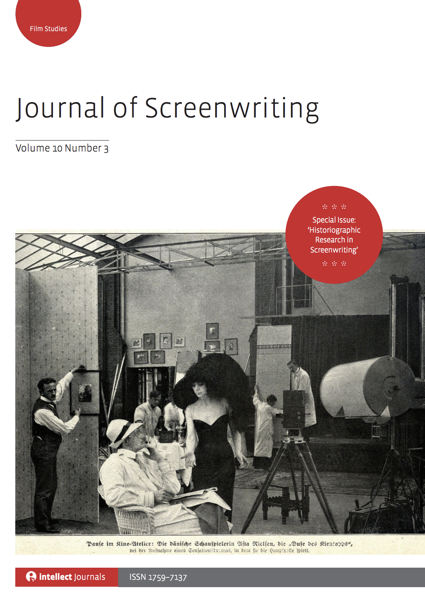

The Journal of Screenwriting is an international double-blind peer-reviewed journal that is published three times a year. The journal highlights current academic and professional thinking about the screenplay and intends to promote, stimulate and bring together current research and contemporary debates around the screenplay whilst encouraging groundbreaking research in an international arena. The journal is discursive, critical, rigorous and engages with issues in a dynamic and developing field, linking academic theory to screenwriting practice. 

Get your copy and subscription to the Journal of Screenwriting Today!


Screenwriting Research Network Conference 2020

Join me at the Screenwriting Research Network’s Annual Conference in Oxford, UK


* A portion of each sale from Amazon.com directly supports our blogs
** Many of these books may be available from your local library. Check it out!
Women’s History Month 10: Jacqueline Cochran

Women's History Month 10: Jacqueline Cochran

Jacqueline Cochran

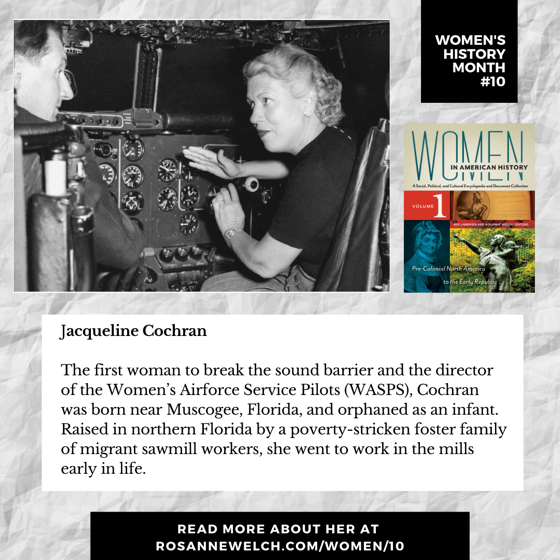
The first woman to break the sound barrier and the director of the Women’s Airforce Service Pilots (WASPS), Cochran was born near Muscogee, Florida, and orphaned as an infant. Raised in northern Florida by a poverty-stricken foster family of migrant sawmill workers, she went to work in the mills early in life.

Learn more about Jacqueline Cochran


Learn about more Women In History with these encyclopedia from Dr. Rosanne Welch and Dr. Peg Lamphier

* A portion of each sale from Amazon.com directly supports our blogs
** Many of these books may be available from your local library. Check it out!
† Available from the LA Public Library

A Photographic February for Stephens MFA in TV and Screenwriting

February was a month of sharing the marvelous photos from all the guest lectures who graced the January Stephens College MFA in TV and Screenwriting workshop with their talent and inspiration… (plus a quick shot of my upcoming book on Films of the Civil War).

February at Stephens MFA in TV and Screenwriting


Visit the Stephens College MFA in TV and Screenwriting for more information.

Follow @StephensMFA on Instagram

Follow and Like the Stephens College MFA in TV and Screenwriting

#MentorMonday 8 - Dawn Comer Jefferson - Stephens College MFA in TV and Screenwriting

Write Your Family’s Stories! – Stephens College MFA in TV and Screenwriting

Sometimes the best scripts are hidden in our own families – call relatives, have dinners, write letters.

Then come to the Stephens College MFA in TV and Screenwriting to learn how to Write, Reach, and Represent all those hidden stories.Write Your Family's Stories! - Stephens College MFA in TV and Screenwriting

Charles M. Schulz Museum

💪🍪 We honor the great women who have gone ahead of us and who walk beside us every day on this #InternationalWomensDay. This Peanuts strip was first published on November 11, 1976⁠.⁠⁠


Visit the Stephens College MFA in TV and Screenwriting for more information.

Follow @StephensMFA on Instagram

Follow and Like the Stephens College MFA in TV and Screenwriting

#MentorMonday 8 - Dawn Comer Jefferson - Stephens College MFA in TV and Screenwriting

#FacultyFriday: Phillip LaZebnik – Stephens College MFA in TV and Screenwriting

#FacultyFriday: Phil LaZebnik - Stephens College MFA in TV and Screenwriting

The Stephens College MFA in TV and Screenwriting would like to celebrate one of our mentors Philip LaZebnik, whose musical THE PRINCE OF EGYPT just opened on the West End! Congratulations Philip! #FacultyFriday

Philip Lazebnik has written numerous television episodes and motion picture screenplays in Los Angeles and Europe. His screenwriting credits include Disney’s Pocahontas and Mulan, and DreamWorks’ Prince of Egypt and The Legend of El Dorado. For the past several years, LaZebnik has lived in Denmark, where he has written movies and television shows throughout Europe and the U.S. His produced movies include the three Treasure of the Templar Knights movies in Denmark and The Three Investigators: The Secret of Skeleton Island and The Three Investigators: The Mystery of Terror Castle for Studio Hamburg; the Danish film Emma and Santa Claus; the English screenplay for Asterix and the Vikings and Asterix and the Domain of the Gods. He also wrote the TV mini-series Hindenburg in Germany, the Christmas TV series Ludvig and Santa Claus for TV2 in Denmark, and the book for Fairytale, a theatrical musical about H.C. Andersen with songs by Stephen Schwartz. Most recently he wrote the book for the musical theatrical version of Prince of Egypt with Stephen Schwartz, which opens in London’s West End on February 25, 2020.


Visit the Stephens College MFA in TV and Screenwriting for more information.

Follow @StephensMFA on Instagram

Follow and Like the Stephens College MFA in TV and Screenwriting

#MentorMonday 8 - Dawn Comer Jefferson - Stephens College MFA in TV and Screenwriting

Women’s History Month 9: Charlotte Forten

Women's History Month 9: Charlotte Forten

Charlotte Forten

A freeborn African-American educator and anti-slavery activist, Charlotte Bridges Forten Grimke, was one of the most influential of abolitionists and civil rights activists of the mid-nineteenth century. In 1862, in the midst of the Civil War, Forten went to Port Royal, South Carolina, where slaves abandoned by their masters after they fled Union forces, were preparing for life after slavery.  Forten established a school for former slaves. Her ultimate goal was to provide her students with the skills to live as free persons. After the war Forten worked for issues such as women’s rights and black civil rights.

Learn more about Charlotte Forten


Learn about more Women In History with these encyclopedia from Dr. Rosanne Welch and Dr. Peg Lamphier

* A portion of each sale from Amazon.com directly supports our blogs
** Many of these books may be available from your local library. Check it out!
† Available from the LA Public Library

Women’s History Month 8: Rear Admiral Grace Hopper

Women's History Month 8: Rear Admiral Grace Hopper

Rear Admiral Grace Hopper

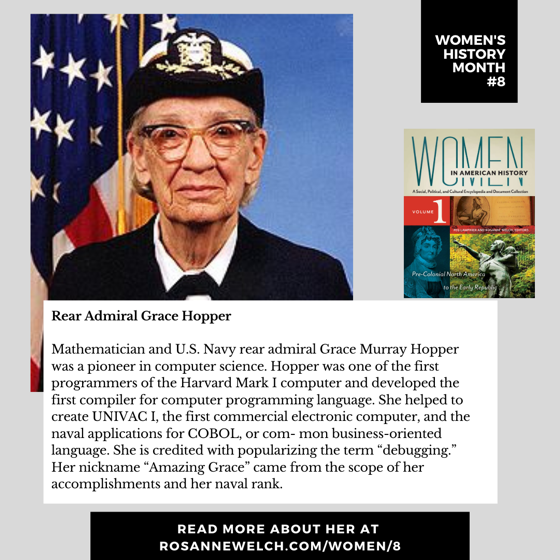
Mathematician and U.S. Navy rear admiral Grace Murray Hopper was a pioneer in computer science. Hopper was one of the first programmers of the Harvard Mark I computer and developed the first compiler for computer programming language. She helped to create UNIVAC I, the first commercial electronic computer, and the naval applications for COBOL, or com- mon business-oriented language. She is credited with popularizing the term “debugging.” Her nickname “Amazing Grace” came from the scope of her accomplishments and her naval rank.

Learn more about Rear Admiral Grace Hopper


Learn about more Women In History with these encyclopedia from Dr. Rosanne Welch and Dr. Peg Lamphier

* A portion of each sale from Amazon.com directly supports our blogs
** Many of these books may be available from your local library. Check it out!
† Available from the LA Public Library

Women’s History Month 7: Thomasine/Thomas Hall

Women's History Month 7: Thomasine/Thomas Hall

Thomasine/Thomas Hall

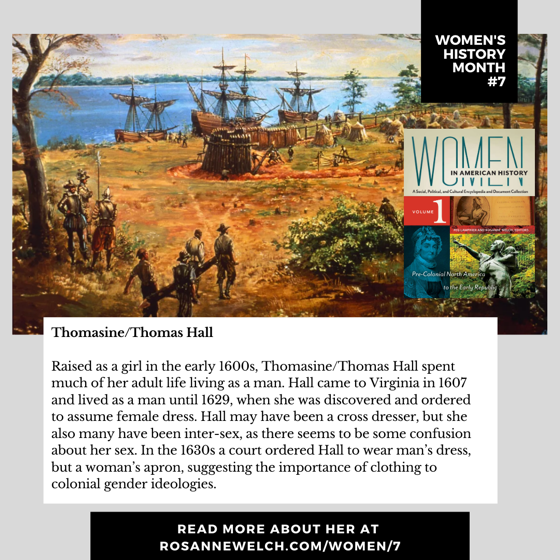
Raised as a girl in the early 1600s, Thomasine/Thomas Hall spent much of her adult life living as a man. Hall came to Virginia in 1607 and lived as a man until 1629, when she was discovered and ordered to assume female dress. Hall may have been a cross dresser, but she also many have been inter-sex, as there seems to be some confusion about her sex. In the 1630s a court ordered Hall to wear man’s dress, but a woman’s apron, suggesting the importance of clothing to colonial gender ideologies.

Learn more about Thomasine/Thomas Hall


Learn about more Women In History with these encyclopedia from Dr. Rosanne Welch and Dr. Peg Lamphier

* A portion of each sale from Amazon.com directly supports our blogs
** Many of these books may be available from your local library. Check it out!
† Available from the LA Public Library

From The “When Women Wrote Hollywood” Archives 16: “Ida May Park.” Women Film Pioneers Project. Center for Digital Research and Scholarship, 27 Sept. 2013

Months of research went into the creation of the essays in “When Women Wrote Hollywood.” Here are some of the resources used to enlighten today’s film lovers to the female pioneers who helped create it.

From The “When Women Wrote Hollywood” Archives 16: “Ida May Park.” Women Film Pioneers Project. Center for Digital Research and Scholarship, 27 Sept. 2013

From The

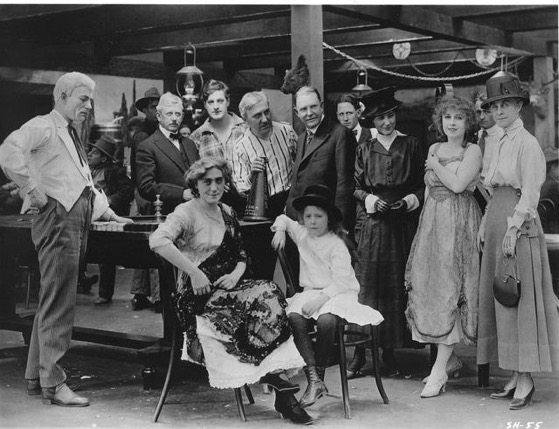
The 1916 Motion Picture News Studio Directory credits Los Angeles native Ida May Park with twelve years of stage experience as a “leading woman in support of well-known stars” and with screen experience at Pathé and the Universal Film Manufacturing Company, where she was then employed as a scenario writer (134). Park flourished at Universal, where she wrote forty-four films, half of them feature length, between 1914 and 1919. Before 1917, Park’s husband, Joseph De Grasse, directed almost all of the films she wrote. In 1917, Park began directing her own scenarios and, according to a 1918 story in the Universal Weekly, a newspaper for exhibitors, editing them as well (29). She crafted a total of eleven features by this method in a scant two years. Park is important to understand as part of a strong creative presence that we now refer to as “Universal Women,” those who between 1912 and 1919 were promoted from acting or writing to directing and were credited on at least one hundred and seventy titles, a cohort that included Ruth Ann Baldwin, Cleo Madison, Ruth Stonehouse, Lois Weber, and Elsie Jane Wilson (Cooper 17, Denton 50). Park and De Grasse left Universal in the spring or summer of 1919 for reasons as yet unknown. On September 12, the Los Angeles Times reported that Lew Cody and manager-producer Louis J. Gasnier had signed her to direct motion pictures in which Cody would star (16). She made one such title, and, with De Grasse, directed two features for Andrew J. Callaghan Productions in 1920.

Read more


Buy “When Women Wrote Hollywood” Today!

Paperback Edition | Kindle Edition | Google Play Edition

Help Support Local Bookstores — Buy at Bookshop.org

* A portion of each sale from Amazon.com directly supports our blogs
** Many of these books may be available from your local library. Check it out!
† Available from the LA Public Library

Women’s History Month 6: Dolores Huerta


Dolores Huerta

Dolores Huerta

Civil rights and labor activist Dolores Clara Fernandez Huerta has made a life’s work of advocacy for farmworkers, immigrants, women, and the American Hispanic (Latino/a) community. Huerta is the co-founder of three major civil rights organizations, including the Stockton, California, chapter of the Community Service Organization (1955); the Agricultural Workers Association (1960); and the National Farm Workers Association (1962) with Cesar Chavez (1927–1993), which later became the United Farm Workers (UFW).

Learn more about Dolores Huerta


Learn about more Women In History with these encyclopedia from Dr. Rosanne Welch and Dr. Peg Lamphier

* A portion of each sale from Amazon.com directly supports our blogs
** Many of these books may be available from your local library. Check it out!
† Available from the LA Public Library