From The Research Vault: Don’t Trust Anyone Over 30, Unless it’s Jack Weinberg, (2000, April 6), The Berkeley Daily Planet.

Don’t Trust Anyone Over 30, Unless it’s Jack Weinberg, (2000, April 6), The Berkeley Daily Planet.

From The Research Vault: Don’t Trust Anyone Over 30, Unless it’s Jack Weinberg, (2000, April 6), The Berkeley Daily Planet.

The man who coined the phrase “Don’t trust anyone over 30” turned 60 years old Tuesday. 
Jack Weinberg uttered the phrase – which became one of the most memorable expressions of the turbulent 1960s era – during the height of the Free Speech Movement at UC Berkeley. The Free Speech Movement was a struggle by students over the right to engage in political speech on campus, which helped to catalyze broader political activism on campuses around the country over student rights, civil rights and the Vietnam War. 

In a news release recently distributed by a Chicago public relations agency – owned by his wife, it should be noted – Weinberg says he made the statement primarily to get rid of a reporter who was bothering him. He doesn’t even regard the statement as the most important thing he’s ever said. 

Read the entire article — Don’t Trust Anyone Over 30, Unless it’s Jack Weinberg 


Why The Monkees Matter: Teenagers, Television and American Pop Culture

Order Your Copy Now!

Why Study The Television We Watch? from Why The Monkees Matter Book Signing [Video] (0:58)

This book signing at Book Soup was wonderful – good people, good conversation (before and after the signing). Just another example of the kind of quality positive people who have been drawn to The Monkees across generations – I even met a former head of publicity for ScreenGems who had some fun stories to tell. — Rosanne

Watch this entire presentation

Why Study The Television We Watch? from Why The Monkees Matter Book Signing


Transcript:

I think when we think about the intimacy of what we get from television we learn a lot about why isn’t important and why we should pay attention to the kind of television we’re watching and supporting. For me, obviously, that’s going backward to The Monkees and showing that to students today, so that they can think about what ideas were prevalent in the 60s. I think all the things that we credit to All in the Family and the whole Norman Lear empire, those things appeared on The Monkees long before it happened on those programs. Studying The Monkees, for me, illustrates the history and the evolution of the medium of television and it provides a time capsule of American society at that moment when youth culture was becoming everything and if you think about it, we still look at it that way. Everyone’s still trying to pretend with the botox and whatever that they are still 22. It’s an interesting point. But it was the beginning of teenagers in America in many ways and the films and the television were showing us what teenagers were all about.

Buy “Why The Monkees Matter” Today!

Why The Monkees Matter: Teenagers, Television and American Pop Culture

McFarland (Direct from Publisher) | Amazon | Kindle Edition | Nook Edition


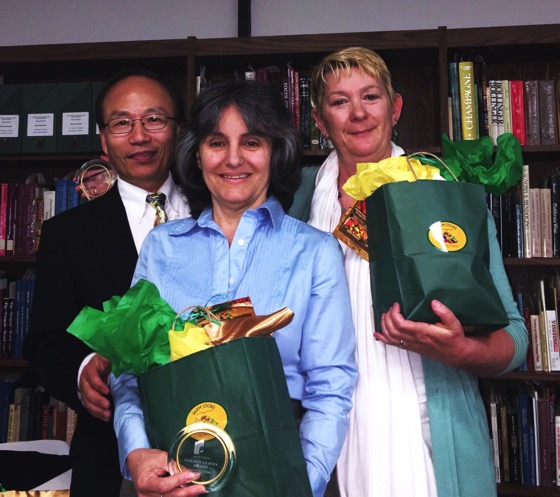
Cal Poly Pomona Golden Leaves Presentation to Dr. Rosanne Welch and Dr. Peg Lamphier

Cal Poly Pomona Golden Leaves Presentation to Dr. Rosanne Welch and Dr. Peg Lamphier

Celebrating my 2017 Award-Winning Books 

Here my co-editor (and the funnest office mate ever) Dr. Peg Lamphier are smiling besideLibrary Dean Dr. Ray Wang at the Cal Poly Pomona Golden Leaves Award ceremony celebrating professors who have published in the past year.  

For us it was our 3-years-in-the-making “Women in American History: A Social, Political, and Cultural Encyclopedia” – then I earned a second award for my 2-years-in-the-making Monkees book “Why The Monkees Matter: Teenagers, Television and American Pop Culture”.   

Quotes from “Why The Monkees Matter” by Dr. Rosanne Welch – 60 in a series – Monkee Romps

** Buy “Why The Monkees Matter” Today **

Quotes from

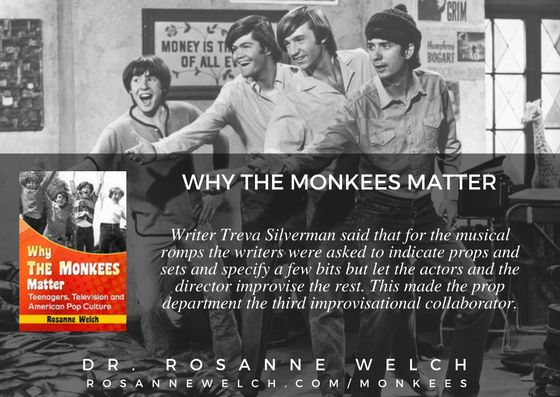
Writer Treva Silverman said that for the musical romps the writers were asked to indicate props and sets and specify a few bits but let the actors and the director improvise the rest. This made the prop department the third improvisational collaborator.   

from Why The Monkees Mattered by Dr. Rosanne Welch —  Buy your Copy today!

 Why The Monkees Matter: Teenagers, Television and American Pop Culture


McFarland (Direct from Publisher) | Amazon | Kindle Edition | Nook Edition

Dr. Rosanne Welch appears on Zilch Monkees Podcast #89: “Infinite Tuesday” Discussion-“SSB” & More!

Many Thanks to Sarah Clark for inviting me along on this book group discussion of Mike Nesmith’s new “Infinite Tuesday” – which due to his eclectic writing style and his honest look at his life’s successes and failures, turns out to be an interesting testament to how to survive having been young and famous in the 1960s.

Zilch #89 “Infinite Tuesday” Discussion-“SSB” & More!

Zilch #89

Sarah Clark is joined by Rosanne Welch, Ghosty Tmrs, and Music Biographer Andrew Vaughan to dig deep into Infinite Tuesday: an Autobiographical Riff! Hear the panel’s thoughts, some of Sarah’s favorite Nez Songs (not featured on the Infinite Tuesday soundtrack), Then Melanie Mitchell talks Peter Tork “SSB” Pics surface, Monkees News & More!

Listen to this show


Buy the books and music

Print | Kindle

* A portion of each sale from Amazon.com directly supports our blogs
** Many of these books may be available from your local library. Check it out! 

From The Research Vault: How to help horses helped by a Monkee, Statesman Journal

How to help horses helped by a Monkee

Carol McAlice Currie and Michael Davis, Statesman Journal

How to help horses helped by a Monkee

With apologies to the songwriting duo of Tommy Boyce and Bobby Hart:

“Here she comes. Walkin’ down the street. She could get the funniest looks from. Ev’ryone she meets.”

But she doesn’t. In fact, rather than monkeying around, Salem author Jerri Keele has been busy writing a book to benefit the Davy Jones Equine Memorial Foundation. (Yes, that Davy Jones, the lead-singing, television heartthrob of ’60s boy band The Monkees).

Read How to help horses helped by a Monkee


Why The Monkees Matter: Teenagers, Television and American Pop Culture

Order Your Copy Now!

Television is Intimate from Why The Monkees Matter Book Signing [Video] (0:47)

This book signing at Book Soup was wonderful – good people, good conversation (before and after the signing). Just another example of the kind of quality positive people who have been drawn to The Monkees across generations – I even met a former head of publicity for ScreenGems who had some fun stories to tell. — Rosanne

Watch this entire presentation

Television is Intimate from Why The Monkees Matter Book Signing


Transcript:

The thing that I think is special about TV is that if you go to a film, you’ve chosen to pay your money for that message. So, you’re not likely to learn anything new. You’re not likely to believe you’re going to pay for something you don’t wan to be told, but television is intimate. It sneaks into your house when you’re not thinking. When you kid switches the channel and suddenly new messages come to them that you might never have wanted them to hear and that’s what The Monkees were doing. They were embedding some new political ideas into the 13 and 14-year-olds who were watching the show at that time and if you think about it, we’re in 1966, give those kids 5 or 6 years and they’re the ones protesting the Vietnam War in the 70’s. That’s when the big protests hit. So, this is a period that The Monkees falls into.

Buy “Why The Monkees Matter” Today!

Why The Monkees Matter: Teenagers, Television and American Pop Culture

McFarland (Direct from Publisher) | Amazon | Kindle Edition | Nook Edition


Quotes from “Why The Monkees Matter” by Dr. Rosanne Welch – 59 in a series – Dean Martin and The Monkees

** Buy “Why The Monkees Matter” Today **

Quotes from

On a side note, there are many connections between The Dean Martin Show and The Monkees, beginning with the connection between his daughter, Deana Martin, and The Monkees.  She guest starred in “Some Like it Lukewarm” which aired as the next episode after “Mind Their Manor”.   

from Why The Monkees Mattered by Dr. Rosanne Welch —  Buy your Copy today!

 Why The Monkees Matter: Teenagers, Television and American Pop Culture


McFarland (Direct from Publisher) | Amazon | Kindle Edition | Nook Edition

From The Research Vault: The Invention of Teenagers: LIFE and the Triumph of Youth Culture

The Invention of Teenagers: LIFE and the Triumph of Youth Culture

Ben Cosgrove, Time, September 28. 2013

From The Research Vault: The Invention of Teenagers: LIFE and the Triumph of Youth Culture

Historians and social critics differ on the specifics of the timeline, but most cultural observers agree that the strange and fascinating creature known as the American teenager — as we now understand the species — came into being sometime in the early 1940s. This is not to say that for millennia human beings had somehow passed from childhood to adulthood without enduring the squalls of adolescence. But the modern notion of the teen years as a recognized, quantifiable life stage, complete with its own fashions, behavior, vernacular and arcane rituals, simply did not exist until the post-Depression era.

Here, in the first of a series of galleries on the evolution of LIFE magazine’s — and, by extension, America’s — view of teenagers through the middle part of the 20th century, LIFE.com presents photos that the inimitable Nina Leen shot for a December 1944 article, “Teen-Age Girls: They Live in a Wonderful World of Their Own.”

Read The Invention of Teenagers: LIFE and the Triumph of Youth Culture on Time


Why The Monkees Matter: Teenagers, Television and American Pop Culture

Order Your Copy Now!

The 60’s Culture and The Monkees from Why The Monkees Matter Book Signing [Video] (0:43)

This book signing at Book Soup was wonderful – good people, good conversation (before and after the signing). Just another example of the kind of quality positive people who have been drawn to The Monkees across generations – I even met a former head of publicity for ScreenGems who had some fun stories to tell. — Rosanne

Watch this entire presentation

The 60's Culture and The Monkees from Why The Monkees Matter Book Signing


Transcript:

…and The Monkees were part of the childish period where they were playing around with what they could do. I think that makes them very special. We think about where we were in 1966. it was only two decades after World War II. People were still holding on to memories of rationing– whether you’re in England or here in the United States — you remembered that period and the United States was  still trying to figure out where it fit in the world. we were becoming a super power, but we didn’t know what that meant and so here come these four kids with the long hair breaking all the rules showing up on television and when you’re supposed to be the nice kids on The Adventures of Ozzie and Harriet or Leave it to Beaver and that made people sit up and take notice. 

Buy “Why The Monkees Matter” Today!

Why The Monkees Matter: Teenagers, Television and American Pop Culture

McFarland (Direct from Publisher) | Amazon | Kindle Edition | Nook Edition