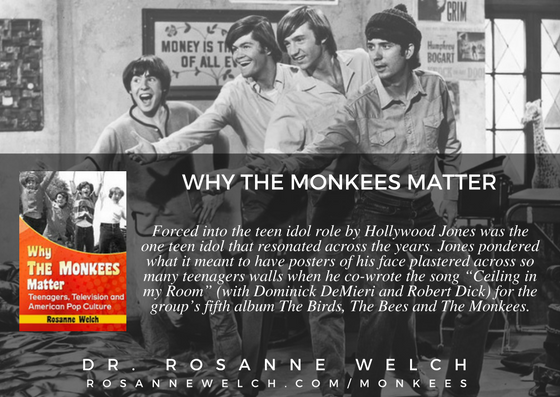
Forced into the teen idol role by Hollywood Jones was the one teen idol that resonated across the years. Jones pondered what it meant to have posters of his face plastered across so many teenagers walls when he co-wrote the song “Ceiling in my Room” (with Dominick DeMieri and Robert Dick) for the group’s fifth album The Birds, The Bees and The Monkees.
The Gold Rush is a 1925 American comedy film written, produced, and directed by Charlie Chaplin. The film also stars Chaplin in his Little Tramp persona, Georgia Hale, Mack Swain, Tom Murray, Henry Bergman, and Malcolm Waite.
The Gold Rush received Academy Award nominations for Best Music and Best Sound Recording upon its re-release in 1942. It is today one of Chaplin’s most celebrated works, and he himself declared several times that it was the film for which he most wanted to be remembered.[3]
The idea for this film came from Chaplin looking at the pictures of the Gold Rush in Klondike in 1896. At the same time, he accidentally read a book about immigrants who trapped the snow in Sierra Nevada, had to eat their own boots or the corpses of their friends. Chaplin, who believed tragedies and comics were not far from each other, decided to combine these stories of deprivation and horror in comedy. He decided that his famous rogue figure should become a gold-digger who joins a brave optimist determined to face all the pitfalls associated with the search for gold, such as sickness, hunger, loneliness, or the possibility that he may at any time be attacked by a grizzly. In the movie, we see scenes like Chaplin cooking and dreaming of his shoe, or how his starving friend Big Jim sees him as a chicken. — Wikipedia
* A portion of each sale from Amazon.com directly supports our blogs ** Many of these books may be available from your local library. Check it out! † Available at the LA Public Library
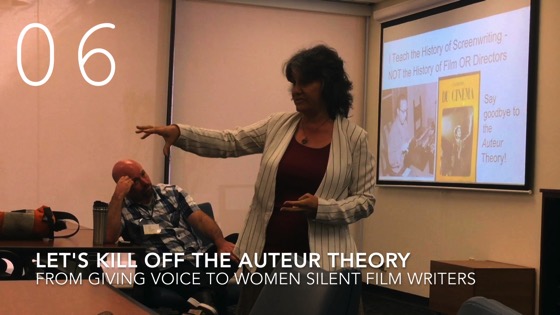
You got to the next question which is my first exercise in class — Name the writer. Lucky if they can. If it’s a writer/director, they can. Otherwise, they can’t and they suddenly are embarrassed because they adore the words of a person whose name they can’t tell you. If they have a favorite book they can tell you who wrote it, but they don’t know who wrote their favorite film. So it’s my goal to make them know that. I can’t stand the Auteur Theory because I think it’s bullshit. Directors aren’t the authors of their film. I don’t want to insult any directors in the class but you can’t direct something that doesn’t exist on the page first. It’s a collaborative thing and directors have lovely, but they’ve been given all the credit for far too long because, as we know, it goes back to all the book reviews in Cahiers and they came up with that theory. It’s nonsense.
In terms of creating the fictional identity of “Micky the Monkee”, Dolenz felt the writers created the character more so than he did: “They were looking for that guy who just jumped off the screen at them. And to say how much of it was me — I don’t know if I can quantify it. They developed that character of the wacky drummer. They gave me the funny voice. I don’t do funny voices all the time and I don’t run backward at a high rate of speed. But it was partly my personality.”
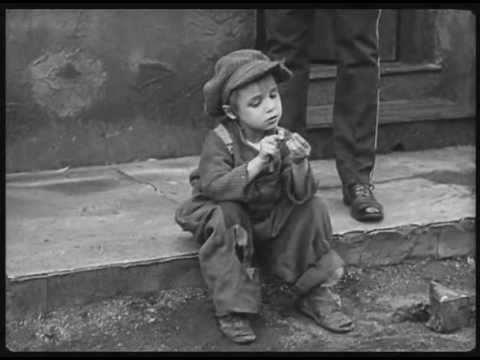
The Kid is a 1921 American silent comedy-drama film written by, produced by, directed by, and starring Charlie Chaplin, and features Jackie Coogan[4] as his adopted son and sidekick. This was Chaplin’s first full-length film as a director (he had been a co-star in 1914’s Tillie’s Punctured Romance). It was a huge success, and was the second-highest-grossing film in 1921, behind The Four Horsemen of the Apocalypse. In 2011, The Kid was selected for preservation in the United States National Film Registry by the Library of Congress as being “culturally, historically, or aesthetically significant.” Innovative in its combination of comedic and dramatic elements,[5] The Kid is widely considered one of the greatest films of the silent era.[6] — Wikipedia
* A portion of each sale from Amazon.com directly supports our blogs ** Many of these books may be available from your local library. Check it out! † Available at the LA Public Library
This is about strategies in teaching film and television history and current events — which is what David will do when I am done — and so, gee, I’m all about the chicks so we have Dorothy Parker and we have Tina Fey. There is a direct line between those women and if you love Tina Fey then you had better study a little bit of Dorothy Parker or you don’t understand why Tina Fey works today. So, why study screenwriting history? That’s actually the first screen of a lecture that I give on this very topic to my students on opening day because when you mention movies nobody says, “You know I love that shot in… ” They say, “My name is Inigo Montoya.You killed my father. Prepare to Die.” They remember the words in the movies. They remember the screenwriting, but when we look at the history of tv and film, we’re not doing that. We’re teaching directors. Everyone can name their favorite films and they can normally name the director of those films.
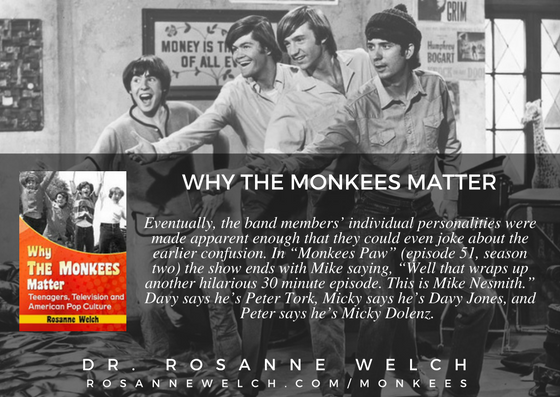
Eventually, the band members’ individual personalities were made apparent enough that they could even joke about the earlier confusion. In “Monkees Paw” (episode 51, season two) the show ends with Mike saying, “Well that wraps up another hilarious 30 minute episode. This is Mike Nesmith.” Davy says he’s Peter Tork, Micky says he’s Davy Jones, and Peter says he’s Micky Dolenz.
Updated and expanded for the third edition, this volume combines scholarship with movie lore to present a comprehensive account of the development and influence of the American screenwriter. The text is written in an informal style and includes anecdotes and stories that spotlight writer’s creative work and their struggle to achieve recognition.— Amazon
* A portion of each sale from Amazon.com directly supports our blogs *
I teach several classes for the Stephens College Low-Residency MFA in Screenwriting, including History of Screenwriting. In fact, I created the curriculum for that course from scratch and customized it to this particular MFA in that it covers ‘Screenwriting’ (not directors) and even more specifically, the class has a female-centric focus. As part History of Screenwriting I, the first course in the four-class series, we focus on the early women screenwriters of the silent film era who male historians have, for the most part, quietly forgotten in their books. In this series, I share with you some of the screenwriters and films that should be part of any screenwriters education. I believe that in order to become a great screenwriter, you need to understand the deep history of screenwriting and the amazing people who created the career. — Dr. Rosanne Welch


 †
†


 †
†