One attendee comment made my evening, “This panel was both inspirational and aspirational!”
Tonight: This panel of rockstar writers shares their process for crafting strong female characters. Thanks for moderating, @rosannewelch! pic.twitter.com/W8FUfWWSz6
In honor of Sinatra’s 100th birthday, Pete Hamill’s classic tribute returns with a new introduction by the author.
In this unique homage to an American icon, journalist and award-winning author Pete Hamill evokes the essence of Sinatra–examining his art and his legend from the inside, as only a friend of many years could do. Shaped by Prohibition, the Depression, and war, Francis Albert Sinatra became the troubadour of urban loneliness. With his songs, he enabled millions of others to tell their own stories, providing an entire generation with a sense of tradition and pride belonging distinctly to them.
With a new look and a new introduction by Hamill, this is a rich and touching portrait that lingers like a beautiful song. — Amazon
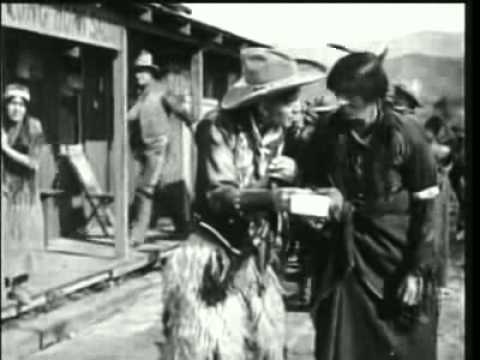
This first screen version of the story was the legendary DeMille’s first movie assignment. It also holds the distinction of being the first feature-length movie filmed specifically in Hollywood. DeMille wanted to emphasize the outdoors and wanted to shoot the movie in a place that had exotic scenery and great vistas. Initially he traveled to Flagstaff, Arizona to film the movie.[3] After seeing the vast amount of mountains near Flagstaff; the filming was moved to the Los Angeles area. It was not the first film to be made in the Los Angeles area, and film historians agree that shorts had previously been filmed in Hollywood, with In Old California considered the earliest. Harbor scenes were shot in San Pedro, California and the western saloon set was built beside railroad tracks in the San Fernando Valley. Footage of cattle on the open range were shot at Keen Camp near Idyllwild, California, while snow scenes were shot at Mount Palomar.[4] Cecil B. DeMille felt that lighting in a movie was extremely important and viewed it as the visual and emotional foundation to build his image. He believed that lighting was to a film as “music is to an opera”.[1]
The Squaw Man went on to become the only movie successfully filmed three times by the same director/producer, DeMille. He filmed a silent remake in 1918, and a talkieversion in 1931. The Squaw Man was 74 minutes long and generated $244,700 in profit.[1] — Wikipedia
* A portion of each sale from Amazon.com directly supports our blogs ** Many of these books may be available from your local library. Check it out!
I teach several classes for the Stephens College Low-Residency MFA in Screenwriting, including History of Screenwriting. In fact, I created the curriculum for that course from scratch and customized it to this particular MFA in that it covers ‘Screenwriting’ (not directors) and even more specifically, the class has a female-centric focus. As part History of Screenwriting I, the first course in the four-class series, we focus on the early women screenwriters of the silent film era who male historians have, for the most part, quietly forgotten in their books. In this series, I share with you some of the screenwriters and films that should be part of any screenwriters education. I believe that in order to become a great screenwriter, you need to understand the deep history of screenwriting and the amazing people who created the career. — Dr. Rosanne Welch
Gangster films are one of the writers’ favorite genres to parody, enjoying giving Micky Dolenz a chance to do his Jimmy Cagney impression three times in the first season. This happened in “Monkees in a Ghost Town”, which also parodied John Steinbeck’s Of Mice and Men, and in “Monkees ala Carte”, which was rife with Italian-American clichés from meatballs to machine guns.
A Trip to the Moon (French: Le Voyage dans la Lune)[a] is a 1902 French silent film directed by Georges Méliès. Inspired by a wide variety of sources, including Jules Verne‘s novels From the Earth to the Moon and Around the Moon, the film follows a group of astronomers who travel to the Moon in a cannon-propelled capsule, explore the Moon’s surface, escape from an underground group of Selenites (lunar inhabitants), and return to Earth with a captive Selenite. It features an ensemble cast of French theatrical performers, led by Méliès himself in the main role of Professor Barbenfouillis, and is filmed in the overtly theatrical style for which Méliès became famous.
The film was an internationally popular success on its release, and was extensively pirated by other studios, especially in the United States. Its unusual length, lavish production values, innovative special effects, and emphasis on storytelling were markedly influential on other film-makers and ultimately on the development of narrative film as a whole. Scholars have commented upon the film’s extensive use of pataphysical and anti-imperialist satire, as well as on its wide influence on later film-makers and its artistic significance within the French theatrical féerie tradition. Though the film disappeared into obscurity after Méliès’s retirement from the film industry, it was rediscovered around 1930, when Méliès’s importance to the history of cinema was beginning to be recognized by film devotees. An original hand-colored print was discovered in 1993 and restored in 2011.
A Trip to the Moon was named one of the 100 greatest films of the 20th century by The Village Voice, ranked 84th.[6] The film remains the best-known of the hundreds of films made by Méliès, and the moment in which the capsule lands in the Moon’s eye remains one of the most iconic and frequently referenced images in the history of cinema. It is widely regarded as the earliest example of the science fiction film genre and, more generally, as one of the most influential films in cinema history. — Wikipedia
* A portion of each sale from Amazon.com directly supports our blogs ** Many of these books may be available from your local library. Check it out!
I teach several classes for the Stephens College Low-Residency MFA in Screenwriting, including History of Screenwriting. In fact, I created the curriculum for that course from scratch and customized it to this particular MFA in that it covers ‘Screenwriting’ (not directors) and even more specifically, the class has a female-centric focus. As part History of Screenwriting I, the first course in the four-class series, we focus on the early women screenwriters of the silent film era who male historians have, for the most part, quietly forgotten in their books. In this series, I share with you some of the screenwriters and films that should be part of any screenwriters education. I believe that in order to become a great screenwriter, you need to understand the deep history of screenwriting and the amazing people who created the career. — Dr. Rosanne Welch
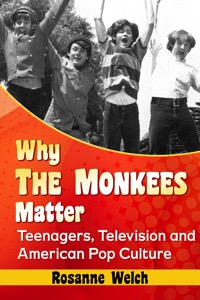
Jean Powergirl takes the host reigns and welcomes her guest Rosanne Welch, PhD to the show! They’ll be discussing Roseanne’s book, “Why The Monkees Matter: Teenagers, Television and American Pop Culture.”
Transcript:
Rosanne: One of the interesting things — it was the first show that had a set of teenagers who didn’t have a father figure or a mother who looked over them and watched over them. And Peter Tork has often said that that’s one of the things that attracted teenagers that they saw teenagers living independently and out current teenagers think of themselves as 16 and 17. These guys are 18-19 — those are still considered teenagers because you still had to wait until you were 21 to vote. You were not a full adult and…
Jean: …and if kids didn’t go to college or join the military, they still lived with their parents in American culture and they have a job and they have to do things.
Rosanne: So they were teenagers.
Jean: Isn’t he the one whos mother invented Liquid Paper? Yes, that’s always…so, the funny thing was he wasn’t going to get that inheritance till later in life. So he didn’t have much cash as a young man. He got on the show and made a ton of cash and has admitted in other interviews that he spent it all on cars and pretty much bankrupted himself when everything was done and had to revive — he began a video company in Northern California that was very successful and so he’s quite well off these days.
A hit television show about a fictitious rock band, The Monkees (1966-1968) earned two Emmys–Outstanding Comedy Series and Outstanding Directorial Achievement in Comedy. Capitalizing on the show’s success, the actual band formed by the actors, at their peak, sold more albums than The Beatles and The Rolling Stones combined and set the stage for other musical TV characters from The Partridge Family to Hannah Montana. In the late 1980s, the Monkees began a series of reunion tours that continued into their 50th anniversary.
This book tells the story of The Monkees and how the show changed television, introducing a new generation to the fourth-wall-breaking slapstick created by Laurel and Hardy and the Marx Brothers. Its creators contributed to the innovative film and television of 1970s with projects like Bob & Carol & Ted & Alice, The Mary Tyler Moore Show, Laugh-In and Welcome Back, Kotter. Immense profits from the show, its music and its merchandising funded the producers’ move into films such as Head, Easy Rider and Five Easy Pieces.
Rosanne Welch, PhD has written for television (Touched by an Angel, Picket Fences) and print (Three Ring Circus: How Real Couples Balance Marriage, Work and Kids and The Encyclopedia of Women in Aviation and Space). In the documentary world she has written and produced Bill Clinton and the Boys Nation Class of 1963 for ABC NEWS/Nightline and consulted on PBS’s A Prince Among Slaves, the story of a prince from West Africa who was enslaved in the 1780s, freed by order of President John Quincy Adams in the 1820s and returned to his homeland.
Into a photography studio full of large fantastic machines steps an elderly couple. The bearded proprietor explains the equipment and gives them a demonstration and projects a painting of three women onto a large screen; suddenly the women begin to move. The customers are impressed. First the women sits in the special seat: she’s projected onto the screen, and her good nature comes out in the laughing image. Then it’s the man’s turn, but on the screen it projects a painted, apelike Friar Tuck face. The man gets angry and tries to wreck the machine getting an electric jolt in the process. – Silent Film House
* A portion of each sale from Amazon.com directly supports our blogs ** Many of these books may be available from your local library. Check it out!
I teach several classes for the Stephens College Low-Residency MFA in Screenwriting, including History of Screenwriting. In fact, I created the curriculum for that course from scratch and customized it to this particular MFA in that it covers ‘Screenwriting’ (not directors) and even more specifically, the class has a female-centric focus. As part History of Screenwriting I, the first course in the four-class series, we focus on the early women screenwriters of the silent film era who male historians have, for the most part, quietly forgotten in their books. In this series, I share with you some of the screenwriters and films that should be part of any screenwriters education. I believe that in order to become a great screenwriter, you need to understand the deep history of screenwriting and the amazing people who created the career. — Dr. Rosanne Welch
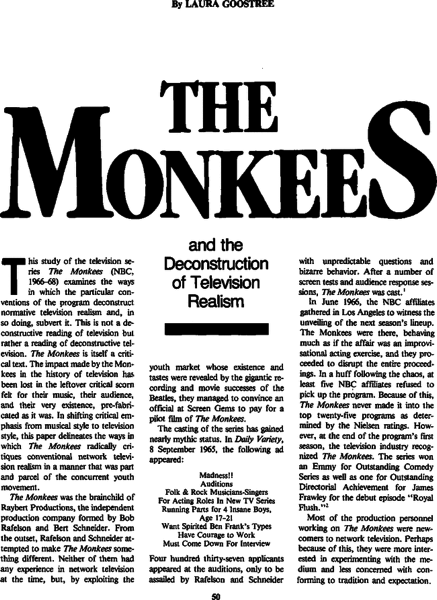
Unlike Get Smart where the only genre they parodied was spy thriller, on The Monkees the writers were free to parody them all, again keeping the audience guessing. Across the run of the show they would parody Hollywood films, gangster movies, monster movies, racing films, motorcycle sagas and a slew of other styles.




![14: More On Michael Nesmith and The Monkees : “Why The Monkees Matter” Interview with Jean Power [Video] (1:00)](https://rosannewelch.com/wp-content/uploads/2017/08/rmw-power-14-nesmith-2.jpeg)