A History of Screenwriting – 3 in a series – Making An American Citizen (1912) – Alice Guy Blaché

I teach several classes for the Stephens College Low-Residency MFA in Screenwriting, including History of Screenwriting. In fact, I created the curriculum for that course from scratch and customized it to this particular MFA in that it covers ‘Screenwriting’ (not directors) and even more specifically, the class has a female-centric focus.  As part History of Screenwriting I, the first course in the four-class series, we focus on the early women screenwriters of the silent film era  who male historians have, for the most part, quietly forgotten in their books. In this series, I share with you some of the screenwriters and films that should be part of any screenwriters education. I believe that in order  to become a great screenwriter, you need to understand the deep history of screenwriting and the amazing people who created the career. — Dr. Rosanne Welch


Making An American Citizen (1912) – Alice Guy Blaché

A History of Screenwriting  - 3 in a series - Making An American Citizen (1912) - Alice Guy Blaché

Making an American Citizen is a 1912 silent comedy short film by the pioneering French woman filmmaker Alice Guy-Blaché, produced at Solax Studios.[1] Originally advertised as “educational drama” or “educational subject,” it grapples with the theme of immigration, assimilation, and of becoming a “good American.”[2][3] The film carries an explicit feminist message: the lopsided power dynamics in an immigrant couple becomes increasingly equalized, as the couple spends more time in America. The wife learns to stand up to her husband’s abuses, while the husband is repeatedly coerced by other American citizens into treating his wife as his equal, until he is able to internalize the ethos of the Progressive Era. The film works to allay anxieties over Eastern European immigrant men bringing “Old World” patriarchal values and practices to the “New World.”[4][5] — Wikipedia

Alice Guy Blaché on Wikipedia


Learn more about Alice Guy Blaché

Books on Alice Guy Blaché

* A portion of each sale from Amazon.com directly supports our blogs
** Many of these books may be available from your local library. Check it out! 


When Women Ran Hollywood: Citizen Jane Film School 2016 [Video] (1 hour)

I am so proud and excited to post this link to the presentations 5 of my Stephens College MFA in Screenwriting students made at this year’s Citizen Jane Film Festival.  The event was titled:  When Women Ran Hollywood: Meet 5 Female Screenwriters Who Helped Invent Hollywood.  My students gave tight, ten minute presentations on female screenwriters who we should all know – women like Anita Loos and Adela Rogers St. Johns – whose biographies I had read as a child in Cleveland – and women like Frances Goodrich Hackett, who I hadn’t heard of until I began my own PhD dissertation – and finally Eve Unsell and Jeanie MacPherson.  

Rather than be new names to most all of you we ought to recognize these women’s names – and accomplishments –  much as we instantly recognize the names of the male directors of early Hollywood. Sadly, historians frequently left the women’s names out of the books so this course and this assignment are an exercise in bringing Anita, Adela, Frances, Eve and Jeanie back into the mainstream conversation about the art – and history – of screenwriting.

The students I have to thank for researching, writing and presenting on these women – and then trekking out to Columbia, Missouri (home of Stephens College) to share their findings with the larger community of scholars – are Toni Anita Hull, Amelia Phillips, Laura Kirk, Sarah Whorton and Julie Berkobien.
Watch and learn – and fall in love with all 10 of these women all over again – or for the first time.

When Women Ran Hollywood: Citizen Jane Film School 2016 [Video] (1 hour)

CJ Film School 2016 When Women Ran Hollywood from CitizenJaneFilmFestival on Vimeo.

The Stephens College MFA in Screenwriting is proud to present five of our fabulous MFA students who will in turn introduce the audience to five female screenwriters whose work we know, but whose names have been left out of the textbooks. Help us write them back in and remind us all that Women Ran Hollywood once and are on their way to doing it again!

  • Rosanne Welch, Master of Fine Arts in TV and Screenwriting Professor
  • Toni Anita Hull, Master of Fine Arts in TV and Screenwriting Candidate
  • Amelia Phillips, Master of Fine Arts in TV and Screenwriting Candidate
  • Laura Kirk, Master of Fine Arts in TV and Screenwriting Candidate
  • Sarah Whorton, Master of Fine Arts in TV and Screenwriting Candidate
  • Julie Berkobien, Master of Fine Arts in TV and Screenwriting Candidate

Quotes from “Why The Monkees Matter” by Dr. Rosanne Welch – 42 in a series – Mexicans, Italians and Jews

** Buy “Why The Monkees Matter” Today **

Quotes from

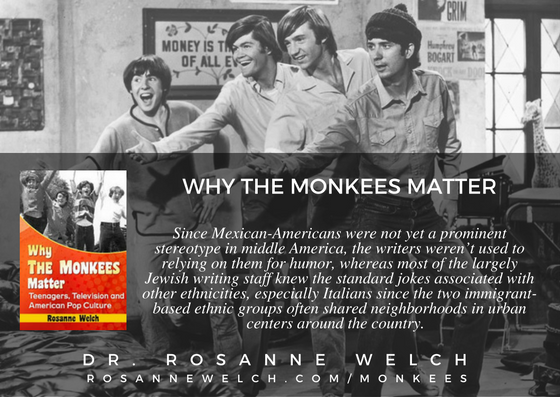
Since Mexican-Americans were not yet a prominent stereotype in middle America, the writers weren’t used to relying on them for humor, whereas most of the largely Jewish writing staff knew the standard jokes associated with other ethnicities, especially Italians since the two immigrant-based ethnic groups often shared neighborhoods in urban centers around the country.  

from Why The Monkees Mattered by Dr. Rosanne Welch —  Buy your Copy today!

 Why The Monkees Matter: Teenagers, Television and American Pop Culture


McFarland (Direct from Publisher) | Amazon | Kindle Edition | Nook Edition

More On Adapting The Prince of Tides from A History of the Art of Adaptation [Video] (1:00)

You Can Please Some of the People Some of the Time… None of the People All of the Time: A History of the Art of Adaptation in Movies like Dune, The Godfather, Harry Potter and More!

Dr. Rosanne Welch speaks on A History of the Art of Adaptation in Movies like Dune, The Godfather, Harry Potter and More! at the California State University, Fullerton Library

Part of the program series for Dune by Frank Herbert: A 50th Anniversary Celebration.

Watch this entire presentation

More On Adapting The Prince of Tides from A History of the Art of Adaptation


Transcript:

It all takes place in New York City, because that’s where the therapist lives and where the girl has gone. When we turn it into a movie Barbra Streisand and the staff completely took out the second brother. He’s already dead when the book starts. Instead of flashbacking to him, she just said “Nevermind. We don’t care” and the title of book “Prince of Tides” is Luke Wingo. by kicking him out of the story she turns that into being Tom, the main character. So many people who adored the book and adored this character Luke were angry because not only did she erase him, but they reconfigured where his nickname went. That’s a huge change from the original mention in the book, but it tightened the movie, because the movie, in the end, is a love story between the guy and the therapist. That is part of the novel, but not the focus of the novel. So, her she’s going to star in the thing. She’s going to play the therapist. Guess who’s going to be the more important character? Sorry. You want Barbra Streisand to make your move, that’s what you are going to get.   

About this talk

Dr. Rosanne Welch (RTVF) speaks on the craft of history of film adaptations from the controversy of the silent film Birth of a Nation (protested by the National Association for the Advancement of Colored People in 1915) to Breakfast at Tiffany’s (to which author Truman Capote famously said, “The only thing left from the book is the title”) to The Godfather . Naturally, the behemoth in adaptation – Harry Potter (which depended on the relationship created by adapter Steve Kloves and author J.K. Rowling) will be discussed, as will the subject of this month’s celebration: Dune.

Date: Wednesday, October 14, 2015 Time: 1:00pm – 2:00pm

About Dr. Rosanne Welch

Dr. Rosanne Welch is a professor in the Low Residency MFA in Screenwriting Program from Stephens College, California State University, Fullerton, Mount San Antonio Community College and Cal Poly Pomona.  In 2007, she graduated with her Ph.D. in 20th Century U.S./Film History from Claremont Graduate University.  She graduated with her M.A. in 20th Century United States History from California State University, Northridge in 2004.

Welch is also a television writer/producer with credits for Beverly Hills 90210 , CBS’s Emmy winning Picket Fences and Touched By An Angel . She also writes and hosts her own podcasts on 3rdPass.media, her first one titled “Mindful(I) Media with Dr. Rosanne Welch.”

Her upcoming book, “Why The Monkees Matter: Teenagers, Television and American Pop Culture” will be published in Fall 2016

Three Ring Circus: How Real Couples Balance Marriage, Work and Kids and The Encyclopedia of Women in Aviation and Space are two books she has written. Los Angeles Times and the Journal of Screenwriting hold some of her published articles.

Dr. Rosanne Welch Web Site and Blog

Follow Dr. Welch on Twitter

Dr. Rosanne Welch on YouTube

From the Index… The V’s & W’s – “Why The Monkees Matter”

Wonder what and who I mentioned in “Why The Monkees Matter”? Check out these index entries!

vampire  87, 93, 102

Van Zandt, Steven  68

Vaughn, Ondine  79

Veronica Mars  22

Vietnam War  1, 7,  25-26, 34, 40-41, 50, 55, 108, 147, 155-156

Vigo, Mark  104


“Waist Deep in the Big Muddy”  24, 40

Walker, Jimmy  69

Wagner, Robert  119

We Love The Monkees  124

Webber, Sir Andrew Lloyd  107

Weinberger, Jack  81

Welcome Back, Kotter  50, 53

Weld, Tuesday  17

Werts, Diane  41

West Side Story  16, 17, 21

Where The Action Is  19

Where’s Charley?  111

“The Wild Monkees”  35, 62, 65, 97

Wilder, Billy  111

Williams, Andy  19

Williams, Jack  83, 100-102

Willis, Alee  150-151

Wilson, Brian  14

Wilson, Cassandra  151

Winkler, Henry  8, 119

Winter, Jack  38, 39, 74, 80, 98, 102

Winters, David  16, 96

Wiz, The  69

Wizard of Oz, The  111

WKRP in Cincinnati  69

Wolfman, The  35, 89, 93, 97, 114

Wood, Natalie  13, 17-18

“Words”  99

World War II  12, 25-26, 110

Written By  1, 2


 Why The Monkees Matter: Teenagers, Television and American Pop Culture


McFarland (Direct from Publisher) | Amazon | Kindle Edition | Nook Edition

A History of Screenwriting – 2 in a series – The Birth, the Life and the Death of Christ (1906)

I teach several classes for the Stephens College Low-Residency MFA in Screenwriting, including History of Screenwriting. In fact, I created the curriculum for that course from scratch and customized it to this particular MFA in that it covers ‘Screenwriting’ (not directors) and even more specifically, the class has a female-centric focus.  As part History of Screenwriting I, the first course in the four-class series, we focus on the early women screenwriters of the silent film era  who male historians have, for the most part, quietly forgotten in their books. In this series, I share with you some of the screenwriters and films that should be part of any screenwriters education. I believe that in order  to become a great screenwriter, you need to understand the deep history of screenwriting and the amazing people who created the career. — Dr. Rosanne Welch


The Birth, the Life and the Death of Christ (1906) – Alice Guy Blaché

A History of Screenwriting  - 2 in a series - The Birth, the Life and the Death of Christ (1906)

Alice Guy Blaché on Wikipedia

Read more about this film on Silent Volume

Learn more about Alice Guy Blaché

Books on Alice Guy Blaché

* A portion of each sale from Amazon.com directly supports our blogs
** Many of these books may be available from your local library. Check it out! 


2016 – A Publication Packed Year!

Dr. Rosanne Welch with Peter Tork and Micky Dolenz of The Monkees

Rmw book soup bnw

My book on The Monkees — Why The Monkees Matter — brought great joy into my life this year – allowing me to host a few book signings, attend a few concerts, meet a few of the more fabulous members of the Zilch Podcast Nation and even resulted in my being invited into the (marvelous and mind-blowing to my inner nine-year-old) St. Louis concert VIP photo op line where I had this lovely photo taken with Micky and Peter (and saw to it that they both had copies of the book).

Listen to my Zilch Podcast Interview about Why The Monkees Matter

Order your copy today 

Wow!  Isn’t that enough for one year?  

But I don’t want to slight the other, shorter works I published this year which included:

How Television Writers Transmit Cultures Transnationally via the Parent Characters Created for Police Procedurals
New Review of Film and Television Studies edited by Paolo Russo & Lindsay Steenberg

Read It Now!

Rfts20 v014 i04 cover

How William Shatner’s Chest Inspired one (or more) Female Television Writers to Succeed in the Boys Club of Hollywood
covering the episode:This Side of Paradise
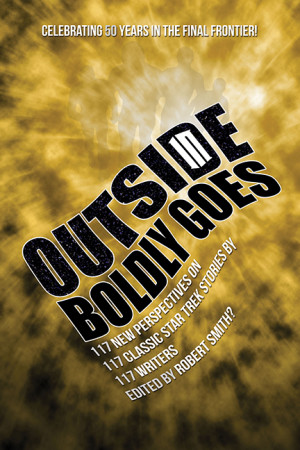
Outside In Boldly Goes…: 117 Unique Perspectives on 117 Original Star Trek Stories by 117 Writers”
ATB Publishing.

Order Your Copy Today

In 2017 I’m looking forward to seeing these projects published:

PERFORM: Succeeding as a Creative Professional.
Chapter 5 Essay. Starting Over: “Everything I Need To Know About A Career In Hollywood I Learned From Writing Scripts” 
Editor: Anna Weinstein.  January 2017

Blue and Gray in Black and White and Color
Chapter: “Hidden Behind Hoopskirts: The Many Women of Hollywood’s Civil War Sagas”, “
Doug Brode, editor, 2018. 

Women in American History: A Social, Political, and Cultural Encyclopedia and Document Collection
ABC-CLIO Publishing, January 2017 (a full 4 volume collection)

Share this encyclopedia with your your local librarian 

And my co-editor Peg Lamphier and I are already in production on our 2018 release:

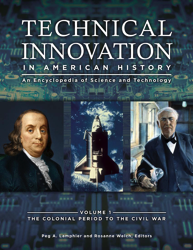
Technical Innovation in American History: An Encyclopedia of Science and Technology. ABC-CLIO Publishing, Spring 2018. 

Technical Innovation in American History: An Encyclopedia of Science and Technology

Quotes from “Why The Monkees Matter” by Dr. Rosanne Welch – 41 in a series – Ethnic Studies

** Buy “Why The Monkees Matter” Today **

Quotes from

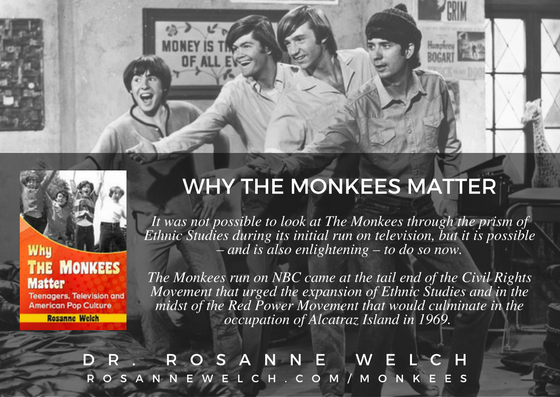
It was not possible to look at The Monkees through the prism of Ethnic Studies during its initial run on television, but it is possible – and is also enlightening – to do so now. 

The Monkees run on NBC came at the tail end of the Civil Rights Movement that urged the expansion of Ethnic Studies and in the midst of the Red Power Movement that would culminate in the occupation of Alcatraz Island in 1969. 

from Why The Monkees Mattered by Dr. Rosanne Welch —  Buy your Copy today!

 Why The Monkees Matter: Teenagers, Television and American Pop Culture


McFarland (Direct from Publisher) | Amazon | Kindle Edition | Nook Edition

Adapting The Prince of Tides from A History of the Art of Adaptation [Video] (1:03)

You Can Please Some of the People Some of the Time… None of the People All of the Time: A History of the Art of Adaptation in Movies like Dune, The Godfather, Harry Potter and More!

Dr. Rosanne Welch speaks on A History of the Art of Adaptation in Movies like Dune, The Godfather, Harry Potter and More! at the California State University, Fullerton Library

Part of the program series for Dune by Frank Herbert: A 50th Anniversary Celebration.

Watch this entire presentation

Adapting The Prince of Tides from A History of the Art of Adaptation


Transcript:

Here’s one of the most controversial adaptations over the last 15 years. Pat Conroy and The Prince of Tides which was purchased by Barbra Streisand’s company to be turned into a film. People who read Conroy’s stuff — and particularly this novel — they were so in love with this book and I must say, I read it after I saw the movie, so it was a very unique experience. Had I read it first, I might have been on their side and angry with how the movie came out, but I didn’t. So, I didn’t understand and the movies, I thought, was quite well done. It got many Oscar nominations and whatnot. The story here is about a southern family  — Tome Wingo is our lead character — the sister, Savannah, the brother Luke — who has committed suicide in the course of the novel and this therapist, Susan Lowenstein, who is played by Barbra Streisand who also directed the film. So, in the book, we have the family and the therapist and the therapist is working with the girl, Savannah, because she has tried to commit suicide and so we have to understand that it all traces back to this dark day in the family where this awful thing happened and the mother covered it up.    

About this talk

Dr. Rosanne Welch (RTVF) speaks on the craft of history of film adaptations from the controversy of the silent film Birth of a Nation (protested by the National Association for the Advancement of Colored People in 1915) to Breakfast at Tiffany’s (to which author Truman Capote famously said, “The only thing left from the book is the title”) to The Godfather . Naturally, the behemoth in adaptation – Harry Potter (which depended on the relationship created by adapter Steve Kloves and author J.K. Rowling) will be discussed, as will the subject of this month’s celebration: Dune.

Date: Wednesday, October 14, 2015 Time: 1:00pm – 2:00pm

About Dr. Rosanne Welch

Dr. Rosanne Welch is a professor in the Low Residency MFA in Screenwriting Program from Stephens College, California State University, Fullerton, Mount San Antonio Community College and Cal Poly Pomona.  In 2007, she graduated with her Ph.D. in 20th Century U.S./Film History from Claremont Graduate University.  She graduated with her M.A. in 20th Century United States History from California State University, Northridge in 2004.

Welch is also a television writer/producer with credits for Beverly Hills 90210 , CBS’s Emmy winning Picket Fences and Touched By An Angel . She also writes and hosts her own podcasts on 3rdPass.media, her first one titled “Mindful(I) Media with Dr. Rosanne Welch.”

Her upcoming book, “Why The Monkees Matter: Teenagers, Television and American Pop Culture” will be published in Fall 2016

Three Ring Circus: How Real Couples Balance Marriage, Work and Kids and The Encyclopedia of Women in Aviation and Space are two books she has written. Los Angeles Times and the Journal of Screenwriting hold some of her published articles.

Dr. Rosanne Welch Web Site and Blog

Follow Dr. Welch on Twitter

Dr. Rosanne Welch on YouTube

From the Index… The T’s & U’s – “Why The Monkees Matter”

Wonder what and who I mentioned in “Why The Monkees Matter”? Check out these index entries!

Tayback, Vic  21, 70, 73

Taylor, Rip  92

Teen Wolf  114

Television Parts  155

Temple, Shirley  13

Ten Little Indians  113

That Girl  13, 55

That Was The Week That Was  46, 113

30 Rock  109

Thriller  117

Tick, The  155

Tiger Beat  124

Tinker, Grant  96

Tolkien, J.R.R.  31

“Too Many Girls”  77, 88, 98, 116, 132

Tootsie  111

Top of the Pops  66

Tork, Peter  2, 3, 6-7, 10, 14, 21-22, 24-27, 29-37, 39-41, 45, 47, 50, 52, 55, 59-63, 65, 69-70, 72-76, 78, 80-81, 87-93, 95-100, 103-104, 107-109, 111-112, 115, 118, 120-121, 123-129, 132, 134-138, 140, 142-145, 148-149, 151-152, 154-156

Transcendental Meditation  32

Treasure of the Sierra Madre, The  91

Trillin, Calvin  113

Truffaut, Francois  43

Tubor, Morton  96

Tucker, Larry  27, 44, 46, 57, 84

Tuesdays with Morrie  133

Turteltaub, Saul  113

Turtles, The  152

TV Guide  17, 83, 89, 144

Twain, Mark  112

26th Amendment  156

Twilight Zone, The  84

Two and a Half Men  53


Ullrich, Lars  152


 Why The Monkees Matter: Teenagers, Television and American Pop Culture


McFarland (Direct from Publisher) | Amazon | Kindle Edition | Nook Edition