Quotes from “Why The Monkees Matter” by Dr. Rosanne Welch – 70 in a series – Gangsters

** Buy “Why The Monkees Matter” Today **

Quotes from

Gangster films are one of the writers’ favorite genres to parody, enjoying giving Micky Dolenz a chance to do his Jimmy Cagney impression three times in the first season. This happened in “Monkees in a Ghost Town”, which also parodied John Steinbeck’s Of Mice and Men, and in “Monkees ala Carte”, which was rife with Italian-American clichés from meatballs to machine guns. 

from Why The Monkees Mattered by Dr. Rosanne Welch —  Buy your Copy today!

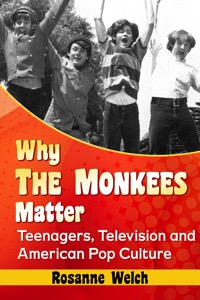
 Why The Monkees Matter: Teenagers, Television and American Pop Culture


McFarland (Direct from Publisher) | Amazon | Kindle Edition | Nook Edition

15: Micky Dolenz and The Monkees : “Why The Monkees Matter” Interview with Jean Power [Video] (1:04)

Rosanne Welch talks about “Why The Monkees Matter” with Jean Hopkins Power

Watch this entire presentation (45 mins)

Jean Powergirl takes the host reigns and welcomes her guest Rosanne Welch, PhD to the show! They’ll be discussing Roseanne’s book, “Why The Monkees Matter: Teenagers, Television and American Pop Culture.”

15: Micky Dolenz and The Monkees : “Why The Monkees Matter” Interview with Jean Power [Video] (1:04)


Transcript:

Jean: So let’s talk about our second Monkee here. Who’s this guy on the drums?

Rosanne: On the drums, we have Micky Dolenz who came to this audition as a child actor. He’d been in a show called Circus Boy when he was 10, but in that show his father George Dolenz was the star of a show in the 50’s called The Count of Monte Cristo and so they didn’t want to look like nepotism and also Micky Dolenz provides — on this show, believe it or not, because when you look at the pictures he looks like a white boy. He was….

Jean: They’re all white. So there’s an ethnicity here.

Rosanne: The Italians were still a weird ethnic group in the 1960s. We don’t have The Godfather yet. We don’t have any main…

Jean: …Corleones…

Rosanne: No. Exactly, so and it’s interesting to me in studying this, had the show been made 5 years later, they would have had an African-American character. I mean this was the trend in the civil rights movement, but they weren’t there yet. So, to them. the most ethnically odd was this guy because he was Italian.

Jean:…and Rosanne is Italian-American…

Rosanne: Exactly. So, of course, I was drawn to that character because that was representative of my culture on television.

Get your copy today!

A hit television show about a fictitious rock band, The Monkees (1966-1968) earned two Emmys–Outstanding Comedy Series and Outstanding Directorial Achievement in Comedy. Capitalizing on the show’s success, the actual band formed by the actors, at their peak, sold more albums than The Beatles and The Rolling Stones combined and set the stage for other musical TV characters from The Partridge Family to Hannah Montana. In the late 1980s, the Monkees began a series of reunion tours that continued into their 50th anniversary.

This book tells the story of The Monkees and how the show changed television, introducing a new generation to the fourth-wall-breaking slapstick created by Laurel and Hardy and the Marx Brothers. Its creators contributed to the innovative film and television of 1970s with projects like Bob & Carol & Ted & Alice, The Mary Tyler Moore Show, Laugh-In and Welcome Back, Kotter. Immense profits from the show, its music and its merchandising funded the producers’ move into films such as Head, Easy Rider and Five Easy Pieces.

Rosanne Welch, PhD has written for television (Touched by an Angel, Picket Fences) and print (Three Ring Circus: How Real Couples Balance Marriage, Work and Kids and The Encyclopedia of Women in Aviation and Space). In the documentary world she has written and produced Bill Clinton and the Boys Nation Class of 1963 for ABC NEWS/Nightline and consulted on PBS’s A Prince Among Slaves, the story of a prince from West Africa who was enslaved in the 1780s, freed by order of President John Quincy Adams in the 1820s and returned to his homeland.

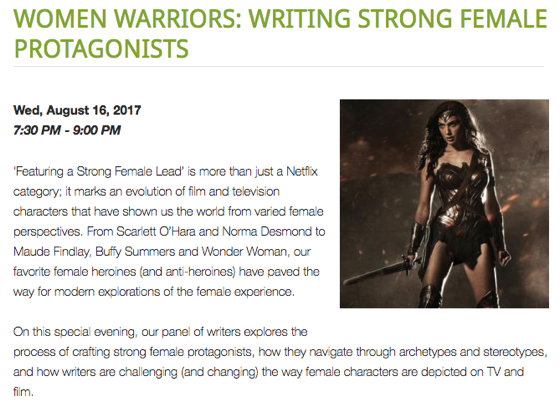
Dr. Rosanne Welch Moderates WGA Panel: Women Warriors: Writing Strong Female Protagonists – August 16, 2017

I’m so honored to have been asked to moderate this exciting panel coming up next Wednesday August 16, 2017: WOMEN WARRIORS: WRITING STRONG FEMALE PROTAGONISTS with a panel that includes Allan Heinberg (WONDER WOMAN), and Moira Walley-Beckett (ANNE WITH AN E), Amy Berg (COUNTERPART), Liz Flahive (GLOW), Carly Mensch (GLOW).

Dr. Rosanne Welch Moderates WGA Panel: Women Warriors: Writing Strong Female Protagonists - August 16, 2017

Unfortunately, this event is sold out.

‘Featuring a Strong Female Lead’ is more than just a Netflix category; it marks an evolution of film and television characters that have shown us the world from varied female perspectives. From Scarlett O’Hara and Norma Desmond to Maude Findlay, Buffy Summers and Wonder Woman, our favorite female heroines (and anti-heroines) have paved the way for modern explorations of the female experience.

On this special evening, our panel of writers explores the process of crafting strong female protagonists, how they navigate through archetypes and stereotypes, and how writers are challenging (and changing) the way female characters are depicted on TV and film.

Panelists:

Amy Berg – Amy is a writer and executive producer for film and television. She’s written for a multitude of shows including DA VINCI’S DEMONS, PERSON OF INTEREST, EUREKA, LEVERAGE, and THE 4400. She also created the award-winning digital series CAPER. Along with her feature work, she’s currently co-showrunning the upcoming Starz series COUNTERPART starring J.K. Simmons and consulting on a series for Hulu.

Liz Flahive & Carly Mensch – Creators of Netflix Original Series GLOW

Allan Heinberg – Allan is the screenwriter of the film Wonder Woman, directed by Patty Jenkins. His television writing and producing credits include The Naked Truth, Party Of Five, Sex And The City, Gilmore Girls, The O.C., Grey’s Anatomy, Looking, and Scandal. Most recently, Heinberg developed, wrote, and ran ABC’s The Catch, starring Mireille Enos and Peter Krause. For Marvel Comics, Heinberg created and wrote Young Avengers and its sequel, Avengers: The Children’s Crusade with co-creator/artist Jim Cheung. For DC Comics, Heinberg co-wrote JLA: Crisis Of Conscience with Geoff Johns (art by Chris Batista), and re-launched Wonder Woman with artists Terry and Rachel Dodson.

Moira Walley-Beckett – Moira is a multiple award winning screenwriter. She is currently the Series Creator and Executive Producer of the Netflix drama “ANNE (with an E).”

Recently, Moira created “Flesh and Bone,” a critically acclaimed Limited Series for STARZ. The drama received multiple nominations (including a GOLDEN GLOBE and a WGA nod) and won a SATELLITE AWARD, a GRACIE AWARD, and a WOMEN’S IMAGE (WIN) Award. Before creating “Flesh and Bone,” Moira spent six years as a writer and Co-Executive Producer on the critically acclaimed AMC series “Breaking Bad.” For her work on that show, Moira has won a total of three EMMY AWARDS, three WRITERS’ GUILD AWARDS, three AFI AWARDS, three SATURN AWARDS, two PGA AWARDS, a GOLDEN GLOBE, a PEABODY, and received a PEN LITERARY AWARD nomination. Before her tenure as a writer on “Breaking Bad,” Ms. Walley-Beckett wrote on the NBC dramas “Raines” and “Eli Stone,” and “Pan Am” for ABC.

Currently, Moira has a feature film, The Grizzlies, in post-production with Kennedy/Marshall and Northwood Productions. Ms. Walley-Beckett hails from Vancouver, Canada but resides in Los Angeles.

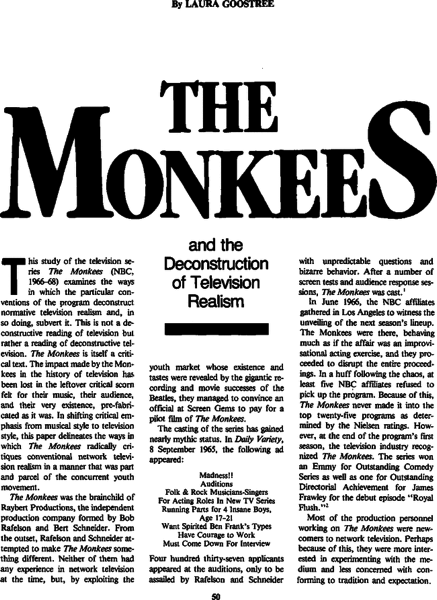
From The Research Vault: The Monkees” and the Deconstruction of Television Realism. Journal of Popular Film & Television

From The Research Vault: The Monkees” and the Deconstruction of Television Realism. Journal of Popular Film & Television

From The Research Vault: The Monkees 

Why The Monkees Matter: Teenagers, Television and American Pop Culture

Order Your Copy Now!

A History of Screenwriting – 33 in a series – A Trip to the Moon (George Méliès, France, 1902)

A History of Screenwriting – 33 in a series – A Trip to the Moon (George Méliès, France, 1902)

A History of Screenwriting - 33 in a series - A Trip to the Moon (George Méliès, France, 1902)

A Trip to the Moon (FrenchLe Voyage dans la Lune)[a] is a 1902 French silent film directed by Georges Méliès. Inspired by a wide variety of sources, including Jules Verne‘s novels From the Earth to the Moon and Around the Moon, the film follows a group of astronomers who travel to the Moon in a cannon-propelled capsule, explore the Moon’s surface, escape from an underground group of Selenites (lunar inhabitants), and return to Earth with a captive Selenite. It features an ensemble cast of French theatrical performers, led by Méliès himself in the main role of Professor Barbenfouillis, and is filmed in the overtly theatrical style for which Méliès became famous.

The film was an internationally popular success on its release, and was extensively pirated by other studios, especially in the United States. Its unusual length, lavish production values, innovative special effects, and emphasis on storytelling were markedly influential on other film-makers and ultimately on the development of narrative film as a whole. Scholars have commented upon the film’s extensive use of pataphysical and anti-imperialist satire, as well as on its wide influence on later film-makers and its artistic significance within the French theatrical féerie tradition. Though the film disappeared into obscurity after Méliès’s retirement from the film industry, it was rediscovered around 1930, when Méliès’s importance to the history of cinema was beginning to be recognized by film devotees. An original hand-colored print was discovered in 1993 and restored in 2011.

A Trip to the Moon was named one of the 100 greatest films of the 20th century by The Village Voice, ranked 84th.[6] The film remains the best-known of the hundreds of films made by Méliès, and the moment in which the capsule lands in the Moon’s eye remains one of the most iconic and frequently referenced images in the history of cinema. It is widely regarded as the earliest example of the science fiction film genre and, more generally, as one of the most influential films in cinema history. — Wikipedia


* A portion of each sale from Amazon.com directly supports our blogs
** Many of these books may be available from your local library. Check it out! 


I teach several classes for the Stephens College Low-Residency MFA in Screenwriting, including History of Screenwriting. In fact, I created the curriculum for that course from scratch and customized it to this particular MFA in that it covers ‘Screenwriting’ (not directors) and even more specifically, the class has a female-centric focus.  As part History of Screenwriting I, the first course in the four-class series, we focus on the early women screenwriters of the silent film era  who male historians have, for the most part, quietly forgotten in their books. In this series, I share with you some of the screenwriters and films that should be part of any screenwriters education. I believe that in order  to become a great screenwriter, you need to understand the deep history of screenwriting and the amazing people who created the career. — Dr. Rosanne Welch

14: More On Michael Nesmith and The Monkees : “Why The Monkees Matter” Interview with Jean Power [Video] (1:00)

Rosanne Welch talks about “Why The Monkees Matter” with Jean Hopkins Power

Watch this entire presentation (45 mins)

Jean Powergirl takes the host reigns and welcomes her guest Rosanne Welch, PhD to the show! They’ll be discussing Roseanne’s book, “Why The Monkees Matter: Teenagers, Television and American Pop Culture.”

14: More On Michael Nesmith and The Monkees : “Why The Monkees Matter” Interview with Jean Power


Transcript:

Rosanne: One of the interesting things — it was the first show that had a set of teenagers who didn’t have a father figure or a mother who looked over them and watched over them. And Peter Tork has often said that that’s one of the things that attracted teenagers that they saw teenagers living independently and out current teenagers think of themselves as 16 and 17. These guys are 18-19 — those are still considered teenagers because you still had to wait until you were 21 to vote. You were not a full adult and…

Jean: …and if kids didn’t go to college or join the military, they still lived with their parents in American culture and they have a job and they have to do things.

Rosanne: So they were teenagers.

Jean: Isn’t he the one whos mother invented Liquid Paper? Yes, that’s always…so, the funny thing was he wasn’t going to get that inheritance till later in life. So he didn’t have much cash as a young man. He got on the show and made a ton of cash and has admitted in other interviews that he spent it all on cars and pretty much bankrupted himself when everything was done and had to revive — he began a video company in Northern California that was very successful and so he’s quite well off these days.

Get your copy today!

A hit television show about a fictitious rock band, The Monkees (1966-1968) earned two Emmys–Outstanding Comedy Series and Outstanding Directorial Achievement in Comedy. Capitalizing on the show’s success, the actual band formed by the actors, at their peak, sold more albums than The Beatles and The Rolling Stones combined and set the stage for other musical TV characters from The Partridge Family to Hannah Montana. In the late 1980s, the Monkees began a series of reunion tours that continued into their 50th anniversary.

This book tells the story of The Monkees and how the show changed television, introducing a new generation to the fourth-wall-breaking slapstick created by Laurel and Hardy and the Marx Brothers. Its creators contributed to the innovative film and television of 1970s with projects like Bob & Carol & Ted & Alice, The Mary Tyler Moore Show, Laugh-In and Welcome Back, Kotter. Immense profits from the show, its music and its merchandising funded the producers’ move into films such as Head, Easy Rider and Five Easy Pieces.

Rosanne Welch, PhD has written for television (Touched by an Angel, Picket Fences) and print (Three Ring Circus: How Real Couples Balance Marriage, Work and Kids and The Encyclopedia of Women in Aviation and Space). In the documentary world she has written and produced Bill Clinton and the Boys Nation Class of 1963 for ABC NEWS/Nightline and consulted on PBS’s A Prince Among Slaves, the story of a prince from West Africa who was enslaved in the 1780s, freed by order of President John Quincy Adams in the 1820s and returned to his homeland.

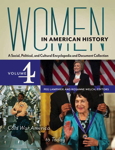
Excellent Review of Women in American History Encyclopedia from Choice, August 2017

What wonderful news to wake up to! The 4-volume Women in American History encyclopedia I co-edited with my wonderful friend Peg Lamphier received this review that shows the reviewer found all the things we tried so hard to do in the work.

From the review by R. Tolley:

“Care was taken to provide a woman’s best-known name as well as variants, and to include many lesser-known figures, including non-Protestants, lesbians, and women of color. The work is corrective in bringing those who were ignored into the story and succeeds in representing a wide spectrum of North American womanhood (including some Canadian and Mexican figures from history and folklore as well as individuals associated with the US proper and its precolonial past). Further, editors avoided gendered language and ideas reflecting patriarchal and militaristic ideology. Clarity regarding their subjects’ sexuality was another emphasis; the entry on Margaret Mead, for example, mentions her bisexuality.”

If you have a chance, send this on to a librarian you know and love – or drop a copy off at your local library and ask them to stock a set.

* A portion of each sale from Amazon.com directly supports our blogs
** Many of these books may be available from your local library. Check it out! 


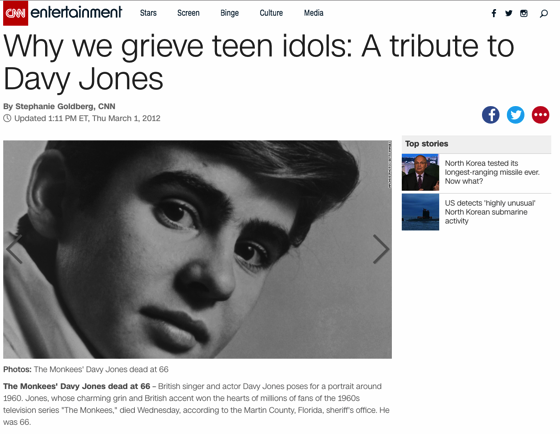
From The Research Vault: Why we grieve teen idols: A tribute to Davy Jones, CNN, March 1, 2012

From The Research Vault: Why we grieve teen idols: A tribute to Davy Jones, CNN, March 1, 2012

From The Research Vault: Why we grieve teen idols: A tribute to Davy Jones, CNN, March 1, 2012

Davy Jones was more than just the star of countless bedroom wall collages in the late 1960s. The Monkees frontman and token Brit who captivated audiences with his talent and charisma was the quintessential teen heartthrob. News of Jones’ passing (he died of a heart attack at age 66 Wednesday) prompted nostalgic outbursts from fans, all wanting to reminisce about the Tiger Beat and 16 Magazine covers, the hours logged in front of the TV, and the moments spent bopping around to “Pleasant Valley Sunday.”

Read the entire article


Why The Monkees Matter: Teenagers, Television and American Pop Culture

Order Your Copy Now!

A History of Screenwriting – 32 in a series – Long Distance Wireless Photography (George Méliès, France, 1908)

A History of Screenwriting – 32 in a series – Long Distance Wireless Photography (George Méliès, France, 1908)

A History of Screenwriting - 32 in a series - Long Distance Wireless Photography (George Méliès, France, 1905)

Into a photography studio full of large fantastic machines steps an elderly couple. The bearded proprietor explains the equipment and gives them a demonstration and projects a painting of three women onto a large screen; suddenly the women begin to move. The customers are impressed. First the women sits in the special seat: she’s projected onto the screen, and her good nature comes out in the laughing image. Then it’s the man’s turn, but on the screen it projects a painted, apelike Friar Tuck face. The man gets angry and tries to wreck the machine getting an electric jolt in the process. – Silent Film House


* A portion of each sale from Amazon.com directly supports our blogs
** Many of these books may be available from your local library. Check it out! 


I teach several classes for the Stephens College Low-Residency MFA in Screenwriting, including History of Screenwriting. In fact, I created the curriculum for that course from scratch and customized it to this particular MFA in that it covers ‘Screenwriting’ (not directors) and even more specifically, the class has a female-centric focus.  As part History of Screenwriting I, the first course in the four-class series, we focus on the early women screenwriters of the silent film era  who male historians have, for the most part, quietly forgotten in their books. In this series, I share with you some of the screenwriters and films that should be part of any screenwriters education. I believe that in order  to become a great screenwriter, you need to understand the deep history of screenwriting and the amazing people who created the career. — Dr. Rosanne Welch

Quotes from “Why The Monkees Matter” by Dr. Rosanne Welch – 69 in a series – Parodying All Genres

** Buy “Why The Monkees Matter” Today **

Quotes from

Unlike Get Smart where the only genre they parodied was spy thriller, on The Monkees the writers were free to parody them all, again keeping the audience guessing.  Across the run of the show they would parody Hollywood films, gangster movies, monster movies, racing films, motorcycle sagas and a slew of other styles. 

from Why The Monkees Mattered by Dr. Rosanne Welch —  Buy your Copy today!

 Why The Monkees Matter: Teenagers, Television and American Pop Culture


McFarland (Direct from Publisher) | Amazon | Kindle Edition | Nook Edition