The newest issue of the Journal of Screenwriting is now available via the Hugh Stephens Library.
Dr. Rosanne Welch of our Stephens College MFA in TV and Screenwriting serves as Book Review Editor and this Issue includes reviews by three graduates of our MFA program: The Girl Who Knew Too Much: Shadow of a Doubt (1943), reviewed by Mikayla Daniels (Class of 2017); Writing for the Screen, Anna Weinstein, reviewed by Yasser O. Shahin (Class of 2017); and The Heroine’s Journey: Woman’s Quest For Wholeness, Maureen Murdock, reviewed by Ilona Rossman Ho (Class of 2019).
Congratulations to Stephens College MFA in TV and Screenwriting graduate (and graduation speaker for the Class of 2019) LeeAnne Lowry who joined the University of Missouri School of Journalism yesterday teaching “Fundamentals of Visual Journalism and Strategic Communication”.
I thought I ought to share it with the whole community, so here it is… — Rosanne
As established members of the entertainment community, we are frequently asked to speak to aspiring filmmakers. And with the success of our book, The Hollywood Pitching Bible, the number of speaking invitations has greatly increased. We are now regularly invited to speak at numerous entertainment industry events, festivals, film schools and conferences.
No matter what the topic of the event, inevitably the dialogue with the audience veers onto our views about the industry in general and life in the biz. Overwhelmingly, there’s one question we get asked more than any other: “How do I get an agent?”
Often the question is asked with such intense interest that we sometimes wonder if the rest of our lecture has been “filler” for the audience who are just waiting to get to this topic. Because of the overwhelming concern with this question, we are presenting this in-depth, three-part article on the topic for the benefit of LA Screenwriter readers.
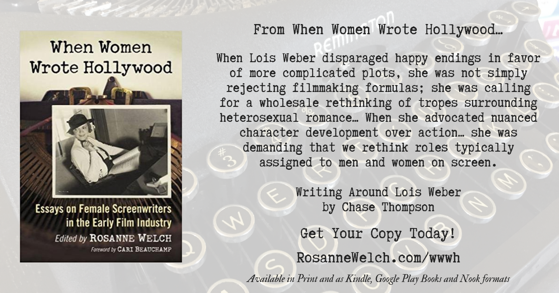
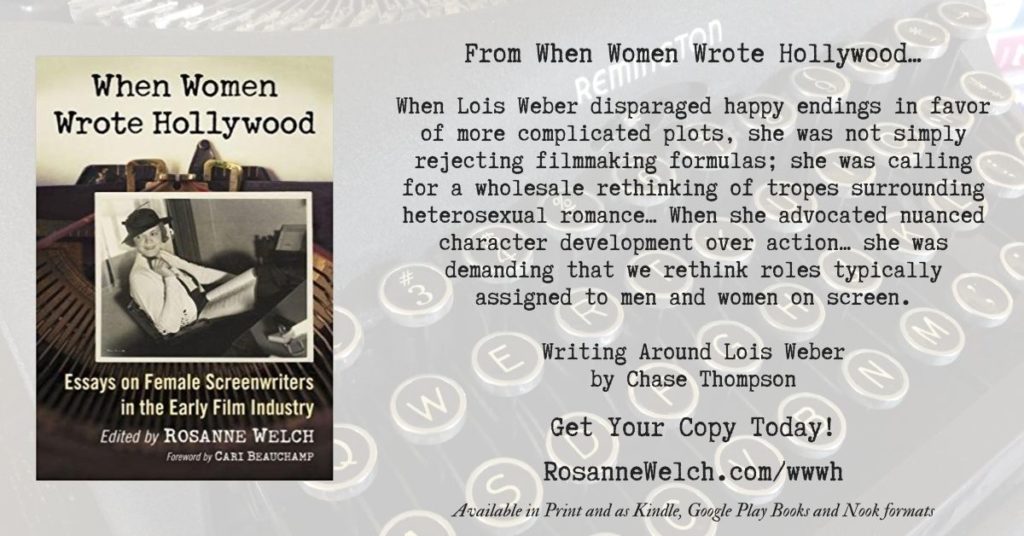
When Lois Weber disparaged happy endings in favor of more complicated plots, she was not simply rejecting filmmaking formulas; she was calling for a wholesale rethinking of tropes surrounding heterosexual romance… When she advocated nuanced character development over action… she was demanding that we rethink roles typically assigned to men and women on screen.
* A portion of each sale from Amazon.com directly supports our blogs
** Many of these books may be available from your local library. Check it out!
† Available from the LA Public Library
Here’s a great Forbes article by Shelley Zalis that our Dean recently shared about the power of women supporting women in their professional worlds.
It illustrates ideas already in place within the alumni and current students in our Stephens College MFA in TV and Screenwriting from “Finding your Squad” to “Amplifying other Women” to “Taking the ‘work’ our of ‘Networking’”. — Rosanne
I always say a woman alone has power; collectively we have impact. Traditionally we have been taught to be competitive with one another, because there was such a scarcity of jobs at the top. It’s so clear that strategy doesn’t work. The truth is that raising each other up and channeling the power of collaboration is truly how we’ll change the equation—and have a lot more fun along the way.
There is a boys’ club where women never felt comfortable, so we decided to create a Girls’ Lounge more than six years ago where everyone feels like they belong. We discovered two things:
There is power in the pack. You realize your strengths make the table better.
On Saturday, November 3rd, 2018 several of the contributors to When Women Wrote Hollywood gathered at the Skylark Bookshop in Columbia, Missouri for a signing and launch party that functioned like a mini-reunion of the Stephens College MFA in TV and Screenwriting Class of 2017.
Many thanks to all who came to hear them each speak with passion about the research subjects who became whole chapters in this book of essays on female screenwriters from the Silent Era into the 1940s.
* A portion of each sale from Amazon.com directly supports our blogs ** Many of these books may be available from your local library. Check it out! † Available from the LA Public Library
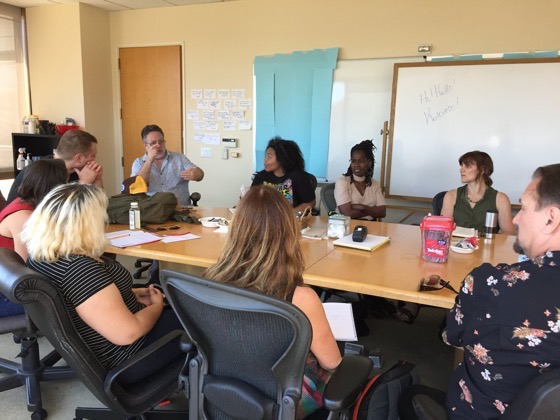
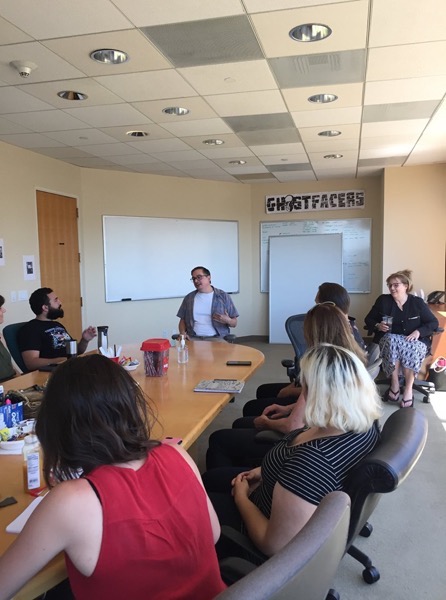
It was a double-header for the 2nd year MFA candidates when they were visited by two writers from The Big Bang Theory and Young Sheldon on consecutive nights this week. On the first night, Eric Kaplan (also a former David Letterman staff writer) came at the invitation of student CJ Ehrlich.
This one allowed me to riff on some of my favorite female science fiction writers across time, whether they be novelists or television writers. It also opened up a good conversation on what art we support and include in our lives – and what that art says to us and about us. — Rosanne
Transcript:
So she’s James, right? There there’s your buddy James. This is a marvelous new book about her life. So really gets into the story of what she was doing and why. I really like autobiographies or biographies because it’s fun. You learn so much about a historical period when you read someone’s individual story and how they worked in the world and society as it was allowing them at the time. So this is actually a book about Alice Sheldon. This lady, Alice Mary Norton, had to be Andre because the boy’s name right? Andre is writing all of these books and look at her again, not the face you imagine when you think of a science fiction writer. She looks like somebody’s great aunt. But why shouldn’t your great-aunt write a really good book, right? Why did we not allow those two things to live in our brain at the same time? So I think it’s really interesting and her stuff is really fascinating. You know we’re all into swords and all that sort of thing. She’s doing the whole Game Of Thrones thing long before we get involved in that right? So we need to give her a little more credit.
* A portion of each sale from Amazon.com directly supports our blogs ** Many of these books may be available from your local library. Check it out!
Sadly she died early in 1948. He lived another 15 years and when he did an oral history and did interviews about his work, when they brought her up, because the good a good historian would look at the names on the things and ask him — he would say “Oh Jeanne. She wasn’t such a good writer but you know I kept her around because she needed that money. — immediately writing her out of the history of the business she had helped to found right? So this is what happens. This is how women fall out of history so easily. We interview the guys and the guys want you to remember how brilliant they are right and that’s really sad. “Who lives? Who dies?” It matters who tells your story. You have to be in charge of your own story.
Dr. Rosanne Welch discusses the women in her new book “When Women Wrote Hollywood” which covers female screenwriters from the Silents through the early 1940s when women wrote over 50% of films and Frances Marion was the highest paid screenwriter (male or female) and the first to win 2 Oscars. Yet, she fails to appear in film history books, which continue to regurgitate the myth that male directors did it all – even though it’s been proven that the only profitable movies Cecil B. de Mille ever directed were all written by Jeannie Macpherson film ever won for Best Picture was written by Robert E. Sherwood (who people have heard of, mostly due to his connection to Dorothy Parker) and Joan Harrison.
* A portion of each sale from Amazon.com directly supports our blogs ** Many of these books may be available from your local library. Check it out! † Available from the LA Public Library