
Why The Monkees Matter: Teenagers, Television and American Pop Culture
Author: Dr. Rosanne Welch
A History of Screenwriting – 31 in a series – Hilarious Posters (George Méliès, France, 1907)
A History of Screenwriting – 31 in a series – Hilarious Posters (George Méliès, France, 1907)

A worker sets up his ladder, applies some glue and puts up a fresh poster for the Parisiana Hotel amid a wall of similar adverts (and covering over a bit of anti-police graffiti in the process) in this 1907 short. After the worker leaves the scene, the happy couple from the poster comes to life and steps onto the sidewalk. When two policemen come strolling by, the figures return to their inanimate state but then reemerge to harass a passing gentleman. Soon the police join the fray and rip down the offending Parisiana poster only to find that the whole wall will come down along with it. – Robert Avila
* A portion of each sale from Amazon.com directly supports our blogs
** Many of these books may be available from your local library. Check it out!
I teach several classes for the Stephens College Low-Residency MFA in Screenwriting, including History of Screenwriting. In fact, I created the curriculum for that course from scratch and customized it to this particular MFA in that it covers ‘Screenwriting’ (not directors) and even more specifically, the class has a female-centric focus. As part History of Screenwriting I, the first course in the four-class series, we focus on the early women screenwriters of the silent film era who male historians have, for the most part, quietly forgotten in their books. In this series, I share with you some of the screenwriters and films that should be part of any screenwriters education. I believe that in order to become a great screenwriter, you need to understand the deep history of screenwriting and the amazing people who created the career. — Dr. Rosanne Welch
Conclusion and Acknowledgements from Why The Monkees Matter Book Signing [Video] (1:48)
This book signing at Book Soup was wonderful – good people, good conversation (before and after the signing). Just another example of the kind of quality positive people who have been drawn to The Monkees across generations – I even met a former head of publicity for ScreenGems who had some fun stories to tell. — Rosanne
Watch this entire presentation

Transcript:
For me, the book is hoping to contribute to the significance of The Monkees. That’s why it’s called “Why The Monkees Matter.” What is it that we learn from them and those are just a few of the thing that strikes me. I think that if we meet this group of early television writers and performers and directors — all of them who made television back in the day — it’s going to help us understand what I call the magic of The Monkees and how much The Monkees have contributed to the myths we have about the magic of the 1960s. So, for me, that was the purpose of putting the book together along with getting to interview Micky Dolenz. That was always underneath it all.
While I have the chance, of course, I want to thank a lot of people that were involved with helping me with the book. My friend, Mia — who’s not here tonight, but she copyedited for me and that was really important to have somebody look at all my spelling. I’m not bad at spelling, but you know, when you’re in a hurry and see things it was great to have someone do that. Of course, I want to think my Mom for letting me watch TV so much when I was a kid, because, geez whiz, I grew up to be a TV writer and write books about TV. So I was actually studying back in the day. Nobody was really paying attention. So I think that’s really important. Some people said you shouldn’t let your kids watch TV. It will be bad for them and it turned out to be very good for me. So, I have to say, I have to thank my husband and my son, because I spent many nights just typing on my computer ignoring them and they seemed to be fine with that and, in fact, i also have to thank my son for coming to Monkees concerts with me and for reminding me that they have something else yet to teach which is that when he was 15 and saw them perform at the age of 70, yet he had seen them in television at the age of 18, because that is when they are forever saved in these programs, he said that what he learned from watching them is that he should find something he loved to do in life because he wanted to be able to do it as long as they were doing what they loved and to me that’s a huge lesson and I think they just continue teaching us lessons over and over and over.
Buy “Why The Monkees Matter” Today!
Why The Monkees Matter: Teenagers, Television and American Pop Culture
McFarland (Direct from Publisher) | Amazon | Kindle Edition | Nook Edition
Podcast: Play in new window | Download
Subscribe: RSS
Quotes from “Why The Monkees Matter” by Dr. Rosanne Welch – 68 in a series – Flat Out Farce
** Buy “Why The Monkees Matter” Today **

The only flat out farce ever attempted, “Fairy Tale” involved Mike in the challenging dual role of both Mike the cobbler and in drag as the Queen that Peter’s character worships. As part of the farcical element of the episode, Davy later played Little Red Riding Hood and Gretl while Micky played Goldilocks. No other episode breaks the fourth wall nearly as much from the cardboard sets to the stumbling delivery of dialogue to the anachronistic props that keep popping up.
from Why The Monkees Mattered by Dr. Rosanne Welch — Buy your Copy today!
Why The Monkees Matter: Teenagers, Television and American Pop Culture

McFarland (Direct from Publisher) | Amazon | Kindle Edition | Nook Edition
12 : Women and The Monkees : “Why The Monkees Matter” Interview with Jean Power [Video] (1:04)
Rosanne Welch talks about “Why The Monkees Matter” with Jean Hopkins Power
Watch this entire presentation (45 mins)
Jean Powergirl takes the host reigns and welcomes her guest Rosanne Welch, PhD to the show! They’ll be discussing Roseanne’s book, “Why The Monkees Matter: Teenagers, Television and American Pop Culture.”

Transcript:
Rosanne: Even in the very first episode of the series, called “Royal Flush”, Davy, of course, falls in love with a princess from an unknown country and you think princes that’s silly and non-sensical, but near the end of the episode he asks her to stay in America with him and she says no because she has an obligation to her people. Of course, every girl’s dream was to have Davy Jones ask them to do that, but she didn’t pick the boy. She picked her — and she didn’t pick “I’m a princess . I want to wear pretty dresses and go do that.” She picked a duty. A job that had been given to her that she was going to do well.
Jean: Like Princess Leia from Star Wars. It ties back!
Rosanne: …or even The Crown is very big on Netflix now. You know that’s all what Queen Elizabeth was about. I have an obligation. So, I thought it was hilarious that I found no girl who was useless among all the girls that ended up guesting on the show so my theory, if you will, that as a 6-year-old and 8-year-old watching the show, learned that if I wanted to marry a Monkee I had to be a woman of substance.
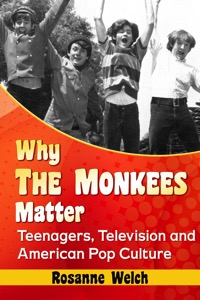
A hit television show about a fictitious rock band, The Monkees (1966-1968) earned two Emmys–Outstanding Comedy Series and Outstanding Directorial Achievement in Comedy. Capitalizing on the show’s success, the actual band formed by the actors, at their peak, sold more albums than The Beatles and The Rolling Stones combined and set the stage for other musical TV characters from The Partridge Family to Hannah Montana. In the late 1980s, the Monkees began a series of reunion tours that continued into their 50th anniversary.
This book tells the story of The Monkees and how the show changed television, introducing a new generation to the fourth-wall-breaking slapstick created by Laurel and Hardy and the Marx Brothers. Its creators contributed to the innovative film and television of 1970s with projects like Bob & Carol & Ted & Alice, The Mary Tyler Moore Show, Laugh-In and Welcome Back, Kotter. Immense profits from the show, its music and its merchandising funded the producers’ move into films such as Head, Easy Rider and Five Easy Pieces.
Rosanne Welch, PhD has written for television (Touched by an Angel, Picket Fences) and print (Three Ring Circus: How Real Couples Balance Marriage, Work and Kids and The Encyclopedia of Women in Aviation and Space). In the documentary world she has written and produced Bill Clinton and the Boys Nation Class of 1963 for ABC NEWS/Nightline and consulted on PBS’s A Prince Among Slaves, the story of a prince from West Africa who was enslaved in the 1780s, freed by order of President John Quincy Adams in the 1820s and returned to his homeland.
Podcast: Play in new window | Download
Subscribe: RSS
From The Research Vault: Feeling Italian: The Art of Ethnicity in America by Thomas J. Ferraro
A History of Screenwriting – 30 in a series – The Eclipse: The Courtship of the Sun and Moon (George Méliès, 1905)

A professor of astronomy gives a lecture instructing on an impending solar eclipse. The class rushes to an observation tower to witness the event, which features an anthropomorphic Sun and Moon coming together. The Moon and the Sun lick their lips in anticipation as the eclipse arrives, culminating in a romantic encounter between the two celestial bodies. Various heavenly bodies, including planets and moons, hang in the night sky; a meteor shower is depicted using the ghostly figures of girls. The professor of astronomy, shocked by all he has witnessed, topples from the observation tower.
The Eclipse has been remarked upon for its overt sexual symbolism.[1][2] Christine Cornea posits that the film’s primary theme, the clash of scientific logic with sexual desire, was also evident in Méliès’ earlier films A Trip to the Moon and The Impossible Voyage, and would become a prominent in many subsequent science-fiction films.[1]
Some scholars, interpreting the Sun and the Moon to be both male, have described the erotic “eclipse” as an early depiction of homosexuality in cinema,[2][3] with an “effeminate” Moon being seduced by an “devilishly masculine” Sun.[1] By contrast, Méliès’s film catalogue describes the liaison in heterosexual terms, referring to the participants as “the man in the sun” and “dainty Diana” and using pronouns to match.[4] — Wikipedia
* A portion of each sale from Amazon.com directly supports our blogs
** Many of these books may be available from your local library. Check it out!
I teach several classes for the Stephens College Low-Residency MFA in Screenwriting, including History of Screenwriting. In fact, I created the curriculum for that course from scratch and customized it to this particular MFA in that it covers ‘Screenwriting’ (not directors) and even more specifically, the class has a female-centric focus. As part History of Screenwriting I, the first course in the four-class series, we focus on the early women screenwriters of the silent film era who male historians have, for the most part, quietly forgotten in their books. In this series, I share with you some of the screenwriters and films that should be part of any screenwriters education. I believe that in order to become a great screenwriter, you need to understand the deep history of screenwriting and the amazing people who created the career. — Dr. Rosanne Welch
Working lunch today with @douglaswelch via Instagram

Working lunch today with @douglaswelch. I’m writing a book on Filippo Mazzei while Doug has bit of a nosh.
Rosanne Welch talks “The Invention of the Teenager” on Pop!: The Pop Culture Podcast
Rosanne Welch talks “The Invention of the Teenager” on Pop!: The Pop Culture Podcast
I had quite a good time when Ken Mills interviewed me about the ‘invention’ of the teenager – something I teach in my classes and spent a whole chapter on in my book, Why The Monkees Matter!
Marketers created teenagers in the same way The Disney Channel and Nickelodeon helped spread the term Tweeners for their shows.
The whole episode is fun – I really like the coverage of Anne Moses and her time editing Tiger Beat Magazine (but if you’re pressed for time my interview starts at 18:22).

Podcast: Play in new window | Download
Subscribe: RSS
Buy “Why The Monkees Matter” Today!
Why The Monkees Matter: Teenagers, Television and American Pop Culture
McFarland (Direct from Publisher) | Amazon | Kindle Edition | Nook Edition
Quotes from “Why The Monkees Matter” by Dr. Rosanne Welch – 67 in a series – Davy, Girls, and The Monkees
** Buy “Why The Monkees Matter” Today **

While beautiful young women were often provided for Davy in many episodes, few storylines focused mainly on his pursuit of a particular female, and those that did hit all the plot points of proper rom-coms. There would be what modern television and film writing manuals have designated the ‘cute meet’, followed by a series of obstacles that kept the couple apart, and a miscommunication that threatened their reuniting.
from Why The Monkees Mattered by Dr. Rosanne Welch — Buy your Copy today!
Why The Monkees Matter: Teenagers, Television and American Pop Culture
McFarland (Direct from Publisher) | Amazon | Kindle Edition | Nook Edition