I had quite a good time when Ken Mills interviewed me about the ‘invention’ of the teenager – something I teach in my classes and spent a whole chapter on in my book, Why The Monkees Matter!
Marketers created teenagers in the same way The Disney Channel and Nickelodeon helped spread the term Tweeners for their shows.
The whole episode is fun – I really like the coverage of Anne Moses and her time editing Tiger Beat Magazine (but if you’re pressed for time my interview starts at 18:22).
The article provides a quick historical survey of the work of several prominent female screenwriters across the first century of filmmaking, including Anita Loos, Dorothy Parker, Frances Goodrich and Joan Didion. In all of their memoirs and other writings about working on screenplays, each mentioned the importance of (often) being the lone woman in the room during pitches and during the development of a screenplay. Goodrich summarized all their experiences concisely when she wrote, ‘I’m always the only woman working on the picture and I hold the fate of the women [characters] in my hand… I’ll fight for what the gal will or will not do, and I can be completely unfeminine about it.’ Also, the rise of female directors, such as Barbra Streisand or female production executives, such as Kathleen Kennedy, prove that one of the greatest assets to having a female voice in the room is the ability to invite other women inside. Therefore, this paper contributes to the scholarship on women in film and to authorship studies.
The title is a riff on a series of one-act plays I worked on in college called “Honey, You Know I Can’t Hear You When the Water’s Running” written by Robert Anderson (author of the plays Tea and Sympathy and was Oscar-nominated for the screenplays A Nun’s Story and I Never Sang for my Father.)
You can read and download the entire journal, edited by Louise Sawtell, Stayci Taylor, which includes other fine articles have a global reach, covering questions of gender in screenwriting practice; reflections on the Irish film industry; Female Screenwriters and Street Films in Weimar Republic; Narrative and Masculinity in The Long Goodbye; How Hollywood Screenplays Inscribe Gender.
The editors had also asked all contributors to create video abstracts for each piece. Thanks to Doug’s help, mine came out pretty good:
This book signing at Book Soup was wonderful – good people, good conversation (before and after the signing). Just another example of the kind of quality positive people who have been drawn to The Monkees across generations – I even met a former head of publicity for ScreenGems who had some fun stories to tell. — Rosanne
I think when we think about the intimacy of what we get from television we learn a lot about why isn’t important and why we should pay attention to the kind of television we’re watching and supporting. For me, obviously, that’s going backward to The Monkees and showing that to students today, so that they can think about what ideas were prevalent in the 60s. I think all the things that we credit to All in the Family and the whole Norman Lear empire, those things appeared on The Monkees long before it happened on those programs. Studying The Monkees, for me, illustrates the history and the evolution of the medium of television and it provides a time capsule of American society at that moment when youth culture was becoming everything and if you think about it, we still look at it that way. Everyone’s still trying to pretend with the botox and whatever that they are still 22. It’s an interesting point. But it was the beginning of teenagers in America in many ways and the films and the television were showing us what teenagers were all about.
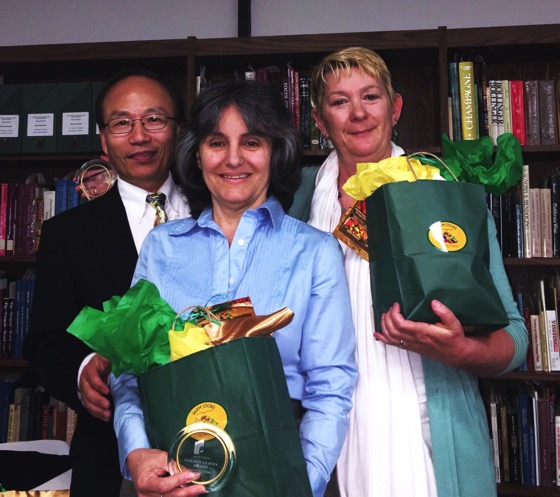
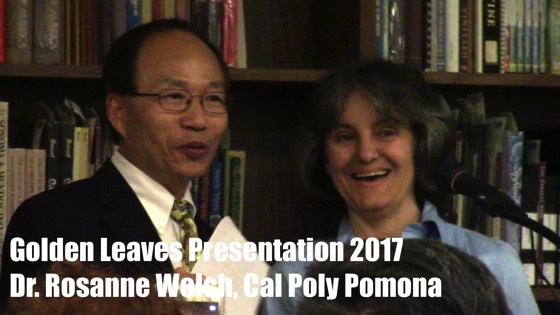
Here my co-editor (and the funnest office mate ever) Dr. Peg Lamphier are smiling besideLibrary Dean Dr. Ray Wang at the Cal Poly Pomona Golden Leaves Award ceremony celebrating professors who have published in the past year.
Many Thanks to Sarah Clark for inviting me along on this book group discussion of Mike Nesmith’s new “Infinite Tuesday” – which due to his eclectic writing style and his honest look at his life’s successes and failures, turns out to be an interesting testament to how to survive having been young and famous in the 1960s.
Sarah Clark is joined by Rosanne Welch, Ghosty Tmrs, and Music Biographer Andrew Vaughan to dig deep into Infinite Tuesday: an Autobiographical Riff! Hear the panel’s thoughts, some of Sarah’s favorite Nez Songs (not featured on the Infinite Tuesday soundtrack), Then Melanie Mitchell talks Peter Tork “SSB” Pics surface, Monkees News & More!
This book signing at Book Soup was wonderful – good people, good conversation (before and after the signing). Just another example of the kind of quality positive people who have been drawn to The Monkees across generations – I even met a former head of publicity for ScreenGems who had some fun stories to tell. — Rosanne
The thing that I think is special about TV is that if you go to a film, you’ve chosen to pay your money for that message. So, you’re not likely to learn anything new. You’re not likely to believe you’re going to pay for something you don’t wan to be told, but television is intimate. It sneaks into your house when you’re not thinking. When you kid switches the channel and suddenly new messages come to them that you might never have wanted them to hear and that’s what The Monkees were doing. They were embedding some new political ideas into the 13 and 14-year-olds who were watching the show at that time and if you think about it, we’re in 1966, give those kids 5 or 6 years and they’re the ones protesting the Vietnam War in the 70’s. That’s when the big protests hit. So, this is a period that The Monkees falls into.
Each author was asked to describe their book. The encyclopedia came first (since Peg’s last name is Lamphier and the practice of alphabetical discrimination lives on). I let her have the honors since I knew I would speak about The Monkees’ book last. Going last I also had to keep in mind that the rest of the audience had already received their awards and were anxious to get back to the delightful dessert table – so humor came to the rescue as I commented on how odd it was to be speaking about my favorite television show when I was six after other professors had spoken of Immanuel Kant and architectural digs in South America and Mass Spectatorship in Modern France.
Here’s how I closed out the show…
Thanks to Doug for taking all the photos and video – and to Peg for being such a great collaborator – and to all the friends and fans who have read the book and enjoyed learning more about the 1967 Emmy Winner for Best New Comedy Series.
Buy These Books and Share Them With Your Local Librarian
* A portion of each sale from Amazon.com directly supports our blogs ** Many of these books may be available from your local library. Check it out!
The student reviewer from the Poly Post said it, “led to uncontrollable laughter amongst the crowd as the women presented different types of moans such as the Obama and even the Cal Poly Student moan.”
My first royalty check arrived today from McFarland!
Big Thanks to all of you who bought copies of Why The Monkees Matter: Teenagers, Television and American Pop Culture!
Please continue following this page for more posts From the Research Files, video clips, Monkee and more — and please tell a Monkees fan friend about “Why The Monkees Matter” today!


![Why Study The Television We Watch? from Why The Monkees Matter Book Signing [Video] (0:58)](https://rosannewelch.com/wp-content/uploads/2017/05/wtmm-reading-08-study-tv.jpeg)


![Television is Intimate from Why The Monkees Matter Book Signing [Video] (0:47)](https://rosannewelch.com/wp-content/uploads/2017/05/wtmm-reading-07-tv-intimate.jpeg)
![Dr. Rosanne Welch at Golden Leaves Presentation 2017, Cal Poly Pomona [Video]](https://rosannewelch.com/wp-content/uploads/2017/04/golden-leaves-award.jpg)


![Rosanne Welch and Peg Lamphier performing in The Vagina Monologues at Cal Poly Pomona [Video] (14:12)](https://rosannewelch.com/wp-content/uploads/2017/03/Vagina-Monologues-2017-Clip.jpeg)
