Brigadier Lethbridge-Stewart as Father Figure 2 from How Doctor Who Redefined Masculinity [Video] (1:35)

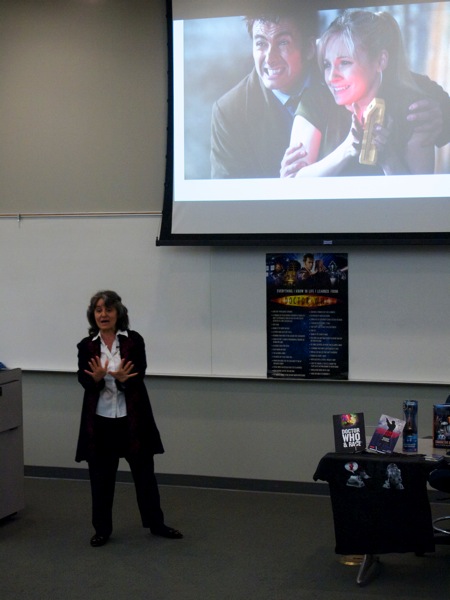
Dr. Rosanne Welch presents “How Doctor Who Redefined Masculinity: A Study of the Doctors and their Male Companions“ at the Cal Poly Pomona University Library. Dr. Welch teaches in the IGE (Interdisciplinary General Education) program.

Watch the entire presentation here

Brigadier Lethbridge-Stewart as Father Figure 2 from How Doctor Who Redefined Masculinity [Video] (1:35)


Transcript:

We learn that he has a daughter. So in the modern Who, the military person is Kate Lethbridge-Stewart, his daughter. So. she’s inherited her father’s job, if you will. She’s a science officer more than a military officer with UNIT, which is the group that takes care of all of that. So, we meet Kate and when we get to Death in Heaven the problem is all the corpses have been turned into Cybermen and their all rising out of the cemetery and, at a certain point, we lose Kate — they toss her out of an airplane, so we know she’s dead, right? Because she hit the ground, splat, she’s dead. Except among all the corpses we’ve been reminded is her father who has been turned into a Cyberman and when we go to that point in the episode we find out that she’s still walking around the cemetery. She hasn’t been harmed, because she never went splat. He caught her and brought her to the ground safely. He protected his child all the way to the end and then he went up to heaven with Danny. Danny pulled all the Cybermen out and it’s The Doctor — never salutes because he doesn’t like the military — but for this act — the act of saving his child, he’s going to salute and I think that speaks to what The Doctor thinks about what makes a man a man. And again, it’s all tied into being part of a family.

A clip from this 5th talk on various aspects of Doctor Who presented by Dr. Welch. You can find Dr. Welch’s other Doctor Who talks using the links below.

Dr. Rosanne Welch

Follow Dr. Rosanne Welch on the Web and via social media at:

Dr. Rosanne Welch Speaks on “How Star Wars In Influenced Movie Themes, Female Characters, Fandom & Fan Fiction” – Tuesday, April 12 – Noon – Cal Poly Pomona

Dr. Rosanne Welch Speaks on “How Star Wars In Influenced Movie Themes, Female Characters, Fandom & Fan Fiction” – Tuesday, April 12 – Noon – Cal Poly Pomona

Star wars cpp

(DOWNLOAD PDF FLYER)

 The University Library celebrates National Library Week with

Star Wars Saga

“How Star Wars In Influenced Movie Themes, Female Characters, Fandom & Fan Fiction”

Tuesday, April 12 – Noon

Cal Poly Pomona University Library

Special Events Room (4th Floor)


Brigadier Lethbridge-Stewart as Father Figure from How Doctor Who Redefined Masculinity [Video] (1:07)

Dr. Rosanne Welch presents “How Doctor Who Redefined Masculinity: A Study of the Doctors and their Male Companions“ at the Cal Poly Pomona University Library. Dr. Welch teaches in the IGE (Interdisciplinary General Education) program.

Watch the entire presentation here

Brigadier Lethbridge-Stewart as Father Figure from How Doctor Who Redefined Masculinity


Transcript:

We’ll go back in history to one character I don’t think we give enough attention to, and that’s  Lethbridge-Stewart, who arrives in the Jon Pertwee era as a military dude, so he’s a warrior from that period and that’s largely what we see him do for a long time. Again, we’re in the 70s now, so we’re not thinking about dads as an important role for men. But, as we go through time and the show stays on the air, guess what? He grows older, you know, because time flies and actors are actual humans and he appears on The Sarah Jane Adventures here as Lethbridge-Stewart so he still exists in her time period. He’s a grandfatherly type and he’s going to help her with some adventures. Now, because he’s a real human being, he passed away. By the time we got to Capaldi’s episodes — and now here I’m in Death in Heaven — he has passed away and so this is a portrait. We have to be reminded of his existence and his character in case you’ve never seen the show before, because we’re going to move to the ending place in this episode where he does the most fatherly, heroic thing.

A clip from this 5th talk on various aspects of Doctor Who presented by Dr. Welch. You can find Dr. Welch’s other Doctor Who talks using the links below.

Dr. Rosanne Welch

Follow Dr. Rosanne Welch on the Web and via social media at:

TEDxCPP Features Two CEIS Professors via Cal Poly Pomona Web Site

The Cal Poly Pomona Web Site has a feature article today on the two College of Education and Integrative Studies professors (including myself) who will be presenting at this week’s TEDxCPP. — Rosanne

TEDxCPP Features Two CEIS Professors

Two professors from the College of Education & Integrative Studies will explore persistent stigmas in society at the second TEDxCPP.

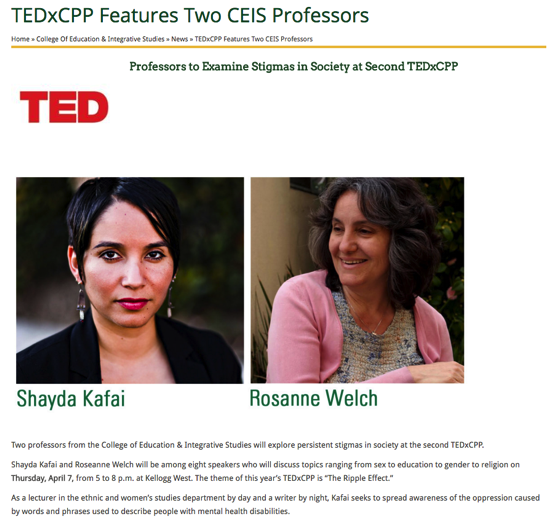
Shayda Kafai and Roseanne Welch will be among eight speakers who will discuss topics ranging from sex to education to gender to religion on Thursday, April 7, from 5 to 8 p.m. at Kellogg West. The theme of this year’s TEDxCPP is “The Ripple Effect.”

As a lecturer in the ethnic and women’s studies department by day and a writer by night, Kafai seeks to spread awareness of the oppression caused by words and phrases used to describe people with mental health disabilities.

Kafai aims to change perspectives on mental health stigmas in her speech titled “The Language of Madness.”

“I am going to be exploring the stigmatic ways we socially frame psychiatric disabilities,” Kafai says. “Through the use of personal narrative, I will share reasons why we must collectively unlearn totalizing language.”

Welch has taken her writing and professional experiences from mainstream television to the classroom by teaching humanities in the interdisciplinary general education department. She holds a doctorate in American social history of the 21st century.

Welch’s speech, titled “The Importance of Having a Female Voice in the Writer’s Room,” will address issues with “othering,” which occurs when one group takes another group’s differences and uses that against them.

“Based on my previous career as a television writer, I’ll be speaking about moments when new perspectives in the writer’s room can help influence thousands of viewers,” Welch says.

Kafai and Welch have a common goal: broadening perspectives on stigmas that persist in society.

To learn more about these speakers and to get tickets, visit the TEDxCPP website.

Danny Pink and Fatherhood Part 2 from How Doctor Who Redefined Masculinity [Video Clip] (1:10)

Dr. Rosanne Welch presents “How Doctor Who Redefined Masculinity: A Study of the Doctors and their Male Companions“ at the Cal Poly Pomona University Library. Dr. Welch teaches in the IGE (Interdisciplinary General Education) program.

Watch the entire presentation here

Danny Pink and Fatherhood Part 2 from How Doctor Who Redefined Masculinity


Transcript:

…and then what happens, God Forbid. You did realize there would be spoilers. Right? I assume people have seen these episodes. God Forbid, he is turned into a Cyberman, too and this so awful, so awful. But. He is a warrior and he’s able to do a thing that will save the family around him — the people of Earth, right?…by beating the Cybermen by getting all the other Cybermen to follow him up. he loses Clara, which is terrible, but, being the show, he gets that second chance to come back from the afterlife and he doesn’t take it, because there’s only one chance to come back and instead he gives it to little Afghan boy that he killed by accident, when he was at war. So, he gives up his happiness and his chance essentially at a resurrection to give it to the child whose chance he took away and he sends that child back into the world so he can start again. Again, if that isn’t the pseudo-father to that child than I don’t know who is.

A clip from this 5th talk on various aspects of Doctor Who presented by Dr. Welch. You can find Dr. Welch’s other Doctor Who talks using the links below.

Dr. Rosanne Welch

Follow Dr. Rosanne Welch on the Web and via social media at:

Out of the Research Vault: Micky Dolenz & Peter Tork on Nightwatch – 1986

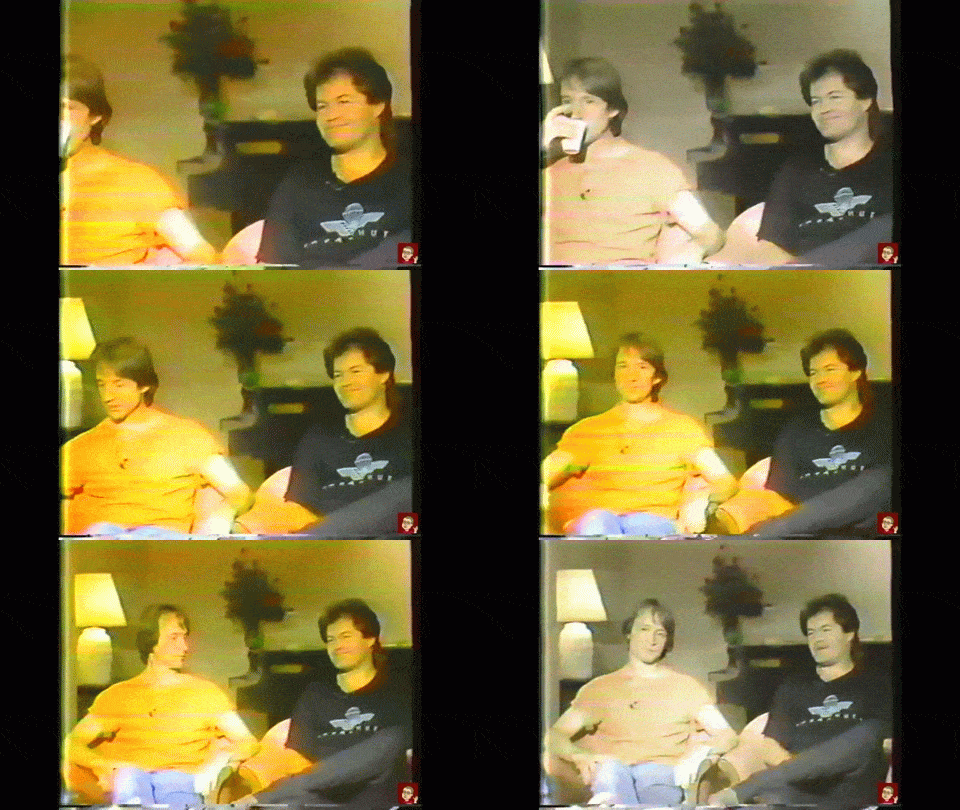
Since Micky and Peter are conducting this current tour alone, this 1986 episode of Nightwatch, hosted by Charlie Rose, is quite fun to watch as it only involves the two of them. 

Out of Research Vault: Micky Dolenz & Peter Tork on Nightwatch - 1986

Micky discusses “Why now?” for their 20th anniversary tour in 1986 – and pins it all on the success of the premiere of the television show and the new generation introduced to it by MTV’s “Pleasant Valley” Marathon.  Peter discusses why the show worked – citing things I cover in the book about how The Monkees were originally considered dangerous (due to their long hair and connection to the counter-culture).  He also mentions how the fan base went from mostly female to nearly 60/40 female/male.  Then Micky discusses his directing career in England and how hard it was to leave it behind for this one summer – that he had no idea how long this one anniversary tour would last!


1986 MTV Monkees marathon ad from TV Guide

from The Monkees Live Almanac

The video is shaky but fun to watch because they are so deeply complimentary to each other’s talents, they talk about the ‘patrimony’ of the series in how the money made by the producers funded Five Easy Pieces and the new musical-variety version of the show they hoped to do in the third season that lead to the cancellation.

Previously in Out of Research Vault:

Danny Pink and Fatherhood from How Doctor Who Redefined Masculinity [Video Clip] (0:49)

Dr. Rosanne Welch presents “How Doctor Who Redefined Masculinity: A Study of the Doctors and their Male Companions“ at the Cal Poly Pomona University Library. Dr. Welch teaches in the IGE (Interdisciplinary General Education) program.

Watch the entire presentation here

Danny Pink and Fatherhood from How Doctor Who Redefined Masculinity


Transcript:

Now we go back to Danny Pink. Danny we don’t get a chance to see do the whole Dad thing, but we see a few things. First of all, what’s his job when he’s not being a soldier? He’s a teacher. So, we define again teacher as a gendered kid of job. We generally see women int he education field. Especially when it’s in middle school, elementary school, a few more guys in high school, but largely we see that as a female job, because it’s about nurturing a younger generation of people. So, as a teacher we see him protective of the children in his care. He is their pseudo-father when they are at school with him and I think that’s really important. That’s how Danny is defined for us. We see him first as this and then we hear about the warrior — oh yeah, he was a soldier. So his first definition is this. 

A clip from this 5th talk on various aspects of Doctor Who presented by Dr. Welch. You can find Dr. Welch’s other Doctor Who talks using the links below.

Dr. Rosanne Welch

Follow Dr. Rosanne Welch on the Web and via social media at:

Saved By Fatherhood from How Doctor Who Redefined Masculinity [Video Clip] (1:35)

Dr. Rosanne Welch presents “How Doctor Who Redefined Masculinity: A Study of the Doctors and their Male Companions“ at the Cal Poly Pomona University Library. Dr. Welch teaches in the IGE (Interdisciplinary General Education) program.

Watch the entire presentation here

Saved By Fatherhood from How Doctor Who Redefined Masculinity


Transcript:

One of my favorite episodes to do with family and fatherhood is the episode where James Corden guest starred as Craig Owens and his job was to take care of his baby and he was very bad at it. How many people have seen this episode? How cute it Stormageddon? I have a question for…of course, James Corden from “Into The Woods” right now and he’s also on his TV show, but what’s great about this episode is what saves his life? Does being a warrior save his life? Does being super-intelligent save his life? When the Cybermen show up and turn him into a Cyberman — which have never seen anyone undo. Once the Cybermen get you, you are done and the poor Doctor has to do that emotion inhibitor thing and suddenly you feel emotions and you blow up. it’s the only way to kill you once your a Cyberman. Except for him. He breaks the bond of “cyber” because he hears his baby cry and his need to save his child is stronger then the pull the Cybermen have on him in this metal casket that they’re creating around him. If that’s not a Dad, I don’t know what is. If that’s not a man who defines himself by his fatherhood, I do not know what is. So, I thinks a really interesting again, turn, in the modern Who. This is how Steven Moffat is defining masculinity as men who love their families. That’s the highest calling that a man can be brought to. 

A clip from this 5th talk on various aspects of Doctor Who presented by Dr. Welch. You can find Dr. Welch’s other Doctor Who talks using the links below.

Dr. Rosanne Welch

Follow Dr. Rosanne Welch on the Web and via social media at:

Rory Williams – Family Man Part 3 from How Doctor Who Redefined Masculinity [Video Clip] (1:14)

Dr. Rosanne Welch presents “How Doctor Who Redefined Masculinity: A Study of the Doctors and their Male Companions“ at the Cal Poly Pomona University Library. Dr. Welch teaches in the IGE (Interdisciplinary General Education) program.

Watch the entire presentation here

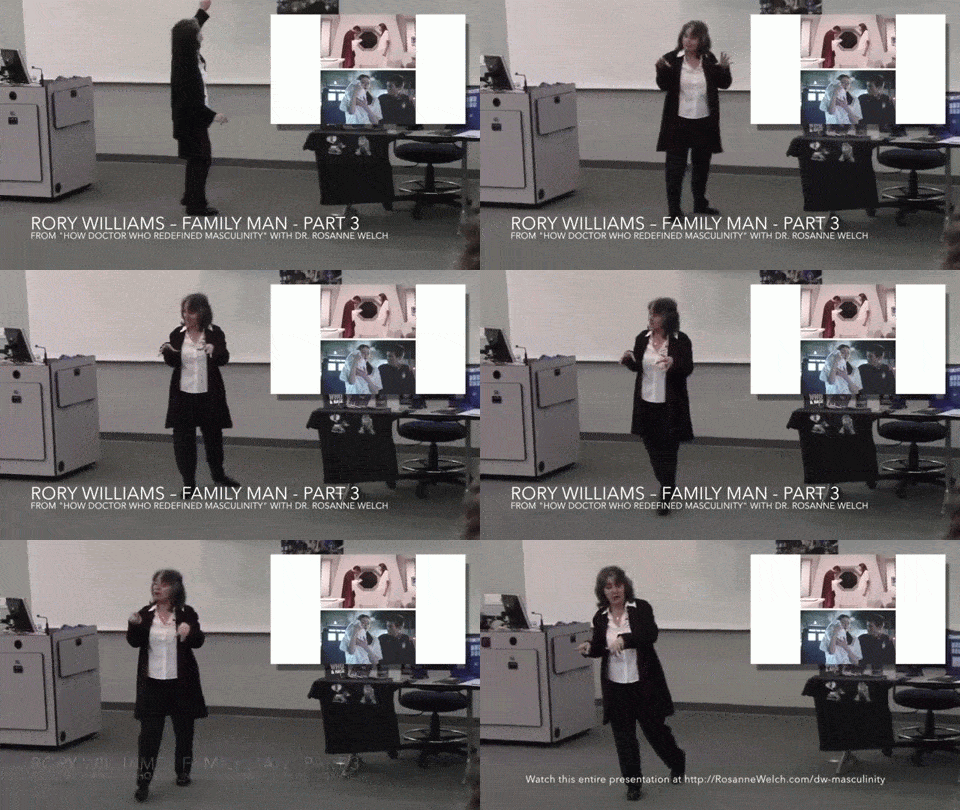
Rory Williams - Family Man Part 3 from How Doctor Who Redefined Masculinity


Transcript:

So Rory is a reflection of modern day fathers and what women are looking for ina modern man, if they’re going to spend the rest of their life. You want somebody else who’s going to help you clean the toilet. Right? When you get married, it’s not just you cooking dinner every night. It’s a shared job. It didn’t use to be. I had a friend who would go to work, her husband got home an hour before she did. He would sit on the couch and wait for her to get home and start making dinner, ’cause dinner was her job. Yeah, yeah. So things have switched around and the show is reflective of that. I think that’s really beautiful. And, of course, we know who the baby grew up to be. River Song! Who allows us a family of “Ponds”, even though they were stripped of the chance to raise her. We now have a Pond family as part of The Doctor’s story and again Rory overlooking all of that. He had to deal with his feelings of losing his chance to raise his child. That was something that harmed him, more than all the danger. How many times did Rory die. Really now. All those deaths didn’t bother him nearly as much as being denied the chance to raise his own child. So, I think that defines him much more deeply as a family man above all other things.  

A clip from this 5th talk on various aspects of Doctor Who presented by Dr. Welch. You can find Dr. Welch’s other Doctor Who talks using the links below.

Dr. Rosanne Welch

Follow Dr. Rosanne Welch on the Web and via social media at:

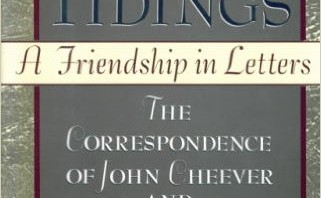
My Favorite Book of Letters Between Writers, Cheever’s Glad Tidings

glad-tidings

Answering another friend’s Facebook post reminded me today of one of my favorite books of letters between writers is between Cheever and John Weaver.

I stumbled upon Glad Tidings: A Friendship in Letters : The Correspondence of John Cheever and John D. Weaver, 1945-1982 many years ago at a used bookstore and deeply enjoyed reading how these two writers discussed their work and the origins of their most famous projects.

Of course, Cheever was also writing to Harriet Weaver but the editors left her name off the title, so it’s also a good look at how the Weaver marriage operated (in the same way The Letters of S.J. Perlemnan became a look at the marriage of Dorothy Parker and Alan Campbell since he wrote so often to them).

What I enjoyed most was the inside look Cheever gave of coming to Hollywood when a studio adapted his story The Swimmer into a film – Weaver had much more experience living in Los Angeles as a writer of local histories so he helped Cheever navigate La-La-Land.

If you don’t know either of these writers, a selection of Cheever’s short stories, The Stories of John Cheever, won the 1979 Pulitzer Prize for Fiction (not too shabby) and John D. Weaver’s obituary in the Los Angeles Times tells you how important he was: “Weaver wrote two novels and eight nonfiction books, including one that helped change history: “The Brownsville Raid,” a 1970 book that led to the exoneration of 167 black soldiers who had been discharged without honor 64 years earlier.”

Both are well worth reading – as is Glad Tidings. Check them out.