All of the callers shared Filippo’s enthusiasm for the making – and drinking – of wine, knowing that in 1768, Virginians exported from Britain a little more than thirteen tons of wine from overseas, and another 78,264 from other North American colonies. But a few warned him that Virginia soil had been tried and so far unproven to be suitable.
To highlight the wonderful yet largely forgotten work of a collection of female screenwriters from the early years of Hollywood (and as a companion to the book, When Women Wrote Hollywood) we will be posting quick bits about the many films they wrote along with links to further information and clips from their works which are still accessible online. Take a few moments once or twice a week to become familiar with their names and their stories. I think you’ll be surprised at how much bold material these writers tackled at the birth of this new medium. — Rosanne Welch
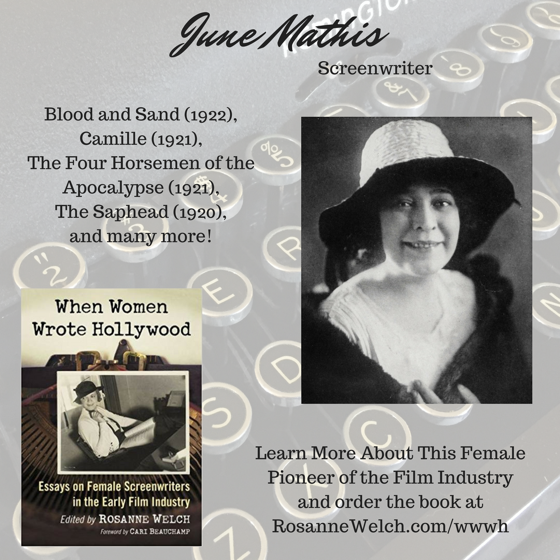
June Mathis (January 30, 1887 – July 26, 1927) was an American screenwriter. Mathis was the first female executive for Metro/MGM and at only 35, she was the highest paid executive in Hollywood.[1] In 1926 she was voted the third most influential woman in Hollywood, behind Mary Pickford and Norma Talmadge.[2] Mathis is best remembered for discovering Rudolph Valentino and writing such films as The Four Horsemen of the Apocalypse (1921) and Blood and Sand (1922).
Mathis was determined to become a screenwriter and, accompanied with her mother, she moved to New York City, where she studied writing and went to the movies in the evenings.[6] She entered a screenwriting competition; but despite not winning, her entry was so impressive it did bring job offers. Her first script, House of Tears, would be directed by Edwin Carewe in 1915 and led to a contract in 1918 with Metro studios, later to be merged into MGM. As one of the first screenwriters to include details such as stage directions and physical settings in her work, Mathis saw scenarios as a way to make movies into more of an art form. Much of the standard screenwriting styles can be attributed to her. Mathis later credited her success to a strong concentration on plot and theme: “No story that did not possess a theme has ever really lived…. Occasionally one may make money and perhaps be popular for a time. But in the end it dies.”[6]
By 1919 Mathis and her mother had moved to Hollywood. After only a year of screenwriting, she had advanced to the head of Metro’s scenario department.[7] She was one of the first heads of any film department and the only female executive at Metro.[8]
During her early years, she had a close association with silent star Alla Nazimova. Their films together can be said to be marked by over-sentimentality; what little praise these films received was due to Nazimova’s acting rather the conventional romantic stories.[6] — Wikipedia
* A portion of each sale from Amazon.com directly supports our blogs ** Many of these books may be available from your local library. Check it out! † Available from the LA Public Library
Michael Nesmith of The Monkees isn’t exactly known for being a road warrior. With the exception of a few tours with his past and present Monkee bandmates (Davy Jones died in 2012), the last two years have brought Nesmith back to the road for his first official solo dates since 1992.
But don’t mistake this for indifference or laziness. Nesmith is more than just a musician. He’s an innovator (after all, he IS partially responsible for the beginning stages of MTV), thespian, Liquid Paper heir, novelist, entrepreneur and producer. Yes, Michael Nesmith never seems to have a problem staying occupied.
Over the last year Nesmith has cited several reasons for his long awaited return to the stage, but don’t expect a greatest hits package if he decides to stop by a venue near you.
* A portion of each sale from Amazon.com directly supports our blogs ** Many of these books may be available from your local library. Check it out! † Available from the LA Public Library
To highlight the wonderful yet largely forgotten work of a collection of female screenwriters from the early years of Hollywood (and as a companion to the book, When Women Wrote Hollywood) we will be posting quick bits about the many films they wrote along with links to further information and clips from their works which are still accessible online. Take a few moments once or twice a week to become familiar with their names and their stories. I think you’ll be surprised at how much bold material these writers tackled at the birth of this new medium. — Rosanne Welch
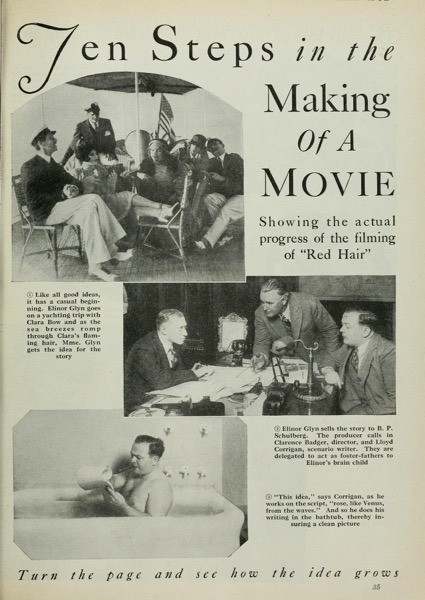
“It” is a 1927 silent romantic comedy film that tells the story of a shop girl who sets her sights on the handsome, wealthy boss of the department store where she works. It is based on a novella by Elinor Glyn that was originally serialized in Cosmopolitan magazine.
This film turned actress Clara Bow into a major star, and led people to label her the It girl.
The film had its world premiere in Los Angeles on January 14, 1927, followed by a New York showing on February 5, 1927. “It” was released to the general public on February 19, 1927.
The picture was considered lost for many years, but a Nitrate-copy was found in Prague in the 1960s.[1] In 2001, “It” was selected for preservation in the United States National Film Registry by the Library of Congress as being “culturally, historically, or aesthetically significant”. — Wikipedia
* A portion of each sale from Amazon.com directly supports our blogs ** Many of these books may be available from your local library. Check it out! † Available from the LA Public Library
Rosanne Welch, PhD, Author of Why The Monkees Matter, presents “How The Monkees Changed Television” at a Cal State Fullerton Lunch Lecture on May 8, 2018.
In this talk, she shows how The Monkees, and specifically their presence on television, set the stage for large changes to come in the late 1960s.
Transcript
This is a great shot. I love from the Associated Press. All four of the men — three of the men — were drafted while they were on the show because they were all like 18, 19 and 20 years old. Michael Nesmith had already been in the Air Force so he was not but the other 3 guys were and they had to find a way around it. Even Davy Jones who was from England was drafted because he was living and making money in the United States. Thee girls took to the streets and said “If Davy goes, we go too!” The protests against losing them were very huge, but in general they were talking about how this is a bad war.. So if you look at this line I love from one of the episodes…
“They want to put the blame on teenagers. Take the war. Whose fault is it? We’re not fighting. it must be those crazy kids. They’re the ones doing all the fighting.”
Again, if that’s not an anti-war message wrapped up in a funny show. I have not idea how they got away with that, but they did.
Rosanne Welch, PhD is a writer, producer and university professor with credits that include Beverly Hills 90210, Picket Fences, Touched by an Angel and ABC NEWS/Nightline. Other books include Why The Monkees Matter: Teenagers, Television and American Pop Culture (McFarland, 2017) and Women in American History: A Social, Political, and Cultural Encyclopedia and Document Collection (ABC-CLIO, 2017), named to the 2018 Outstanding References Sources List, by the Reference and User Services Association (RUSA), a division of the American Library Association. Welch has also published chapters in Torchwood Declassified: Investigating Mainstream Cult Television (I.B.Tauris) and The American Civil War on Film and TV: Blue and Gray in Black and White and Color (Lexington Books, 2018) and essays in Doctor Who and Race: An Anthology and Outside In Makes it So, and Outside in Boldly Goes (both edited by Robert Smith). By day she teaches courses on the history of screenwriting and on television writing for the Stephens College MFA in Screenwriting programs. Her talk “The Importance of Having a Female Voice in the Room” at the 2016 TEDxCPP is available on YouTube.
To highlight the wonderful yet largely forgotten work of a collection of female screenwriters from the early years of Hollywood (and as a companion to the book, When Women Wrote Hollywood) we will be posting quick bits about the many films they wrote along with links to further information and clips from their works which are still accessible online. Take a few moments once or twice a week to become familiar with their names and their stories. I think you’ll be surprised at how much bold material these writers tackled at the birth of this new medium. — Rosanne Welch
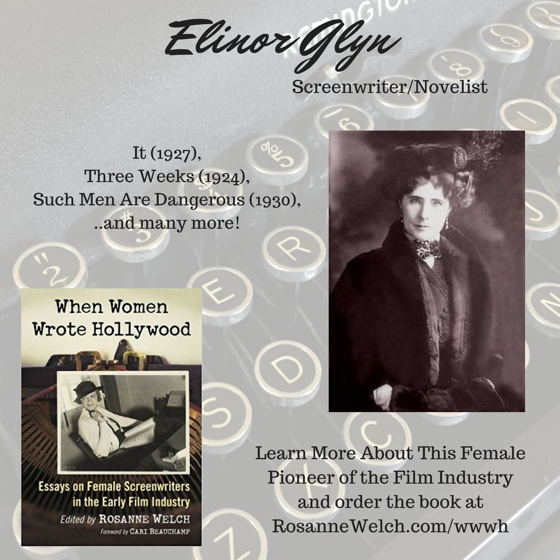
Elinor Glyn (née Sutherland; 17 October 1864 – 23 September 1943) was a British novelist and scriptwriter who specialised in romantic fiction that was considered scandalous for its time. She popularized the concept of It. Although her works are relatively tame by modern standards, she had tremendous influence on early 20th-century popular culture and perhaps on the careers of notable Hollywood stars such as Rudolph Valentino, Gloria Swanson and Clara Bow in particular.
Glyn pioneered risqué, and sometimes erotic, romantic fiction aimed at a female readership, a radical idea for its time—though her writing is not scandalous by modern standards. She coined the use of the word it to mean a human characteristic that “…draws all others with magnetic force. With ‘IT’ you win all men if you are a woman–and all women if you are a man. ‘IT’ can be a quality of the mind as well as a physical attraction.” [13] Her use of the word is often erroneously[citation needed]taken to be a euphemism for sexuality or sex appeal. — Wikipedia
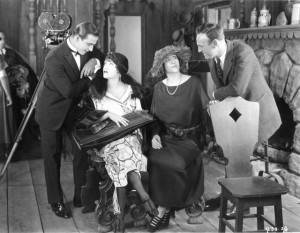
Elinor Glyn (a/w/d/p/o), Beyond the Rocks (1922). PC
* A portion of each sale from Amazon.com directly supports our blogs ** Many of these books may be available from your local library. Check it out! † Available from the LA Public Library
In late November the Triumph docked at Trebell’s Landing & Burwell’s Ferry, on the James River about four miles from Williamsburg. Filippo and his party, which the Captain had dubbed Filippo’s ark as it included such a combination of people, animals and plants as to constitute the beginning of a new Eden, disembarked.
What a treat – reading the review of my book America’s Forgotten Founding Father in Angelus, the weekly Catholic magazine of Los Angeles. I enjoyed the way the magazine’s reviewer, Robert Brennan, compared Mazzei to Forest Gump in that he met so many other, far more well known Founding Fathers. Since it is a novel, Mr. Brennan had called me to ask about the historical accuracy of some of those meetings and I was happy to have been able to say that Mazzei led such an interesting life I didn’t need to make any of that up – even much of his dialogue comes from his own prolific correspondence with everyone from Thomas Jefferson to John Adams.
My favorite part of the review is the ending when Brennan shows how history teaches us how to handle our current lives.
“Although men like Jefferson, Washington and Adams represented a homogeneous group of white, English, Protestant, landed gentry, they all welcomed a new immigrant from a non-English speaking, predominantly Catholic country. And Filippo Mazzei showed that a Catholic could, in good conscience, be fully integrated into that great American experiment at its birth, and help christen it with a little holy water.”