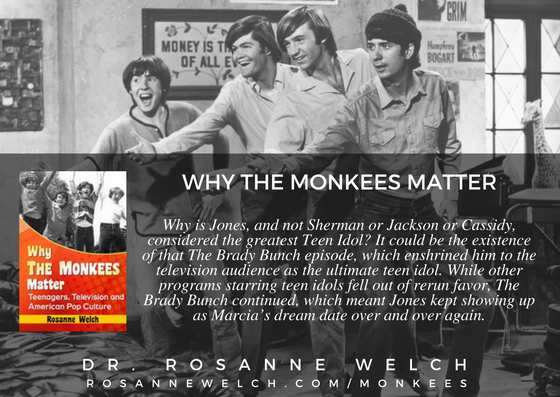
Long after new episodes involving that character ceased to exist, Jones continued to exist in the most intimate space of their home – their bedroom. When asked what she dreams about, Tony Award-winning composer and pop diva Cyndi Lauper told the Daily Mail, “What or who do you dream about? I have vivid dreams – from banal to crazy. One time I was married to Davy Jones of The Monkees. Go figure!”
Mabel’s Married Life (1914) is an American comedy silent film made by Keystone Studios starring and co-written by Charles Chaplin and Mabel Normand, and directed by Chaplin. As was so often the case during his first year in film, Chaplin’s character is soon staggering drunk. —Wikipedia
Learn More About Mabel Normand with these books
†
* A portion of each sale from Amazon.com directly supports our blogs ** Many of these books may be available from your local library. Check it out! † Available at the LA Public Library
Hi everybody! It’s so wonderful to have you here. I’m going to be talking about a book and a film and a television series and I think the trajectory from serious to bubblegum back to slightly serious is what’s interesting to me and it’s all about the adaptation of something and how the true person’s story can get lost along the way and I believe TV allows a chance to tell longer stories — you can tell a hundred hours in the life of a person instead of two hours and so I think we’re going to end up discovering that TV was the better place for this story to house itself.
“How Gidget Got Into the Girl Ghetto by Accident (and How We Can Get Her Out of it): Demoting Gidget: The Little Girl with Big Ideas from Edgy Coming of Age Novel to Babe on the Beach Genre Film via Choices made in the Adaptation Process.”
It’ a long title, as I joke up front, but covers the process of adapting the true life story of Kathy Kohner (nicknamed ‘Gidget’ by the group of male surfers who she spent the summers with in Malibu in the 1950s) into the film and television series that are better remembered than the novel. The novel had been well-received upon publication, even compared to A Catcher in the Rye, but has mistakenly been relegated to the ‘girl ghetto’ of films. Some of the adaptations turned the focus away from the coming of age story of a young woman who gained respect for her talent at a male craft – surfing – and instead turned the focus far too much on Kathy being boy crazy.
Along the way I found interesting comparisons between how female writers treated the main character while adapting the novel and how male writers treated the character.
Dr. Rosanne Welch teaches the History of Screenwriting and One-Hour Drama for the Stephens College MFA in Screenwriting.
Writing/producing credits include Beverly Hills 90210, Picket Fences, ABCNEWS: Nightline and Touched by an Angel. In 2016 she published the book Why The Monkees Matter: Teenagers, Television and American Pop; co-edited Women in American History: A Social, Political, and Cultural Encyclopedia; and placed “Transmitting Culture Transnationally Via the Characterization of Parents in Police Procedurals” in the New Review of Film and Television Studies. Essays appear in Torchwood Declassified: Investigating Mainstream Cult Television and Doctor Who and Race: An Anthology. Welch serves as Book Reviews editor for Journal of Screenwriting and on the Editorial Advisory Board for Written By magazine, the magazine of the Writers Guild.
The Screenwriting Research Network is a research group consisting of scholars, reflective practitioners and practice-based researchers interested in research on screenwriting. The aim is to rethink the screenplay in relation to its histories, theories, values and creative practices.
I think when you teach slient films and early films of course your teaching character because that is where all these archetypes came from. Yes, we can go back to France and we can go back to Aristophanes. They came from way back then, but on the film they came from this time period and we find all these characters in these early films.Sometimes in more simplistic ways which helps students understand how to back to the simple part of their story — who wants what and what’s getting in their way and you see that in this sort of film. You can teach structure in teaching silent films because we all know the purpose of having 3 acts is because you had reels and you had 1 reel and then 2 reels and then 3 reels and began to write in terms of that. It was also Paul Gulino’s sequence approach which is just about each reel. You have 8 reels, 8 sequences. They visualize, ‘Oh, this is why they do it this way because they had to to — oh, I get it!” It helps students understand the history of this profession. I love that Warren calls it a profession because that is what it is.
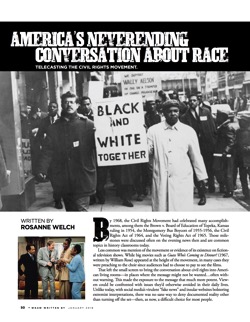
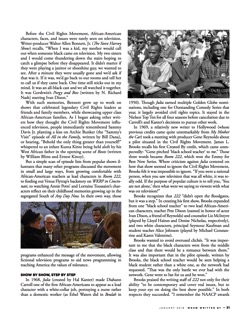
I have an article about how the Civil Rights Movement was reflected on the TV shows of the 1960s and 70s – “America’s Neverending Conversation” in the current issue (January 2018) of Written By which is out today with revolving covers (like TV Guide does with special issues) featuring Lena Waite and/or Jordan Peele.
I had the wonderful experience of interviewing Jim Brooks about Room 222, a show I watched incessantly in my childhood before I knew what an ‘ideology’ was and that I was being offered one – and I spoke at length with Nancy Miller at length about Any Day Now – a show that relished highlighting the brave men and women who worked in the Civil Rights Movement – and still do.
By 1968, the Civil Rights Movement had celebrated many accomplishments, among them the Brown v. Board of Education of Topeka, Kansas ruling in 1954, the Montgomery Bus Boycott of 1955-1956, the Civil Rights Act of 1964, and the Voting Rights Act of 1965. Those milestones were discussed often on the evening news then and are common topics in history classrooms today.
Less common was mention of the movement or evidence of its existence on fictional television shows. While big movies such as Guess Who’s Coming to Dinner? (1967, written by William Rose) appeared at the height of the movement, in many cases they were preaching to the choir since audiences had to choose to pay to see the films.
That left the small screen to bring the conversation about civil rights into American living rooms—in places where the message might not be wanted…often without warning. This made the exposure to the message that much more potent. Viewers could be confronted with issues they’d otherwise avoided in their daily lives. Unlike today, with social media’s virulent “fake news” and insular websites bolstering extremist interpretations, there was no sane way to deny documented reality other than turning off the set—then, as now, a difficult choice for most people.
Teaching Silent Films allows you to teach diversity again because there were filmmakers of all colors and ethnic backgrounds. Much of that work has been lost. Some of it is findable. Oscar Micheaux was one of the people I found for my students. He was a hugely successful African-American writer/director and he also wrote novels and he translated his novels into films. One of them is called Within Our Gates and it’s free on YouTube as well and he looked at middle class African-Americans talking in the 1910’s and presented them to the audience in ways that other movies were not and I thin kit’s important for them to know his work in line with Cecil B. DeMille and D. W. Griffith and all those other guys because they’re not the only men – they’re not the only people who are around but if you look at film history classes that’s all they’ve learned and that really bothers me.
Why is Jones, and not Sherman or Jackson or Cassidy, considered the greatest Teen Idol? It could be the existence of that The Brady Bunch episode, which enshrined him to the television audience as the ultimate teen idol. While other programs starring teen idols fell out of rerun favor, The Brady Bunch continued, which meant Jones kept showing up as Marcia’s dream date over and over again.


 †
†

![01 Introduction from How Gidget Got Into the Girl Ghetto – Dr. Rosanne Welch – SRN Conference 2017 [Video]](https://rosannewelch.com/wp-content/uploads/2017/10/gidget-srn.png)

![Teaching Character and Structure from Giving Voice to Silent Films and the Far From Silent Women Who Wrote Them with Dr. Rosanne Welch [Video]](https://rosannewelch.com/wp-content/uploads/2017/12/ufva-11-character-structure.jpeg)




![Silent Films and Diversity from Giving Voice to Silent Films and the Far From Silent Women Who Wrote Them with Dr. Rosanne Welch [Video]](https://rosannewelch.com/wp-content/uploads/2017/12/ufva-10-diversity.jpeg)