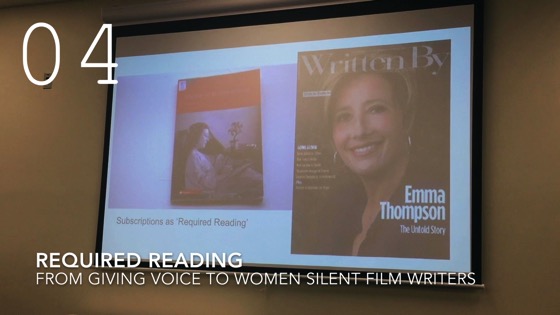
I am also on the editorial board for Written By Magazine and the book review editor of the Journal of Screenwriting so if anyone’s interested in writing book reviews for the Journal of Screenwriting which publishes out of the UK, please let me know because I am always looking for book reviewers and you get the book for free, but also I have — the schools that I teach at have subscription to the journal. I have students read journal articles because I want them — it is a Masters Program — I want them to have a comfort level with that, but I have my undergrads at least do one journal article reading as well to have an accessibility to that. And then I get the schools and/or the kids to read Written By Magazine every month. We do a different screenwriter or television writer on the front cover. It’s a wonderful inside look at how the process of writing is done. The subscription is not that expensive, rather than a textbook for undergrads, but we also publish most of that online for free at the Written By web site, so they can read these articles on their own as assignments and learn about these writers. So I think all that stuff is valid for the class.
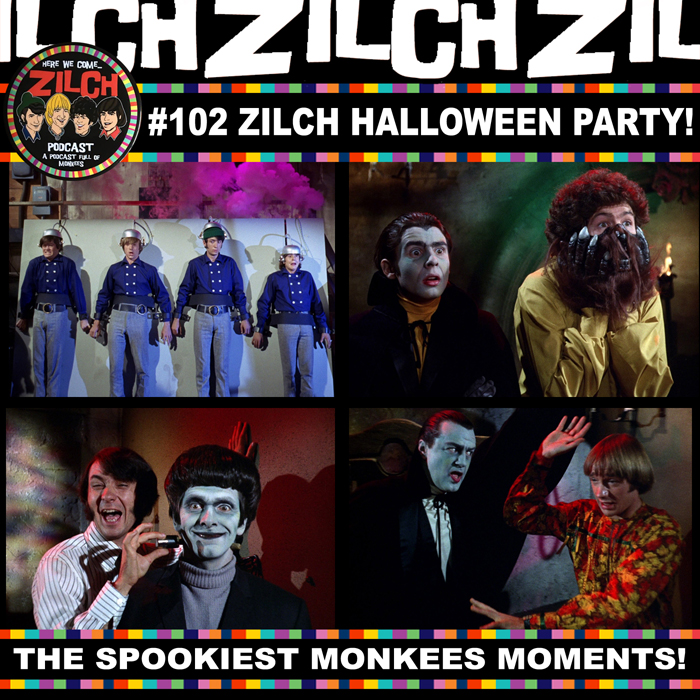
It’s always a pleasure to be invited to chat Monkees moments with other experts and this panel was extra fun since Halloween is one of my favorite holidays. We each chose our favorite scary episodes to create a perfect 5 episode binge – so listen in for the list, pop your popcorn, purchase your candy corn and cuddle up on your couch to watch with us this Halloween!
Trick or Treat! Welcome to a Zilch Halloween episode! Join Kenacula & Christine Carlson Werewolf as they Haunt the Zilch Castle.Then a Spooky Panel of Scary Monkees Moments with Courtney Cronin Dold, Dr.Rosanne Welch, Sarah Clark, Melanie Mitchell! Boo! Be safe and Happy Halloween!
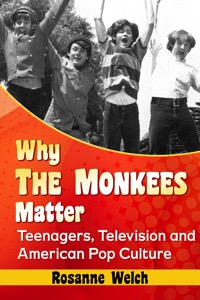
Jean Powergirl takes the host reigns and welcomes her guest Rosanne Welch, PhD to the show! They’ll be discussing Roseanne’s book, “Why The Monkees Matter: Teenagers, Television and American Pop Culture.”
Transcript:
Rosanne: So, I originally wrote about that and that’s how I got to talk with Micky because I knew, as a child actor, he would understand how one worked with writers and, of course, he always did credit the writers — both the songwriters and the show writers when he was doing his interviews. I did get to talk to him and the secret — which isn’t much of a secret — because I put it in the preface to the book — is that he had been my favorite Monkee so to actually talk to him was the big deal. Even at the age of 50 for god’s sake.
Jean: So she got to talk to her favorite Monkee and was he able to give you some insight?
Rosanne: He was. I mean he, of course, he took seriously the work of the writers and, as an actor, you’ll notice that while they did a lot of ad lib — actors can’t do as much improv as we assume because camera angles have to be created by the directors and they’re based on the script.
Jean:…and isn’t there a tight time and money is time, right
Rosanne: Yes. Because of all the crazy quick shots, this show would do sometimes 60 or 70 camera setups a day when 20 is normal.
A hit television show about a fictitious rock band, The Monkees (1966-1968) earned two Emmys–Outstanding Comedy Series and Outstanding Directorial Achievement in Comedy. Capitalizing on the show’s success, the actual band formed by the actors, at their peak, sold more albums than The Beatles and The Rolling Stones combined and set the stage for other musical TV characters from The Partridge Family to Hannah Montana. In the late 1980s, the Monkees began a series of reunion tours that continued into their 50th anniversary.
This book tells the story of The Monkees and how the show changed television, introducing a new generation to the fourth-wall-breaking slapstick created by Laurel and Hardy and the Marx Brothers. Its creators contributed to the innovative film and television of 1970s with projects like Bob & Carol & Ted & Alice, The Mary Tyler Moore Show, Laugh-In and Welcome Back, Kotter. Immense profits from the show, its music and its merchandising funded the producers’ move into films such as Head, Easy Rider and Five Easy Pieces.
Rosanne Welch, PhD has written for television (Touched by an Angel, Picket Fences) and print (Three Ring Circus: How Real Couples Balance Marriage, Work and Kids and The Encyclopedia of Women in Aviation and Space). In the documentary world she has written and produced Bill Clinton and the Boys Nation Class of 1963 for ABC NEWS/Nightline and consulted on PBS’s A Prince Among Slaves, the story of a prince from West Africa who was enslaved in the 1780s, freed by order of President John Quincy Adams in the 1820s and returned to his homeland.
This is my background in the business. These are all the different shows that I worked on. Always with a focus on the female characters. How can I make the female characters stronger? I’m a girl. Interesting enough I have a boy — a son — and when I had him I thought, “Oh no, I’m supposed to have a girl so I can teach her to be a feminist.” and then someone went “No let me teach him to love a feminist.” and I thought, ‘Oh yeah.” So, and this is the stuff that I have written. Mostly focused on women — women in Doctor Who and how race is portrayed. Women in Aviation. I’ve just got a second encyclopedia set of women in History. I am part of the Women Screenwriters Encyclopedia and my latest book is on The Monkees and feminism in The Monkees because it was actually there in the show if you look hard enough.
This whole conference is about inclusion and convergence which made this topic seem useful to me and hopefully to you. I’ve always gone back from my childhood to learning about Abagail Adams — the woman who told John while you’re working on that Constitution, could you please “remember the ladies.” We tend to forget them in this town and int he history of this town. The other book that I’ve got there is “What Happens Next” which everyone uses in their classes and has a paragraph about the women that that entire book covers. He finds time to cover them in a paragraph and that makes my students crazy. They read 5 different books on the history of screenwriting and chronologically and they come to Frances last and they are like why, why have I not heard of her until now and that book was written in the middle so you know some men write books before that book came out. They didn’t know the women existed. Then they knew and they still didn’t’ write about them and it’s important that we are in these books. So. I thought that was my background.
I teach the history of screenwriting, not film, to an MFA program for Stephens College, a low residency program. We do workshops at the Jim Henson Studios in Hollywood for 10 days twice a year and then the students do the rest of their work online. I’m also an adjunct at Cal State Fullerton, so I’ve had the pleasure of teaching all three of these gentlemen. So that’s been a lovely thing but I don’t teach this class there, so they haven’t actually seen me do this. With them, I’ve done screenwriting and workshopping, but here I’m going to talk about why I teach this class for a couple of reasons and I gave it this particular name, “Giving Voice to Silent Films…and the Far From Silent Women Who Wrote Them” – you’ll see that one of those books is by Carrie Beauchamp and it is, “Without Lying Down.” The life story of Frances Marion and the highest paid screenwriter in Hollywood in the entire Silent and early talkie period and none of my students have ever heard of her and I think it is very important that we hear about her and Anita Loos and a bunch of other important women.
I was pleased to be asked to participate in a panel designed by former student (and current kick-ass professor) Warren Lewis. The panel included two other former students from the MFA in Screenwriting program at CSUF: David Morgassen and Lucas Cuny. For the panel’s theme — “What Else Do We Teach When We Teach Screenwriting: Context And Controversy: Strategies For Teaching Film And Television History And Current Events To Screenwriters” — I chose to present on: “Giving Voice to Silent Films and the Far From Silent Women Who Wrote Them”.
It involves the fact that when teaching screenwriting history, I begin chronologically. In essence I force students to watch the classic films of the silent era (happily accessible for free on YouTube) first because that is when women ran the town as evidenced in Cari Beachamp’s Without Lying Down: Frances Marion and the Powerful Women of Early Hollywood”.) Beauchamp’s book is on my reading list so that they can encounter the careers of Frances Marion, Anita Loos, Lois Weber, Adela Rogers St. Johns, Eve Unsell and a host of other women who ran their own production companies for many years.
Secondly, knowing women once ran Hollywood makes it harder for today’s executives to wonder if today’s women can do the same.
Third, I have learned that teaching silent films reminds modern students that in screenwriting the visual is as important as the verbal.
Fourth, recognizing the birth of major iconic archetypes helps them recognize those archetypes in modern films and develop their own characters more three-dimensionally.
Fifth, I had to embarrassingly realize that in my zest to focus on forgotten females, I forgot to cover the careers of forgotten men and women of color and so expanded my viewing list to include the work of Oscar Mischeaux and other artists of color from the era.
Finally, I stretch back to the silents as a reminder that all artists stand of the shoulders of those who came before them – be they women or men.
Rosanne Welch, PhD has written for television (Touched by an Angel, Picket Fences) and print (Three Ring Circus: How Real Couples Balance Marriage, Work and Kids and The Encyclopedia of Women in Aviation and Space). In the documentary world she has written and produced Bill Clinton and the Boys Nation Class of 1963 for ABC NEWS/Nightline and consulted on PBS’s A Prince Among Slaves, the story of a prince from West Africa who was enslaved in the 1780s, freed by order of President John Quincy Adams in the 1820s and returned to his homeland.
Welch teaches the History of Screenwriting and One-Hour Drama for the Stephens College MFA in Screenwriting. Writing/producing credits include Beverly Hills 90210, Picket Fences,ABCNEWS: Nightline and Touched by an Angel. In 2016 she published the book Why The Monkees Matter: Teenagers, Television and American Pop; co-edited Women in American History: A Social, Political, and Cultural Encyclopedia; and placed “Transmitting Culture Transnationally Via the Characterization of Parents in Police Procedurals” in the New Review of Film and Television Studies. Essays appear in Torchwood Declassified: Investigating Mainstream Cult Television and Doctor Who and Race: An Anthology. Welch serves as Book Reviews editor for Journal of Screenwriting and on the Editorial Advisory Board for Written By magazine, the magazine of the Writers Guild.
“How Gidget Got Into the Girl Ghetto by Accident (and How We Can Get Her Out of it): Demoting Gidget: The Little Girl with Big Ideas from Edgy Coming of Age Novel to Babe on the Beach Genre Film via Choices made in the Adaptation Process.”
It’ a long title, as I joke up front, but covers the process of adapting the true life story of Kathy Kohner (nicknamed ‘Gidget’ by the group of male surfers who she spent the summers with in Malibu in the 1950s) into the film and television series that are better remembered than the novel. The novel had been well-received upon publication, even compared to A Catcher in the Rye, but has mistakenly been relegated to the ‘girl ghetto’ of films. Some of the adaptations turned the focus away from the coming of age story of a young woman who gained respect for her talent at a male craft – surfing – and instead turned the focus far too much on Kathy being boy crazy.
Along the way I found interesting comparisons between how female writers treated the main character while adapting the novel and how male writers treated the character.
Dr. Rosanne Welch teaches the History of Screenwriting and One-Hour Drama for the Stephens College MFA in Screenwriting.
Writing/producing credits include Beverly Hills 90210, Picket Fences, ABCNEWS: Nightline and Touched by an Angel. In 2016 she published the book Why The Monkees Matter: Teenagers, Television and American Pop; co-edited Women in American History: A Social, Political, and Cultural Encyclopedia; and placed “Transmitting Culture Transnationally Via the Characterization of Parents in Police Procedurals” in the New Review of Film and Television Studies. Essays appear in Torchwood Declassified: Investigating Mainstream Cult Television and Doctor Who and Race: An Anthology. Welch serves as Book Reviews editor for Journal of Screenwriting and on the Editorial Advisory Board for Written By magazine, the magazine of the Writers Guild.
The Screenwriting Research Network is a research group consisting of scholars, reflective practitioners and practice-based researchers interested in research on screenwriting. The aim is to rethink the screenplay in relation to its histories, theories, values and creative practices.
I was pleased to be asked to participate in a panel designed by former student (and current kick-ass professor) Warren Lewis. The panel included two other former students from the MFA in Screenwriting program at CSUF: David Morgassen and Lucas Cuny. For the panel’s theme — “What Else Do We Teach When We Teach Screenwriting: Context And Controversy: Strategies For Teaching Film And Television History And Current Events To Screenwriters” — I chose to present on: “Giving Voice to Silent Films and the Far From Silent Women Who Wrote Them”.
It involves the fact that when teaching screenwriting history, I begin chronologically. In essence I force students to watch the classic films of the silent era (happily accessible for free on YouTube) first because that is when women ran the town as evidenced in Cari Beachamp’s Without Lying Down: Frances Marion and the Powerful Women of Early Hollywood”.) Beauchamp’s book is on my reading list so that they can encounter the careers of Frances Marion, Anita Loos, Lois Weber, Adela Rogers St. Johns, Eve Unsell and a host of other women who ran their own production companies for many years.
Secondly, knowing women once ran Hollywood makes it harder for today’s executives to wonder if today’s women can do the same. Third, I have learned that teaching silent films reminds modern students that in screenwriting the visual is as important as the verbal.
Fourth, recognizing the birth of major iconic archetypes helps them recognize those archetypes in modern films and develop their own characters more three-dimensionally. Fifth, I had to embarrassingly realize that in my zest to focus on forgotten females, I forgot to cover the careers of forgotten men and women of color and so expanded my viewing list to include the work of Oscar Mischeaux and other artists of color from the era.
Finally, I stretch back to the silents as a reminder that all artists stand of the shoulders of those who came before them – be they women or men.
Rosanne Welch, PhD has written for television (Touched by an Angel, Picket Fences) and print (Three Ring Circus: How Real Couples Balance Marriage, Work and Kids and The Encyclopedia of Women in Aviation and Space). In the documentary world she has written and produced Bill Clinton and the Boys Nation Class of 1963 for ABC NEWS/Nightline and consulted on PBS’s A Prince Among Slaves, the story of a prince from West Africa who was enslaved in the 1780s, freed by order of President John Quincy Adams in the 1820s and returned to his homeland.
This book signing at Book Soup was wonderful – good people, good conversation (before and after the signing). Just another example of the kind of quality positive people who have been drawn to The Monkees across generations – I even met a former head of publicity for ScreenGems who had some fun stories to tell. — Rosanne
For me, the book is hoping to contribute to the significance of The Monkees. That’s why it’s called “Why The Monkees Matter.” What is it that we learn from them and those are just a few of the thing that strikes me. I think that if we meet this group of early television writers and performers and directors — all of them who made television back in the day — it’s going to help us understand what I call the magic of The Monkees and how much The Monkees have contributed to the myths we have about the magic of the 1960s. So, for me, that was the purpose of putting the book together along with getting to interview Micky Dolenz. That was always underneath it all.
While I have the chance, of course, I want to thank a lot of people that were involved with helping me with the book. My friend, Mia — who’s not here tonight, but she copyedited for me and that was really important to have somebody look at all my spelling. I’m not bad at spelling, but you know, when you’re in a hurry and see things it was great to have someone do that. Of course, I want to think my Mom for letting me watch TV so much when I was a kid, because, geez whiz, I grew up to be a TV writer and write books about TV. So I was actually studying back in the day. Nobody was really paying attention. So I think that’s really important. Some people said you shouldn’t let your kids watch TV. It will be bad for them and it turned out to be very good for me. So, I have to say, I have to thank my husband and my son, because I spent many nights just typing on my computer ignoring them and they seemed to be fine with that and, in fact, i also have to thank my son for coming to Monkees concerts with me and for reminding me that they have something else yet to teach which is that when he was 15 and saw them perform at the age of 70, yet he had seen them in television at the age of 18, because that is when they are forever saved in these programs, he said that what he learned from watching them is that he should find something he loved to do in life because he wanted to be able to do it as long as they were doing what they loved and to me that’s a huge lesson and I think they just continue teaching us lessons over and over and over.




![24: Writers, Actors and The Monkees : “Why The Monkees Matter” Interview with Jean Power [Video] (0:57)](https://rosannewelch.com/wp-content/uploads/2017/10/rmw-power-24-writers-actors.jpeg)
![My Background from Giving Voice to Silent Films and the Far From Silent Women Who Wrote Them with Dr. Rosanne Welch [Video] (0:40)](https://rosannewelch.com/wp-content/uploads/2017/10/ufva-03-background.jpeg)
![Remember the Ladies from Giving Voice to Silent Films and the Far From Silent Women Who Wrote Them with Dr. Rosanne Welch [Video] (0:56)](https://rosannewelch.com/wp-content/uploads/2017/10/ufva-02-remember-ladies.jpeg)
![Introduction from Giving Voice to Silent Films and the Far From Silent Women Who Wrote Them with Dr. Rosanne Welch [Video] (1 min)](https://rosannewelch.com/wp-content/uploads/2017/09/Slide01.jpg)
![How Gidget Got Into the Girl Ghetto – Dr. Rosanne Welch – SRN Conference 2017 [Video] (23 mins)](https://rosannewelch.com/wp-content/uploads/2017/10/gidget-srn.png)

![Conclusion and Acknowledgements from Why The Monkees Matter Book Signing [Video] (1:48)](https://rosannewelch.com/wp-content/uploads/2017/07/wtmm-reading-16-conclusion.jpeg)
