
A morning at @lakotacoffee to start our @citizenjanefilmfestival day!Fun today, work tomorrow!
On Screenwriting and Media with Dr. Rosanne Welch
Writing, Film, Television and More!

When Women Wrote Hollywood – 38 in a series – Sarah Y. Mason and Victor Heerman

Mason was born Sarah Yeiser Mason in Pima, Arizona. She and her husband Victor Heerman won the Academy Award for best screenplay adaptation for their adaptation for the 1933 film Little Women, based on the novel by Louisa May Alcott. Mason was one of the first people in Hollywood to specialize in script supervision and film continuity when the industry switched from silent film to talkies.[2][3] — Wikipedia
More about Sarah Y. Mason and Victor Heerman
Buy a signed copy of when Women Wrote Hollywood
Paperback Edition | Kindle Edition | Google Play Edition
* A portion of each sale from Amazon.com directly supports our blogs
** Many of these books may be available from your local library. Check it out!
† Available from the LA Public Library

What does Star Wars mean to you? How has it affected your life!
Video coming soon to RosanneWelch.com and YouTube.com/drrosannewelch
Subscribe today to be notified!

How do I scan a nametag?
To scan a nametag using the Instagram app camera:
To scan a nametag from your profile:
Learn more about Star Wars with these books and videos!
†
More Star Wars Merchandise and Books
* A portion of each sale from Amazon.com directly supports our blogs
** Many of these books may be available from your local library. Check it out!
† Available from the LA Public Library

What does Star Wars mean to you? How has it affected your life!
Rosanne Speaks on “How Star Wars Changed Films Forever” at Cal Poly Pomona’s University Library
Video coming soon to RosanneWelch.com and YouTube.com/drrosannewelch
Subscribe today to be notified!
How do I scan a nametag?
To scan a nametag using the Instagram app camera:
To scan a nametag from your profile:
Learn more about Star Wars with these books and videos!
†
More Star Wars Merchandise and Books
* A portion of each sale from Amazon.com directly supports our blogs
** Many of these books may be available from your local library. Check it out!
† Available from the LA Public Library
Do you know about these women screenwriters? Many don’t. Learn more about them today!

“In London one of Eve Unsell’s first employees was a young Alfred Hitchcock who designed title cards presumably under Unsell’s tutelage on such films as The Call of Youth (1921). Unsell is credited with teaching Hitchcock ‘the ins and outs of story and screenplay mechanics as well as adapting novels for film.'”
Smart Girl In Charge: Eve Unsell
Laura Kirk
Buy a signed copy of when Women Write Hollywood
Paperback Edition | Kindle Edition | Google Play Edition
* A portion of each sale from Amazon.com directly supports our blogs
** Many of these books may be available from your local library. Check it out!
† Available from the LA Public Library
When Women Wrote Hollywood – 37 in a series – Rebecca – Wr: Joan Harrison, Dir: Alfred Hitchcock
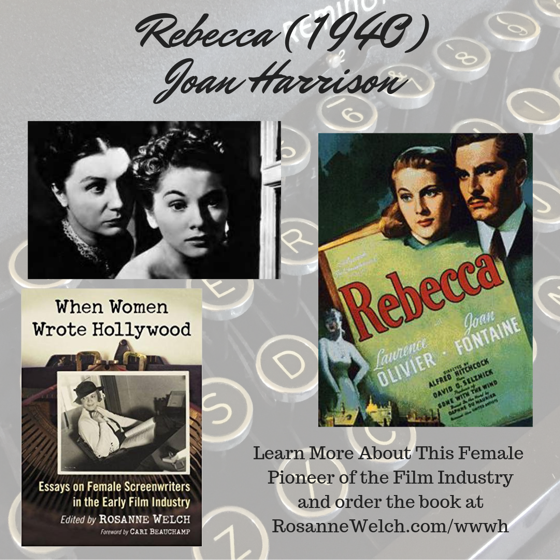
Rebecca is a 1940 American romantic psychological thriller film directed by Alfred Hitchcock. It was Hitchcock’s first American project, and his first film under contract with producer David O. Selznick. The screenplay by Robert E. Sherwood and Joan Harrison, and adaptation by Philip MacDonald and Michael Hogan, were based on the 1938 novel of the same name by Daphne du Maurier. The film stars Laurence Olivier as the brooding, aristocratic widower Maxim de Winter and Joan Fontaine as the young woman who becomes his second wife, with Judith Anderson and George Sanders in supporting roles. The film won the 1940 Academy Award for Best Picture.
The film is a gothic tale shot in black-and-white. Maxim de Winter’s first wife Rebecca, who died before the events of the film, is never seen. Her reputation and recollections of her, however, are a constant presence in the lives of Maxim, his new wife and the housekeeper Mrs. Danvers.
Rebecca won two Academy Awards, Best Picture and Cinematography, out of a total 11 nominations. Olivier, Fontaine and Anderson also were Oscar-nominated for their respective roles as were Hitchcock and the screenwriters. Rebecca was the opening film at the 1st Berlin International Film Festival in 1951.[2] — Wikipedia
More about Rebecca
More about Joan Harrison
Buy a signed copy of when Women Wrote Hollywood
Paperback Edition | Kindle Edition | Google Play Edition
* A portion of each sale from Amazon.com directly supports our blogs
** Many of these books may be available from your local library. Check it out!
† Available from the LA Public Library
When Women Wrote Hollywood – 36 in a series – Joan Harrison
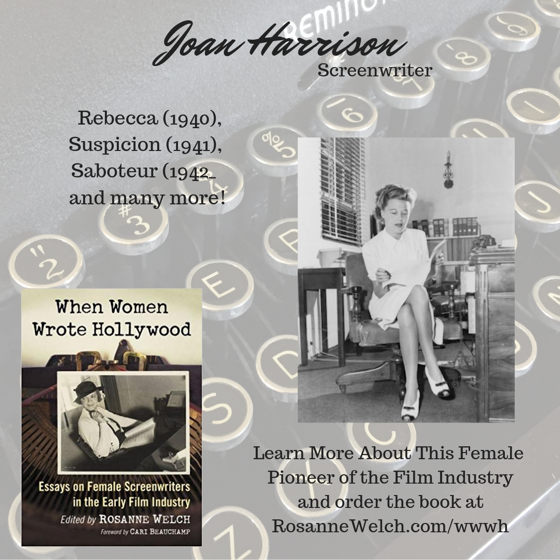
Born in Guildford, Surrey, Harrison studied at St Hugh’s College, Oxford and reviewed films for the student newspaper. She also studied at the Sorbonne. In 1933, she became Alfred Hitchcock’s secretary. Eventually she began reading books and scripts for him and became one of Hitchcock’s most trusted associates. Harrison appears in a scene in Hitchcock’s original version of The Man Who Knew Too Much (1934), eating dinner with Peter Lorre’s character. She was among the screenwriters for the film Jamaica Inn (1939) based on the novel by Daphne du Maurier.
When Hitchcock moved to Hollywood in March 1939 to begin his contract with David O. Selznick to direct films, Harrison went with him as an assistant and writer.[1] She continued contributing to the screenplays for Hitchcock’s films Rebecca (1940), also adapted from a du Maurier novel, Foreign Correspondent(1940), Suspicion (1941), and Saboteur (1942). She was also credited as one of the screenwriters for Dark Waters (1944). — Wikipedia
More about Joan Harrison
Buy a signed copy of when Women Wrote Hollywood
Paperback Edition | Kindle Edition | Google Play Edition
* A portion of each sale from Amazon.com directly supports our blogs
** Many of these books may be available from your local library. Check it out!
† Available from the LA Public Library

“The Lost World was an adaptation of Arthur Conan Doyle’s famous dinosaur novel, and the film itself did the story justice. Fairfax both wrote the adaptation and directed the editing.
After the massive success of The Lost World, which broke records, Fairfax was more in demand than ever.”
Silent Screenwriter, Producer and Director: Marion Fairfax
Sarah Phillips
Buy a signed copy of when Women Write Hollywood
Paperback Edition | Kindle Edition | Google Play Edition
* A portion of each sale from Amazon.com directly supports our blogs
** Many of these books may be available from your local library. Check it out!
† Available from the LA Public Library
When Women Wrote Hollywood – 35 in a series – “A Star Is Born” (1937), Wr: Dorothy Parker
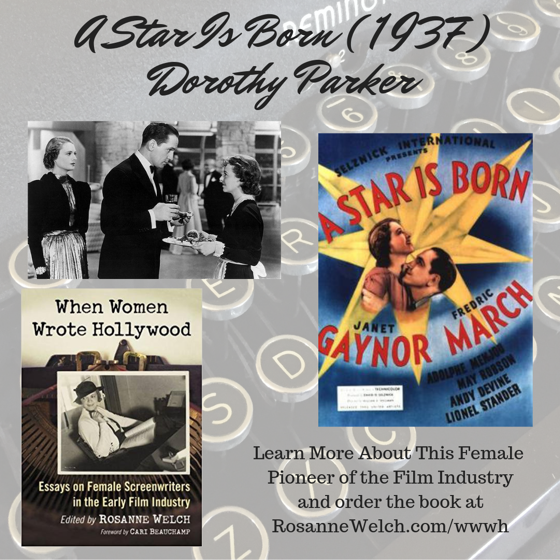
A Star Is Born is a 1937 American Technicolor romantic drama film produced by David O. Selznick, directed by William A. Wellman from a script by Wellman, Robert Carson, Dorothy Parker, and Alan Campbell, and starring Janet Gaynor (in her only Technicolor film) as an aspiring Hollywood actress, and Fredric March(in his Technicolor debut) as a fading movie star who helps launch her career. The supporting cast features Adolphe Menjou, May Robson, Andy Devine, Lionel Stander, and Owen Moore.
It was originally made in 1937 with Janet Gaynor and Fredric March, and then remade three times: 1954 (starring Judy Garland and James Mason), in 1976(starring Barbra Streisand and Kris Kristofferson), and in 2018 (starring Lady Gaga and Bradley Cooper).
North Dakota farm girl Esther Victoria Blodgett yearns to become a Hollywood actress. Although her aunt and father discourage such thoughts, Esther’s grandmother gives Esther her savings to follow her dream.
Esther goes to Hollywood and tries to land a job as an extra, but so many others have had the same idea that the casting agency has stopped accepting applications. Esther is told that her chances of becoming a star are one in 100,000. She befriends a new resident at her boarding house, assistant director Danny McGuire, himself out of work. When Danny and Esther go to a concert to celebrate Danny’s employment, Esther has her first encounter with Norman Maine, an actor she admires greatly. Norman has been a major star for years, but his alcoholism has sent his career into a downward spiral. — Wikipedia
A Star is Born (1937) Trailer
More About “A Star Is Born” (1937)
More about Dorothy Parker
More books by and about Dorothy Parker
†††
Buy a signed copy of when Women Wrote Hollywood
Paperback Edition | Kindle Edition | Google Play Edition
* A portion of each sale from Amazon.com directly supports our blogs
** Many of these books may be available from your local library. Check it out!
† Available from the LA Public Library
When Women Wrote Hollywood – 33 in a series – The Little Foxes (1941) – Wr: Lillian Hellman
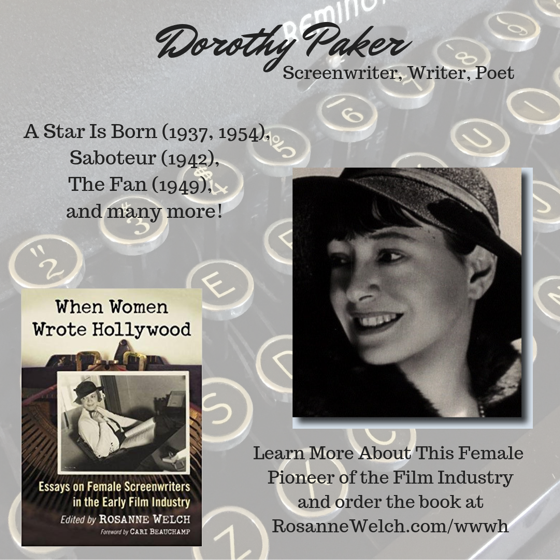
Dorothy Parker (née Rothschild; August 22, 1893 – June 7, 1967) was an American poet, writer, critic, and satirist based in New York; she was best known for her wit, wisecracks, and eye for 20th-century urban foibles.
From a conflicted and unhappy childhood, Parker rose to acclaim, both for her literary works published in such magazines as The New Yorker and as a founding member of the Algonquin Round Table. Following the breakup of the circle, Parker traveled to Hollywood to pursue screenwriting. Her successes there, including two Academy Award nominations, were curtailed when her involvement in left-wing politics resulted in the being placed on the Hollywood blacklist.
Dismissive of her own talents, she deplored her reputation as a “wisecracker.” Nevertheless, both her literary output and reputation for sharp wit have endured. — Wikipedia
A Star is Born (1937) Trailer
More about Dorothy Parker
More books by and about Dorothy Parker
†††
Buy a signed copy of when Women Wrote Hollywood
Paperback Edition | Kindle Edition | Google Play Edition
* A portion of each sale from Amazon.com directly supports our blogs
** Many of these books may be available from your local library. Check it out!
† Available from the LA Public Library
 and Follow