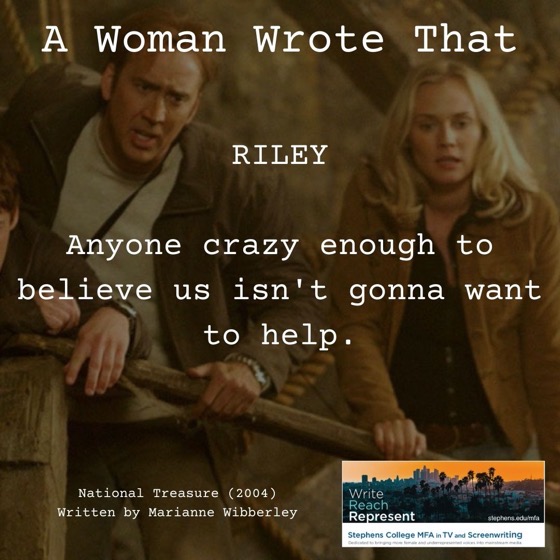
This new “A Woman Wrote That” post is an echo of the Writers Guild campaign of a few years ago (“A Writer Wrote That”) where they noted famous movie quotes and credited the screenwriter rather than the director. The difference here being that we will be posting lines from films written by female screenwriters. Feel free to share! — Rosanne
CLAIRE
The only person I’d run through an airport for is you.
Journalist Alexis Schwartz contacted me a few weeks ago to be interviewed for an article she was writing about female writers in Hollywood on the eve of hoping a woman would win this year’s Oscar for Best Screenplay.
Alexis noted, teenagers entering high school this fall would never have seen a female win in that category since the last win was 13 years ago (Diablo Cody for Juno). Happily, Emerald Fennell did win – for Promising Young Woman. Then Chloe Zhao won for directing Nomadland. Yet notice how in the Chloe Zhao descriptions no one calls her the writer-director of Nomadland even though she adapted the book. They only call her the director – though she did both important tasks on that now Academy Award-winning film. So there is still much work to be done for writers to be recognized on an equal level.
We had so much fun talking and there was so much to say that it’s no surprise something got mixed up. The initial published version of the story reported that Eve Unsell was Cecil B. deMille’s mother – but that was playwright, Broadway producer Beatrice deMille who had hired Unsell after reading one of her short stories and therefore began Unsell’s career as one of Hollywood’s earliest writer-producer-directors – and as the woman who taught Hitchcock how to direct. Read the article to learn more. And then read our book – When Women Wrote Hollywood– to learn more about the important work women have been doing since the founding of the film industry.
As Alexis and I noted during the interview – we really could talk about this all day – and look – how wonderful for both Fennel and Zhao to win that night.
The 2007 Academy Awards’ futuristic stage was adorned with three large pillars—some 25 feet in diameter—superficially holding up the Dolby Theatre. Within the stage’s center, an equally large Oscar statue loomed over the diminutive presenters like a god demanding hecatomb. Throughout the evening, celebrities weaved through the stage, including winners Alan Arkin, Helen Mirren, Forest Whitaker, and Martin Scorsese, the latter of whom’s cop-and-mob film The Departed (2006) would go on to win four statues that evening. But something happened in the middle-pack of the awards—more “popular” than sound editing, less “popular” than original score —an unsuspecting former exotic dancer and first-time screenwriter, Diablo Cody, won Best Original Screenplay for her freshman film, Juno.
[…]
Writers such as Jeanie MacPherson, who wrote most of the profitable films credited to director and Hollywood tycoon Cecil B. deMille, have been all but forgotten. Meanwhile, deMille is described as “a founder of the Hollywood motion-picture industry” and is the namesake for the Cecil B. deMille Award of Excellence presented annually at the Golden Globes. Paradoxically, deMille’s mother, Eve Unsell, who taught Alfred Hitchcock everything he knew was later regarded as an erasable footnote by Hitchock himself. She was left uncredited in his memoir—only to be known as “a middle-aged woman.” Even worse, these titans set a precedent by often discrediting writers’ work during interviews. This became standard practice—if the writer was mentioned at all. “The [director-ownership model] destroyed writers, even great men, like Preston Sturges [the first-ever winner of the Academy Award for Original Screenplay], had to become directors to protect their words and characters,” Rosanne Welch, PhD, screenwriting historian and former Beverly Hills 90210 writer says. “No one was safe.”
This new “A Woman Wrote That” post is an echo of the Writers Guild campaign of a few years ago (“A Writer Wrote That”) where they noted famous movie quotes and credited the screenwriter rather than the director. The difference here being that we will be posting lines from films written by female screenwriters. Feel free to share! — Rosanne
RILEY
Anyone crazy enough to believe us isn’t gonna want to help.
I first found Anita Loos in her memoir A Girl Like I which sat on the sparsely covered “Hollywood History” shelf in my local library one summer. Reading her story showed me women had been masterful in the world of screenwriting, which taught me that they could – and would be again – even though it was the late 1970s and I could only name two female screenwriters. Nancy Dowd, who had won the Best Screenplay Oscar for Coming Home and Harriet Frank, Jr., who had been nominated for Norma Rae. (Watch future columns for more on their storied careers.)
If you’ve never heard of Anita Loos, now you have. Historians admit she “discovered the key to all good movie writing, a story to be seen rather than told” in her very first screen story The New York Hat. The 1912 film came from a very particularly female perspective being a social satire highlighting the hypocrisy of how gossip destroys women’s reputations (available on YouTube – go watch now!). Yet many male historians also dismiss Loos because they fell for the fragile little girl persona she created for herself, so necessary to prop up the egos of the men who bought her scripts. One could say Loos understood branding even before Mae West (whose writing career you will also read about in a future column).
Loos became one of the busiest writers of the silent period. By 1913 she had sold upwards of 40 scenarios writing for the biggest stars of the day including creating the swashbuckling persona of Douglas Fairbanks. She would go on to write over 140 films across her career with more being remade in her retirement. Loos is also known as the first literate screenwriter since she included dialogue in her silent film scenarios to make them more interesting for the directors to read and therefore more sellable.
Loos frequently had to use her alcoholic husband, John Emerson as a conduit to communicate with directors and other executives who balked at dealing with a woman on equal footing. This worked well to promote the idea they were a writing “team” and a happy couple, when in fact Loos did most all of the writing, including writing her signature novel, Gentlemen Prefer Blondes, alone. This novel concerns the romantic adventures of two nightclub singers traveling to Paris to perform. It proved so popular it has never been out of print. Loos adapted Blondes as a film in 1928. Then she adapted it as a Broadway musical in 1949, cementing Loos as the writer who gave flappers respect as independent women and not floozies. (Most fans are familiar with the iconic 1953 film musical starring Marilyn Monroe. Charles Lederer did that adaptation).
Loos also worked behind the scenes to aid fellow females in their entry into the film world. For example, in 1920 Vanity Fair magazine fired their theatre reviewer, a young Dorothy Parker, for writing disparaging reviews of actresses whose producer husbands or boyfriends threatened to pull advertising from the magazine. Friends and fellow writers Robert Benchley and Robert Sherwood resigned the same day. Loos and another highly paid female screenwriter of the day, Frances Marion, both suggested to actress and producer Lillian Gish that she hire Parker for a film she was currently supervising that starred her sister, also named Dorothy. More on Dorothy Parker as a screenwriter next month!
This new “A Woman Wrote That” post is an echo of the Writers Guild campaign of a few years ago (“A Writer Wrote That”) where they noted famous movie quotes and credited the screenwriter rather than the director. The difference here being that we will be posting lines from films written by female screenwriters. Feel free to share! — Rosanne
MERIDA
I am Merida, firstborn descendant of Clan Dunbroch. And I’ll be shooting for my own hand!
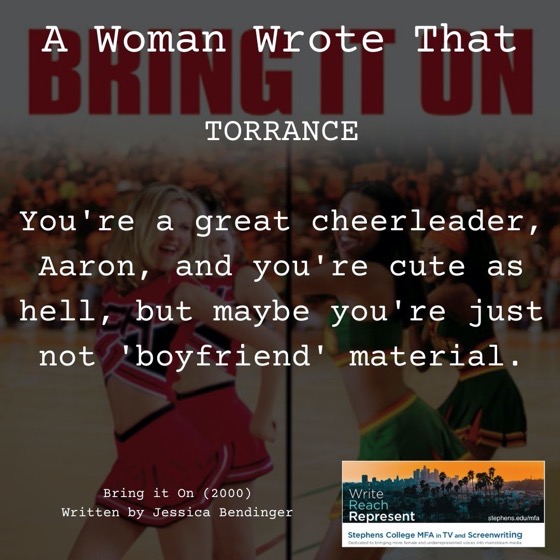
This new “A Woman Wrote That” post is an echo of the Writers Guild campaign of a few years ago (“A Writer Wrote That”) where they noted famous movie quotes and credited the screenwriter rather than the director. The difference here being that we will be posting lines from films written by female screenwriters. Feel free to share! — Rosanne
TORRANCE
You’re a great cheerleader, Aaron, and you’re cute as hell, but maybe you’re just not ‘boyfriend’ material.
This new “A Woman Wrote That” post is an echo of the Writers Guild campaign of a few years ago (“A Writer Wrote That”) where they noted famous movie quotes and credited the screenwriter rather than the director. The difference here being that we will be posting lines from films written by female screenwriters. Feel free to share! — Rosanne
UNCLE ARTHUR
Do you want the long version or the short version? Keep in mind, the long version is in Aramaic.
Connections at conferences matter! Through the most recent SCMS, I met Vicki Callahan, whose film history focus right now is on Mabel Normand. When she learned I could put together a lecture on the importance of the female voice in the A Star is Born franchise she asked me to give that lecture to her master students.
It made for a great opportunity for me to hone the ideas I’m working on for a chapter on that franchise that I’m writing for a new book from Bloomsbury: The Bloomsbury Handbook Of International Screenplay Theory. It’s always nice when one piece of research can be purposed in other ways – and it’s always fun revisiting such a female-centric film franchise – one that drew the talents of such powerful performers as Janet Gaynor, Judy Garland, Barbara Streisand, and Lady Gaga.
Nearly two years ago I had the pleasure of being invited to join a panel at the then upcoming SCMS (Society of Cinema and Media Studies) conference set for Seattle. As you know that was canceled due to Covid with the hopes of reconvening in Colorado in 2021. That became a virtual conference but our group decided to reapply our panel and we four were able to ‘meet’ on Zoom on Sunday and present: Writing Between the Lines: Feminist Strategies for Historical Absences, Cliché, and the Unreliable Narrator.
Here you can watch my part of the presentation,
“When Men Forget Women: The Many Ways Male Screenwriters Fail to Mention their Female Colleagues in Oral Histories”
Our intrepid panel leader, Christina Lane (author of Phantom Lady – the new biography of writer-producer Joan Harrison) kept us connected across the time. Other panel participants included Philana Payton (UCLA) who is researching the memoirs of Eartha Kitt and Vicki Callahan (USC) who covered the career of Mabel Normand. I was happy to highlight the many female screenwriters whose histories were left on the cutting room floor thanks to the unreliable narrators of their work who included directors, film reviewers, and husbands – all who left the female writers out of their own memories.
V14 Writing Between the Lines: Feminist Strategies for Historical Absences, Cliché, and the Unreliable Narrator
Chair: Christina Lane, University of Miami
Co-Chair: Vicki Callahan, University of Southern California
Vicki Callahan, University of Southern California, “Still Looking for Mabel Normand” Philana Payton, University of Southern California, “Eartha Kitt vs. Eartha Mae: Black Women, Self-Fragmentation, and the Politics of Hollywood Stardom” Rosanne Welch, Stephens College, “When Men Forget Women: The Many Ways Male Screenwriters Fail to Mention their Female Colleagues in Oral Histories” Christina Lane, University of Miami, “Alternative Writing Strategies: Notes on Discovering the ‘Women Who Knew’ Joan Harrison”