12 LGBTQ Representation and Doctor Who from Gender Diversity in the Who-niverse [Video] (0:52)

Watch this entire presentation: Gender Diversity in the Who-niverse: Paving the Way for a Lady Doctor with Dr. Rosanne Welch [Video] (36:58)

12 LGBTQ Representation and Doctor Who from Gender Diversity in the Who-niverse

For her 5th Doctor Who lecture to the CPP community, Dr. Rosanne Welch discusses how society – and the show’s writing staff – prepared the audience for a major change in this 50-year franchise – the creation of the first Lady Doctor!

Transcript:

Also, of course, as I said, Captain Jack, the first time we’re going to see — not first time but the first time very obviously Russell Davies wanted young gay men to see themselves on television as normal people. So you’re going to have Captain Jack in male relationships and gay relationships and it was just so incredibly cool to see and he’s so incredibly sexy. This is a lovely episode where we find out that Captain Jack stole his name from a real soldier in World War II and when they go back in time and they visit that guy it turns out to be the night before he’s going to die and our Captain Jack knows it but the real man doesn’t know it and they have a dance before he dies. You’re like “Oh my G–, I’m going to cry” it was so so good. So well done and then later he had an affair with one of the gentlemen who worked at Torchwood named Ianto and there’s a whole thing in England. There’s a whole shrine to Ianto. Very popular character.

Follow Dr. Welch on Twitter and Instagram
https://twitter.com/rosannewelchhttp://instagram.com/drrosannewelch


Rosanne Welch, PhD

Rosanne Welch PhD teaches the History of Screenwriting and One-Hour Drama for the Stephens College MFA in Screenwriting.

Writing/producing credits include Beverly Hills 90210, Picket Fences, ABCNEWS: Nightline and Touched by an Angel. In 2016 she published the book Why The Monkees Matter: Teenagers, Television and American Pop; co-edited Women in American History: A Social, Political, and Cultural Encyclopedia; and placed “Transmitting Culture Transnationally Via the Characterization of Parents in Police Procedurals” in the New Review of Film and Television Studies. Essays appear in Torchwood Declassified: Investigating Mainstream Cult Television and Doctor Who and Race: An Anthology. Welch serves as Book Reviews editor for Journal of Screenwriting and on the Editorial Advisory Board for Written By magazine, the magazine of the Writers Guild.

Watch Dr. Welch’s talk “The Importance of Having a Female Voice in the Room” at the 2016 TEDxCPP.

When Women Wrote Hollywood: Essays on Female Screenwriters in the Early Film Industry — Now Available!

When Women Wrote Hollywood: Essays on Female Screenwriters in the Early Film Industry 

I’m so excited to see that we’re now publishing on this collection of essays written by the original cohort of students in our first Stephens College MFA in Screenwriting which I edited and for which author Cari Beauchamp wrote a wonderful forward covering the life and influence of Frances Marion.

These 23 essays cover a range of female screenwriters from the early years of film through the 1940s, women whose work helped create the unforgettable stories and characters beloved generations of audiences but whose names have been left out of most film histories.  Not this one. This collection is dedicated to those women and written by a group of women grateful to stand on the shoulders of those who came before – as a beacon to those who will come after.

Rosanne Welch

When Women Write Hollywood Cover

Paperback Edition | Kindle Edition | Google Play Edition

Use “When Women Wrote Hollywood” in your classroom! — Contact McFarland directly for library and academic purchases. 


Like Us on Facebook!


Table Of Contents

Acknowledgments

Foreword: Finding Frances Marion
Cari Beauchamp

Introduction
Rosanne Welch 5

Adela Rogers St. Johns: Survival Of The Feisty
Sarah Amble Whorton

Jeanie Macpherson: A Life Unknown
Amelia Phillips

Anita Loos: A Girl Like Her
Toni Anita Hull

The Nature And Genius Of Alice Guy Blaché
Khanisha Foster

“You’d Better Learn To Hold Your Liquor”: Bess Meredyth And A Career In Early Hollywood
Sydney Haven

The Best Revenge Is Outliving Them All: The Life And Heartbreak Of Frederica Sagor Maas
Mikayla Daniels

Silent Screenwriter, Producer And Director: Marion Fairfax
Sarah Phillips

Smart Girl In Charge: Eve Unsell
Laura Kirk

The Glorious Ms. Glyn
Amy L. Banks

Fearless And Fierce: June Mathis
Lauren Elizabeth Smith

Writing Around Lois Weber
Chase Thompson

Gene Gauntier: Ascending By Drowning
Yasser Omar Shahin

Lorna Moon: A Woman Of A Certain Influence
Elizabeth Dwyer Sandlin

Clara Beranger: The Unseen Laborer
Amanda R. Stockwell

Ida May Park: Prolific Pioneer
Jackie Perez

Frances Goodrich And Albert Hackett: The Most Beloved Couple In Hollywood
Julie Berkobien

In Defense Of Lillian Hellman
Kelley C. Zinge

The Intimately Unknowable Dorothy Parker: A Study Of Her Life And Art
Elizabeth Dwyer Sandlin

Joan Harrison: Redefining Femininity In Film Noir And Hollywood
Chelsea Andes

The Six Degrees Of Sarah Y. Mason And Victor Heerman
Pamela L. Scott

Zoë Akins: A Quiet Rebellion
Sarah Amble Whorton

Marriage Of Words: Bella And Sam Spewack
Laura Kirk

The Forgettable Ms. Murfin
Amy L. Banks

A Team In Passionate Action: Ruth Gordon And Garson Kanin
Rosanne Welch

About The Contributors

11 Torchwood and Doctor Who from Gender Diversity in the Who-niverse [Video] (0:44)

Watch this entire presentation: Gender Diversity in the Who-niverse: Paving the Way for a Lady Doctor with Dr. Rosanne Welch [Video] (36:58)

11 Torchwood and Doctor Who from Gender Diversity in the Who-niverse

For her 5th Doctor Who lecture to the CPP community, Dr. Rosanne Welch discusses how society – and the show’s writing staff – prepared the audience for a major change in this 50-year franchise – the creation of the first Lady Doctor!

Transcript:

During Doctor Who, Russell also invented Torchwood which I think is a fascinating show, if you’ve never you should check it out because, again, playing with gender, on this program, Captain Jack is the head of the Torchwood unit. Hsi second in command is a female, Gwen, who was a policewoman. She joins this elite alien group. you know, of police, if you will and her husband is a stay at home kind of guy and he’s going to take care of the baby when they eventually have it. He’s got a construction job. He comes home at night and makes her dinner. She works funny hours. Russell Davies specifically said”I want to swap the gender stereotypes. I want to see how that works in the world and that is a way many marriages are working these days but it was still considered new.

Follow Dr. Welch on Twitter and Instagram
https://twitter.com/rosannewelchhttp://instagram.com/drrosannewelch


Dr. Rosanne Welch

Dr. Rosanne Welch teaches the History of Screenwriting and One-Hour Drama for the Stephens College MFA in Screenwriting.

Writing/producing credits include Beverly Hills 90210, Picket Fences, ABCNEWS: Nightline and Touched by an Angel. In 2016 she published the book Why The Monkees Matter: Teenagers, Television and American Pop; co-edited Women in American History: A Social, Political, and Cultural Encyclopedia; and placed “Transmitting Culture Transnationally Via the Characterization of Parents in Police Procedurals” in the New Review of Film and Television Studies. Essays appear in Torchwood Declassified: Investigating Mainstream Cult Television and Doctor Who and Race: An Anthology. Welch serves as Book Reviews editor for Journal of Screenwriting and on the Editorial Advisory Board for Written By magazine, the magazine of the Writers Guild.

Watch Dr. Welch’s talk “The Importance of Having a Female Voice in the Room” at the 2016 TEDxCPP.

Today I Became a Citation: Little Women, Feminism and Me!

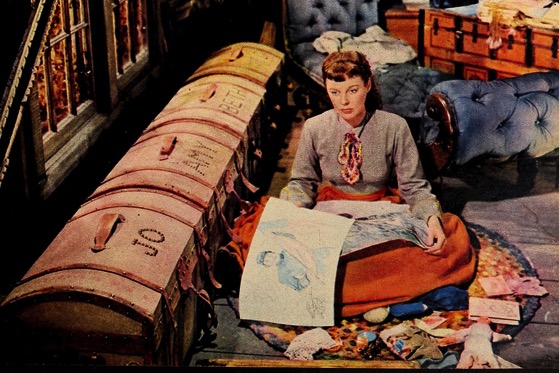
I usually use Google Alerts to find mentions of The Monkees but this weekend something interesting happened. Google Alerts found my name in an essay on the JSTOR Daily about the new BBC miniseries version of Little Women, adapted by Heidi Thomas of “Call the Midwife”) from a novel by a female writer (Louisa May Alcott, as if you didn’t know) and directed by a woman (Vanessa Caswill). 

My Summer of Watching Little Women by Benjamin Winterhalter

Little women movie 1050x700

The writer of the essay was a male, JSTOR Daily’s features editor Benjamin Winterhalter and he was reminiscing about a summer in his elementary years when his mother and friends dissected all the filmed adaptations of the novel  in preparation for writing an article —  “A Feminist Romance: Adapting Little Women to the Screen”  for Tulsa Studies in Women’s Literature. 

Read the Journal Article


Join the Rosanne Welch Mailing List for future book and event announcements!
 

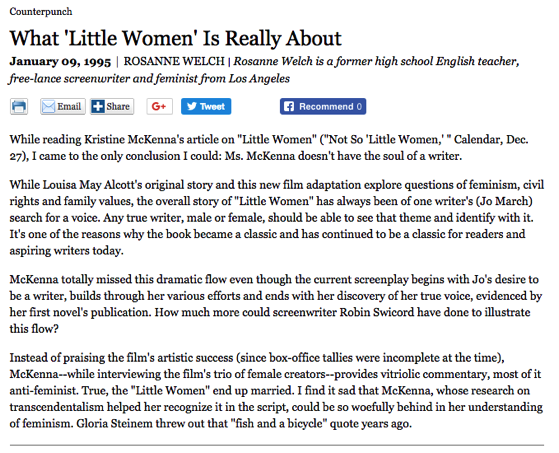
Winterhalter’s article came up because along his research way he came across an Op-Ed I had written for the Los Angeles Times, “What ‘Little Women’ Is Really About” about the 1995 Robin Schiff adaptation (starring Winona Ryder) which I had framed as both a more deeply feminist interpretation but, more importantly, accessible to all as the story of a writer finding their voice.

Today I Became a Citation: Little Women. Feminism and Me!

How fun to be reminded of that Op-Ed and to see how accessible my earlier work can be with archives going digital.  It’s also good timing as I often recommend to screenwriting students that they write for various local publications in order to get their names out there and to fill out their writing CVs.  Here’s an example of a piece I wrote when I had a passionate idea ( the one about how this is more the story of a writer finding their voice than merely a bunch of sisters surviving the Civil War). Since I did not see that idea represented in the mainstream press, I brought it to their attention and they noticed it and presented it to their readers.

10 The New Companions from Gender Diversity in the Who-niverse [Video] (0:59)

Watch this entire presentation: Gender Diversity in the Who-niverse: Paving the Way for a Lady Doctor with Dr. Rosanne Welch [Video] (36:58)

10 The New Companions from Gender Diversity in the Who-niverse

For her 5th Doctor Who lecture to the CPP community, Dr. Rosanne Welch discusses how society – and the show’s writing staff – prepared the audience for a major change in this 50-year franchise – the creation of the first Lady Doctor!

Transcript:

…and through Russell, we’re going to gain a new look both female and male characters particularly his first companion he is going to invent is Rose and Rose is very strong. We’re going to talk about how in a minute. We’re going to have Martha Jones who happens to be one of my favorite companions and I’ll explain why, because Iknow there are some people don’t like Martha and how she was treated. I think Martha was actually stronger than people are giving her credit for. Then, Donna Noble who was just a “friend” and there’s a whole discussion about the idea that women didn’t have to be a sexual or a partner companion, they could just be friends as of maybe Y’all actually have friends who are of the opposite sex. Really? That’s possible? I don’t know. Right? So that was a new thing. And of course, Captain Jack Harkness who was the first openly gay, but also omnisexual. He’s had sex with women, men, aliens, you name it he was good for it and that was an interesting thing to be said on a television program. And he’s just so gorgeous, what can you say?

Follow Dr. Welch on Twitter and Instagram
https://twitter.com/rosannewelchhttp://instagram.com/drrosannewelch


Dr. Rosanne Welch

Dr. Rosanne Welch teaches the History of Screenwriting and One-Hour Drama for the Stephens College MFA in Screenwriting.

Writing/producing credits include Beverly Hills 90210, Picket Fences, ABCNEWS: Nightline and Touched by an Angel. In 2016 she published the book Why The Monkees Matter: Teenagers, Television and American Pop; co-edited Women in American History: A Social, Political, and Cultural Encyclopedia; and placed “Transmitting Culture Transnationally Via the Characterization of Parents in Police Procedurals” in the New Review of Film and Television Studies. Essays appear in Torchwood Declassified: Investigating Mainstream Cult Television and Doctor Who and Race: An Anthology. Welch serves as Book Reviews editor for Journal of Screenwriting and on the Editorial Advisory Board for Written By magazine, the magazine of the Writers Guild.

Watch Dr. Welch’s talk “The Importance of Having a Female Voice in the Room” at the 2016 TEDxCPP.

09 Regeneration of Doctor Who from Gender Diversity in the Who-niverse [Video] (0:57)

Watch this entire presentation: Gender Diversity in the Who-niverse: Paving the Way for a Lady Doctor with Dr. Rosanne Welch [Video] (36:58)

09 Regeneration of Doctor Who from Gender Diversity in the Who-niverse

For her 5th Doctor Who lecture to the CPP community, Dr. Rosanne Welch discusses how society – and the show’s writing staff – prepared the audience for a major change in this 50-year franchise – the creation of the first Lady Doctor!

Transcript:

The show was canceled in 1989. It had finally run its course at that time. In 2005, this gentleman, Russell Davies, who I was so excited to actually, — this is an article that I wrote about him in a magazine for the Writers Guild, so I got to interview him when he came to the United States and was working on his show Torchwood. He was the most successful producer at the BBC for this show, Queer as Folk. He happens to be a gay man and he was an openly gay man and so he wrote Queer As Folk. Huge success. It also was redone her in the United States, but because of the success of this program, the BBC said to him “What would you like to do next? Invent any show you like.” And he said, “I want to bring Doctor Who back.” Which had never happened to a show. Show’s canceled. It’s done. We’re finished with it, but they were like, “Hmm, whatever you want, Russell, you can do it!” So he revived the show, which is an amazing step.

Follow Dr. Welch on Twitter and Instagram
https://twitter.com/rosannewelchhttp://instagram.com/drrosannewelch


Dr. Rosanne Welch

Dr. Rosanne Welch teaches the History of Screenwriting and One-Hour Drama for the Stephens College MFA in Screenwriting.

Writing/producing credits include Beverly Hills 90210, Picket Fences, ABCNEWS: Nightline and Touched by an Angel. In 2016 she published the book Why The Monkees Matter: Teenagers, Television and American Pop; co-edited Women in American History: A Social, Political, and Cultural Encyclopedia; and placed “Transmitting Culture Transnationally Via the Characterization of Parents in Police Procedurals” in the New Review of Film and Television Studies. Essays appear in Torchwood Declassified: Investigating Mainstream Cult Television and Doctor Who and Race: An Anthology. Welch serves as Book Reviews editor for Journal of Screenwriting and on the Editorial Advisory Board for Written By magazine, the magazine of the Writers Guild.

Watch Dr. Welch’s talk “The Importance of Having a Female Voice in the Room” at the 2016 TEDxCPP.

08 MacGyver, Douglas Adams and Doctor Who from Gender Diversity in the Who-niverse [Video] (1:10)

Watch this entire presentation: Gender Diversity in the Who-niverse: Paving the Way for a Lady Doctor with Dr. Rosanne Welch [Video] (36:58)

08 MacGyver, Douglas Adams and Doctor Who from Gender Diversity in the Who-niverse

For her 5th Doctor Who lecture to the CPP community, Dr. Rosanne Welch discusses how society – and the show’s writing staff – prepared the audience for a major change in this 50-year franchise – the creation of the first Lady Doctor!

Transcript:

Now if you know anything about the old, and new, MacGyver, very similar to Doctor Who in that MacGyver doesn’t carry a gun. he makes changes in the world with his brains his science knowledge and his ability to think fast in a situation. So in essence, nobody knew it but he was an American Doctor Who if you think about it. That personality of male and I have to cop to the fact that I haven’t watched the new MacGyver. I’ll bet you that it’s lovely but I can’t get past Richard Dean Anderson. That’s my MacGyver, so too bad. But that’s what Terry Nation brought into the story. Many of you, if you’re science fiction fans will know Douglas Adams. Maybe not from Doctor Who but he did, in fact, did write for Doctor Who and was a story editor for one season. So, of course, we know him from The Hitchhikers Guide to the Galaxy. He wrote a few episodes of Doctor Who including The Pirate Planet and he worked with this character, Romana, who was a lady Timelord. So naturally, we know that in their alien species there were female characters and she’s intelligent and she matches the Doctor for wit and for charm and all that so we had the early feeling of, there can be women doing this adventuring.

Follow Dr. Welch on Twitter and Instagram
https://twitter.com/rosannewelchhttp://instagram.com/drrosannewelch


Dr. Rosanne Welch

Dr. Rosanne Welch teaches the History of Screenwriting and One-Hour Drama for the Stephens College MFA in Screenwriting.

Writing/producing credits include Beverly Hills 90210, Picket Fences, ABCNEWS: Nightline and Touched by an Angel. In 2016 she published the book Why The Monkees Matter: Teenagers, Television and American Pop; co-edited Women in American History: A Social, Political, and Cultural Encyclopedia; and placed “Transmitting Culture Transnationally Via the Characterization of Parents in Police Procedurals” in the New Review of Film and Television Studies. Essays appear in Torchwood Declassified: Investigating Mainstream Cult Television and Doctor Who and Race: An Anthology. Welch serves as Book Reviews editor for Journal of Screenwriting and on the Editorial Advisory Board for Written By magazine, the magazine of the Writers Guild.

Watch Dr. Welch’s talk “The Importance of Having a Female Voice in the Room” at the 2016 TEDxCPP.

07 Terry Nation, Doctor Who and MacGyver from Gender Diversity in the Who-niverse [Video] (0:50)

Watch this entire presentation: Gender Diversity in the Who-niverse: Paving the Way for a Lady Doctor with Dr. Rosanne Welch [Video] (36:58)

07 Terry Nation, Doctor Who and MacGyver from Gender Diversity in the Who-niverse

For her 5th Doctor Who lecture to the CPP community, Dr. Rosanne Welch discusses how society – and the show’s writing staff – prepared the audience for a major change in this 50-year franchise – the creation of the first Lady Doctor!

Transcript:

Later in the era of Doctor Who we get Terry Nation and Terry Nation is a really cool writer. He invented the Daleks. So without him, we wouldn’t have the world’s coolest villains, right? We wouldn’t be able to “Exterminate” any time we wanted. So I think that’s really cool, but what’s excellently interesting to me about Terry Nation as a writer is that he also invented this character, Sara Kingdom and she’s a secret agent who changes sides to work with the Doctor. She’s a bad girl who uses her badness to help the good guy. So that was a concoction of Terry Nation’s in the early days of the show and then you’re asking yourself “why is this old picture of MacGyver up there?” How did this one thing affect another, exactly? Terry Nation came from England and over to the states to work in America in television and he helped create MacGyver.

Follow Dr. Welch on Twitter and Instagram
https://twitter.com/rosannewelchhttp://instagram.com/drrosannewelch


Dr. Rosanne Welch

Dr. Rosanne Welch teaches the History of Screenwriting and One-Hour Drama for the Stephens College MFA in Screenwriting.

Writing/producing credits include Beverly Hills 90210, Picket Fences, ABCNEWS: Nightline and Touched by an Angel. In 2016 she published the book Why The Monkees Matter: Teenagers, Television and American Pop; co-edited Women in American History: A Social, Political, and Cultural Encyclopedia; and placed “Transmitting Culture Transnationally Via the Characterization of Parents in Police Procedurals” in the New Review of Film and Television Studies. Essays appear in Torchwood Declassified: Investigating Mainstream Cult Television and Doctor Who and Race: An Anthology. Welch serves as Book Reviews editor for Journal of Screenwriting and on the Editorial Advisory Board for Written By magazine, the magazine of the Writers Guild.

Watch Dr. Welch’s talk “The Importance of Having a Female Voice in the Room” at the 2016 TEDxCPP.

Display in Special Collections at Cal Poly Pomona Library via My Instagram

Display in Special Collections at Cal Poly Pomona Library via My Instagram

Display on myself, my editing partner, Peg Lamphier and other women doing important work in Special Collections at Cal Poly Pomona Library.

Instagram and Follow

06 Barbara Is 1st Strong Female Character from Gender Diversity in the Who-niverse [Video] (0:25)

Watch this entire presentation: Gender Diversity in the Who-niverse: Paving the Way for a Lady Doctor with Dr. Rosanne Welch [Video] (36:58)

06 Barbara Is 1st Strong Female Character from Gender Diversity in the Who-niverse [Video] (0:25)

For her 5th Doctor Who lecture to the CPP community, Dr. Rosanne Welch discusses how society – and the show’s writing staff – prepared the audience for a major change in this 50-year franchise – the creation of the first Lady Doctor!

Transcript:

So this was their invention, and I think it’s important to recognize that from the very beginning barbara is not a housewife

She’s not passive. She’s not boring

She’s a teacher who is very excited about these adventures she chooses to go on them

And she learns along the way she often lectures the doctor the older man

About how he should be behaving in the other worlds that they visit so we started with a strong woman. Let’s just remember that

Follow Dr. Welch on Twitter and Instagram
https://twitter.com/rosannewelchhttp://instagram.com/drrosannewelch


Dr. Rosanne Welch

Dr. Rosanne Welch teaches the History of Screenwriting and One-Hour Drama for the Stephens College MFA in Screenwriting.

Writing/producing credits include Beverly Hills 90210, Picket Fences, ABCNEWS: Nightline and Touched by an Angel. In 2016 she published the book Why The Monkees Matter: Teenagers, Television and American Pop; co-edited Women in American History: A Social, Political, and Cultural Encyclopedia; and placed “Transmitting Culture Transnationally Via the Characterization of Parents in Police Procedurals” in the New Review of Film and Television Studies. Essays appear in Torchwood Declassified: Investigating Mainstream Cult Television and Doctor Who and Race: An Anthology. Welch serves as Book Reviews editor for Journal of Screenwriting and on the Editorial Advisory Board for Written By magazine, the magazine of the Writers Guild.

Watch Dr. Welch’s talk “The Importance of Having a Female Voice in the Room” at the 2016 TEDxCPP.