When Women Wrote Hollywood went to the printer today!
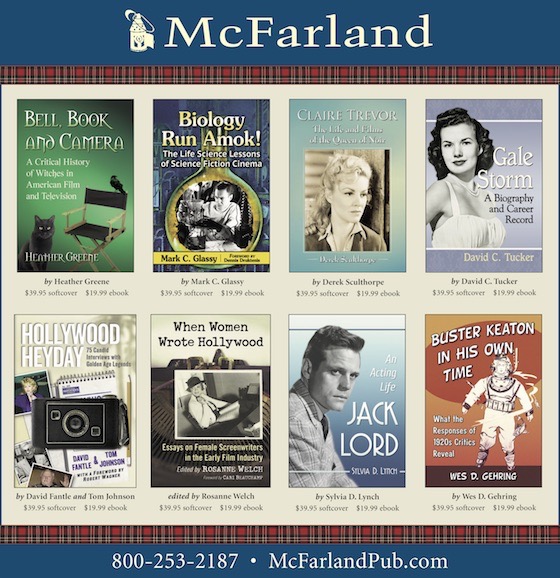
We are on schedule for our planned publication date of July 31st AND here’s the first time an ad for the book appears alongside some other fun McFarland titles in Classic Images: The Newspaper of Film Fandom.
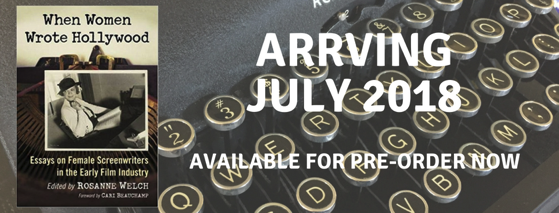
Available for Print Pre-Order Now. Electronic Editions Coming Soon!
Use “When Women Wrote Hollywood” in your classroom!
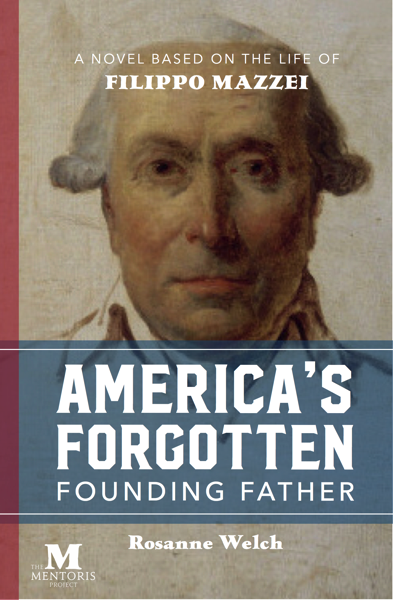
Dejected and disillusioned about his family, Filippo returned to London and in 1764 he opened a shop selling imported Italian wares including wine and olive oil. He named the shop Martini & Company to avoid incurring a reputation as merely a shopkeeper, since he still didn’t know what the future would hold. While he had decided not to pursue medicine anymore, he felt he had simply fallen into business and wanted to stay open to other opportunities as they arose.
To highlight the wonderful yet largely forgotten work of a collection of female screenwriters from the early years of Hollywood (and as a companion to the book, When Women Wrote Hollywood) we will be posting quick bits about the many films they wrote along with links to further information and clips from their works which are still accessible online. Take a few moments once or twice a week to become familiar with their names and their stories. I think you’ll be surprised at how much bold material these writers tackled at the birth of this new medium. — Rosanne Welch
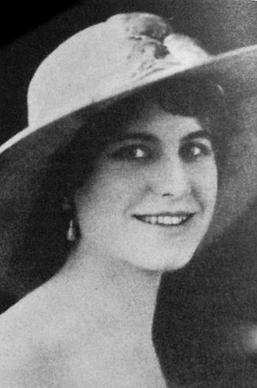
When Women Wrote Hollywood – 4 in a series – Jeanie MacPherson
Jeanie MacPherson (May 18, 1886[1] – August 26, 1946) was an American actress, writer, and director from 1908 until the late 1940s. She was a pioneer for women in the film industry. She worked with some of the best filmmakers of the time period including D. W. Griffith and Cecil B. DeMille. While she started in the theater, and then had a brief stint as an actress, she ultimately dedicated her life’s work to screenwriting for DeMille.[2] She was appraised for her new level resourcefulness and attentiveness to the needs of DeMille.[3]
DeMille and MacPherson formed what became one of the most influential and long-lasting partnerships in the industry.[3] She was infatuated with his perfection and force of will, while he was captivated by her high spirited courage. She penned 30 of DeMille’s next 34 films. They admired each other; he would provide the crowd shots and epic sense, while she would humanize the heroine. They both loathed weakness, which they defined as a man being degraded and women, who were shallow and money-hungry, looking for a man to take care of them. They both believed in the power of people to change their ways, which many of their scripts showed.[3] — Wikipedia
* A portion of each sale from Amazon.com directly supports our blogs ** Many of these books may be available from your local library. Check it out! † Available from the LA Public Library
For her 5th Doctor Who lecture to the CPP community, Dr. Rosanne Welch discusses how society – and the show’s writing staff – prepared the audience for a major change in this 50-year franchise – the creation of the first Lady Doctor!
Transcript:
Finally, we’re now looking at what will happen to the show with a new writer Chris Chibnall and Chris Chibnall is a really interesting writer. He worked on Torchwood as a staff writer. He created this program Broachchurch which I highly recommend if you have some time. One of the best-written mini-series I have ever seen. Very good stuff and in doing the show he worked with Jody Whittaker who played the mother on Broadchurch of a 10-year-old boy who went missing. Jody, blonded out, is going to be the new Doctor Who. So through working with Chris on this previous program, he decided she had the chutzpah and the charisma and what was necessary to be the new Doctor Who and also, as I said earlier, in his writing for Doctor Who he invented Kate Lethbridge-Stewart who is a head in the military. Her father was a head. We’re going to talk about in a minute. So, I think Chris is a really interesting writer. I think he’s going to do a lot of good work for the show. So that’s what I want to think about.
Rosanne Welch PhD teaches the History of Screenwriting and One-Hour Drama for the Stephens College MFA in Screenwriting.
Writing/producing credits include Beverly Hills 90210, Picket Fences, ABCNEWS: Nightline and Touched by an Angel. In 2016 she published the book Why The Monkees Matter: Teenagers, Television and American Pop; co-edited Women in American History: A Social, Political, and Cultural Encyclopedia; and placed “Transmitting Culture Transnationally Via the Characterization of Parents in Police Procedurals” in the New Review of Film and Television Studies. Essays appear in Torchwood Declassified: Investigating Mainstream Cult Television and Doctor Who and Race: An Anthology. Welch serves as Book Reviews editor for Journal of Screenwriting and on the Editorial Advisory Board for Written By magazine, the magazine of the Writers Guild.
A beautifully written remembrance from one writer to another – a good read to understand the breadth and depth of a writer’s full life – Josh Greenfield wrote ‘Harry and Tonto’ (with Paul Mazursky, who was one of the co-writers of The Monkees pilot -small world indeed!). Harry and Tonto is a worthwhile character study film to watch over the summer. Art Carney won an Oscar for it and if you don’t know who Art Carney is……. 🙁 But as you’ll learn when you read this, Greenfield also wrote reviews and books about his autistic son — and was friends with other writers we should already know – from Joan Didion to Mario Puzo to Arthur Miller.
Oddly enough, I have a novel based on the movie in my bookshelf – but nowhere does it say it is based on a movie – and nowhere does the movie identify itself as an adaptation. That makes me wonder if, in 1974, it was still thought that a novel based on a movie wouldn’t be worth reading… I’ll have to do more research on that! The one (sadly bad) review of the book on Amazon says it is written like a bad dictation from the film. The movie was released August 12th 1974; the book came out earlier, in January of that year. Again, an odd way of doing things. Maybe the film was held up in post production???
Either way, the movie is GREAT! And Greenfield seems to have lived a fascinating life as a writer – and as a human.
I always knew I’d write about my friend Josh Greenfeld. I even started to take notes, long lost, about the piercingly acute things he’d say about Hollywood and the movie business, but I never thought it would be this hard. Best known in the business as the Oscar-nominated screenwriter of “Harry and Tonto,” the film that won a best acting Oscar for Art Carney in 1974, Josh (who died last month at age 90) was an under-the-radar insider and consummate professional, deft, gifted and successful in a wide range of writing disciplines.
Dorothy Parker’s story is such a classic it keeps being made and remade across the decades – first adapted by Moss Hart, then by Joan Didion and John Gregory Dunne – this time by Eric Roth (Oscar winner for Forest Gump), Bradley Cooper and Will Fetters. THAT is a successful piece of writing. The trailer already has me teared up- that’s how powerful the story still is.
* A portion of each sale from Amazon.com directly supports our blogs ** Many of these books may be available from your local library. Check it out! † Available from the LA Public Library
To highlight the wonderful yet largely forgotten work of a collection of female screenwriters from the early years of Hollywood (and as a companion to the book, When Women Wrote Hollywood) we will be posting quick bits about the many films they wrote along with links to further information and clips from their works which are still accessible online. Take a few moments once or twice a week to become familiar with their names and their stories. I think you’ll be surprised at how much bold material these writers tackled at the birth of this new medium. — Rosanne Welch
The Ten Commandments (1923), Wr: Jeanie Macpherson, Dirs: Cecil B. DeMille, USA 136 mins
Segments from The Ten Commandments (1923)
Original Poster Art
The Ten Commandments is a 1923 American silent religious, epic film and produced and directed by Cecil B. DeMille. Written by Jeanie MacPherson, the film is divided into two parts: a prologue recreating the biblical story of the Exodus and a modern story concerning two brothers and their respective views of the Ten Commandments.
Lauded for its “immense and stupendous” scenes, use of Technicolor process 2, and parting of the Red Sea sequence,[3] the expensive film proved to be a box-office hit upon release.[4] It is the first in DeMille’s biblical trilogy, followed by The King of Kings (1927) and The Sign of the Cross (1932).
Despite its epic scale, the Moses story takes up only about the first third of the film. After that, the story changes to a modern setting involving living by the lessons of the commandments. Two brothers make opposite decisions, one, John, to follow his mother’s teaching of the Ten Commandments and become a poor carpenter, and the other, Danny, to break every one of them and rise to the top. The film shows his unchecked immorality to be momentarily gainful, but ultimately disastrous. — Wikipedia
* A portion of each sale from Amazon.com directly supports our blogs ** Many of these books may be available from your local library. Check it out! † Available from the LA Public Library
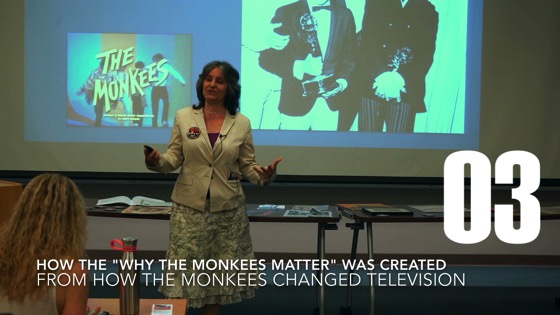
Rosanne Welch, PhD, Author of Why The Monkees Matter, presents “How The Monkees Changed Television” at a Cal State Fullerton Lunch Lecture on May 8, 2018.
In this talk, she shows how The Monkees, and specifically their presence on television, set the stage for large changes to come in the late 1960s.
Transcript
Meeting all those folks was really interesting and I realized I had much more material than just for that article. So then I started looking around and I realized there were critical studies books explaining Gilligans Island and The Brady Bunch and Hogan’s Heros and there wasn’t a book about The Monkees, which shocked me and I also knew at that time that their 50th anniversary was coming up so that’s a great time to get some free publicity so I put the book together and was able to put it out that same year so that was really a lot of fun. So we’ll talk about how The Monkees Changed Television. First of all, you’ll notice in this picture — the show on 2 Emmys in its first year. So this isn’t some piece of fluff that’s just for little children. They won for Best New Comedy Series which ranks them right up there with Seinfeld and The Big Bang Theory and all the major shows.
Rosanne Welch, PhD is a writer, producer and university professor with credits that include Beverly Hills 90210, Picket Fences, Touched by an Angel and ABC NEWS/Nightline. Other books include Why The Monkees Matter: Teenagers, Television and American Pop Culture (McFarland, 2017) and Women in American History: A Social, Political, and Cultural Encyclopedia and Document Collection (ABC-CLIO, 2017), named to the 2018 Outstanding References Sources List, by the Reference and User Services Association (RUSA), a division of the American Library Association. Welch has also published chapters in Torchwood Declassified: Investigating Mainstream Cult Television (I.B.Tauris) and The American Civil War on Film and TV: Blue and Gray in Black and White and Color (Lexington Books, 2018) and essays in Doctor Who and Race: An Anthology and Outside In Makes it So, and Outside in Boldly Goes (both edited by Robert Smith). By day she teaches courses on the history of screenwriting and on television writing for the Stephens College MFA in Screenwriting programs. Her talk “The Importance of Having a Female Voice in the Room” at the 2016 TEDxCPP is available on YouTube.
In the daytime Filippo worked on selling the products he had transported from Tuscany and with the help of Chamier, he made more money than he had hoped. At night, Filippo worked on learning the English language through a method he invented. He would take a book written in English on a subject he knew well, usually medicine or literature, and copy out one whole chapter over and over.




 To highlight the wonderful yet largely forgotten work of a collection of female screenwriters from the early years of Hollywood (and as a companion to the book,

![15 Chris Chibnall and Doctor Who from Gender Diversity in the Who-niverse [Video] (0:54)](https://rosannewelch.com/wp-content/uploads/2018/06/gender-dw-15-chibnall.jpeg)


 and Follow