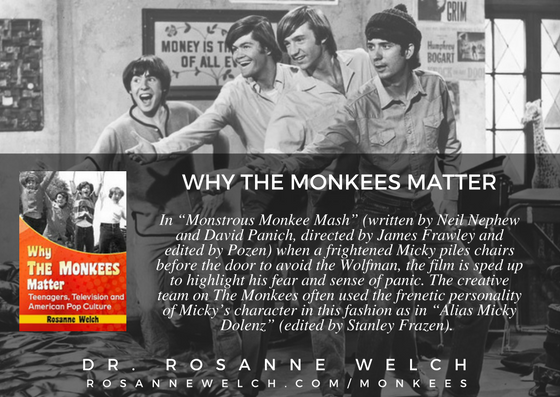
In “Monstrous Monkee Mash” (written by Neil Nephew and David Panich, directed by James Frawley and edited by Pozen) when a frightened Micky piles chairs before the door to avoid the Wolfman, the film is sped up to highlight his fear and sense of panic. The creative team on The Monkees often used the frenetic personality of Micky’s character in this fashion as in “Alias Micky Dolenz” (edited by Stanley Frazen).
I teach several classes for the Stephens College Low-Residency MFA in Screenwriting, including History of Screenwriting. In fact, I created the curriculum for that course from scratch and customized it to this particular MFA in that it covers ‘Screenwriting’ (not directors) and even more specifically, the class has a female-centric focus. As part History of Screenwriting I, the first course in the four-class series, we focus on the early women screenwriters of the silent film era who male historians have, for the most part, quietly forgotten in their books. In this series, I share with you some of the screenwriters and films that should be part of any screenwriters education. I believe that in order to become a great screenwriter, you need to understand the deep history of screenwriting and the amazing people who created the career. — Dr. Rosanne Welch
From Raff & Gammon price list: Three Japanese ladies in the costumes of their country.
From Edison films catalog: A charming representation of The Mikado dance by three beautiful Japanese ladies in full costume. Very effective when colored. 45 feet. $6.75.
OTHER TITLES Title in Maguire & Gammon catalogue: Japanese dance
CREATED/PUBLISHED United States : Edison Manufacturing Co., [1894]
NOTES Copyright: no reg.
Performers: Sarashe Sisters.
Camera, William Heise.
Filmed ca. October-November 1894, in Edison’s Black Maria studio.
SUBJECTS Dance–United States. Dancers–United States. Japanese–United States. Dance Musical
RELATED NAMES Dickson, W. K.-L. (William Kennedy-Laurie), 1860-1935, production. Heise, William, camera. Sarashe Sisters, performers. Thomas A. Edison, Inc. AFI/Holt (H.L.) Collection (Library of Congress)
You never know when you’ll stumble on a piece of popular culture proof that The Monkees were an entrenched part of the 1960s – and a bonafide world-wide phenomenon of that time. I thought I had found quite a few of them in my research for the book – from the then newest moment on the first season of Grace and Frankie (where Frankie admits she once hung out with Micky) to the couple of Simpsons show references – to the now ubiquitous “I’m a Believer” ending of Shrek (no matter who sings it, that is always a Monkees song).
But watching reruns of the long-running BBC detective series Lewis unearthed a new one I had missed. This moment I’m posting came in Season 3, Episode 3, titled “The Point of Vanishing” in 2009 between characters at a high class Oxford cocktail party. The character properly credits the writer of “I’m a Believer” as Neil Diamond (in my other, non-Monkees-fan life I do teach screenwriting so I’m always pleased to see writers credited) so he does not call it a Monkees song – but we all know that it IS a Monkees song being referenced in this high-end program (it did air in the U.S. on PBS’s Mystery.
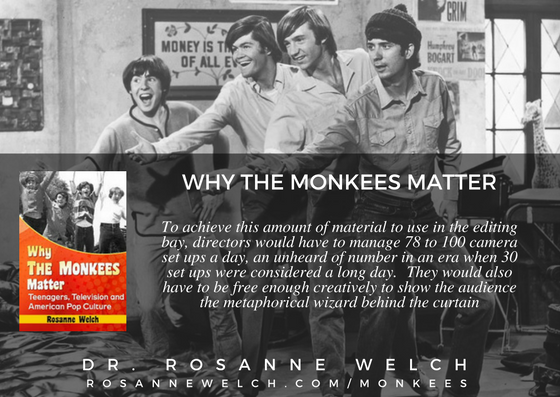
To achieve this amount of material to use in the editing bay, directors would have to manage 78 to 100 camera set ups a day, an unheard of number in an era when 30 set ups were considered a long day. They would also have to be free enough creatively to show the audience the metaphorical wizard behind the curtain.
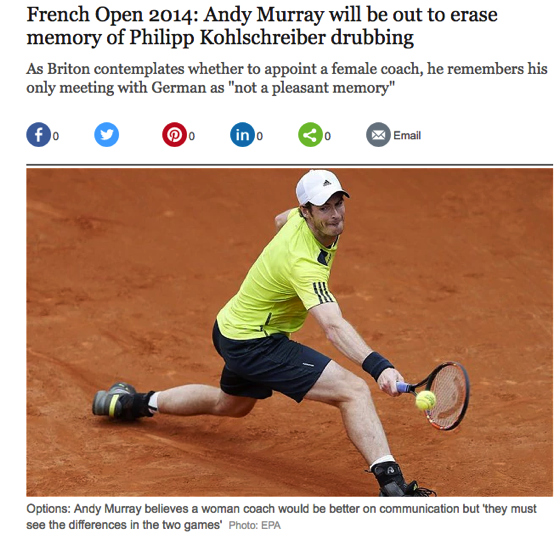
Blondie, the Monkees and Joseph and the Amazing Technicolor Dreamcoat: these were Andy Murray’s musical touchstones as a child. As he explained on Friday, “My mum used to drive us a lot to and from tournaments that were five, six hours away, and singing was one way of keeping us amused.”
I teach several classes for the Stephens College Low-Residency MFA in Screenwriting, including History of Screenwriting. In fact, I created the curriculum for that course from scratch and customized it to this particular MFA in that it covers ‘Screenwriting’ (not directors) and even more specifically, the class has a female-centric focus. As part History of Screenwriting I, the first course in the four-class series, we focus on the early women screenwriters of the silent film era who male historians have, for the most part, quietly forgotten in their books. In this series, I share with you some of the screenwriters and films that should be part of any screenwriters education. I believe that in order to become a great screenwriter, you need to understand the deep history of screenwriting and the amazing people who created the career. — Dr. Rosanne Welch
This book signing at Book Soup was wonderful – good people, good conversation (before and after the signing). Just another example of the kind of quality positive people who have been drawn to The Monkees across generations – I even met a former head of publicity for ScreenGems who had some fun stories to tell. — Rosanne
Now, a deep study into anything can teach us much about everything. it’s why we teach critical studies in television in the first place and that’s why I wrote the book for my students, but I also wrote it in honor of — and to honor — all the fans who have loved the show hoping to see these people in concert again when they grow up and that dream was actually realized in the last so many generations and so that is pretty amazing. What’s interesting about The Monkees to me is anything that reaches the 50-year mark tends to get a little bit more respect finally. The Hula Hoop went from a kids craze to a staple in physical education classes. Today, it’s considered a very important thing. War surplus spam has become hip because people in Hawaii started to eat it and then it was cool because that’s where it came from. Now Spam. you can go eat at restaurants. I don’t know why you would, but people do. This book, it tends to show how the 50-year charm has proven true for The Monkees.
Sandra Day O’Connor’s place in history was secured when President Ronald Reagan appointed her as the first female to serve on the U.S. Supreme Court. However, her role as the swing vote on an increasingly divided Court guaranteed that she will be remembered as far more than a pathbreaking symbol.






![The Monkees and the 50 Year Charm from Why The Monkees Matter Book Signing, Book Soup, Hollywood [Video] (0:57)](https://rosannewelch.com/wp-content/uploads/2017/03/wtmm-reading-04-50-year-charm.jpeg)
