To highlight the wonderful yet largely forgotten work of a collection of female screenwriters from the early years of Hollywood (and as a companion to the book, When Women Wrote Hollywood) we will be posting quick bits about the many films they wrote along with links to further information and clips from their works which are still accessible online. Take a few moments once or twice a week to become familiar with their names and their stories. I think you’ll be surprised at how much bold material these writers tackled at the birth of this new medium. — Rosanne Welch
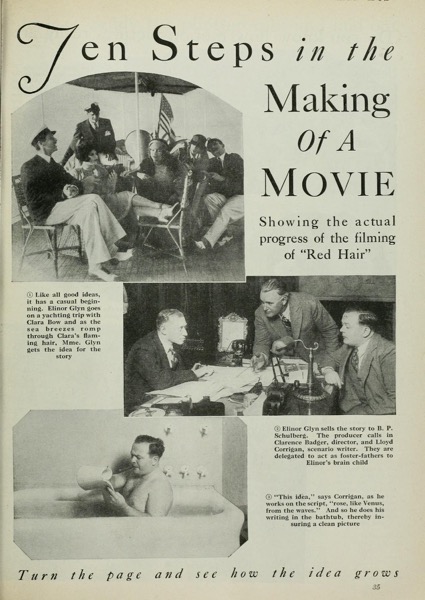
“It” is a 1927 silent romantic comedy film that tells the story of a shop girl who sets her sights on the handsome, wealthy boss of the department store where she works. It is based on a novella by Elinor Glyn that was originally serialized in Cosmopolitan magazine.
This film turned actress Clara Bow into a major star, and led people to label her the It girl.
The film had its world premiere in Los Angeles on January 14, 1927, followed by a New York showing on February 5, 1927. “It” was released to the general public on February 19, 1927.
The picture was considered lost for many years, but a Nitrate-copy was found in Prague in the 1960s.[1] In 2001, “It” was selected for preservation in the United States National Film Registry by the Library of Congress as being “culturally, historically, or aesthetically significant”. — Wikipedia
* A portion of each sale from Amazon.com directly supports our blogs ** Many of these books may be available from your local library. Check it out! † Available from the LA Public Library
Rosanne Welch, PhD, Author of Why The Monkees Matter, presents “How The Monkees Changed Television” at a Cal State Fullerton Lunch Lecture on May 8, 2018.
In this talk, she shows how The Monkees, and specifically their presence on television, set the stage for large changes to come in the late 1960s.
Transcript
This is a great shot. I love from the Associated Press. All four of the men — three of the men — were drafted while they were on the show because they were all like 18, 19 and 20 years old. Michael Nesmith had already been in the Air Force so he was not but the other 3 guys were and they had to find a way around it. Even Davy Jones who was from England was drafted because he was living and making money in the United States. Thee girls took to the streets and said “If Davy goes, we go too!” The protests against losing them were very huge, but in general they were talking about how this is a bad war.. So if you look at this line I love from one of the episodes…
“They want to put the blame on teenagers. Take the war. Whose fault is it? We’re not fighting. it must be those crazy kids. They’re the ones doing all the fighting.”
Again, if that’s not an anti-war message wrapped up in a funny show. I have not idea how they got away with that, but they did.
Rosanne Welch, PhD is a writer, producer and university professor with credits that include Beverly Hills 90210, Picket Fences, Touched by an Angel and ABC NEWS/Nightline. Other books include Why The Monkees Matter: Teenagers, Television and American Pop Culture (McFarland, 2017) and Women in American History: A Social, Political, and Cultural Encyclopedia and Document Collection (ABC-CLIO, 2017), named to the 2018 Outstanding References Sources List, by the Reference and User Services Association (RUSA), a division of the American Library Association. Welch has also published chapters in Torchwood Declassified: Investigating Mainstream Cult Television (I.B.Tauris) and The American Civil War on Film and TV: Blue and Gray in Black and White and Color (Lexington Books, 2018) and essays in Doctor Who and Race: An Anthology and Outside In Makes it So, and Outside in Boldly Goes (both edited by Robert Smith). By day she teaches courses on the history of screenwriting and on television writing for the Stephens College MFA in Screenwriting programs. Her talk “The Importance of Having a Female Voice in the Room” at the 2016 TEDxCPP is available on YouTube.
To highlight the wonderful yet largely forgotten work of a collection of female screenwriters from the early years of Hollywood (and as a companion to the book, When Women Wrote Hollywood) we will be posting quick bits about the many films they wrote along with links to further information and clips from their works which are still accessible online. Take a few moments once or twice a week to become familiar with their names and their stories. I think you’ll be surprised at how much bold material these writers tackled at the birth of this new medium. — Rosanne Welch
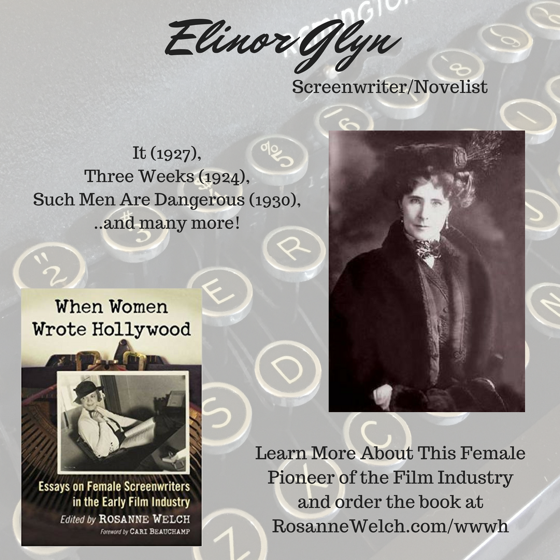
Elinor Glyn (née Sutherland; 17 October 1864 – 23 September 1943) was a British novelist and scriptwriter who specialised in romantic fiction that was considered scandalous for its time. She popularized the concept of It. Although her works are relatively tame by modern standards, she had tremendous influence on early 20th-century popular culture and perhaps on the careers of notable Hollywood stars such as Rudolph Valentino, Gloria Swanson and Clara Bow in particular.
Glyn pioneered risqué, and sometimes erotic, romantic fiction aimed at a female readership, a radical idea for its time—though her writing is not scandalous by modern standards. She coined the use of the word it to mean a human characteristic that “…draws all others with magnetic force. With ‘IT’ you win all men if you are a woman–and all women if you are a man. ‘IT’ can be a quality of the mind as well as a physical attraction.” [13] Her use of the word is often erroneously[citation needed]taken to be a euphemism for sexuality or sex appeal. — Wikipedia
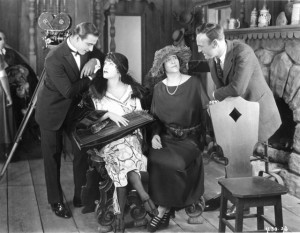
Elinor Glyn (a/w/d/p/o), Beyond the Rocks (1922). PC
* A portion of each sale from Amazon.com directly supports our blogs ** Many of these books may be available from your local library. Check it out! † Available from the LA Public Library
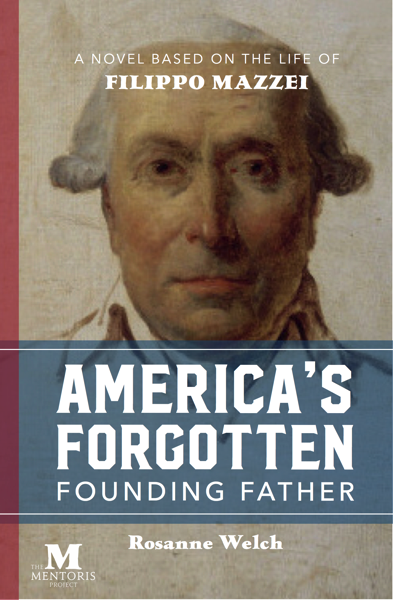
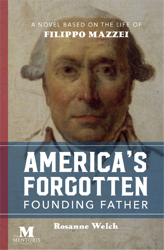
In late November the Triumph docked at Trebell’s Landing & Burwell’s Ferry, on the James River about four miles from Williamsburg. Filippo and his party, which the Captain had dubbed Filippo’s ark as it included such a combination of people, animals and plants as to constitute the beginning of a new Eden, disembarked.
I’m working on my novel on the life of Giuseppe Garibaldi (the General who united Italy in 1860) for The Mentoris Project and I discovered that Giuseppe Verdi was a supporter of the Risorgimento (Resurgence), the movement to unite Italy. Moreover, in his 1842 opera, Nabucco (which follows the plight of the Jews as they are conquered and exiled by the Babylonian King Nebuchadnezzar II (Nabucco in Italian) he wrote a song — Va Pensiero (to think/to recall) — which was popular among the men of the movement in the 1840s through 1860.
Poetic license comes in when I see it wasn’t performed in South America (where Garibaldi could have access to it) until a year after he’d left that country. So, I created a scene where he hears it from a newly arrived Italian sailor on the local docks and then Garibaldi goes home to sing it as a lullaby with his wife, Anita, and their son.
Of course, I had to hear the song myself (being more a Dean Martin fan than an opera fan I had not seen Nabucco) so, naturally, I turned to YouTube where I found this beautiful rendition of it with Pavorotti singing in Italian and Italian singer Zucchero Fornaciari, known mostly as Zucchero (but brand new to me!).
Va, pensiero, sull’ali dorate; va, ti posa sui clivi, sui colli, ove olezzano tepide e molli l’aure dolci del suolo natal!
Del Giordano le rive saluta, di Sionne le torri atterrate… O, mia patria, sì bella e perduta! O, membranza, sì cara e fatal!
Arpa d’or dei fatidici vati, perché muta dal salice pendi? Le memorie nel petto raccendi, ci favella del tempo che fu!
O simile di Sòlimaai fati traggi un suono di crudo lamento, o t’ispiri il Signore un concento che ne infonda al patire virtù.[11]
Go, thought, on wings of gold; go settle upon the slopes and the hills, where, soft and mild, the sweet airs of our native land smell fragrant!
Greet the banks of the Jordan and Zion’s toppled towers… Oh, my country, so beautiful and lost! Oh, remembrance, so dear and so fatal!
Golden harp of the prophetic seers, why dost thou hang mute upon the willow? Rekindle our bosom’s memories, and speak to us of times gone by!
Either, akin to the fate of Jerusalem, give forth a sound of crude lamentation, or let the Lord inspire you a harmony of voices which may instill virtue to suffering.
Buy the album
* A portion of each sale from Amazon.com directly supports our blogs
A classic resource on feminist theory, Feminist Thought offers a clear, comprehensive, and incisive introduction to the major traditions of feminist theory, from liberal feminism, radical feminism, and Marxist and socialist feminism to care-focused feminism, psychoanalytic feminism, and ecofeminism. The fifth edition has been thoroughly revised, and now includes a new chapter on Third Wave and Third Space Feminism. Also added to this edition are significantly expanded discussions on women of color feminisms, psychoanalytic and care feminisms, as well as new examinations of queer theory, LGBTQ and trans feminism.Learning tools like end-of-chapter discussion questions and the bibliography make Feminist Thought an essential resource for students and thinkers who want to understand the theoretical origins and complexities of contemporary feminist debates. — Amazon
* A portion of each sale from Amazon.com directly supports our blogs ** Many of these books may be available from your local library. Check it out! † Available from the LA Public Library
To highlight the wonderful yet largely forgotten work of a collection of female screenwriters from the early years of Hollywood (and as a companion to the book, When Women Wrote Hollywood) we will be posting quick bits about the many films they wrote along with links to further information and clips from their works which are still accessible online. Take a few moments once or twice a week to become familiar with their names and their stories. I think you’ll be surprised at how much bold material these writers tackled at the birth of this new medium. — Rosanne Welch
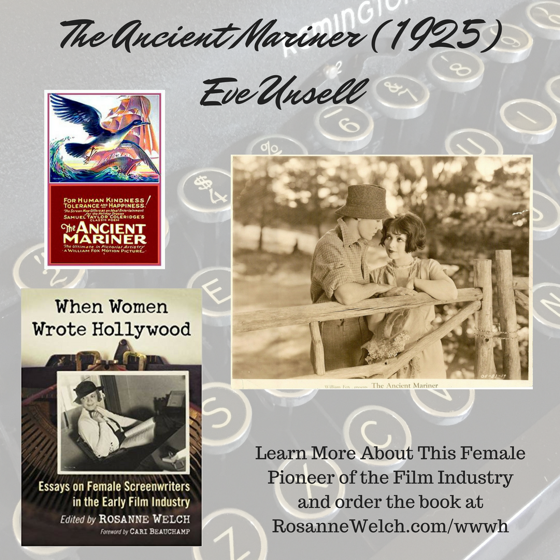
The Ancient Mariner is a 1925 American fantasy-drama silent film based on the popular poem, The Rime of the Ancient by Samuel Taylor Coleridge, first published in 1798.[1] The film was directed by Henry Otto and Chester Bennett, and it was adapted for the screen by Eve Unsell. The film stars Clara Bow, Gladys Brockwell, Nigel De Brulier and was distributed by Fox Film Corporation. The film is presumed to be lost.[2][3]
The official plot synopsis, as provided by the Fox Film Corporation to the copyright registration office and then entered at the Library of Congress:[3][4]
Doris Matthews, a beautiful, innocent young girl, forsakes her sweetheart, Joel Barlowe, in favor of Victor Brant, a wealthy roué. On the night before they are to elope, an old sailor gives Brant a strange potion to drink and then unfolds before his eyes The Rime of the Ancient . Deeply touched by this story about the consequences of the wanton destruction of innocent beauty, Brant leaves without Doris. After some time, he returns and finds to his pained satisfaction that Doris, having overcome her infatuation for him, has again turned her tender attentions toward Joel.
* A portion of each sale from Amazon.com directly supports our blogs ** Many of these books may be available from your local library. Check it out! † Available from the LA Public Library
Rosanne Welch, PhD, Author of Why The Monkees Matter, presents “How The Monkees Changed Television” at a Cal State Fullerton Lunch Lecture on May 8, 2018.
In this talk, she shows how The Monkees, and specifically their presence on television, set the stage for large changes to come in the late 1960s.
Transcript
This is a song that Mickey’s famous for singing. He wrote it while he was in England. He heard this phrase — Randy Scouse Git — He didn’t know what it meant. He just thought they were funny words. It’s actually — it’s cussing in English. It was from a TV Show that is the TV show that, in America, we based All In The Family on, rights so it was older man yelling at his son-in-law calling him a randy scouse git. Randy means you have too much sex and scouse git are bad words. He just thought they were funny words so he came back and wrote this song, but think about the lyrics…
Why don’t you hate who I hate Kill who I kill to be free
If that’s not a Vietnam protest war song I don’t know what is and they got away with singing that on broadcast television in their very trippy hippie clothes. So I couldn’t believe how much they got away with frankly in terms of messages.
Rosanne Welch, PhD is a writer, producer and university professor with credits that include Beverly Hills 90210, Picket Fences, Touched by an Angel and ABC NEWS/Nightline. Other books include Why The Monkees Matter: Teenagers, Television and American Pop Culture (McFarland, 2017) and Women in American History: A Social, Political, and Cultural Encyclopedia and Document Collection (ABC-CLIO, 2017), named to the 2018 Outstanding References Sources List, by the Reference and User Services Association (RUSA), a division of the American Library Association. Welch has also published chapters in Torchwood Declassified: Investigating Mainstream Cult Television (I.B.Tauris) and The American Civil War on Film and TV: Blue and Gray in Black and White and Color (Lexington Books, 2018) and essays in Doctor Who and Race: An Anthology and Outside In Makes it So, and Outside in Boldly Goes (both edited by Robert Smith). By day she teaches courses on the history of screenwriting and on television writing for the Stephens College MFA in Screenwriting programs. Her talk “The Importance of Having a Female Voice in the Room” at the 2016 TEDxCPP is available on YouTube.
The Grand Duke gave Filippo one final warning that he was making the move during a particularly tumultuous time in the colonies.
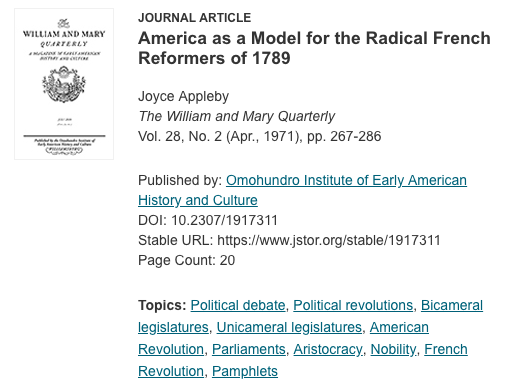
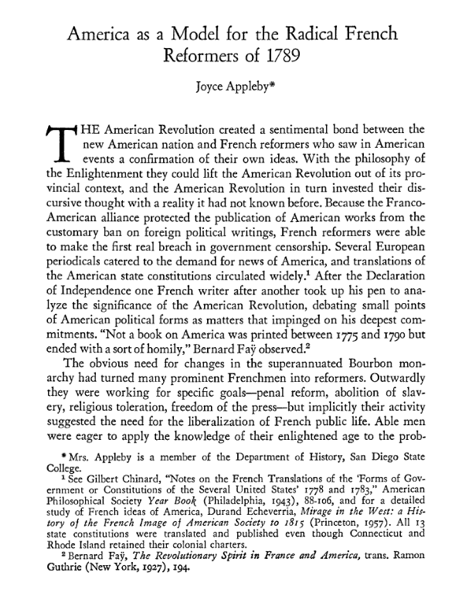
Correspondence between Royals all over Europe crackled with worry about how King George handled the colonies and what other colonies belonging to other empires might learn from the protests then going on in America.
Due to his friendships with Franklin and Adams, and the correspondence he himself had begun with Thomas Jefferson over questions of farming in Virginia, Filippo knew much about the thoughts of the colonists.


![11 The War and The Monkees from How The Monkees Changed Television [Video] (0:53)](https://rosannewelch.com/wp-content/uploads/2018/08/monkees-tv-11-monkees-war.jpeg)





.jpg#/media/File:Giuseppe_Garibaldi_(1866).jpg)



 †
†
![10 Randy Scouse Git and the War from How The Monkees Changed Television [Video] (0:53)](https://rosannewelch.com/wp-content/uploads/2018/07/monkees-tv-10-randy-scouse-git.jpeg)

_-_Giuseppe_Verdi.jpg)