When Women Wrote Hollywood – 30 in a series – Frances Goodrich and Albert Hackett

To highlight the wonderful yet largely forgotten work of a collection of female screenwriters from the early years of Hollywood (and as a companion to the book, When Women Wrote Hollywood) we will be posting quick bits about the many films they wrote along with links to further information and clips from their works which are still accessible online. Take a few moments once or twice a week to become familiar with their names and their stories. I think you’ll be surprised at how much bold material these writers tackled at the birth of this new medium. — Rosanne Welch


When Women Wrote Hollywood – 30 in a series – Frances Goodrich and Albert Hackett

When Women Wrote Hollywood - 30 in a series - Frances Goodrich and Albert Hackett

Frances Goodrich (December 21, 1890 – January 29, 1984) was an American dramatist and screenwriter, best known for her collaborations with her partner and husband Albert Hackett.

Not long after marrying Hackett, the couple went to Hollywood in the late 1920s to write the screenplay for their stage success Up Pops the Devil for Paramount Pictures. In 1933 they signed a contract with MGM and remained with them until 1939. Among their earliest assignments was writing the screenplay for The Thin Man (1934). They were encouraged by the director W. S. Van Dyke to use the writing of Dashiell Hammett as a basis only, and to concentrate on providing witty exchanges for the principal characters, Nick and Nora Charles (played by William Powell and Myrna Loy). The resulting film was one of the major hits of the year, and the script, considered to show a modern relationship in a realistic manner for the first time, is considered groundbreaking. — Wikipedia 

More about Frances Goodrich and Albert Hackett

Biography of Frances Goodrich and Albert Hackett


Buy a signed copy of when Women Wrote Hollywood


Paperback Edition | Kindle Edition | Google Play Edition

* A portion of each sale from Amazon.com directly supports our blogs
** Many of these books may be available from your local library. Check it out!
† Available from the LA Public Library

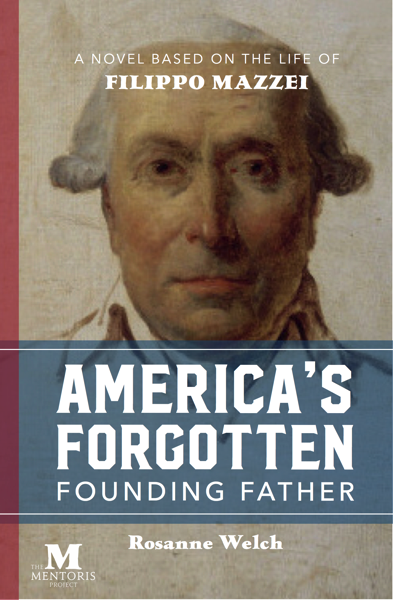
Quote from “America’s Forgotten Founding Father” by Dr. Rosanne Welch – 30 in a series – No turning back

Quote from

As they each played devil’s advocate in a debate over taking such a strong step toward the independence of the colonies, Filippo warned Jefferson, “If we do this, there will be no turning back.”

“I don’t believe I want to turn back anymore,” Jefferson responded.

With that the two men began spending intense hours bent over their quill pens writing their original essays and then editing each other’s work. Filippo wrote in Italian and Jefferson translated his words into English. 

 From America’s Forgotten Founding Father — Get Your Copy Today!


Join the Rosanne Welch Mailing List for future book and event announcements!
 

Order an autographed copy of America’s Forgotten Founding Father

Print Edition | Kindle Edition | Apple iBooks Edition | Nook Edition

Also from the Mentoris Project

Want to use these books in your classroom? Contact the Mentoris Project!`

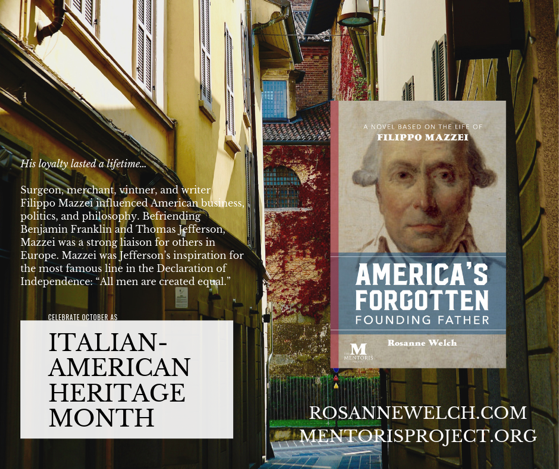
“America’s Forgotten Founding Father: Filippo Mazzei” – Italian-American Heritage Month – 2 in a series

Print Edition | Kindle Edition | Apple iBooks Edition | Nook Edition

His loyalty lasted a lifetime…

Surgeon, merchant, vintner, and writer Filippo Mazzei influenced American business, politics, and philosophy. Befriending Benjamin Franklin and Thomas Jefferson, Mazzei was a strong liaison for others in Europe. Mazzei was Jefferson’s inspiration for the most famous line in the Declaration of Independence: “All men are created equal.”

Clearly, Mazzei had a gift of language and often used his words to share his ideas about religious freedom. Mazzei encouraged other Italians still living overseas to join him in a country rich with opportunity and promise. Often, when returning from Italy, he booked passages on ships for people who desired to travel to America and employed them on his estate—just to ensure a better, more fruitful life for everyone. During those travels, Mazzei found himself at the center of many fights for freedom.

He was truly a friend to freedom around the world.


Join the Rosanne Welch Mailing List for future book and event announcements!
 

Also from the Mentoris Project

Want to use these books in your classroom? Contact the Mentoris Project!`

More on Mazzei: Philip Mazzei And His Polish Friend by Howard R. Marraro

 cover small 2This series will focus on material I found while researching my book, America’s Forgotten Founding Father: A Novel Based on the Life of Filippo Mazzei.

These next few items come from the Bibliography I submitted when proposing the original book. — Rosanne.


More on Mazzei: Philip Mazzei And His Polish Friend by Howard R. Marraro

More on Mazzei: Philip Mazzei And His Polish Friend by Howard R. Marraro

Bulletin of the Polish Institute of Arts and Sciences in America
Vol. 2, No. 3 (April, 1944), pp. 757-822 (66 pages)
Published by: Polish Institute of Arts & Sciences of America


Join the Rosanne Welch Mailing List for future book and event announcements!
 

Order an autographed copy of America’s Forgotten Founding Father

Print Edition | Kindle Edition | Apple iBooks Edition | Nook Edition

Also from the Mentoris Project

Want to use these books in your classroom? Contact the Mentoris Project!`

October is Italian Heritage Month! – Celebrate with these events and my book on America’s Forgotten Founding Father: Filippo Mazzei!

October is Italian Heritage Month! - Celebrate with these events!

Did you know there was an Italian Heritage Month? And that it is October?

It was declared in 1989 so stay tuned to some fun things I’ll be posting this month to celebrate the contributions Italians have made to America since the days even before the country was founded (which you can learn about in my book “America’s Forgotten Founding Father: Filippo Mazzei”. 


Print Edition | Kindle Edition | Apple iBooks Edition | Nook Edition

If you live in Los Angeles, here are some fun things you can think about doing to celebrate with your friends of Italian descent.

Los Angeles Italian Heritage Month Events

See also:

Upcoming Event:

ITALIAN GENEALOGY: DISCOVERING YOUR ANCESTRAL RECORDS IN ITALY & THE USA – ITALIAN CULTURAL INSTITUTE (OCT. 14, 2017)

Taking place at the Italian Cultural Institute (IIC) this two-day workshop offers practical methods for researching documents relevant to families that emigrated from Southern Italy to the U.S. No knowledge of Italian is needed. Event recognized by the Consulate General of Italy in Los Angeles. Two sessions, $90 (non-member) / $85 (IIC members). Info and registration at (310) 824-7408 or classes.iicla@esteri.it.


Join the Rosanne Welch Mailing List for future book and event announcements!
 

Also from the Mentoris Project

Want to use these books in your classroom? Contact the Mentoris Project!`

From Stephens College…

Today’s Stephens College newsletter has a great piece about the Los Angeles launch party for When Women Wrote Hollywood with details about our upcoming launch at the Skylar Bookstore in Columbia, Missouri during the Citizen Jane Film Festival. — Rosanne

Book launch party on Aug. 11 in L.A. Pictured (L-to-R): Sarah Phillips ’17 M.F.A., Khanisha Foster ’17 M.F.A. (with her daughter), Lauren Smith ’17 M.F.A., Laura Kirk ’17 M.F.A., Amelia Phillips ’17 M.F.A., Julie Berkobien ’17 M.F.A., Toni Anita Hull ’04 B.F.A., ’17 M.F.A. and Dr. Rosanne Welch, book editor/Stephens professor.

M.F.A. class publishes book of essays

Stephens College’s M.F.A. program now proudly boasts “When Women Wrote Hollywood,” a book of essays that focuses on the lives of female screenwriters of Golden Age Hollywood. The book, which published in July, is written by members of the inaugural graduating class of the Stephens M.F.A. in TV and Screenwriting. In the collection of 23 essays, Stephens Class of 2017 alumni write about female writers like Anita Loos, Adela Rogers St. Johns, and Gene Gauntier, whose work helped create unforgettable stories and characters beloved by audiences — but whose names are excluded from most film histories.“The mission of our M.F.A. program matched the mission of this book brilliantly — to increase the number of female screenwriters and female-centric stories told in Hollywood,” said Dr. Rosanne Welch, the book’s editor, and a Stephens assistant professor. She said her students used the essays as a way of thanking the earlier pioneering female writers who came before them.“When I introduce our Screenwriting History course, I remind students that we stand on the shoulders of those who came before us,” said Welch, a veteran television writer and scholar of screenwriting history. “Students are shocked at how many of these women were left out of most history books and are passionate about researching them for their final projects. When I read this first batch of essays, I knew they were worthy of publication.”The book is available on Amazon. It can also be purchased during Stephens’ Alumnae Leaders Weekend (Nov. 2-3) at the coinciding Citizen Jane Film Festival. In addition, a book launch event with local contributors will be held from 1-3 p.m. on Nov. 3 at Skylark Bookstore in downtown Columbia. Books can be purchased and signed by the authors.

Quotes from When Women Wrote Hollywood – 6 in a series – “She has to be mentioned”

Quotes from When Women Wrote Hollywood - 6 in a series -

“In an interview with Pamela Green the director of the soon to be released documentary Be Natural, a film that takes the exploration of Alice Guy Blaché’s life and career to new depths, Green shared, “Anytime you mention early cinema, she has to be mentioned. If you talk about Hollywood before Hollywood, she has to be mentioned. If you talk about an artist and an entrepreneur at the time, she has to be mentioned.””

The Nature and Genius of Alice Guy Blaché
Khanisha Foster


Buy a signed copy of when Women Write Hollywood

or Buy the Book on Amazon


Paperback Edition | Kindle Edition | Google Play Edition

* A portion of each sale from Amazon.com directly supports our blogs
** Many of these books may be available from your local library. Check it out!
† Available from the LA Public Library

When Women Wrote Hollywood – 29 in a series – “The Grand Passion (1918), Wr: Ida May Park

To highlight the wonderful yet largely forgotten work of a collection of female screenwriters from the early years of Hollywood (and as a companion to the book, When Women Wrote Hollywood) we will be posting quick bits about the many films they wrote along with links to further information and clips from their works which are still accessible online. Take a few moments once or twice a week to become familiar with their names and their stories. I think you’ll be surprised at how much bold material these writers tackled at the birth of this new medium. — Rosanne Welch


When Women Wrote Hollywood – 29 in a series – “The Grand Passion (1918), Wr: Ida May Park

When Women Wrote Hollywood - 29 in a series -

The Grand Passion is a 1918 American silent western film directed by Ida May Park and starring Lon Chaney.[1] It is not known whether the film currently survives.[1]

As described in a film magazine,[2] Dick Evans (Stowell), boss of Powderville, decides to start a newspaper and support it through coerced advertising from the businesses in the town. He hires Jack Ripley (Mulhall), a New York newspaperman, to be its editor. Viola (Phillips), niece of Paul Argos (Chaney), arrives on the same train as Ripley. Forming a relationship with her, Evans decides to clean up the town. In the meantime, Viola has been kidnapped and hidden in a roadhouse on the other side of the tracks. Evans and Ripley rescue her but incur the enmity of the denizens of the district. They attack the newspaper office and, in the face of defeat, Evans orders Ripley to escape with Viola. When she discovers that Evans is missing, she returns to the burning town and discovers him wounded. She declares her love and indications are that he will survive to claim it. — Wikipedia 

More about The Grand Passion (1918)

More about Ida May Park


Buy a signed copy of when Women Wrote Hollywood


Paperback Edition | Kindle Edition | Google Play Edition

* A portion of each sale from Amazon.com directly supports our blogs
** Many of these books may be available from your local library. Check it out!
† Available from the LA Public Library

18 All About Intelligence from How The Monkees Changed Television [Video] (0:48)

What this entire presentation — How The Monkees Changed Television with Rosanne Welch, PhD (Complete Presentation and Q&A) [Video] (45:06)

18 All About Intelligence from How The Monkees Changed Television [Video] (0:48)

Rosanne Welch, PhD, Author of Why The Monkees Matter, presents “How The Monkees Changed Television” at a Cal State Fullerton Lunch Lecture on May 8, 2018.

In this talk, she shows how The Monkees, and specifically their presence on television, set the stage for large changes to come in the late 1960s.


Transcript

…And then there’s an episode called “99 Pound Weakling” where Micky falls in love with a girl and look how he defines her. It’s about her intelligence. Two words about how smart she is. Only one word about how pretty she is. So it’s her smarts that makes him want her and go through all this trouble to try and get muscles and whatnot and it’s cute, but never did they want a girl just because she was pretty and I thought that was particularly unexpected in an era when — in The Big Bang Theory which is having its 250th episode this week, which is lovely. It really is all about who’s going to have sex with who next week. Right? I mean that’ what the show devolved to in terms of their personal relationships and this did not. Now, I have to grant you that, back in the day, they couldn’t discuss that on television, but they didn’t even go to a point where it was about getting a beautiful girl. it was about getting a smart girl. So that strikes me as very cool.


 Why The Monkees Matter: Teenagers, Television and American Pop Culture


McFarland (Direct from Publisher) | Amazon | Kindle Edition | Nook Edition

Want to use “Why The Monkees Matter” in your classroom?

Order Examination Copies, Library and Campus Bookstore orders directly from McFarland

McFarland Company logo


About Rosanne Welch, PhD

Rosanne Welch, PhD is a writer, producer and university professor with credits that include Beverly Hills 90210, Picket Fences, Touched by an Angel and ABC NEWS/Nightline. Other books include Why The Monkees Matter: Teenagers, Television and American Pop Culture (McFarland, 2017) and Women in American History: A Social, Political, and Cultural Encyclopedia and Document Collection (ABC-CLIO, 2017), named to the 2018 Outstanding References Sources List, by the Reference and User Services Association (RUSA), a division of the American Library Association. Welch has also published chapters in Torchwood Declassified: Investigating Mainstream Cult Television (I.B.Tauris) and The American Civil War on Film and TV: Blue and Gray in Black and White and Color (Lexington Books, 2018) and essays in Doctor Who and Race: An Anthology and Outside In Makes it So, and Outside in Boldly Goes (both edited by Robert Smith). By day she teaches courses on the history of screenwriting and on television writing for the Stephens College MFA in Screenwriting programs. Her talk “The Importance of Having a Female Voice in the Room” at the 2016 TEDxCPP is available on YouTube.

When Women Wrote Hollywood – 28 in a series – Ida May Park

To highlight the wonderful yet largely forgotten work of a collection of female screenwriters from the early years of Hollywood (and as a companion to the book, When Women Wrote Hollywood) we will be posting quick bits about the many films they wrote along with links to further information and clips from their works which are still accessible online. Take a few moments once or twice a week to become familiar with their names and their stories. I think you’ll be surprised at how much bold material these writers tackled at the birth of this new medium. — Rosanne Welch


When Women Wrote Hollywood – 28 in a series – Ida May Park

When Women Wrote Hollywood - 28 in a series - Ida May Park

Ida May Park (December 28, 1879 – June 13, 1954)[1] was an American screenwriter and film director of the silent era, in the early 20th century. She wrote for more than 50 films between 1914 and 1930, and directed 14 films between 1917 and 1920.[2] She was born and died in Los Angeles, California. She was married to film director and producer Joseph De Grasse, with whom she was regularly teamed at Universal.[3]

Park got her start in the entertainment industry as a stage actress when she was fifteen years old. During her time in the theatre she met her future husband, Joseph De Grasse, also an actor. When Pathé hired De Grasse in 1909, Park was also hired as a writer. Together they were hired by Universal.[4] 

The first screenplay that she wrote was titled A Gypsy Romance which was developed into a short scenario by director Wallace Reid. Reid also directed the next scenario that she wrote, The Man Within.[2] Park then started to work with De Grasse who directed the next several pieces that she wrote. The two worked on multiple shorts and scenarios together over several years. Their first joint project was the short Her Bounty (1914), and their first feature-length film was Father and The Boys (1915). Most of the titles that the two worked on together were for Universal’s Bluebird label.[5] Park made her solo directorial debut in 1917 when she directed The Flashlight[6] starring Universal’s top dramatic actress Dorothy Phillips;[4] after this picture, she and DeGrasse took turns directing Bluebird projects featuring Phillips.[6] She went on to direct 13 more films, many of which were deemed “women’s features”.[7] — Wikipedia 

More about Ida May Park


Buy a signed copy of when Women Wrote Hollywood


Paperback Edition | Kindle Edition | Google Play Edition

* A portion of each sale from Amazon.com directly supports our blogs
** Many of these books may be available from your local library. Check it out!
† Available from the LA Public Library