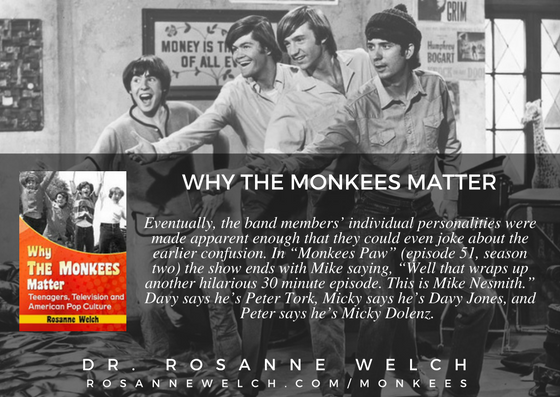
Eventually, the band members’ individual personalities were made apparent enough that they could even joke about the earlier confusion. In “Monkees Paw” (episode 51, season two) the show ends with Mike saying, “Well that wraps up another hilarious 30 minute episode. This is Mike Nesmith.” Davy says he’s Peter Tork, Micky says he’s Davy Jones, and Peter says he’s Micky Dolenz.
Jean Powergirl takes the host reigns and welcomes her guest Rosanne Welch, PhD to the show! They’ll be discussing Roseanne’s book, “Why The Monkees Matter: Teenagers, Television and American Pop Culture.”
Transcript:
Rosanne: So you couldn’t be as improv’d as you might think they were. Much of the improvisation was written into the script or, if they made something up on the set, and the directors approved it, it would have to fit it…
Jean: They would work it in. There would be discussion — you’re going to say this. You’re going to say that.
Rosanne: Exactly and so Micky admitted that most of it was scripted and that they did a good job memorizing it and delivering it in a spontaneous way that seemed like they were making it up. So it was really interesting to get his perspective int hat respect and to, of course, credit the writers. One of my missions as a professor of television
Jean:…and a writer…
Rosanne: …is to make sure more credit is given to the writers because if you like a particular writer on a show, you should look at their career on IMDB and look at their previous work. You might find that you like the themes that they bring out and you’re a fan of their writing not necessarily of the person who produces that show.
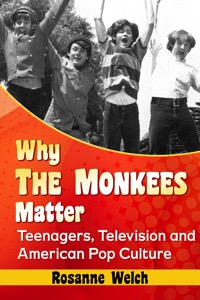
A hit television show about a fictitious rock band, The Monkees (1966-1968) earned two Emmys–Outstanding Comedy Series and Outstanding Directorial Achievement in Comedy. Capitalizing on the show’s success, the actual band formed by the actors, at their peak, sold more albums than The Beatles and The Rolling Stones combined and set the stage for other musical TV characters from The Partridge Family to Hannah Montana. In the late 1980s, the Monkees began a series of reunion tours that continued into their 50th anniversary.
This book tells the story of The Monkees and how the show changed television, introducing a new generation to the fourth-wall-breaking slapstick created by Laurel and Hardy and the Marx Brothers. Its creators contributed to the innovative film and television of 1970s with projects like Bob & Carol & Ted & Alice, The Mary Tyler Moore Show, Laugh-In and Welcome Back, Kotter. Immense profits from the show, its music and its merchandising funded the producers’ move into films such as Head, Easy Rider and Five Easy Pieces.
Rosanne Welch, PhD has written for television (Touched by an Angel, Picket Fences) and print (Three Ring Circus: How Real Couples Balance Marriage, Work and Kids and The Encyclopedia of Women in Aviation and Space). In the documentary world she has written and produced Bill Clinton and the Boys Nation Class of 1963 for ABC NEWS/Nightline and consulted on PBS’s A Prince Among Slaves, the story of a prince from West Africa who was enslaved in the 1780s, freed by order of President John Quincy Adams in the 1820s and returned to his homeland.
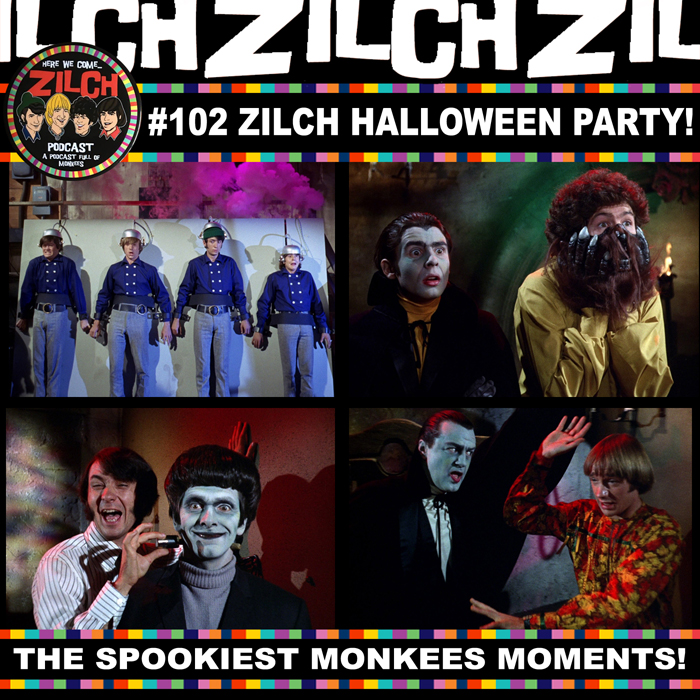
It’s always a pleasure to be invited to chat Monkees moments with other experts and this panel was extra fun since Halloween is one of my favorite holidays. We each chose our favorite scary episodes to create a perfect 5 episode binge – so listen in for the list, pop your popcorn, purchase your candy corn and cuddle up on your couch to watch with us this Halloween!
Trick or Treat! Welcome to a Zilch Halloween episode! Join Kenacula & Christine Carlson Werewolf as they Haunt the Zilch Castle.Then a Spooky Panel of Scary Monkees Moments with Courtney Cronin Dold, Dr.Rosanne Welch, Sarah Clark, Melanie Mitchell! Boo! Be safe and Happy Halloween!
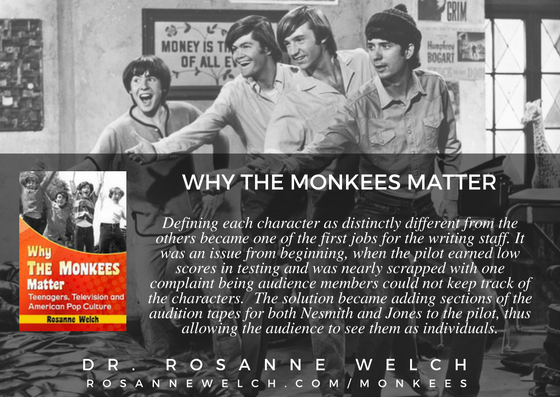
Defining each character as distinctly different from the others became one of the first jobs for the writing staff. It was an issue from beginning, when the pilot earned low scores in testing and was nearly scrapped with one complaint being audience members could not keep track of the characters. The solution became adding sections of the audition tapes for both Nesmith and Jones to the pilot, thus allowing the audience to see them as individuals.
Jean Powergirl takes the host reigns and welcomes her guest Rosanne Welch, PhD to the show! They’ll be discussing Roseanne’s book, “Why The Monkees Matter: Teenagers, Television and American Pop Culture.”
Transcript:
Rosanne: So, I originally wrote about that and that’s how I got to talk with Micky because I knew, as a child actor, he would understand how one worked with writers and, of course, he always did credit the writers — both the songwriters and the show writers when he was doing his interviews. I did get to talk to him and the secret — which isn’t much of a secret — because I put it in the preface to the book — is that he had been my favorite Monkee so to actually talk to him was the big deal. Even at the age of 50 for god’s sake.
Jean: So she got to talk to her favorite Monkee and was he able to give you some insight?
Rosanne: He was. I mean he, of course, he took seriously the work of the writers and, as an actor, you’ll notice that while they did a lot of ad lib — actors can’t do as much improv as we assume because camera angles have to be created by the directors and they’re based on the script.
Jean:…and isn’t there a tight time and money is time, right
Rosanne: Yes. Because of all the crazy quick shots, this show would do sometimes 60 or 70 camera setups a day when 20 is normal.
A hit television show about a fictitious rock band, The Monkees (1966-1968) earned two Emmys–Outstanding Comedy Series and Outstanding Directorial Achievement in Comedy. Capitalizing on the show’s success, the actual band formed by the actors, at their peak, sold more albums than The Beatles and The Rolling Stones combined and set the stage for other musical TV characters from The Partridge Family to Hannah Montana. In the late 1980s, the Monkees began a series of reunion tours that continued into their 50th anniversary.
This book tells the story of The Monkees and how the show changed television, introducing a new generation to the fourth-wall-breaking slapstick created by Laurel and Hardy and the Marx Brothers. Its creators contributed to the innovative film and television of 1970s with projects like Bob & Carol & Ted & Alice, The Mary Tyler Moore Show, Laugh-In and Welcome Back, Kotter. Immense profits from the show, its music and its merchandising funded the producers’ move into films such as Head, Easy Rider and Five Easy Pieces.
Rosanne Welch, PhD has written for television (Touched by an Angel, Picket Fences) and print (Three Ring Circus: How Real Couples Balance Marriage, Work and Kids and The Encyclopedia of Women in Aviation and Space). In the documentary world she has written and produced Bill Clinton and the Boys Nation Class of 1963 for ABC NEWS/Nightline and consulted on PBS’s A Prince Among Slaves, the story of a prince from West Africa who was enslaved in the 1780s, freed by order of President John Quincy Adams in the 1820s and returned to his homeland.
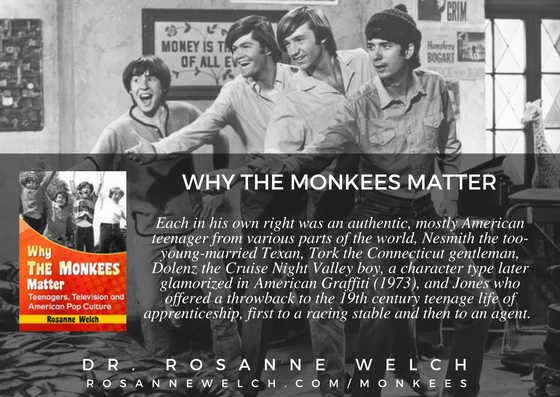
Each in his own right was an authentic, mostly American teenager from various parts of the world, Nesmith the too-young-married Texan, Tork the Connecticut gentleman, Dolenz the Cruise Night Valley boy, a character type later glamorized in American Graffiti (1973), and Jones who offered a throwback to the 19th century teenage life of apprenticeship, first to a racing stable and then to an agent.
Jean Powergirl takes the host reigns and welcomes her guest Rosanne Welch, PhD to the show! They’ll be discussing Roseanne’s book, “Why The Monkees Matter: Teenagers, Television and American Pop Culture.”
Transcript:
Jean: All right, so did you get..have you been able to talk personally to any of The Monkees.
Rosanne: I was able to…I did phone interviews with Micky Dolenz when I was working…originally I did an article about the writers of the show for… this is Written By Magazine which is the magazine of the Writers Guild and I’m on the board there so I sometimes recommend things I’d like to do and if other writers don’t want to take them, I do them. So I had done that article so that is when I interviewed Micky to talk about — to talk to an actor who understood how writers operated and how scripts work. In fact, I also among all the things I bring to the book signings I have an actual script from the show.
Jean: Which I love stuff like this. An actual script. An actual television script which to me is great. it is just a beautiful thing. In the day, this is how it was done. Notice the little brads. I don’t think you Millenials even know what a brad is, but anyway, this is awesome. This is like a relic for Monkees people. Imean you might need a bodyguard because I know some Monkees crazy people that would like tackle you for that, but I digress.
Rosanne: Seriously. In fact, one of the gentlemen I talked to, Coslough Johnson, talked about when he would go to the studio to hand in a freelance script, he would be mauled by teenagers who were hanging around the gates wanting any piece of memorabilia they could get. “I just want to deliver my work.”
A hit television show about a fictitious rock band, The Monkees (1966-1968) earned two Emmys–Outstanding Comedy Series and Outstanding Directorial Achievement in Comedy. Capitalizing on the show’s success, the actual band formed by the actors, at their peak, sold more albums than The Beatles and The Rolling Stones combined and set the stage for other musical TV characters from The Partridge Family to Hannah Montana. In the late 1980s, the Monkees began a series of reunion tours that continued into their 50th anniversary.
This book tells the story of The Monkees and how the show changed television, introducing a new generation to the fourth-wall-breaking slapstick created by Laurel and Hardy and the Marx Brothers. Its creators contributed to the innovative film and television of 1970s with projects like Bob & Carol & Ted & Alice, The Mary Tyler Moore Show, Laugh-In and Welcome Back, Kotter. Immense profits from the show, its music and its merchandising funded the producers’ move into films such as Head, Easy Rider and Five Easy Pieces.
Rosanne Welch, PhD has written for television (Touched by an Angel, Picket Fences) and print (Three Ring Circus: How Real Couples Balance Marriage, Work and Kids and The Encyclopedia of Women in Aviation and Space). In the documentary world she has written and produced Bill Clinton and the Boys Nation Class of 1963 for ABC NEWS/Nightline and consulted on PBS’s A Prince Among Slaves, the story of a prince from West Africa who was enslaved in the 1780s, freed by order of President John Quincy Adams in the 1820s and returned to his homeland.

![25: Improv, Writers and The Monkees : “Why The Monkees Matter” Interview with Jean Power [Video] (0:53)](https://rosannewelch.com/wp-content/uploads/2017/11/rmw-power-25-improv.jpeg)
![24: Writers, Actors and The Monkees : “Why The Monkees Matter” Interview with Jean Power [Video] (0:57)](https://rosannewelch.com/wp-content/uploads/2017/10/rmw-power-24-writers-actors.jpeg)
![23: Writers, Fans and The Monkees : “Why The Monkees Matter” Interview with Jean Power [Video] (1:14)](https://rosannewelch.com/wp-content/uploads/2017/10/rmw-power-23-writers-fans.jpeg)