He invited us to discuss the two awards given to our 4 volume encyclopedia on Women in American History. (It was named to both the 2018 Outstanding References Sources List and the 2018 list of Best Historical Materials, by the Reference and User Services Association (RUSA), a division of the American Library Association) and our current book contracts.
Thanks to Ashley Jones, the Communications Specialist at Cal Poly Pomona, who plans podcasts for helping to highlight the work of adjuncts on our campus. If we can’t get ‘the big bucks’ it’s nice to have our scholarship acknowledged by the larger community.
We filmed this before campus closed down in March so we end up saying our new book on Fact Checking Hollywood History will be out in April… which of course hasn’t happened since most college libraries continue to be closed. We expect it to be released in another couple of months.
I gave the opening lecture entitled, “Why Researching Screenwriters (has Always) Mattered” which appears here in English, though the rest of the papers (naturally) are in Portuguese. It was an honor to be asked to do the lecture and privilege to spend time with Professor Glaucia Davino and her students who made me feel very welcome in their city.
Words matter. Writers matter and women writers matter in this world. It is important to consider writers because the word writer comes before the word director when you describe a filmmaker who can do two things. They are writer-directors, they are not director-writers. That tells us something. The vision of a movie cannot exist without the screenplay. A director cannot direct nothing. There must be an idea. There must be a philosophy. There must be a theme. There must be a story. This proves that the writer is of equal importance. We must remember writers have to be equal partners and I think we realize that without realizing it. When people talk about movies to their friends they don’t say “I loved the camera angle in scene 7.” They quote dialogue from their favorite movies whether they are from a Pixar film or a Disney one, they quote the dialogue and that is the work of the writer. That’s the person who should be given credit, yet often at the start a class I ask students to list their two or three favorite films, who directed those films and who wrote that film. They very often cannot name the person who wrote the film they claim to adore. How can you study to be a writer if you don’t remember writers yourself? Hence the reason to study Screenwriting. Hence researching screenwriters has always mattered.
When actors Frances McDormand won her Oscar for Three Billboards Outside Ebbing Missouri she said of the screenwriter Martin McDonagh, “He did not sketch a blueprint. That’s an insult to a screenplay. He didn’t string together a few words. He wrote, meticulously crafted, a tsunami, and then he allowed his troupe of actors to surf it into the shore.” (https://www.hollywoodreporter.com/news/sag-awards-three-billboards-takes-top-honors-at-a-show-women-took-center-stage-1076726) She credited the writer in a way that many people do not.
Stories – and therefore screenplays and therefore screenwriters — are important because they transmit culture around the world. The United States has had a corner on that market for far too many years but now we’re beginning to see other stories permeate our culture, a good and beneficial thing for a country made of immigrants and the ancestors of immigrants. Stories have always transmitted culture far back to the cave paintings of many ancient cultures, through Gilgamesh, and the griots of Africa. Humans have used stories to move culture forward. Movies are the most current version of doing that so why do we forget to study the storytellers? Now is the time to fix this glaring omission both in casual discussions of films and in academia.
Today’s research tidbit – did you know Eleanor Roosevelt spoke to the nation about Pearl Harbor the night before Franklin did?
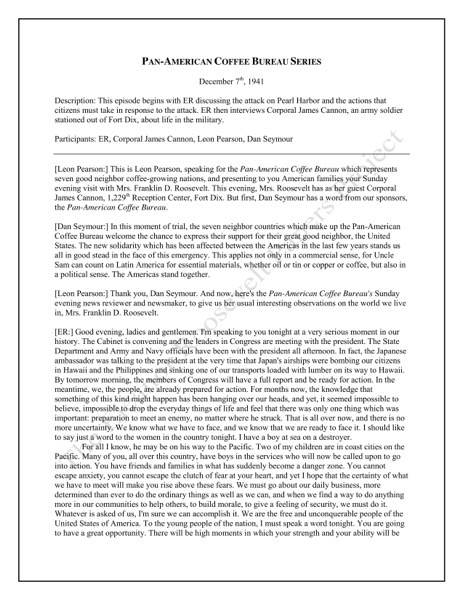
She had a regularly scheduled Sunday night radio show called “Over Our Coffee Cups” so she went on the air that night to say some things that, while not “a date that will live in infamy” do resonate.
On the day of the Japanese attack on Pearl Harbor, ER discusses what the nation must do to face this international crisis. ER also interviews Corporal James Cannon.
You can hear her voice in the collection at the Eleanor Roosevelt Papers or read this:
“Many of you all over the country have boys in the services who will now be called upon to go into action… You cannot escape anxiety. You cannot escape a clutch of fear at your heart and yet I hope that the certainty of what we have to meet will make you rise above these fears. We must go about our daily business more determined than ever to do the ordinary things as well as we can and when we find a way to do anything more in our communities to help others, to build morale, to give a feeling of security, we must do it. Whatever is asked of us I am sure we can accomplish it. We are the free and unconquerable people of the United States of America. To the young people of the nation, I must speak a word tonight. You are going to have a great opportunity. There will be high moments in which your strength and your ability will be tested. I have faith in you. I feel as though I was standing upon a rock and that rock is my faith in my fellow citizens.”
![Dr. Rosanne Welch and Dr. Peg Lamphier Talk Women In America History on the College of Education and Integrative Studies Podcast [Video]](https://rosannewelch.com/wp-content/uploads/2020/09/ceis-podcast-22.jpg)