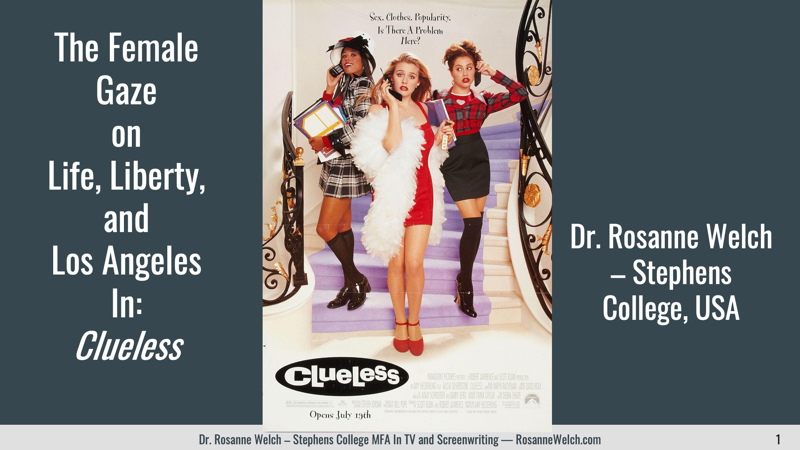
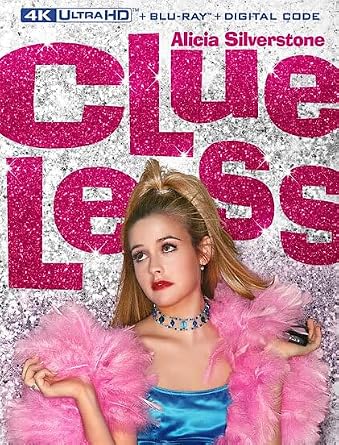
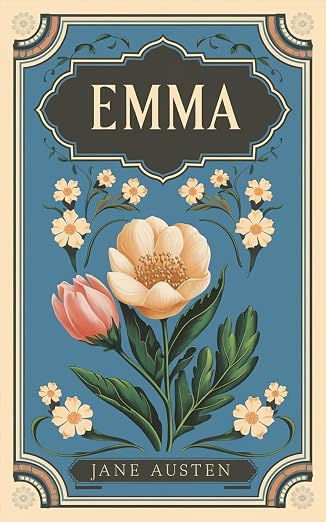
In my short talk, I covered the comparison between Cher, the lead character of Clueless, and Jane Austen’s Emma, showing how Heckerling’s film is a solid example of the female gaze.
I also touched on how Heckerling embedded her own progressive ideas into her main character, from the fact that her high school was named for abolitionist and Transcendentalist Bronson Alcott to Cher’s comment on immigration: “It does not say RSVP on the Statue of Liberty.” Pretty forward-thinking for a film made in 1995.
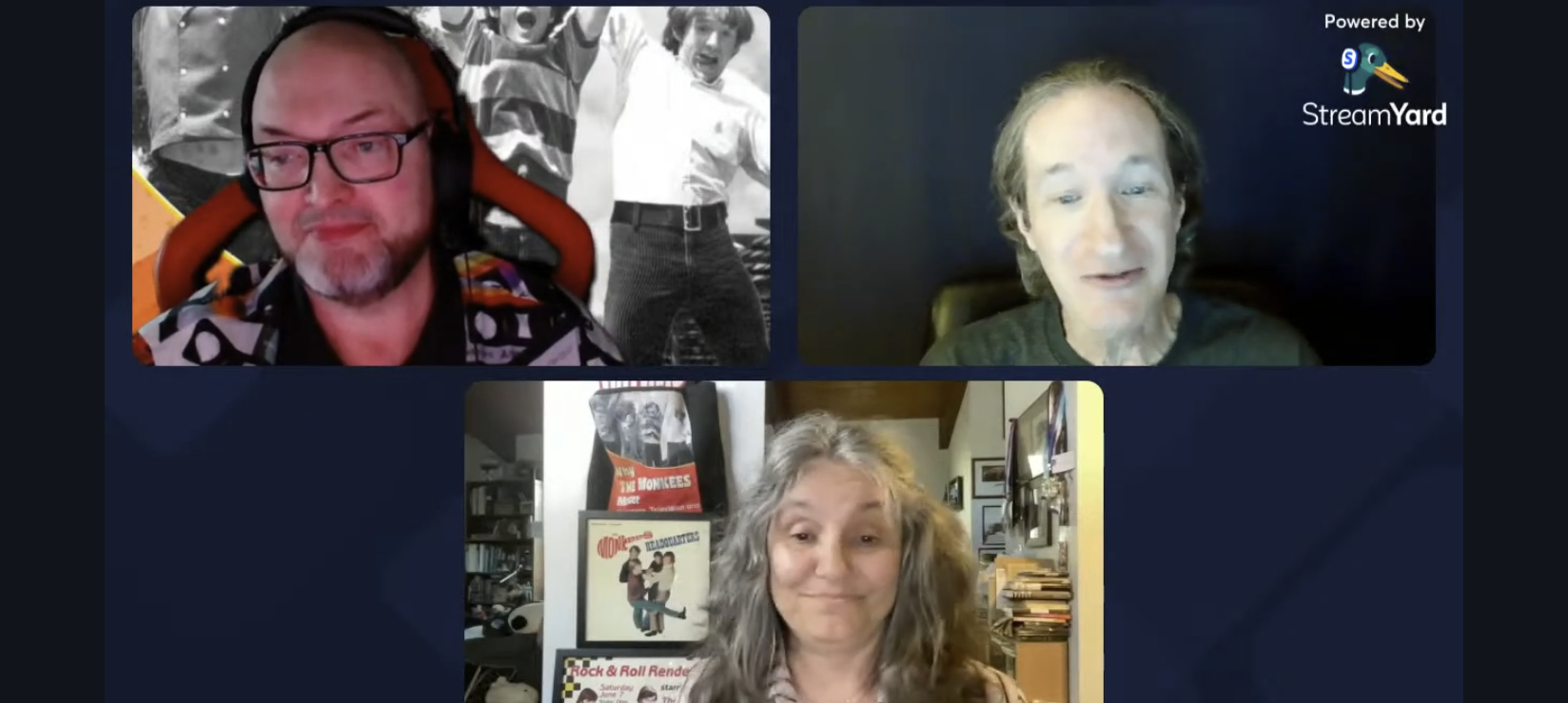
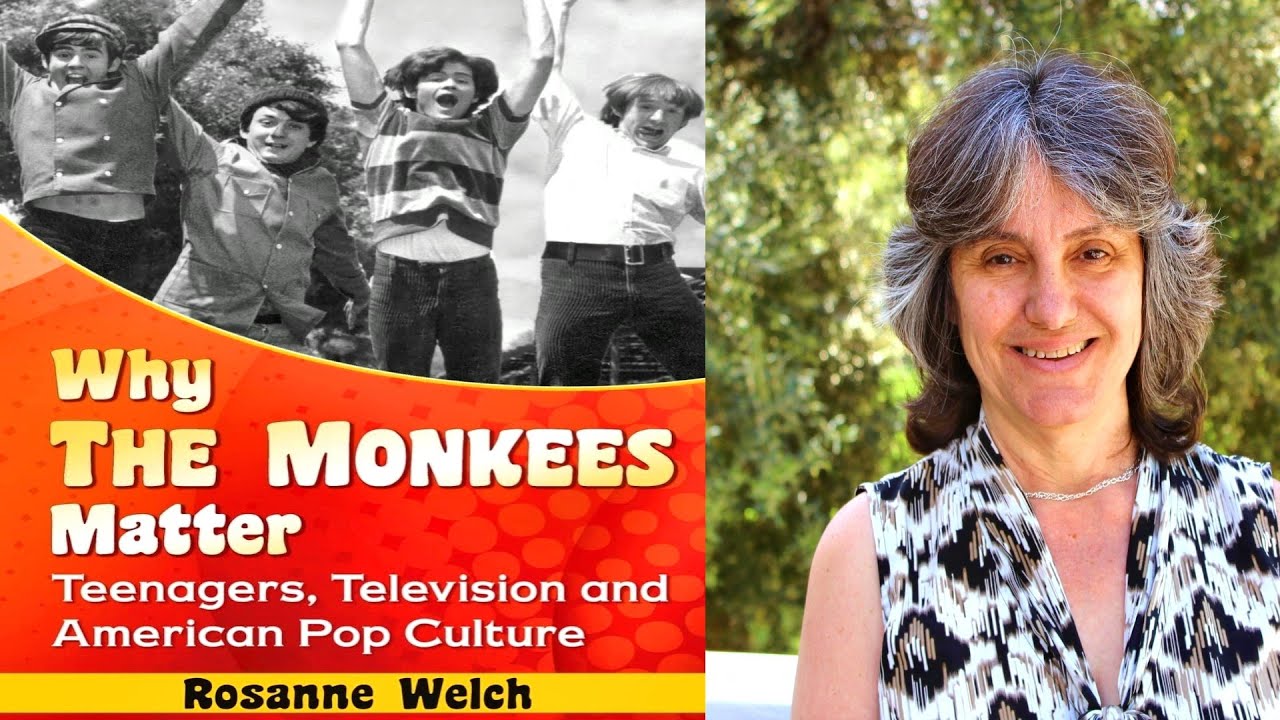
I had a great conversation about Why The Monkees Matter with the two hosts of “Johnny D’s Rock n Roll PhD”. Often, I speak with people who know the music more than the show – or the show more than the music. Here, both hosts had strong knowledge about both, and then we found out he shared the same top 1 songs as our favs.
Watch the video to learn about the many things the TV show taught us about friendship, going against authority and the patriarchy, and living a life full of passion for art above all things commerce – with lots of hidden nods toward the counter culture of the day (like rescuing a giant marijuana plant from misuse by supervillains who would corrupt its powerful fumes for evil). Yeah, they did a whole show about that!
I enjoyed discussing the phenomenon and possible importance of Teen Idols across the generations with Dan Schneider for his Cosmoetica YouTube channel. Of course, he found me thanks to my book on The Monkees ( whose subtitle is “Teenagers, Television, and American Pop Culture”) and I was happy to report on the research I had done for the book about the rise of the term “teen ager” (post WWII when high school became mandatory), those who came before the Monkees (from Sinatra to James Dean to Bobby Sherman), and those who’ve come after (from the Jackson Five to Leonardo DiCaprio to Miley Cyrus).
I shared the panel with Fred Velez who has written about Monkees fandom and together we all delved into what participating in such fandom offers the audience, how streaming and the internet have changed such fandom, and who will be the most remembered teen idols of the century.
At San Diego Who Con 2024 (https://www.sdwhocon.com/), I enjoyed lecturing on “From Shakespeare to Shelley or Dante to Dickens: The Literary References Who Has Introduced You To!”.
I first thought of it while watching an episode with my favorite classic Doctor Peter Davison. I heard a line that was so specific I thought that it had to come from some book I didn’t know. It did. So then I researched what other famous authors had been quoted by the various Doctors and deeply enjoyed finding lots of Shakespeare and Dylan Thomas and of course, Byron and Shelley were in that mix. It was a reminder that writers READ. They read a lot to fuel their work.
The lecture also allowed me to highlight some great English actors who’ve starred in Shakespeare’s works like Patrick Stewart, Derek Jacobi, and Alex Kingston – some of whom also (of course) guested on Doctor Who.
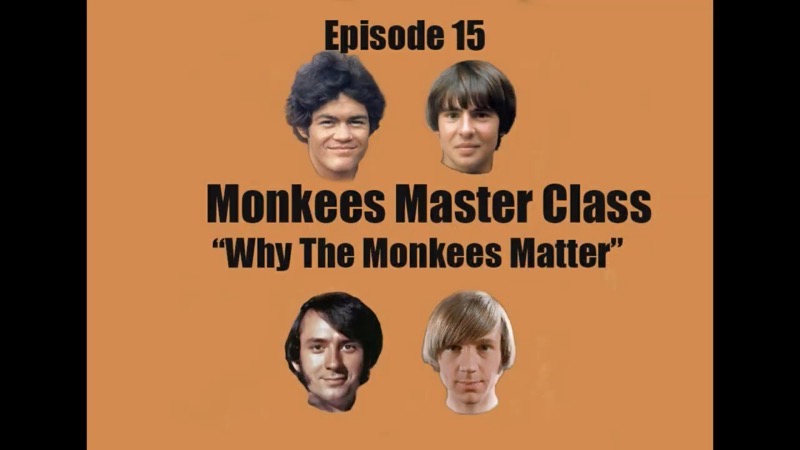
I always say I could talk about The Monkees all day – or at least for an hour, which is what I just had the privilege of doing with Joe Russo of The Monkees Pad on YouTube.
It’s especially fun to talk with folks like Joe, who know The Monkees so well – both the music and the TV show, which is more my specialty. We covered how the show got on the air (thanks to a young Grant Tinker), how so many of their counter-culture jokes made it past the censor, and why the fandom keeps growing across the generations.
If you love The Monkees individually or as a group, and if you love the TV of the 1960s, I hope you enjoy the listen.
Many thanks to SRN member Romana Turina for inviting me to give an online seminar on the benefits of Flipping Your Classroom for the Working Group on Comparative Screenwriting in the Screenwriting Research Network that she leads.
Every month she presents and records a guest lecture for our membership that is then open to the public once she posts it on YouTube.
This month she asked me to speak about the pedagogy of flipping your classroom to enhance learning which, while created with K-12 students in mind is equally effective – and I would add necessary – in the world of MFA candidates. I use this practice in the teaching of screenwriting in our low residency Stephens College MFA in TV and Screenwriting.
It involves the professor providing less “Sage on the stage” performance and more student-focused opportunities. I’ve also come to describe it as not teaching (as defined by dumping all my info into their heads) but as curating an experience from which they glean the knowledge they need.
In the lecture I give examples of the kinds of activities I curate, keeping in mind the different learning styles each MFA candidate presents.
A military veteran, Herrera also runs the Stephens College Mission Promise Kept program. Together we spoke about the many military women whose stories have yet to be told on the big (or small) screen including the Mercury 13. Herrera was kind enough to let me talk about the Screenwriting Research Network conference we were holding on the Stephens campus that week and, of course, about the many military women who have dome through our Stephens College MFA in TV and Screenwriting and how telling our stories helps us heal – whether we turn them into scripts or not it’s the act of talking and being heard that heals.
She Served Too Every 3rd Tue at 5:00 PM With Elizabeth Herrera
Host Elizabeth Herrera has served in the United States Air Force, non-profits, and managing crisis care centers for women. On her show She Served Too, she discusses current issues from her unique perspective.
Since that other, of course, shows have exploded more. We were talking with some folks the other day about these guys but you start with “Inspector Morse” which again was on PBS in the 70s and then that became the spin-off of “Lewis”. So “Lewis” who is the original assistant now becomes the head guy and there’s a “Doctor Who” connection because the guy who played Hathaway was married to Billy Piper and then, of course, they blended that into doing the prequel the “Endeavor” show which is really Morse as a young man right because his real name was Endeavor but he never liked that as a name so they used it for the new show but now that’s something that Americans know a lot about. I have friends who’d never heard of Morse but they all watch “Endeavor” and so then they’re like oh let’s go backwards and see what this guy you know what happens to him later in life.
In this presentation given at the 2022 San Diego WhoCon I had the chance to trace the many ways Doctor Who changed the TV universe. By focusing on the interesting and innovative things the many writers did with the show across the years we were able to see the Who footprint by becoming the first narrative program to reach 50 years on the air, the first to create a spin-off across the ocean, and a show alongside Star Trek that created the Con-craze that brought the world of cosplay to the mainstream. Perhaps most importantly, a love of Doctor Who lead more Americans to watch programming from other countries – from Korean dramas to Mexican telenovelas – which has so enriched our culture.
We tend to forget that actors are sometimes also writers. The same thing happens when I teach something with Emma Thompson. She wrote Sense and Sensibility and then won the Oscar for that and people don’t realize that. She wrote The Nanny McPhee movies. So she adapted the books into film and also starred in them. So Sherlock has gone Global. Again the books always did but shows done earlier no one had paid attention to in the same way. Of course, our Doctor Who connection to Victoria is that it was the next piece that Jenna Coleman did and that became something that everybody was paying some attention to. So the power of Doctor Who and for all these characters is amazing.
In this presentation given at the 2022 San Diego WhoCon I had the chance to trace the many ways Doctor Who changed the TV universe. By focusing on the interesting and innovative things the many writers did with the show across the years we were able to see the Who footprint by becoming the first narrative program to reach 50 years on the air, the first to create a spin-off across the ocean, and a show alongside Star Trek that created the Con-craze that brought the world of cosplay to the mainstream. Perhaps most importantly, a love of Doctor Who lead more Americans to watch programming from other countries – from Korean dramas to Mexican telenovelas – which has so enriched our culture.
As we know Downton Abbey became this huge explosive again filmed in England is a very culturally English story with an English cast and that has a Doctor Who connection because Hugh Bonneville shows up after that on Doctor Who. That’s how powerful now Doctor Who is this worldwide let me see let me have everyone see me here right? So I think that’s a beautiful connection. Sherlock went Global and it has its Doctor Who connection because we know it was written by both Moffat and Gatis who a lot of people don’t take seriously or don’t realize he’s more than an actor. He’s also a writer. He actually has a wonderful – it’s still on YouTube – It’s a three-part documentary on his love of American horror films and so he goes to the history of early horror films. The classic here and then he does one about the modern and in the middle he does one about English horror films but it’s a three-part really fun piece and I show that the students and they recognize him from Sherlock but they don’t know that he wrote it.
In this presentation given at the 2022 San Diego WhoCon I had the chance to trace the many ways Doctor Who changed the TV universe. By focusing on the interesting and innovative things the many writers did with the show across the years we were able to see the Who footprint by becoming the first narrative program to reach 50 years on the air, the first to create a spin-off across the ocean, and a show alongside Star Trek that created the Con-craze that brought the world of cosplay to the mainstream. Perhaps most importantly, a love of Doctor Who lead more Americans to watch programming from other countries – from Korean dramas to Mexican telenovelas – which has so enriched our culture.
![Introducing Clueless at the Autry Museum of Western Heritage with Dr. Rosanne Welch [Video]](https://rosannewelch.com/wp-content/uploads/2026/10/Slide1-1-1200x675.png)
![Rosanne Talks “Why The Monkees Matter” on “Johnny D’s Rock n Roll PhD” Podcast [Video]](https://rosannewelch.com/wp-content/uploads/2025/06/monkees-thumbnail-1-1200x675.jpg)
![Rosanne Interviewed About the History of Teen Idols on Cosmoetica #438: On Teen Idols [Video]](https://rosannewelch.com/wp-content/uploads/2025/02/cosmetica-1-1200x675.jpg)
![Rosanne Interviewed About the History of Teen Idols on Cosmoetica #438: On Teen Idols [Video]](https://rosannewelch.com/wp-content/uploads/2025/02/cosmetica.jpg)
![The Literary References Doctor Who Has Introduced You To With Dr. Rosanne Welch– San Diego Who Con 2024 [Video]](https://rosannewelch.com/wp-content/uploads/2024/10/Slide1-1-1200x675.png)

![The Monkees Pad Show – Ep 15- MONKEES MASTER CLASS – Why The Monkees Matter with Rosanne Welch and JoeR [Podcast]](https://rosannewelch.com/wp-content/uploads/2024/10/monkees-podcast-1-1200x675.jpg)
![Flipping Your Classroom with Dr. Rosanne Welch – Screenwriting Research Network Working Group on Comparative Screenwriting [Video]](https://rosannewelch.com/wp-content/uploads/2024/04/srn-flipped-2024-1.jpg)
![Flipping Your Classroom with Dr. Rosanne Welch - Screenwriting Research Network Working Group on Comparative Screenwriting [Video]](https://rosannewelch.com/wp-content/uploads/2024/04/srn-flipped-2024.jpg)
![Dr. Rosanne Welch Interview - She Served Too, KPON FM, Columbia, MIssouri [Audio]](https://rosannewelch.com/wp-content/uploads/2023/10/rmw-kopn-interview.gif) While I was on the Stephens College campus a couple of weeks ago for the
While I was on the Stephens College campus a couple of weeks ago for the ![14 Inspector Morse, Young and Old from The Doctor Who Changed the TV Universe – Dr. Rosanne Welch [Video]](https://rosannewelch.com/wp-content/uploads/2023/05/sdwhocon-2022-dwtv-14.jpg)

![13 Writing and Acting Crossovers from The Doctor Who Changed the TV Universe – Dr. Rosanne Welch [Video]](https://rosannewelch.com/wp-content/uploads/2023/04/sdwhocon-2022-dwtv-13.jpg)
![12 Downton Abbey, Sherlock, and Doctor Who from The Doctor Who Changed the TV Universe – Dr. Rosanne Welch [Video]](https://rosannewelch.com/wp-content/uploads/2023/04/sdwhocon-2022-dwtv-12.jpg)