When Women Wrote Hollywood – 36 in a series – Joan Harrison

To highlight the wonderful yet largely forgotten work of a collection of female screenwriters from the early years of Hollywood (and as a companion to the book, When Women Wrote Hollywood) we will be posting quick bits about the many films they wrote along with links to further information and clips from their works which are still accessible online. Take a few moments once or twice a week to become familiar with their names and their stories. I think you’ll be surprised at how much bold material these writers tackled at the birth of this new medium. — Rosanne Welch

When Women Wrote Hollywood – 36 in a series – Joan Harrison
When Women Wrote Hollywood - 36 in a series - Joan Harrison

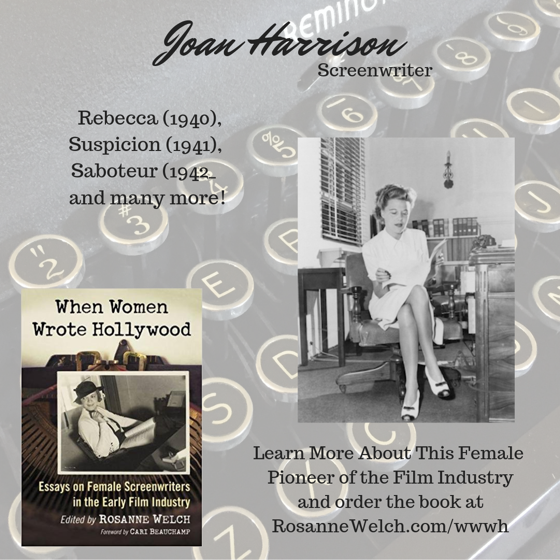
Born in Guildford, Surrey, Harrison studied at St Hugh’s College, Oxford and reviewed films for the student newspaper. She also studied at the Sorbonne. In 1933, she became Alfred Hitchcock’s secretary. Eventually she began reading books and scripts for him and became one of Hitchcock’s most trusted associates. Harrison appears in a scene in Hitchcock’s original version of The Man Who Knew Too Much (1934), eating dinner with Peter Lorre’s character. She was among the screenwriters for the film Jamaica Inn (1939) based on the novel by Daphne du Maurier.

When Hitchcock moved to Hollywood in March 1939 to begin his contract with David O. Selznick to direct films, Harrison went with him as an assistant and writer.[1] She continued contributing to the screenplays for Hitchcock’s films Rebecca (1940), also adapted from a du Maurier novel, Foreign Correspondent(1940), Suspicion (1941), and Saboteur (1942). She was also credited as one of the screenwriters for Dark Waters (1944). — Wikipedia 

More about Joan Harrison


Buy a signed copy of when Women Wrote Hollywood


Paperback Edition | Kindle Edition | Google Play Edition

* A portion of each sale from Amazon.com directly supports our blogs
** Many of these books may be available from your local library. Check it out!
† Available from the LA Public Library

Quotes from When Women Wrote Hollywood – 9 in a series – Marion Fairfax In Demand

Quotes from When Women Wrote Hollywood - 9 in a series - In Demand

Get your copy today!

“The Lost World was an adaptation of Arthur Conan Doyle’s famous dinosaur novel, and the film itself did the story justice. Fairfax both wrote the adaptation and directed the editing.

After the massive success of The Lost World, which broke records, Fairfax was more in demand than ever.”

Silent Screenwriter, Producer and Director: Marion Fairfax
Sarah Phillips


Buy a signed copy of when Women Write Hollywood

or Buy the Book on Amazon


Paperback Edition | Kindle Edition | Google Play Edition

* A portion of each sale from Amazon.com directly supports our blogs
** Many of these books may be available from your local library. Check it out!
† Available from the LA Public Library
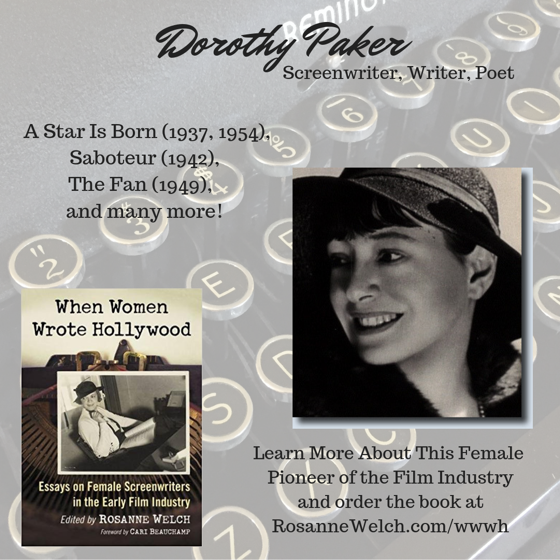
When Women Wrote Hollywood – 35 in a series – “A Star Is Born” (1937), Wr: Dorothy Parker

To highlight the wonderful yet largely forgotten work of a collection of female screenwriters from the early years of Hollywood (and as a companion to the book, When Women Wrote Hollywood) we will be posting quick bits about the many films they wrote along with links to further information and clips from their works which are still accessible online. Take a few moments once or twice a week to become familiar with their names and their stories. I think you’ll be surprised at how much bold material these writers tackled at the birth of this new medium. — Rosanne Welch

When Women Wrote Hollywood – 35 in a series – “A Star Is Born” (1937), Wr: Dorothy Parker

When Women Wrote Hollywood - 35 in a series -

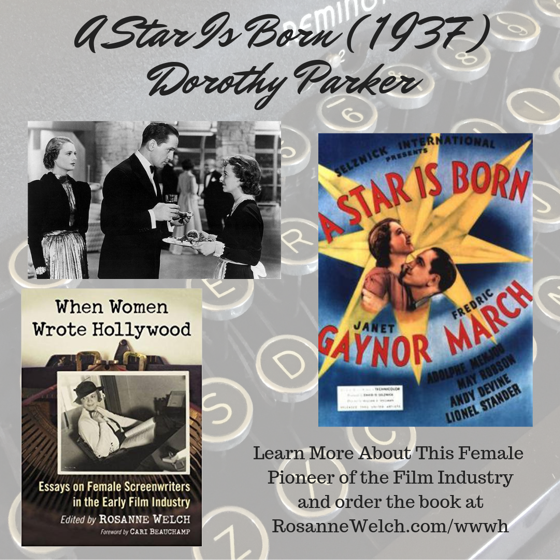
A Star Is Born is a 1937 American Technicolor romantic drama film produced by David O. Selznick, directed by William A. Wellman from a script by Wellman, Robert Carson, Dorothy Parker, and Alan Campbell, and starring Janet Gaynor (in her only Technicolor film) as an aspiring Hollywood actress, and Fredric March(in his Technicolor debut) as a fading movie star who helps launch her career. The supporting cast features Adolphe Menjou, May Robson, Andy Devine, Lionel Stander, and Owen Moore.

It was originally made in 1937 with Janet Gaynor and Fredric March, and then remade three times: 1954 (starring Judy Garland and James Mason), in 1976(starring Barbra Streisand and Kris Kristofferson), and in 2018 (starring Lady Gaga and Bradley Cooper).

North Dakota farm girl Esther Victoria Blodgett yearns to become a Hollywood actress. Although her aunt and father discourage such thoughts, Esther’s grandmother gives Esther her savings to follow her dream.

Esther goes to Hollywood and tries to land a job as an extra, but so many others have had the same idea that the casting agency has stopped accepting applications. Esther is told that her chances of becoming a star are one in 100,000. She befriends a new resident at her boarding house, assistant director Danny McGuire, himself out of work. When Danny and Esther go to a concert to celebrate Danny’s employment, Esther has her first encounter with Norman Maine, an actor she admires greatly. Norman has been a major star for years, but his alcoholism has sent his career into a downward spiral. — Wikipedia 

A Star is Born (1937) Trailer

More About “A Star Is Born” (1937)

More about Dorothy Parker

More books by and about Dorothy Parker

†††


Buy a signed copy of when Women Wrote Hollywood


Paperback Edition | Kindle Edition | Google Play Edition

* A portion of each sale from Amazon.com directly supports our blogs
** Many of these books may be available from your local library. Check it out!
† Available from the LA Public Library
When Women Wrote Hollywood – 34 in a series – Dorothy Parker

To highlight the wonderful yet largely forgotten work of a collection of female screenwriters from the early years of Hollywood (and as a companion to the book, When Women Wrote Hollywood) we will be posting quick bits about the many films they wrote along with links to further information and clips from their works which are still accessible online. Take a few moments once or twice a week to become familiar with their names and their stories. I think you’ll be surprised at how much bold material these writers tackled at the birth of this new medium. — Rosanne Welch

When Women Wrote Hollywood – 33 in a series – The Little Foxes (1941) – Wr: Lillian Hellman

When Women Wrote Hollywood - 34 in a series - Dorothy Parker

Dorothy Parker (née Rothschild; August 22, 1893 – June 7, 1967) was an American poet, writer, critic, and satirist based in New York; she was best known for her wit, wisecracks, and eye for 20th-century urban foibles.

From a conflicted and unhappy childhood, Parker rose to acclaim, both for her literary works published in such magazines as The New Yorker and as a founding member of the Algonquin Round Table. Following the breakup of the circle, Parker traveled to Hollywood to pursue screenwriting. Her successes there, including two Academy Award nominations, were curtailed when her involvement in left-wing politics resulted in the being placed on the Hollywood blacklist.

Dismissive of her own talents, she deplored her reputation as a “wisecracker.” Nevertheless, both her literary output and reputation for sharp wit have endured. — Wikipedia 

A Star is Born (1937) Trailer

More about Dorothy Parker

More books by and about Dorothy Parker

†††


Buy a signed copy of when Women Wrote Hollywood


Paperback Edition | Kindle Edition | Google Play Edition

* A portion of each sale from Amazon.com directly supports our blogs
** Many of these books may be available from your local library. Check it out!
† Available from the LA Public Library
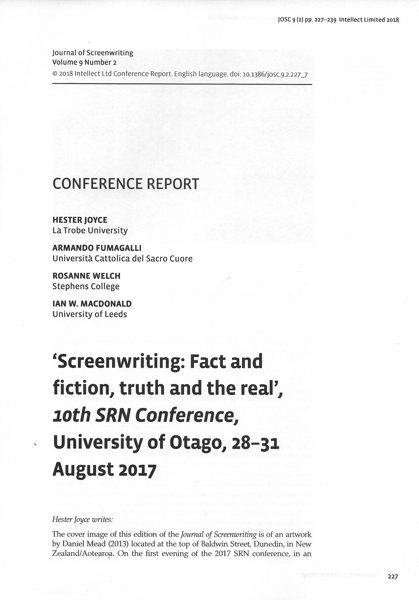
New Journal of Screenwriting Arrives With Lots of Information!

New Journal of Screenwriting Arrives With Lots of Information!

Jos new zealand

It’s always fun when a new issue of the Journal of Screenwriting arrives in my mailbox, but this one’s pleasing on several fronts.

First, in my capacity as Book Reviews Editor, I’m able to publish several of my now-graduated students, often for the first time. 

In this issue I am also the co-author of an article extolling the marvelously successful conference held at Otago University in 2017.  

Also, two of the articles come from that conference – one by  my friend Carmen Sofia Brenes (Chairperson, full professor of poetics and screenwriting at the School of Communication of Universidad de los Andes) is about the 2016 film Jackie, about the life of American icon Jackie Kennedy, written by an American, Noah Oppenheim, and directed by Chilean Pablo Lorrain.

The second article is (not so jokingly) “10 Ways to f#ck up Your Female Characters” by two New Zealand female producers, Fiona Samuel and Kathryn Burnett. I’ve already talked about that one with many an MFA student. 

Ask your local university library to carry a subscription to the Journal of Screenwriting so you can read all the issues when they come out quarterly!

Stephens College MFA in TV and Screenwriting Mini Alumni Meetup

Stephens College MFA in TV and Screenwriting Mini Alumni Meetup

Stephens College MFA in TV and Screenwriting Mini Alumni Meetup

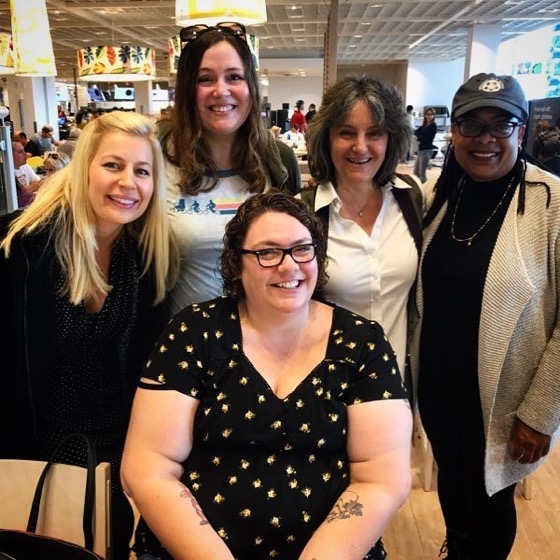
I had such a fun catch up lunch with 2017 Stephens MFA alums and Val yesterday at, of all places, IKEA because alum Amy Banks was in town to attend an all day workshop at the Disney Studios for writers with First Nation backgrounds (in their continued work to provide diversity on their channel).

Amy set it up with me and fellow mentor, Val Woods. Then alums Julie Berkobien and Lauren Smith were also free to drop by. I loved hearing about the various work they were all doing and how their MFAs both helped them get hired and, more importantly, helped them excel in their new positions! It also served as an accidental reunion of several writers of our When Women Wrote Hollywood book of essays, which we will be launching to the Columbia, Missouri community in just a few weeks, during the Citizen Jane Film Festival!

Instagram and Follow 

Quotes from When Women Wrote Hollywood – 8 in a series – Strong Willed Woman

Quotes from When Women Wrote Hollywood - 8 in a series - Strong Willed Woman

Get your copy today!

“Frederica Sagor Maas moved to Hollywood in 1924 and as was true for many young women, those who were considered good looking were pushed towards being seen on screen. Being the strong willed woman that she was, Mass decided she still wanted to be a writer.”

The Best Revenge Is Outliving Them All: The life and heartbreak of Frederica Sagor Maas
Mikayla Daniels


Buy a signed copy of when Women Write Hollywood

or Buy the Book on Amazon


Paperback Edition | Kindle Edition | Google Play Edition

* A portion of each sale from Amazon.com directly supports our blogs
** Many of these books may be available from your local library. Check it out!
† Available from the LA Public Library
When Women Wrote Hollywood – 33 in a series – The Little Foxes (1941) – Wr: Lillian Hellman

To highlight the wonderful yet largely forgotten work of a collection of female screenwriters from the early years of Hollywood (and as a companion to the book, When Women Wrote Hollywood) we will be posting quick bits about the many films they wrote along with links to further information and clips from their works which are still accessible online. Take a few moments once or twice a week to become familiar with their names and their stories. I think you’ll be surprised at how much bold material these writers tackled at the birth of this new medium. — Rosanne Welch

When Women Wrote Hollywood – 33 in a series – The Little Foxes (1941) – Wr: Lillian Hellman

When Women Wrote Hollywood - 33 in a series -  The Little Foxes (1941) - Wr: Lillian Hellman

The Little Foxes (1941) is an American drama film directed by William Wyler. The screenplay by Lillian Hellman is based on her 1939 play The Little Foxes. Hellman’s ex-husband Arthur Kober, Dorothy Parker and her husband Alan Campbell contributed additional scenes and dialogue.[2]

The title comes from Chapter 2, Verse 15 in the Song of Solomon in the King James version of the Bible, which reads, “Take us the foxes, the little foxes, that spoil the vines: for our vines have tender grapes.”[3] The same passage also inspired the title of an unrelated film, Our Vines Have Tender Grapes.

Southern aristocrat Regina Hubbard Giddens (Bette Davis) struggles for wealth and freedom within the confines of an early 20th-century society where a father considered only sons as legal heirs. As a result, her avaricious brothers, Benjamin (Charles Dingle) and Oscar (Carl Benton Reid), are independently wealthy, while she must rely for financial support upon her sickly husband Horace (Herbert Marshall), who has been away undergoing treatment for a severe heart condition. — Wikipedia 

More about The Little Foxes (1941)

More about Lillian Hellman

More books by and about Lillian Hellman

††


Buy a signed copy of when Women Wrote Hollywood


Paperback Edition | Kindle Edition | Google Play Edition

* A portion of each sale from Amazon.com directly supports our blogs
** Many of these books may be available from your local library. Check it out!
† Available from the LA Public Library

When Women Wrote Hollywood – 32 in a series – Lillian Hellman

To highlight the wonderful yet largely forgotten work of a collection of female screenwriters from the early years of Hollywood (and as a companion to the book, When Women Wrote Hollywood) we will be posting quick bits about the many films they wrote along with links to further information and clips from their works which are still accessible online. Take a few moments once or twice a week to become familiar with their names and their stories. I think you’ll be surprised at how much bold material these writers tackled at the birth of this new medium. — Rosanne Welch

When Women Wrote Hollywood – 32 in a series – Lillian Hellman

When Women Wrote Hollywood - 32 in a series - Lillian Hellman

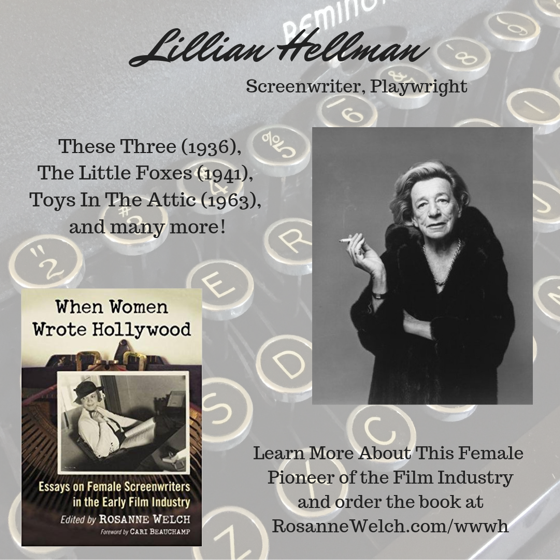
Lillian Florence Hellman (June 20, 1905 – June 30, 1984) was an American dramatist and screenwriter known for her success as a playwright on Broadway, as well as her left-wing sympathies and political activism. She was blacklisted after her appearance before the House Committee on Un-American Activities (HUAC) at the height of the anti-communist campaigns of 1947–52. Although she continued to work on Broadway in the 1950s, her blacklisting by the American film industry caused a drop in her income. Many praised Hellman for refusing to answer questions by HUAC, but others believed, despite her denial, that she had belonged to the Communist Party.

As a playwright, Hellman had many successes on Broadway, including Watch on the Rhine, The Autumn Garden, Toys in the Attic, Another Part of the Forest, The Children’s Hour and The Little Foxes. She adapted her semi-autobiographical play The Little Foxes into a screenplay, which starred Bette Davis and received an Academy Award nomination in 1942.

Hellman was romantically involved with fellow writer and political activist Dashiell Hammett, author of the classic detective novels The Maltese Falcon and The Thin Man, who also was blacklisted for 10 years until his death in 1961. The couple never married — Wikipedia 

More about Lillian Hellman

More books by and about Lillian Hellman

††


Buy a signed copy of when Women Wrote Hollywood


Paperback Edition | Kindle Edition | Google Play Edition

* A portion of each sale from Amazon.com directly supports our blogs
** Many of these books may be available from your local library. Check it out!
† Available from the LA Public Library

Event: How Star Wars Changed Films Forever with Dr. Rosanne Welch, Cal State Fullerton, October 25, 2018 at Noon

How Star Wars Changed Films and Fandom Forever with Dr. Rosanne Welch, Cal State Fullerton, October 25, 2018 at Noon

How Star Wars Changed Films Forever with Dr. Rosanne Welch, Cal State Fullerton, October 25, 2018 at Noon

Date: Thursday, October 25, 2018
Time: 12:00pm – 1:00pm
Location: Special Events Room 4829, Cal State Fullerton Pollack Library, 800 N State College Blvd, Fullerton, CA 92831
Campus: Building 15

In her talk screenwriter and professor Rosanne Welch will discuss everything Star Wars from George Lucas to Leigh Brackett to Lawrence Kasdan. From Luke Skywalker to Han Solo to Lando Calrissian (both original and prequel versions) to Poe. From Leia Organa to Rey to Jyn Erso. From Jaws to the whole Star Wars franchise to Raiders of the Lost Ark in a look at how Star Wars changed films and fandom forever.