33 Mickey and Martha from Gender Diversity in the Who-niverse [Video] (1:01)

Watch this entire presentation: Gender Diversity in the Who-niverse: Paving the Way for a Lady Doctor with Dr. Rosanne Welch [Video] (36:58)

33 Mickey and Martha from Gender Diversity in the Who-niverse [Video] (1:01)

For her 5th Doctor Who lecture to the CPP community, Dr. Rosanne Welch discusses how society – and the show’s writing staff – prepared the audience for a major change in this 50-year franchise – the creation of the first Lady Doctor!

Transcript:

…and just a side note in the world of production which I think is so interesting. When they went to film this particular episode each of these two actors had other jobs. So it turned out by accident they were only available on the same morning to film their goodbye scene. So Russell Davies invented the fact that they were married. he actually had two different stories written for them to film on different days and suddenly he only had them for 3 hours one morning. So he married them off. Though it was cute. Put it up there. Controversy from people saying “You took the only people of African descent and forced them to be married to each other like you don’t believe in interracial marriage.” I had two actors who could only work on one day. I had to be creative and I personally think that that’s an excellent ending for both of them because they shared adventures with The Doctor. How do you get together with someone who doesn’t share your background? who can’t understand your emotions and what you’ve done in your life, right? So Mickey. Mickey is a cool sensitive guy. Of course, I’ve already talked about captain Jack so I’ll just fly through him. Nothing wrong with looking at a few pictures of Captain Jack for a few minutes. Doesn’t hurt anybody to go, “Wow!”

Follow Dr. Welch on Twitter and Instagram
https://twitter.com/rosannewelch – http://instagram.com/drrosannewelch


Rosanne Welch, PhD

Rosanne Welch PhD teaches the History of Screenwriting and One-Hour Drama for the Stephens College MFA in Screenwriting.

Writing/producing credits include Beverly Hills 90210, Picket Fences, ABCNEWS: Nightline and Touched by an Angel. In 2016 she published the book Why The Monkees Matter: Teenagers, Television and American Pop; co-edited Women in American History: A Social, Political, and Cultural Encyclopedia; and placed “Transmitting Culture Transnationally Via the Characterization of Parents in Police Procedurals” in the New Review of Film and Television Studies. Essays appear in Torchwood Declassified: Investigating Mainstream Cult Television and Doctor Who and Race: An Anthology. Welch serves as Book Reviews editor for Journal of Screenwriting and on the Editorial Advisory Board for Written By magazine, the magazine of the Writers Guild.

Watch Dr. Welch’s talk “The Importance of Having a Female Voice in the Room” at the 2016 TEDxCPP.

Quotes from When Women Wrote Hollywood – 9 in a series – Marion Fairfax In Demand

Quotes from When Women Wrote Hollywood - 9 in a series - In Demand

Get your copy today!

“The Lost World was an adaptation of Arthur Conan Doyle’s famous dinosaur novel, and the film itself did the story justice. Fairfax both wrote the adaptation and directed the editing.

After the massive success of The Lost World, which broke records, Fairfax was more in demand than ever.”

Silent Screenwriter, Producer and Director: Marion Fairfax
Sarah Phillips


Buy a signed copy of when Women Write Hollywood

or Buy the Book on Amazon


Paperback Edition | Kindle Edition | Google Play Edition

* A portion of each sale from Amazon.com directly supports our blogs
** Many of these books may be available from your local library. Check it out!
† Available from the LA Public Library

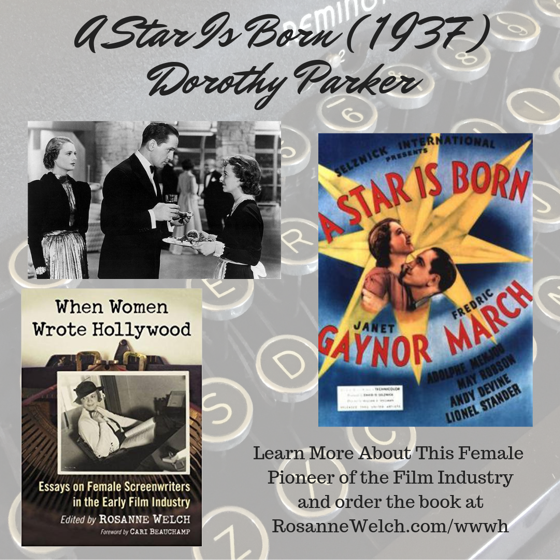
When Women Wrote Hollywood – 35 in a series – “A Star Is Born” (1937), Wr: Dorothy Parker

To highlight the wonderful yet largely forgotten work of a collection of female screenwriters from the early years of Hollywood (and as a companion to the book, When Women Wrote Hollywood) we will be posting quick bits about the many films they wrote along with links to further information and clips from their works which are still accessible online. Take a few moments once or twice a week to become familiar with their names and their stories. I think you’ll be surprised at how much bold material these writers tackled at the birth of this new medium. — Rosanne Welch

When Women Wrote Hollywood – 35 in a series – “A Star Is Born” (1937), Wr: Dorothy Parker

When Women Wrote Hollywood - 35 in a series -

A Star Is Born is a 1937 American Technicolor romantic drama film produced by David O. Selznick, directed by William A. Wellman from a script by Wellman, Robert Carson, Dorothy Parker, and Alan Campbell, and starring Janet Gaynor (in her only Technicolor film) as an aspiring Hollywood actress, and Fredric March(in his Technicolor debut) as a fading movie star who helps launch her career. The supporting cast features Adolphe Menjou, May Robson, Andy Devine, Lionel Stander, and Owen Moore.

It was originally made in 1937 with Janet Gaynor and Fredric March, and then remade three times: 1954 (starring Judy Garland and James Mason), in 1976(starring Barbra Streisand and Kris Kristofferson), and in 2018 (starring Lady Gaga and Bradley Cooper).

North Dakota farm girl Esther Victoria Blodgett yearns to become a Hollywood actress. Although her aunt and father discourage such thoughts, Esther’s grandmother gives Esther her savings to follow her dream.

Esther goes to Hollywood and tries to land a job as an extra, but so many others have had the same idea that the casting agency has stopped accepting applications. Esther is told that her chances of becoming a star are one in 100,000. She befriends a new resident at her boarding house, assistant director Danny McGuire, himself out of work. When Danny and Esther go to a concert to celebrate Danny’s employment, Esther has her first encounter with Norman Maine, an actor she admires greatly. Norman has been a major star for years, but his alcoholism has sent his career into a downward spiral. — Wikipedia 

A Star is Born (1937) Trailer

More About “A Star Is Born” (1937)

More about Dorothy Parker

More books by and about Dorothy Parker

†††


Buy a signed copy of when Women Wrote Hollywood


Paperback Edition | Kindle Edition | Google Play Edition

* A portion of each sale from Amazon.com directly supports our blogs
** Many of these books may be available from your local library. Check it out!
† Available from the LA Public Library

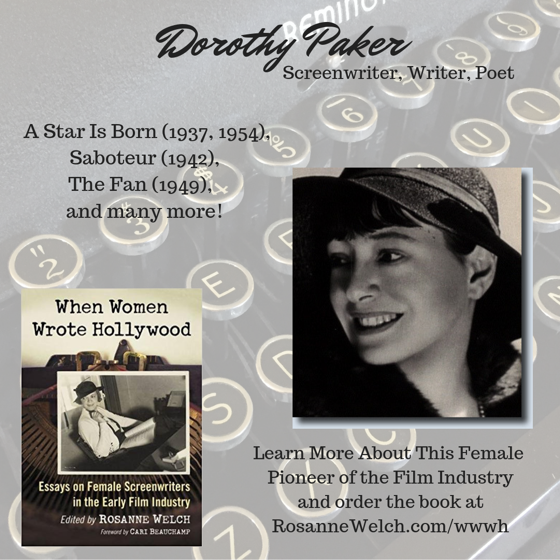
When Women Wrote Hollywood – 34 in a series – Dorothy Parker

To highlight the wonderful yet largely forgotten work of a collection of female screenwriters from the early years of Hollywood (and as a companion to the book, When Women Wrote Hollywood) we will be posting quick bits about the many films they wrote along with links to further information and clips from their works which are still accessible online. Take a few moments once or twice a week to become familiar with their names and their stories. I think you’ll be surprised at how much bold material these writers tackled at the birth of this new medium. — Rosanne Welch

When Women Wrote Hollywood – 33 in a series – The Little Foxes (1941) – Wr: Lillian Hellman

When Women Wrote Hollywood - 34 in a series - Dorothy Parker

Dorothy Parker (née Rothschild; August 22, 1893 – June 7, 1967) was an American poet, writer, critic, and satirist based in New York; she was best known for her wit, wisecracks, and eye for 20th-century urban foibles.

From a conflicted and unhappy childhood, Parker rose to acclaim, both for her literary works published in such magazines as The New Yorker and as a founding member of the Algonquin Round Table. Following the breakup of the circle, Parker traveled to Hollywood to pursue screenwriting. Her successes there, including two Academy Award nominations, were curtailed when her involvement in left-wing politics resulted in the being placed on the Hollywood blacklist.

Dismissive of her own talents, she deplored her reputation as a “wisecracker.” Nevertheless, both her literary output and reputation for sharp wit have endured. — Wikipedia 

A Star is Born (1937) Trailer

More about Dorothy Parker

More books by and about Dorothy Parker

†††


Buy a signed copy of when Women Wrote Hollywood


Paperback Edition | Kindle Edition | Google Play Edition

* A portion of each sale from Amazon.com directly supports our blogs
** Many of these books may be available from your local library. Check it out!
† Available from the LA Public Library

32 Mickey Smith from Gender Diversity in the Who-niverse [Video ] (1:07)

Watch this entire presentation: Gender Diversity in the Who-niverse: Paving the Way for a Lady Doctor with Dr. Rosanne Welch [Video] (36:58)

32 Mickey Smith from Gender Diversity in the Who-niverse [Video ] (1:07)

For her 5th Doctor Who lecture to the CPP community, Dr. Rosanne Welch discusses how society – and the show’s writing staff – prepared the audience for a major change in this 50-year franchise – the creation of the first Lady Doctor!

Transcript:

Mickey is probably one of my favorite companions. Right? Because he starts out as Rose’s boyfriend. He loses her to The Doctor — so that kind of makes him a loser because he lost his girlfriend. That’s kind of sad, right and they played with that a little bit. He wasn’t quite as good as The Doctor, but he worked at it. He discovered that he wanted to be more in the episode where Sarah Jane came back and what he really does that is so cool is when he has a chance to pick a parallel universe or a real universe, he wants to stay in the universe where his grandmother is still alive. His grandmother is the most important influence in his life. Not a grandfather. Not a dad. A woman who he wants to spend more time within his own life. SoI thought that was a super cool thing for him to choose to do. And of course, at the very end of David Tennant’s era, he visited all his past companions and did something to save their life before he regenerated and we discovered that in the interim Mickey and Martha have fallen in love and gotten married. So, he picked the most equal and powerful woman that he could be with if he couldn’t have Rose. Right? So, he grew up and moved on to an adult relationship, not a dependent younger relationship..

Follow Dr. Welch on Twitter and Instagram
https://twitter.com/rosannewelch – http://instagram.com/drrosannewelch


Rosanne Welch, PhD

Rosanne Welch PhD teaches the History of Screenwriting and One-Hour Drama for the Stephens College MFA in Screenwriting.

Writing/producing credits include Beverly Hills 90210, Picket Fences, ABCNEWS: Nightline and Touched by an Angel. In 2016 she published the book Why The Monkees Matter: Teenagers, Television and American Pop; co-edited Women in American History: A Social, Political, and Cultural Encyclopedia; and placed “Transmitting Culture Transnationally Via the Characterization of Parents in Police Procedurals” in the New Review of Film and Television Studies. Essays appear in Torchwood Declassified: Investigating Mainstream Cult Television and Doctor Who and Race: An Anthology. Welch serves as Book Reviews editor for Journal of Screenwriting and on the Editorial Advisory Board for Written By magazine, the magazine of the Writers Guild.

Watch Dr. Welch’s talk “The Importance of Having a Female Voice in the Room” at the 2016 TEDxCPP.

Stephens College MFA in TV and Screenwriting Mini Alumni Meetup

Stephens College MFA in TV and Screenwriting Mini Alumni Meetup

Stephens College MFA in TV and Screenwriting Mini Alumni Meetup

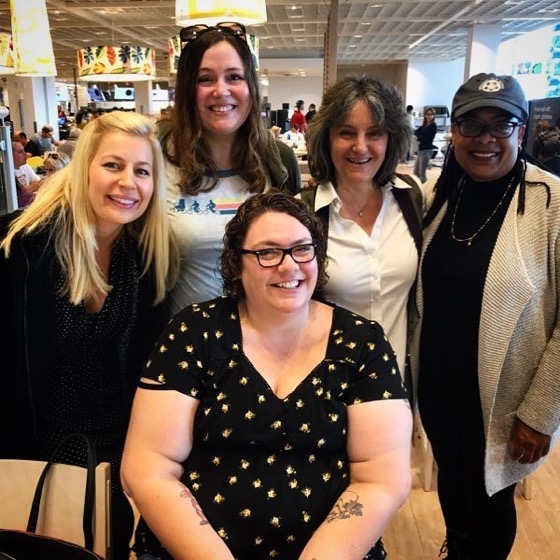
I had such a fun catch up lunch with 2017 Stephens MFA alums and Val yesterday at, of all places, IKEA because alum Amy Banks was in town to attend an all day workshop at the Disney Studios for writers with First Nation backgrounds (in their continued work to provide diversity on their channel).

Amy set it up with me and fellow mentor, Val Woods. Then alums Julie Berkobien and Lauren Smith were also free to drop by. I loved hearing about the various work they were all doing and how their MFAs both helped them get hired and, more importantly, helped them excel in their new positions! It also served as an accidental reunion of several writers of our When Women Wrote Hollywood book of essays, which we will be launching to the Columbia, Missouri community in just a few weeks, during the Citizen Jane Film Festival!

Instagram and Follow 

Quotes from When Women Wrote Hollywood – 8 in a series – Strong Willed Woman

Quotes from When Women Wrote Hollywood - 8 in a series - Strong Willed Woman

Get your copy today!

“Frederica Sagor Maas moved to Hollywood in 1924 and as was true for many young women, those who were considered good looking were pushed towards being seen on screen. Being the strong willed woman that she was, Mass decided she still wanted to be a writer.”

The Best Revenge Is Outliving Them All: The life and heartbreak of Frederica Sagor Maas
Mikayla Daniels


Buy a signed copy of when Women Write Hollywood

or Buy the Book on Amazon


Paperback Edition | Kindle Edition | Google Play Edition

* A portion of each sale from Amazon.com directly supports our blogs
** Many of these books may be available from your local library. Check it out!
† Available from the LA Public Library

When Women Wrote Hollywood – 33 in a series – The Little Foxes (1941) – Wr: Lillian Hellman

To highlight the wonderful yet largely forgotten work of a collection of female screenwriters from the early years of Hollywood (and as a companion to the book, When Women Wrote Hollywood) we will be posting quick bits about the many films they wrote along with links to further information and clips from their works which are still accessible online. Take a few moments once or twice a week to become familiar with their names and their stories. I think you’ll be surprised at how much bold material these writers tackled at the birth of this new medium. — Rosanne Welch

When Women Wrote Hollywood – 33 in a series – The Little Foxes (1941) – Wr: Lillian Hellman

When Women Wrote Hollywood - 33 in a series -  The Little Foxes (1941) - Wr: Lillian Hellman

The Little Foxes (1941) is an American drama film directed by William Wyler. The screenplay by Lillian Hellman is based on her 1939 play The Little Foxes. Hellman’s ex-husband Arthur Kober, Dorothy Parker and her husband Alan Campbell contributed additional scenes and dialogue.[2]

The title comes from Chapter 2, Verse 15 in the Song of Solomon in the King James version of the Bible, which reads, “Take us the foxes, the little foxes, that spoil the vines: for our vines have tender grapes.”[3] The same passage also inspired the title of an unrelated film, Our Vines Have Tender Grapes.

Southern aristocrat Regina Hubbard Giddens (Bette Davis) struggles for wealth and freedom within the confines of an early 20th-century society where a father considered only sons as legal heirs. As a result, her avaricious brothers, Benjamin (Charles Dingle) and Oscar (Carl Benton Reid), are independently wealthy, while she must rely for financial support upon her sickly husband Horace (Herbert Marshall), who has been away undergoing treatment for a severe heart condition. — Wikipedia 

More about The Little Foxes (1941)

More about Lillian Hellman

More books by and about Lillian Hellman

††


Buy a signed copy of when Women Wrote Hollywood


Paperback Edition | Kindle Edition | Google Play Edition

* A portion of each sale from Amazon.com directly supports our blogs
** Many of these books may be available from your local library. Check it out!
† Available from the LA Public Library

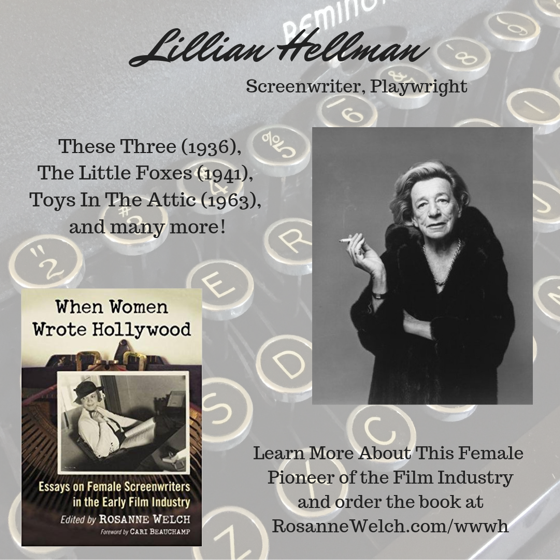
When Women Wrote Hollywood – 32 in a series – Lillian Hellman

To highlight the wonderful yet largely forgotten work of a collection of female screenwriters from the early years of Hollywood (and as a companion to the book, When Women Wrote Hollywood) we will be posting quick bits about the many films they wrote along with links to further information and clips from their works which are still accessible online. Take a few moments once or twice a week to become familiar with their names and their stories. I think you’ll be surprised at how much bold material these writers tackled at the birth of this new medium. — Rosanne Welch

When Women Wrote Hollywood – 32 in a series – Lillian Hellman

When Women Wrote Hollywood - 32 in a series - Lillian Hellman

Lillian Florence Hellman (June 20, 1905 – June 30, 1984) was an American dramatist and screenwriter known for her success as a playwright on Broadway, as well as her left-wing sympathies and political activism. She was blacklisted after her appearance before the House Committee on Un-American Activities (HUAC) at the height of the anti-communist campaigns of 1947–52. Although she continued to work on Broadway in the 1950s, her blacklisting by the American film industry caused a drop in her income. Many praised Hellman for refusing to answer questions by HUAC, but others believed, despite her denial, that she had belonged to the Communist Party.

As a playwright, Hellman had many successes on Broadway, including Watch on the Rhine, The Autumn Garden, Toys in the Attic, Another Part of the Forest, The Children’s Hour and The Little Foxes. She adapted her semi-autobiographical play The Little Foxes into a screenplay, which starred Bette Davis and received an Academy Award nomination in 1942.

Hellman was romantically involved with fellow writer and political activist Dashiell Hammett, author of the classic detective novels The Maltese Falcon and The Thin Man, who also was blacklisted for 10 years until his death in 1961. The couple never married — Wikipedia 

More about Lillian Hellman

More books by and about Lillian Hellman

††


Buy a signed copy of when Women Wrote Hollywood


Paperback Edition | Kindle Edition | Google Play Edition

* A portion of each sale from Amazon.com directly supports our blogs
** Many of these books may be available from your local library. Check it out!
† Available from the LA Public Library

31 Adric from Gender Diversity in the Who-niverse [Video] (0:38)

Watch this entire presentation: Gender Diversity in the Who-niverse: Paving the Way for a Lady Doctor with Dr. Rosanne Welch [Video] (36:58)

31 Adric from Gender Diversity in the Who-niverse [Video] (0:38)

For her 5th Doctor Who lecture to the CPP community, Dr. Rosanne Welch discusses how society – and the show’s writing staff – prepared the audience for a major change in this 50-year franchise – the creation of the first Lady Doctor!

Transcript:

We also had this young gentleman who was in both the Baker and the Davison Era who was Adric, who was a math genius and he was a young kid so he had more access to his emotions. We don’t let young boys have their emotions. We tell them not to cry. That’s stupid. Humans cry. There’s no such thing as not cryng, right, but we do that. So, it was nice to have Adric as an example back in the day. And until I was putting this together I never had read that fun fact. That’s where they got his name from — an actual Nobel-winning guy. I thought it was pretty cool. I love that — again — writers playing and giving us more information. I just learned something a guy I had never heard of, right? A little research.

Follow Dr. Welch on Twitter and Instagram
https://twitter.com/rosannewelch – http://instagram.com/drrosannewelch


Rosanne Welch, PhD

Rosanne Welch PhD teaches the History of Screenwriting and One-Hour Drama for the Stephens College MFA in Screenwriting.

Writing/producing credits include Beverly Hills 90210, Picket Fences, ABCNEWS: Nightline and Touched by an Angel. In 2016 she published the book Why The Monkees Matter: Teenagers, Television and American Pop; co-edited Women in American History: A Social, Political, and Cultural Encyclopedia; and placed “Transmitting Culture Transnationally Via the Characterization of Parents in Police Procedurals” in the New Review of Film and Television Studies. Essays appear in Torchwood Declassified: Investigating Mainstream Cult Television and Doctor Who and Race: An Anthology. Welch serves as Book Reviews editor for Journal of Screenwriting and on the Editorial Advisory Board for Written By magazine, the magazine of the Writers Guild.

Watch Dr. Welch’s talk “The Importance of Having a Female Voice in the Room” at the 2016 TEDxCPP.