
Read about more women from early Hollywood
Podcast: Play in new window | Download
Subscribe: RSS
On Screenwriting and Media with Dr. Rosanne Welch
Writing, Film, Television and More!

Unapologetically Herself: Writing Bold and Complex Young Women
During every MFA Residency Workshop I moderate a panel of writers – often proudly including one of our MFA alums – and this August we’re doing it again. Join us on Friday, August 8, 2025 from 7:00 PM 8:30 PM at the Writers Guild Foundation (7000 West 3rd Street Los Angeles, CA, 90048) for:
We’ll explore how writers develop these strong characters, how to approach sensitive scenes intentionally, and how they navigate nuances of character personalities, behaviors, and motivations.
Panelists include:
Get tickts for this WGA Panel Discussion
And if you’d like to see some of our previous WGA panels you can find them on our MFA Website

Born just 4 years after the end of the Civil War in Boonville, Missouri, the scripts Julia Crawford Ivers wrote (and sometimes directed) often tackled issues of prejudice. After the war, her family emigrated to Los Angeles. As with many female creatives in this era, Ivers used her screenplays to highlight women’s issues from forced marriage to domestic abuse to prejudice.
Read Julia Crawford Ivers: From Rich Widow to Writer-Director
Read about more women from early Hollywood
Podcast: Play in new window | Download
Subscribe: RSS

Born on Christmas Day in 1876 in Massachusetts, Dix and her family lived in various cities around the historic state until she moved to Cambridge, Massachusetts to study English and History at Radcliffe College. There she became the first female to be granted the Sohier Literary Prize, for the best thesis of a Harvard or Radcliffe student. From there it seemed a quick move into the world of writing.
Dix began with books about her favorite subject – the history that surrounded her in Massachusetts. In 1899, at the age of 23, she published Soldier Rigdale: How He Sailed in the Mayflower and How He Served Miles Standish. Her first play, A Rose of Plymouth Town ran for a month in 1902, followed by The Road to Yesterday, which ran for 8 months in 1907. Altogether Dix wrote 18 books and 5 plays before moving into the new world of film.
Read Meet Beulah Marie Dix: Award-Winning Scholar and Anti-War Novelist Turned Screenwriter
Read about more women from early Hollywood
Podcast: Play in new window | Download
Subscribe: RSS
Running Down the Rabbit Hole of Research
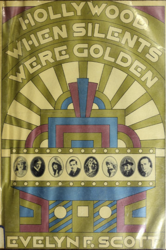 It’s always fun to fall into the rabbit hole of research. It always teaches me new things about other eras, along with reminding me that one of the ways women disappear in history. They change their names, making it harder and harder to find them. I was reminded of this as I was writing a column on novelist turned silent screenwriter Beaulah Marie Dix. In one of many short bits about her online, I found mention of daughter Evelyn Flebbe Scott on the very helpful Women Film Pioneers Project. There, I also found that Evelyn had herself become “an industry writer” and had written a Hollywood memoir, Hollywood When Silents Were Golden (Internet Archive) that can also be ordered from the Los Angeles Public Library.
An online search for Evelyn Scott led to a southern novelist – Evelyn Scott (born Elsie Dunn) – so not the Evelyn Scott I was researching. Luckily, I had my Evelyn Scott’s father’s name, so I added the Flebbe to the search, and that’s when Evelyn Flebbe Scott came up on Goodreads as the author of 2 children’s books + the aforementioned memoir. It also gave the next tidbit, giving me her father’s profession: “was the daughter of screenwriter/author Beulah Marie Dix and book importer Georg Heinrich Flebbe” along with the explanation of where ‘Scott’ came from: “She married film editor David Scott in 1935” AND, the confirmation that “Evelyn F. Scott worked for decades in Hollywood as a story editor at MGM.”
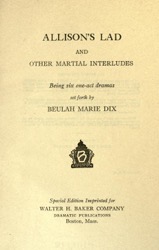 Then, in looking up a tiny smidgen of a clue on IMDB – that she had a play that “the Technicolor Corporation to be adapted as one of their Great Events short color film series” I searched the play’s title Allison’s Lad in IBDB, the Internet Broadway Database – it wasn’t listed. So I broadened to a larger search and found it listed on a new fun site: The Unknown Playwrights site “Where unknown playwrights become known”.
There I learned that “Dix had a thing for history and wars” and the one-act “is set during the bloodletting known as The English Civil War” and “appears in a volume of one-acts set entirely during wartime.” Their Link Heaven took me to the Internet Archive where a printed copy of the play had been scanned.
Now I need to read some books on the MGM scenario department to see if Evelyn worked with Kate Corbaley, the famous head of the story department at MGM in the 1930s, who you can read more about here – How Kate Corbaley, Powerful Reader at MGM in the 1930s, Paved the Way for Today’s Hollywood Literary Scouts.
That’s a tiny example of the rabbit hole of research one can hop into and like Alice in Wonderland, find oneself racing through all sorts of interesting eras and fascinating lives.

The surname DeMille (or de Mille) brings up thoughts of the famous line from Billy Wilder and Raymond Chandler’s Sunset Boulevard “Mr. de Mille, I’m ready for my close up” which references silent screen director Cecil. Perhaps people remember his brother, William, who started as a playwright and became a Hollywood director and joined 3rd wife Clara Beranger in founding the film school at the University of Southern California. And sometimes the surname conjures of memories of Tony Award-winning choreographer Agnes de Mille (daughter of William/granddaughter of Beatrice). From now on it should bring up the writer, producer and mentor who worked frequently in both Broadway and Hollywood – Beatrice DeMille. (From here on out we will call her Beatrice to avoid confusion).
Read Writer, Producer, Agent, and Mentor (And Mom to the DeMille Boys)
Read about more women from early Hollywood
Podcast: Play in new window | Download
Subscribe: RSS