I know this has been posted elsewhere, but the fact that one TV show’s characters are set to meet the characters from The Monkees over 50 years since they all were staples on TV… that just speaks to the power of pop culture – and fandom. I wanted to highlight this quote:
“Artist Joe Eisma agrees, adding, “From day one, The Monkees have been trailblazers in the entertainment business, and I’m excited and honored for the chance to draw their appearance in The Archies. It’s going to be a wild one!” (I also wanted to use cover art with The Monkees!”
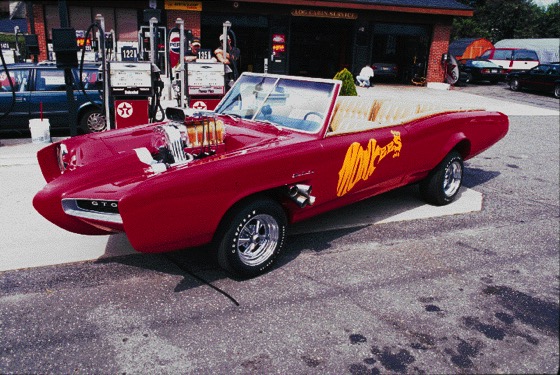
Archie Andrews has met some pretty big names during his comic book career — including Kiss, Marvel’s The Punisher, and even President Barack Obama — but his latest co-stars might beat them all. If nothing else, they get the funniest looks from everyone they meet.
The fourth issue of The Archies, the new comic book series centering around the musical ambitions of Archie and his pals and gals, will bring the band face-to-face with the Prefab Four themselves, as the Monkees guest-star for an issue. The meetings happens as the result of some good old-fashioned time travel, allowing the Riverdale gang to meet Peter, Mickey, Michael and Davy in their 1960s prime.
Alex Segura, co-writer of the series, tells Heat Vision that the two bands are “a perfect pairing, and they resonate in really similar ways — embracing pop sensibilities, crossing over from different mediums and just channeling the most fun parts of whatever they’re doing, be it TV, music, comics and beyond.”
To Segura’s co-writer, it’s also a dream come true.
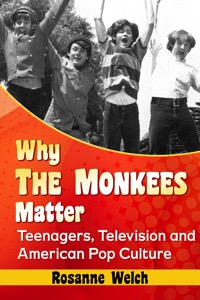
Jean Powergirl takes the host reigns and welcomes her guest Rosanne Welch, PhD to the show! They’ll be discussing Roseanne’s book, “Why The Monkees Matter: Teenagers, Television and American Pop Culture.”
Transcript:
Rosanne: He did — as far as instrumentation — when they started to play their own instruments on their 3rd album, Headquarters, he did and from that point on has been playing on stage forever and he was always though to be the most proficient. He plays 6 different instruments. He eventually taught music after the show was over. So he’s quite brilliant in that aspect. He allowed himself thought to be cast as the village idiot in the show.
Jean: You always had to have a ding-y person on there. Right?
Rosanne: I talked to the writers and as they thought of the characters for each of these 4 individuals to make them stand out, they had an option with the last character. He could either be the idiot or he could be the supremely intelligent one who we make fun of because they can’t connect socially.
Jean: They’re nerding out.
Rosanne: Like Sheldon on The Big Bang Theory and the writers admitted that at the last minute they thought we can make more quick jokes about stupid people than we can about smart people. So let’s just choose that.
A hit television show about a fictitious rock band, The Monkees (1966-1968) earned two Emmys–Outstanding Comedy Series and Outstanding Directorial Achievement in Comedy. Capitalizing on the show’s success, the actual band formed by the actors, at their peak, sold more albums than The Beatles and The Rolling Stones combined and set the stage for other musical TV characters from The Partridge Family to Hannah Montana. In the late 1980s, the Monkees began a series of reunion tours that continued into their 50th anniversary.
This book tells the story of The Monkees and how the show changed television, introducing a new generation to the fourth-wall-breaking slapstick created by Laurel and Hardy and the Marx Brothers. Its creators contributed to the innovative film and television of 1970s with projects like Bob & Carol & Ted & Alice, The Mary Tyler Moore Show, Laugh-In and Welcome Back, Kotter. Immense profits from the show, its music and its merchandising funded the producers’ move into films such as Head, Easy Rider and Five Easy Pieces.
Rosanne Welch, PhD has written for television (Touched by an Angel, Picket Fences) and print (Three Ring Circus: How Real Couples Balance Marriage, Work and Kids and The Encyclopedia of Women in Aviation and Space). In the documentary world she has written and produced Bill Clinton and the Boys Nation Class of 1963 for ABC NEWS/Nightline and consulted on PBS’s A Prince Among Slaves, the story of a prince from West Africa who was enslaved in the 1780s, freed by order of President John Quincy Adams in the 1820s and returned to his homeland.
“How Gidget Got Into the Girl Ghetto by Accident (and How We Can Get Her Out of it): Demoting Gidget: The Little Girl with Big Ideas from Edgy Coming of Age Novel to Babe on the Beach Genre Film via Choices made in the Adaptation Process.”
It’ a long title, as I joke up front, but covers the process of adapting the true life story of Kathy Kohner (nicknamed ‘Gidget’ by the group of male surfers who she spent the summers with in Malibu in the 1950s) into the film and television series that are better remembered than the novel. The novel had been well-received upon publication, even compared to A Catcher in the Rye, but has mistakenly been relegated to the ‘girl ghetto’ of films. Some of the adaptations turned the focus away from the coming of age story of a young woman who gained respect for her talent at a male craft – surfing – and instead turned the focus far too much on Kathy being boy crazy.
Along the way I found interesting comparisons between how female writers treated the main character while adapting the novel and how male writers treated the character.
Dr. Rosanne Welch teaches the History of Screenwriting and One-Hour Drama for the Stephens College MFA in Screenwriting.
Writing/producing credits include Beverly Hills 90210, Picket Fences, ABCNEWS: Nightline and Touched by an Angel. In 2016 she published the book Why The Monkees Matter: Teenagers, Television and American Pop; co-edited Women in American History: A Social, Political, and Cultural Encyclopedia; and placed “Transmitting Culture Transnationally Via the Characterization of Parents in Police Procedurals” in the New Review of Film and Television Studies. Essays appear in Torchwood Declassified: Investigating Mainstream Cult Television and Doctor Who and Race: An Anthology. Welch serves as Book Reviews editor for Journal of Screenwriting and on the Editorial Advisory Board for Written By magazine, the magazine of the Writers Guild.
The Screenwriting Research Network is a research group consisting of scholars, reflective practitioners and practice-based researchers interested in research on screenwriting. The aim is to rethink the screenplay in relation to its histories, theories, values and creative practices.
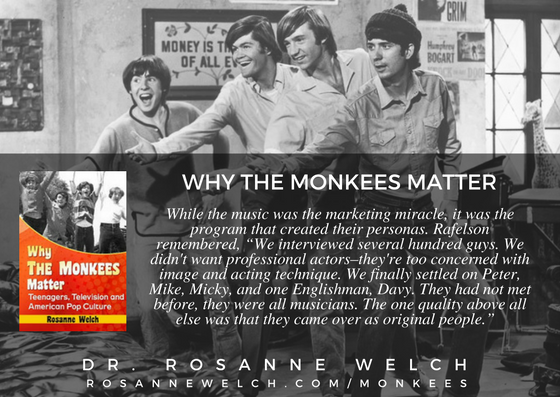
While the music was the marketing miracle, it was the program that created their personas. Rafelson remembered, “We interviewed several hundred guys. We didn’t want professional actors–they’re too concerned with image and acting technique. We finally settled on Peter, Mike, Micky, and one Englishman, Davy. They had not met before, they were all musicians. The one quality above all else was that they came over as original people.”
Jean Powergirl takes the host reigns and welcomes her guest Rosanne Welch, PhD to the show! They’ll be discussing Roseanne’s book, “Why The Monkees Matter: Teenagers, Television and American Pop Culture.”
Transcript:
Jean: All right, we have one more Monkee to discuss. Who is this gentleman here — the guy right there.
Rosanne: This is Peter Tork and he has quite a following. He is, I would say, as cute as Davy and had Davy not shown up he himself might have been a teen idol.
Jean: He might have been singing the love ballads, right?
Rosanne: Seriously and he said in his later career that he wasn’t pushy enough. When they offered up songs he kind of stood in the background and didn’t jump on them.
Jean: I noticed in this town, in this industry, you’ve got to, you cannot be bashful, right? or you will lose.
Rosanne: No, That is very true and yet he was considered, he was quite polite and he was quite the true hippie of the day. He really believed in the message of peace. He also believed in the message of Buddhism, actually, so he wasn’t a pushy guy. Now as they have toured in later years he tends to sing all of the songs Davy sang in concert and he is quite proficient at them. So it’s kind of sad that he didn’t get into the mix more deeply himself.
A hit television show about a fictitious rock band, The Monkees (1966-1968) earned two Emmys–Outstanding Comedy Series and Outstanding Directorial Achievement in Comedy. Capitalizing on the show’s success, the actual band formed by the actors, at their peak, sold more albums than The Beatles and The Rolling Stones combined and set the stage for other musical TV characters from The Partridge Family to Hannah Montana. In the late 1980s, the Monkees began a series of reunion tours that continued into their 50th anniversary.
This book tells the story of The Monkees and how the show changed television, introducing a new generation to the fourth-wall-breaking slapstick created by Laurel and Hardy and the Marx Brothers. Its creators contributed to the innovative film and television of 1970s with projects like Bob & Carol & Ted & Alice, The Mary Tyler Moore Show, Laugh-In and Welcome Back, Kotter. Immense profits from the show, its music and its merchandising funded the producers’ move into films such as Head, Easy Rider and Five Easy Pieces.
Rosanne Welch, PhD has written for television (Touched by an Angel, Picket Fences) and print (Three Ring Circus: How Real Couples Balance Marriage, Work and Kids and The Encyclopedia of Women in Aviation and Space). In the documentary world she has written and produced Bill Clinton and the Boys Nation Class of 1963 for ABC NEWS/Nightline and consulted on PBS’s A Prince Among Slaves, the story of a prince from West Africa who was enslaved in the 1780s, freed by order of President John Quincy Adams in the 1820s and returned to his homeland.
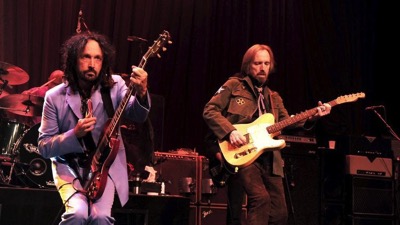
In honor of the loss of Tom Petty, I was reminded of his love for Monkees music in this quote I used in Why The Monkees Matter. He will be missed by many. — Rosanne
The Monkees were on TV. They appealed to the broadest audience possible. The Monkees were sanitized. My mom and dad would watch the Monkees with me, and other than their stupid haircuts, Mom and Dad weren’t bothered much by the Pre-fab Four.
Mom and Dad bought me Monkees records. I read Monkees interviews and through them, learned about a guy named Jimi Hendrix who was their opening act in cities I couldn’t get to. I saw Frank Zappa of the Mothers of Invention on the Monkees TV show and in their movie, “Head,” and soon I’d moved from the innocuous to full blown dangerous rock ‘n’ roll. Things that are for everyone sometimes suck us into things that aren’t for everyone.
Jean Powergirl takes the host reigns and welcomes her guest Rosanne Welch, PhD to the show! They’ll be discussing Roseanne’s book, “Why The Monkees Matter: Teenagers, Television and American Pop Culture.”
Transcript:
Rosanne: Sadly, he passed away of a heart attack in about 4 years ago and the band had been talking about having a 50th Anniversary Tour. So after he died, the three of them did get together and do a short tour and it went well, so they did actually a longer tour the next year and actually they did a big 50th Anniversary Tour last year that was only Micky Dolenz and Peter Tork.
Jean:…but they won’t replace Davy right?
Rosanne: No, they chose never to replace him because he was unreplacable. When he died it was announced on television that the episode — he did a guest spot on The Brady Bunch, which was a big sitcom — a couple of years after the movie and that turns out to be — according to ABC News — the most rerun episode of television ever of any show in the years of reruns. He was that popular.
Jean: I remember that like when Davy Jones shows up on The Brady Bunch.
Rosannne: Marsha wanted him to sing at her prom because she was the president of the Davy Jones Fan Club and he shows up.
A hit television show about a fictitious rock band, The Monkees (1966-1968) earned two Emmys–Outstanding Comedy Series and Outstanding Directorial Achievement in Comedy. Capitalizing on the show’s success, the actual band formed by the actors, at their peak, sold more albums than The Beatles and The Rolling Stones combined and set the stage for other musical TV characters from The Partridge Family to Hannah Montana. In the late 1980s, the Monkees began a series of reunion tours that continued into their 50th anniversary.
This book tells the story of The Monkees and how the show changed television, introducing a new generation to the fourth-wall-breaking slapstick created by Laurel and Hardy and the Marx Brothers. Its creators contributed to the innovative film and television of 1970s with projects like Bob & Carol & Ted & Alice, The Mary Tyler Moore Show, Laugh-In and Welcome Back, Kotter. Immense profits from the show, its music and its merchandising funded the producers’ move into films such as Head, Easy Rider and Five Easy Pieces.
Rosanne Welch, PhD has written for television (Touched by an Angel, Picket Fences) and print (Three Ring Circus: How Real Couples Balance Marriage, Work and Kids and The Encyclopedia of Women in Aviation and Space). In the documentary world she has written and produced Bill Clinton and the Boys Nation Class of 1963 for ABC NEWS/Nightline and consulted on PBS’s A Prince Among Slaves, the story of a prince from West Africa who was enslaved in the 1780s, freed by order of President John Quincy Adams in the 1820s and returned to his homeland.


![22: More on Peter Tork and The Monkees : “Why The Monkees Matter” Interview with Jean Power [Video] (0:54)](https://rosannewelch.com/wp-content/uploads/2017/10/rmw-power-22-peter-tork-2.jpeg)
![How Gidget Got Into the Girl Ghetto – Dr. Rosanne Welch – SRN Conference 2017 [Video] (23 mins)](https://rosannewelch.com/wp-content/uploads/2017/10/gidget-srn.png)

![21: Peter Tork and The Monkees : “Why The Monkees Matter” Interview with Jean Power [Video] (0:55)](https://rosannewelch.com/wp-content/uploads/2017/10/rmw-power-21-peter-tork.jpeg)

![20: Even More on Davy Jones and The Monkees : “Why The Monkees Matter” Interview with Jean Power [Video] (0:57)](https://rosannewelch.com/wp-content/uploads/2017/09/rmw-power-20-davy-jones-3-1.jpeg)