From The “When Women Wrote Hollywood Archives: Cecil B. DeMille’s Hollywood by Robert S. Birchard

Months of research went into the creation of the essays in “When Women Wrote Hollywood.” Here are some of the resources used to enlighten today’s film lovers to the female pioneers who helped create it.


Cecil B. DeMille was the most successful filmmaker in early Hollywood history. Cecil B. DeMille’s Hollywood is a detailed and definitive chronicle of the screen work that changed the course of film history and a fascinating look at how movies were actually made in Hollywood’s Golden Age. Drawing extensively on DeMille’s personal archives and other primary sources, Robert S. Birchard offers a revealing portrait of DeMille the filmmaker that goes behind studio gates and beyond DeMille’s legendary persona. In his forty-five-year career DeMille’s box-office record was unsurpassed, and his swaggering style established the public image for movie directors. DeMille had a profound impact on the way movies tell stories and brought greater attention to the elements of decor, lighting, and cinematography. Best remembered today for screen spectacles such as The Ten Commandments and Samson and Delilah , DeMille also created Westerns, realistic “chamber dramas,” and a series of daring and highly influential social comedies. He set the standard for Hollywood filmmakers and demanded absolute devotion to his creative vision from his writers, artists, actors, and technicians.


Buy “When Women Wrote Hollywood” Today!

Paperback Edition | Kindle Edition | Google Play Edition

* A portion of each sale from Amazon.com directly supports our blogs
** Many of these books may be available from your local library. Check it out!
† Available from the LA Public Library

26 Margaret Atwood from The Sisterhood of Science Fiction – Dr. Rosanne Welch [Video] (48 seconds)

Watch this entire presentation

The Sisterhood of Science Fiction: A Walk Through Some Writers and Characters You (Should) Know And Love

26 Margaret Atwood from The Sisterhood of Science Fiction - Dr. Rosanne Welch [Video] (48 seconds)

Subscribe to Rosanne’s Channel and receive notice of each new video!


This one allowed me to riff on some of my favorite female science fiction writers across time, whether they be novelists or television writers. It also opened up a good conversation on what art we support and include in our lives – and what that art says to us and about us. — Rosanne

Transcript:

Margaret Atwood more people know today than might have a little while ago. She had a book that was read a lot in high school sometimes. Sometimes not. Of course now as an Emmy-winning show on Hulu — The Handmaid’s Tale, which again looking at now issues of misogyny and how society treats women into the future and what could change in the world right? A few laws here. A few laws there change and suddenly people lose rights they used to have. We kind of have to remember in the United States we live by the laws of the Constitution but they can be revoted, right? So women only have the right to vote because we have an amendment. We took prohibition and we undid it and we repealed it. We can repeal any of those amendments. So it is important to think about right who’s in charge because things could change and that’s what she’s discussing there. She wrote that book 35 years ago — 35-40 years ago.


* A portion of each sale from Amazon.com directly supports our blogs
** Many of these books may be available from your local library. Check it out! 

#MentorMonday 6 – Jennifer Maisel – Stephens College MFA in TV and Screenwriting

Jennifer Maisel (IMDB) is our featured mentor at the Stephens College MFA in TV and Screenwriting for #mentormonday this week!

#MentorMonday 6 - Jennifer Maisel - Stephens College MFA in TV and ScreenwritingJennifer Maisel most recently developed an original pilot called “The 626” with Super Deluxe and adapted two Jane Green novels—Tempting Fate and To Have and to Hold, which aired in June. She currently is working on a two-hour about campus rape and institutional betrayal with Just Singer Entertainment. Her screenplay “Lost Boy” was filmed starring Virginia Madsen. She wrote The Assault and The March Sisters for Mar Vista Entertainment and Double Wedding for Jaffe Braunstein. She has written movies for NBC, ABC, MTV and Lifetime, was a staff writer on the television series Related, wrote a pilot for ABC Family and an animated feature for Disney. Maisel has developed original pilots with Bunim-Murray, Ineffable, Stun Media and MomentumTV and co-created the critically acclaimed web series Faux Baby with Laura Brennan and Rachel Leventhal. The screenplay adaptation of her play The Last Seder won Showtime’s Tony Cox Screenwriting Award, meriting her a month’s stay in a haunted farmhouse at the Nantucket Screenwriter’s Colony. A graduate of Cornell University and NYU’s Dramatic Writing program, Maisel is also an award-winning playwright whose Eight Nights will premiere at Antaeus Theatre in October 2019; the play is currently part of a nationwide event called 8 Nights of Eight Nights, raising funds and awareness for HIAS.


Follow and Like the Stephens College MFA in TV and Screenwriting

From The Journal Of Screenwriting V10 Issue 1: Screenwriting for new film mediums: Conceptualizing visual models for interactive storytelling

Highlighting the articles in the past editions of the Journal of Screenwriting, of which I am the Book Reviews Editor. Hopefully these abstracts will entice you to did a little deeper into the history and future of screenwriting. — Rosanne


Screenwriting for new film mediums: Conceptualizing visual models for interactive storytelling
Gwendolyn Ogle

Journal of Screenwriting, Volume 10, Issue 1

This article considers challenges specific to screenwriting for interactive storytelling in new film mediums, and proposes fifteen visual, conceptual models for interactive storytelling. The models are placed on a continuum with increasing degrees of interactivity. Three arguments are posed for the necessity of visual, conceptual models and a review of literature is presented that lends credence to these arguments. Though technology’s ability to provide interaction is an important factor, technology is not the focus of this article. Instead, the focus is on the need for authors to have a voice and a process in this new, interdisciplinary domain of interactive storytelling in new film mediums. The models proposed in this article help establish a common vernacular from which authors, programmers and others can communicate and direct interactive storytelling efforts towards the design of interactive storytelling systems.
Journal of Screenwriting Cover

The Journal of Screenwriting is an international double-blind peer-reviewed journal that is published three times a year. The journal highlights current academic and professional thinking about the screenplay and intends to promote, stimulate and bring together current research and contemporary debates around the screenplay whilst encouraging groundbreaking research in an international arena. The journal is discursive, critical, rigorous and engages with issues in a dynamic and developing field, linking academic theory to screenwriting practice. 

Get your copy and subscription to the Journal of Screenwriting Today!


* A portion of each sale from Amazon.com directly supports our blogs
** Many of these books may be available from your local library. Check it out!
Jule Selbo, Stephens College MFA in TV and Screenwriting Program guest lecturer, garners great play reviews

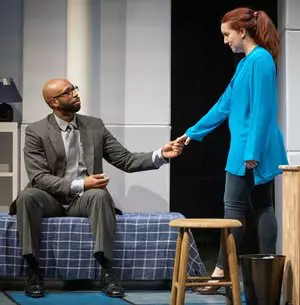
Congratulations to Friend of the Stephens College MFA in TV and Screenwriting Program and frequent guest lecturer Jule Selbo (author of Film Genre for the Screenwriter – the topic on which she’ll lecture this January) for the great reviews her play BOXES has been garnering in its East Coast premiere.

Stephens College MFA in TV and Screenwriting Program guest lecturer, Jule Selbo, garners great play reviews

The Good Theater’s production of Jule Selbo’s BOXES offers a taut psychological study of manipulation and longing, misconceptions about self and love, all carefully crafted into a thriller with rapid twists and turns that compels the audience’s attention for its brisk ninety-minutes. The boxes of the title are literal props used in a clinical psychological research study, but they are really metaphors for the constraints that shape our views of selfhood and for the inscrutable containers of dark secrets.

Read BWW Review: Containers of the Mind- East Coast Premiere of BOXES

Like Stephens College MFA in TV and Screenwriting on Facebook

* A portion of each sale from Amazon.com directly supports our blogs
** Many of these books may be available from your local library. Check it out!
† Available from the LA Public Library

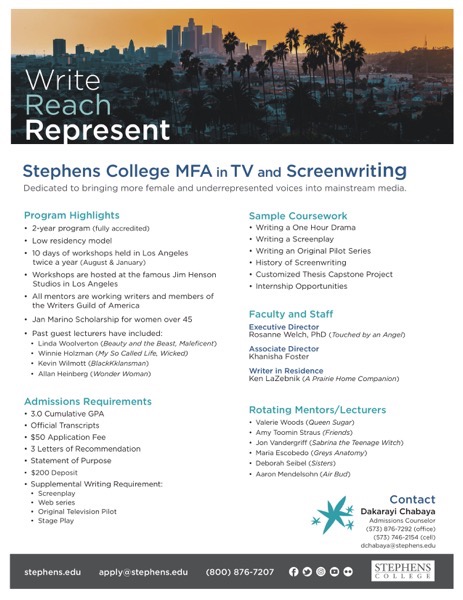
New Stephens College MFA in TV and Screenwriting One Sheet – Please Post and Share!

Here is our latest one sheet for the Stephens College MFA in TV and Screenwriting Program.

Applications are now open, so please share this flyer with our interested friends, family and students!

New Stephens College MFA in TV and Screenwriting One Sheet - Please Pos and Share!

Download a PDF Version – New Stephens College MFA in TV and Screenwriting One Sheet

Like Stephens College MFA in TV and Screenwriting on Facebook

DTLA Film Festival panel discussion, Privileged Characters: How to recognize and avoid implicit bias in your screenwriting via Instagram

Follow Rosanne on Instagram!

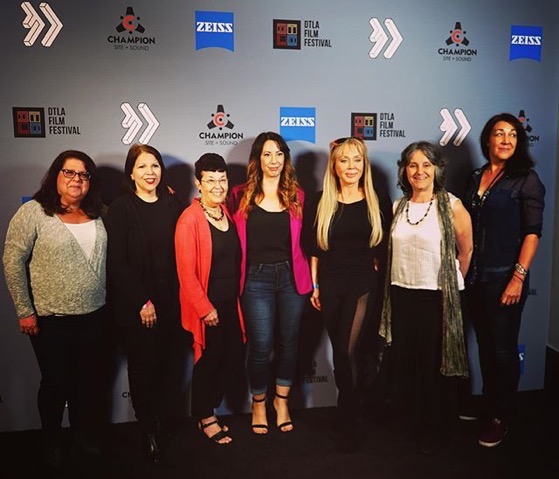
DTLA Film Festival panel discussion, Privileged Characters: How to recognize and avoid implicit bias in your screenwriting.

DTLA Film Festival panel discussion, Privileged Characters: How to recognize and avoid implicit bias in your screenwriting via Instagram

The importance of having material on the internet that helps tell people what you do and how well you do it came to my attention again last month.

I received an email invitation to moderate a panel at the Downtown LA Film Festival (DTLA) (https://www.dtlaff.com/) on the subject of “Implicit Bias” and how screenwriters can keep their scripts clear of their own and society’s implicit bias. Happily, I was able to invite one of our favorite Stephens mentors – Maria Escobeda – to be a panelist so we gave them a double-dose of Stephens College MFA in TV and Screenwriting magic.


Dawn Comer Jefferson, Mentor with Stephens College MFA in TV and Screenwriting at Reel Sisters of the Diaspora Film Festival

Dawn Comer Jefferson, Mentor with Stephens College MFA in TV and Screenwriting at Reel Sisters of the Diaspora Film Festival

Enjoy this short clip of Stephens College MFA in TV and Screenwriting mentor Dawn Comer Jefferson (right) moderating a conversation with Monroe Steele (left) and J’na Jefferson (middle) about skin bleaching after the screening of “Skin” (produced by Beverly Naya) at the Reel Sisters of the Diaspora Film Festival.

Reel Sisters & Stephens College MFA in TV & Screenwriting Present Skin Screening – Oct. 20, 2019 from African Voices/Reel Sisters on Vimeo.

On Oct. 20, 2019, 4 pm, Reel Sisters and Stephens College MFA in TV and Screenwriting hosted the closing night film Skin produced by Beverly Naya and directed by Daniel Etim Effiong. A documentary set in Lagos, Nollywood actress Beverly defines Black beauty and explores the practice of skin bleaching in African culture. Emmy-nominated, award-winning writer Dawn Comer Jefferson moderated the discussion with acclaimed culture, fashion and beauty journalists Channing Hargrove, J’na Jefferson and Monroe Steele.

This screening ass free and sponsored by Stephens College MFA in TV and Screenwriting.


Reel sisters 1

Reel sisters 2

Like Stephens College MFA in TV and Screenwriting on Facebook


25 Marge Piercy from The Sisterhood of Science Fiction – Dr. Rosanne Welch [Video] (46 seconds)

Watch this entire presentation

The Sisterhood of Science Fiction: A Walk Through Some Writers and Characters You (Should) Know And Love

25 Marge Piercy from The Sisterhood of Science Fiction - Dr. Rosanne Welch


Subscribe to Rosanne’s Channel and receive notice of each new video!


This one allowed me to riff on some of my favorite female science fiction writers across time, whether they be novelists or television writers. It also opened up a good conversation on what art we support and include in our lives – and what that art says to us and about us. — Rosanne

Transcript:

I really like Marge Piercy. In one of our classes we sometimes teach her book He, She, and It” which is the story of a Jewish female scientist in the future working with AI right and dealing with the concept of when will they become human and when won’t they and this stuff is getting more and more realistic on a real world. There was a country can’t remember which it was a couple years ago that offered citizenship to an AI robot. So yeah it’s a little crazy. So we’re getting into this place where science fiction used to play and now we’re talking about it in a real world. So March Percy did that like 30 years ago and I just love a lady with a cat. Come on now. She looks like an author. Ladies that have cats they must write books, I don’t know, but Marge Piercy is very very interesting in she’s sort of world understanding and world building and the rest is like “oh my gosh what do now?” That right that’s pretty good — like that book.


* A portion of each sale from Amazon.com directly supports our blogs
** Many of these books may be available from your local library. Check it out! 
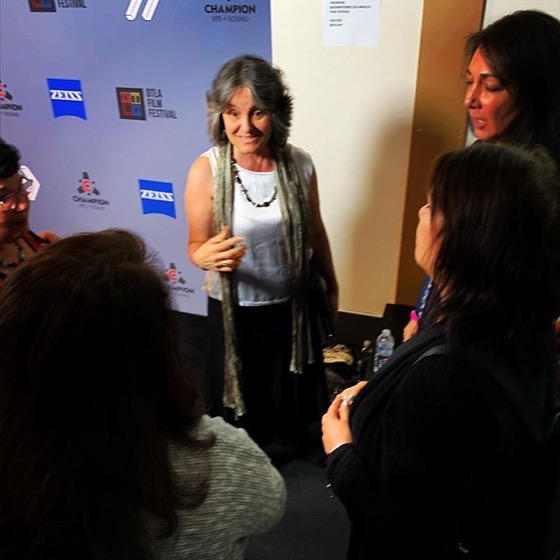
DTLA Film Festival panel discussion, Privileged Characters: How to recognize and avoid implicit bias in your screenwriting via Instagram

Follow Rosanne on Instagram!

DTLA Film Festival panel discussion, Privileged Characters: How to recognize and avoid implicit bias in your screenwriting.

DTLA Film Festival panel discussion, Privileged Characters: How to recognize and avoid implicit bias in your screenwriting via Instagram

Video of this panel coming soon