At twenty-three, Martha Jefferson had a height that did not match her husband but came close enough to keep her from feeling too diminutive when standing beside him. Her auburn hair complimented his sandy red mane and his hazel-blue eyes. Filippo couldn’t help but feel they made a lovely couple, though Martha carried with her a bit of the melancholy Filippo had noticed in other women.
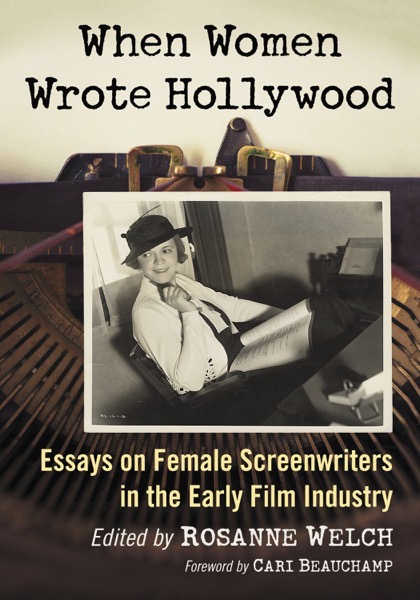
These 23 essays cover a range of female screenwriters from the early years of film through the 1940s, women whose work helped create the unforgettable stories and characters beloved generations of audiences but whose names have been left out of most film histories. Not this one. This collection is dedicated to those women and written by a group of women grateful to stand on the shoulders of those who came before – as a beacon to those who will come after.
Many thanks to the essay contributors who joined us and spoke so eloquently about the women writers they had researched: Toni Anita Hull, Laura Kirk, Amelia Phillips, Sarah Phillips, Julie Berkobien, Khanisha Foster, Lauren Smith, and to Cari Beauchamp, who wrote the Forward to the collection.
* A portion of each sale from Amazon.com directly supports our blogs ** Many of these books may be available from your local library. Check it out! † Available from the LA Public Library
I found she was in Rome during the Risorgimento of 1849 and called on America to send a smart ambassador to Rome, writing:
“Another century and I might ask to be made Ambassador myself, but woman’s day has not yet come.”
She was about right. In 1953 Clare Booth Luce (playwright known for ‘The Women’, elected to the House of Representatives in 1942, ) became the first female ambassador to Rome. Margaret was only off by 5 years.
†
†
* A portion of each sale from Amazon.com directly supports our blogs ** Many of these books may be available from your local library. Check it out! † Available from the LA Public Library
These 23 essays cover a range of female screenwriters from the early years of film through the 1940s, women whose work helped create the unforgettable stories and characters beloved generations of audiences but whose names have been left out of most film histories. Not this one. This collection is dedicated to those women and written by a group of women grateful to stand on the shoulders of those who came before – as a beacon to those who will come after.
Many thanks to the essay contributors who joined us and spoke so eloquently about the women writers they had researched: Toni Anita Hull, Laura Kirk, Amelia Phillips, Sarah Phillips, Julie Berkobien, Khanisha Foster, Lauren Smith, and to Cari Beauchamp, who wrote the Forward to the collection.
* A portion of each sale from Amazon.com directly supports our blogs ** Many of these books may be available from your local library. Check it out! † Available from the LA Public Library
“The resounding mythology around the start of Macpherson’s film career is that she, with immeasurable pluck, simply walked into D.W. Griffith’s office and waited for him for days on end. Finally, the assistant asked about her. “I told him my stage experience. He ignored it, scorned it. ‘We want to know what you can do before a camera,’ he said.”
Jeanie Macpherson: A Life Unknown by Amelia Phillips
* A portion of each sale from Amazon.com directly supports our blogs ** Many of these books may be available from your local library. Check it out! † Available from the LA Public Library
The representation of women in film is often troublesome at best. Hollywood films are often extremely gendered and lack adequate female representation. Male characters greatly outnumber female characters in many films, and female characters in movies are frequently underdeveloped and greatly lack any real depth.
When women are present in film, they are often presented only in relation to men. So even when there are multiple female characters in a film, they mostly only discuss their boyfriend, husband, father or brother. Because of this, cartoonist Alison Bechdel wrote a set of rules in her comic strip “Dykes to Watch Out For” that could help determine whether a film presents fully formed female characters.
* A portion of each sale from Amazon.com directly supports our blogs ** Many of these books may be available from your local library. Check it out! † Available from the LA Public Library
These 23 essays cover a range of female screenwriters from the early years of film through the 1940s, women whose work helped create the unforgettable stories and characters beloved generations of audiences but whose names have been left out of most film histories. Not this one. This collection is dedicated to those women and written by a group of women grateful to stand on the shoulders of those who came before – as a beacon to those who will come after.
Many thanks to the essay contributors who joined us and spoke so eloquently about the women writers they had researched: Toni Anita Hull, Laura Kirk, Amelia Phillips, Sarah Phillips, Julie Berkobien, Khanisha Foster, Lauren Smith, and to Cari Beauchamp, who wrote the Forward to the collection.
* A portion of each sale from Amazon.com directly supports our blogs ** Many of these books may be available from your local library. Check it out! † Available from the LA Public Library







 †