This whole conference is about inclusion and convergence which made this topic seem useful to me and hopefully to you. I’ve always gone back from my childhood to learning about Abagail Adams — the woman who told John while you’re working on that Constitution, could you please “remember the ladies.” We tend to forget them in this town and int he history of this town. The other book that I’ve got there is “What Happens Next” which everyone uses in their classes and has a paragraph about the women that that entire book covers. He finds time to cover them in a paragraph and that makes my students crazy. They read 5 different books on the history of screenwriting and chronologically and they come to Frances last and they are like why, why have I not heard of her until now and that book was written in the middle so you know some men write books before that book came out. They didn’t know the women existed. Then they knew and they still didn’t’ write about them and it’s important that we are in these books. So. I thought that was my background.
The Wind is a 1928 American silent romantic drama film directed by Victor Sjöström. The movie was adapted by Frances Marion from the novel of the same name written by Dorothy Scarborough. It features Lillian Gish, Lars Hanson and Montagu Love. It was one of the last silent films released by Metro-Goldwyn-Mayer, and is considered one of the greatest silent films.[1][2]
Gish came up with the idea of making a film adaptation of the novel of the same name. Irving Thalberg immediately gave her permission to do so. Gish recalled wanting Lars Hanson as her leading man after seeing him in a Swedish film with Greta Garbo. She also assigned Victor Sjöström as the director herself. Sjöström directed Gish before in the 1926 film The Scarlet Letter.[3]
The film was shot partially near Bakersfield and the Mojave Desert, California.[4]
In the original novel, the heroine is driven mad when the wind uncovers the corpse of the man she has killed. She then wanders off into a windstorm to die. According to Gish and popular legend, the original ending intended for the film was the unhappy ending, but it was changed due to the studio’s powerful Eastern office decreeing that a more upbeat ending be shot.[5] It is rumored that this tampering caused Seastrom to move back to Sweden. Mayer’s biographer rejects this on account that the “sad ending” is not known to exist in any form, written or filmed. Regardless of whether an unhappy ending was originally intended, in the resulting film the “happy” ending replaced the original ending against the wishes of both Lillian Gish and Victor Seastrom.[6] — Wikipedia
* A portion of each sale from Amazon.com directly supports our blogs *
* Many of these books may be available from your local library. Check it out!
I teach several classes for the Stephens College Low-Residency MFA in Screenwriting, including History of Screenwriting. In fact, I created the curriculum for that course from scratch and customized it to this particular MFA in that it covers ‘Screenwriting’ (not directors) and even more specifically, the class has a female-centric focus. As part History of Screenwriting I, the first course in the four-class series, we focus on the early women screenwriters of the silent film era who male historians have, for the most part, quietly forgotten in their books. In this series, I share with you some of the screenwriters and films that should be part of any screenwriters education. I believe that in order to become a great screenwriter, you need to understand the deep history of screenwriting and the amazing people who created the career. — Dr. Rosanne Welch
My husband, Douglas E. Welch, will be covering the event for me and the Festival, so watch my Twitter, Instagram and Facebook feeds for up-to-date information, photos and more.
Here are some of our big events:
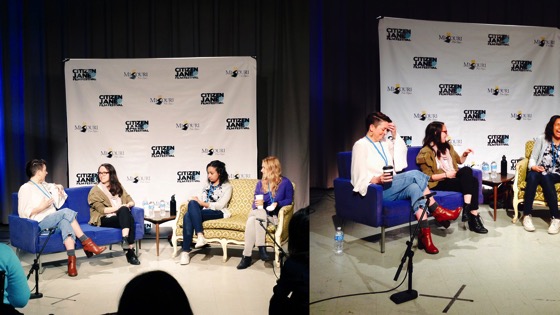
Citizen Jane Film School An afternoon of educational- and fun!- film industry discussions!
Studio A @ Stephens College, 1405 E Broadway
11:00 AM
Screen Grab: From Screenplay To Big Screen, Who Will Win? Judges: Sarah Haas, Ken LaZebnik, Steph Scupham, Kimberly Skyrme
Screenwriters vie for an exclusive production deal pitching their films to a panel of esteemed judges. The top five entries will be discussed and critiqued live before the audience. The winner will be announced before panel’s end. Producer, Sarah Haas, awaits to bring the project to life-a screenwriter’s dream come true!
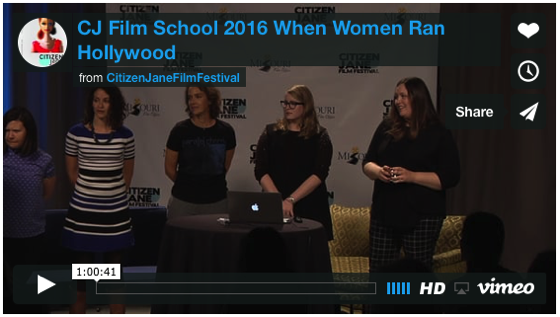
Moderator: Dr. Rosanne Welch Panelist: Amy Banks, Krista Dyson, Cara Epstein, Betsy Leighton, Laura Kirk, Sarah Whorton
The Stephens College MFA in Screenwriting Program is proud to present six of our fabulous students who will introduce the audience to six female screenwriters whose bold, brash, brilliant words have enhanced our film experience, but whose names have been left out of the textbooks. Help us write them back in and remind us all that Women Ran Hollywood once and are on their way to doing it again!
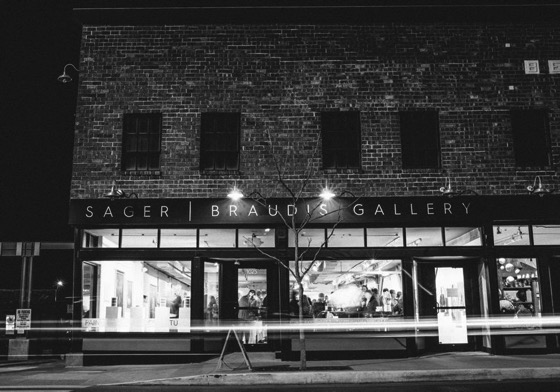
REHERSED: A CJ TABLE READ WITH GREENHOUSE THEATER PROJECT Sager Braudis Gallery, 1025 E. Walnut
Sun / Oct 29 / 1:00 PM-3:00 PM
A staged reading of this year’s Screen Grab competition winner. Experience the art of Sager-Braudis Gallery, and watch as one of Columbia’s favorite theater companies reads a short screenplay. Refreshments provided by Harold’s Doughnuts and Fretboard Coffee.
I teach the history of screenwriting, not film, to an MFA program for Stephens College, a low residency program. We do workshops at the Jim Henson Studios in Hollywood for 10 days twice a year and then the students do the rest of their work online. I’m also an adjunct at Cal State Fullerton, so I’ve had the pleasure of teaching all three of these gentlemen. So that’s been a lovely thing but I don’t teach this class there, so they haven’t actually seen me do this. With them, I’ve done screenwriting and workshopping, but here I’m going to talk about why I teach this class for a couple of reasons and I gave it this particular name, “Giving Voice to Silent Films…and the Far From Silent Women Who Wrote Them” – you’ll see that one of those books is by Carrie Beauchamp and it is, “Without Lying Down.” The life story of Frances Marion and the highest paid screenwriter in Hollywood in the entire Silent and early talkie period and none of my students have ever heard of her and I think it is very important that we hear about her and Anita Loos and a bunch of other important women.
I was pleased to be asked to participate in a panel designed by former student (and current kick-ass professor) Warren Lewis. The panel included two other former students from the MFA in Screenwriting program at CSUF: David Morgassen and Lucas Cuny. For the panel’s theme — “What Else Do We Teach When We Teach Screenwriting: Context And Controversy: Strategies For Teaching Film And Television History And Current Events To Screenwriters” — I chose to present on: “Giving Voice to Silent Films and the Far From Silent Women Who Wrote Them”.
It involves the fact that when teaching screenwriting history, I begin chronologically. In essence I force students to watch the classic films of the silent era (happily accessible for free on YouTube) first because that is when women ran the town as evidenced in Cari Beachamp’s Without Lying Down: Frances Marion and the Powerful Women of Early Hollywood”.) Beauchamp’s book is on my reading list so that they can encounter the careers of Frances Marion, Anita Loos, Lois Weber, Adela Rogers St. Johns, Eve Unsell and a host of other women who ran their own production companies for many years.
Secondly, knowing women once ran Hollywood makes it harder for today’s executives to wonder if today’s women can do the same.
Third, I have learned that teaching silent films reminds modern students that in screenwriting the visual is as important as the verbal.
Fourth, recognizing the birth of major iconic archetypes helps them recognize those archetypes in modern films and develop their own characters more three-dimensionally.
Fifth, I had to embarrassingly realize that in my zest to focus on forgotten females, I forgot to cover the careers of forgotten men and women of color and so expanded my viewing list to include the work of Oscar Mischeaux and other artists of color from the era.
Finally, I stretch back to the silents as a reminder that all artists stand of the shoulders of those who came before them – be they women or men.
Rosanne Welch, PhD has written for television (Touched by an Angel, Picket Fences) and print (Three Ring Circus: How Real Couples Balance Marriage, Work and Kids and The Encyclopedia of Women in Aviation and Space). In the documentary world she has written and produced Bill Clinton and the Boys Nation Class of 1963 for ABC NEWS/Nightline and consulted on PBS’s A Prince Among Slaves, the story of a prince from West Africa who was enslaved in the 1780s, freed by order of President John Quincy Adams in the 1820s and returned to his homeland.
Welch teaches the History of Screenwriting and One-Hour Drama for the Stephens College MFA in Screenwriting. Writing/producing credits include Beverly Hills 90210, Picket Fences,ABCNEWS: Nightline and Touched by an Angel. In 2016 she published the book Why The Monkees Matter: Teenagers, Television and American Pop; co-edited Women in American History: A Social, Political, and Cultural Encyclopedia; and placed “Transmitting Culture Transnationally Via the Characterization of Parents in Police Procedurals” in the New Review of Film and Television Studies. Essays appear in Torchwood Declassified: Investigating Mainstream Cult Television and Doctor Who and Race: An Anthology. Welch serves as Book Reviews editor for Journal of Screenwriting and on the Editorial Advisory Board for Written By magazine, the magazine of the Writers Guild.
“How Gidget Got Into the Girl Ghetto by Accident (and How We Can Get Her Out of it): Demoting Gidget: The Little Girl with Big Ideas from Edgy Coming of Age Novel to Babe on the Beach Genre Film via Choices made in the Adaptation Process.”
It’ a long title, as I joke up front, but covers the process of adapting the true life story of Kathy Kohner (nicknamed ‘Gidget’ by the group of male surfers who she spent the summers with in Malibu in the 1950s) into the film and television series that are better remembered than the novel. The novel had been well-received upon publication, even compared to A Catcher in the Rye, but has mistakenly been relegated to the ‘girl ghetto’ of films. Some of the adaptations turned the focus away from the coming of age story of a young woman who gained respect for her talent at a male craft – surfing – and instead turned the focus far too much on Kathy being boy crazy.
Along the way I found interesting comparisons between how female writers treated the main character while adapting the novel and how male writers treated the character.
Dr. Rosanne Welch teaches the History of Screenwriting and One-Hour Drama for the Stephens College MFA in Screenwriting.
Writing/producing credits include Beverly Hills 90210, Picket Fences, ABCNEWS: Nightline and Touched by an Angel. In 2016 she published the book Why The Monkees Matter: Teenagers, Television and American Pop; co-edited Women in American History: A Social, Political, and Cultural Encyclopedia; and placed “Transmitting Culture Transnationally Via the Characterization of Parents in Police Procedurals” in the New Review of Film and Television Studies. Essays appear in Torchwood Declassified: Investigating Mainstream Cult Television and Doctor Who and Race: An Anthology. Welch serves as Book Reviews editor for Journal of Screenwriting and on the Editorial Advisory Board for Written By magazine, the magazine of the Writers Guild.
The Screenwriting Research Network is a research group consisting of scholars, reflective practitioners and practice-based researchers interested in research on screenwriting. The aim is to rethink the screenplay in relation to its histories, theories, values and creative practices.
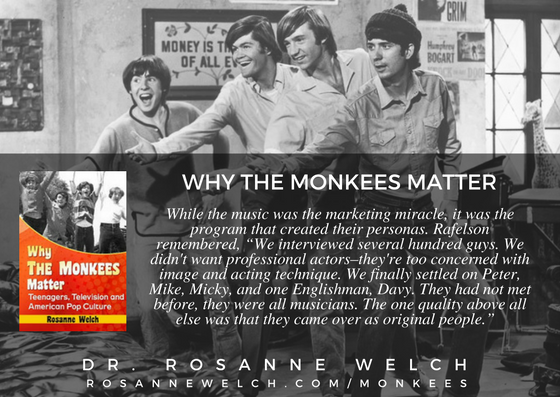
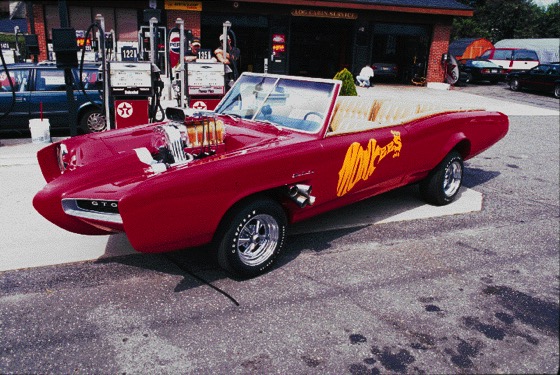
While the music was the marketing miracle, it was the program that created their personas. Rafelson remembered, “We interviewed several hundred guys. We didn’t want professional actors–they’re too concerned with image and acting technique. We finally settled on Peter, Mike, Micky, and one Englishman, Davy. They had not met before, they were all musicians. The one quality above all else was that they came over as original people.”
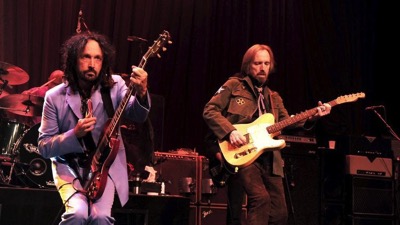
In honor of the loss of Tom Petty, I was reminded of his love for Monkees music in this quote I used in Why The Monkees Matter. He will be missed by many. — Rosanne
The Monkees were on TV. They appealed to the broadest audience possible. The Monkees were sanitized. My mom and dad would watch the Monkees with me, and other than their stupid haircuts, Mom and Dad weren’t bothered much by the Pre-fab Four.
Mom and Dad bought me Monkees records. I read Monkees interviews and through them, learned about a guy named Jimi Hendrix who was their opening act in cities I couldn’t get to. I saw Frank Zappa of the Mothers of Invention on the Monkees TV show and in their movie, “Head,” and soon I’d moved from the innocuous to full blown dangerous rock ‘n’ roll. Things that are for everyone sometimes suck us into things that aren’t for everyone.

![Remember the Ladies from Giving Voice to Silent Films and the Far From Silent Women Who Wrote Them with Dr. Rosanne Welch [Video] (0:56)](https://rosannewelch.com/wp-content/uploads/2017/10/ufva-02-remember-ladies.jpeg)


![Introduction from Giving Voice to Silent Films and the Far From Silent Women Who Wrote Them with Dr. Rosanne Welch [Video] (1 min)](https://rosannewelch.com/wp-content/uploads/2017/09/Slide01.jpg)
![How Gidget Got Into the Girl Ghetto – Dr. Rosanne Welch – SRN Conference 2017 [Video] (23 mins)](https://rosannewelch.com/wp-content/uploads/2017/10/gidget-srn.png)