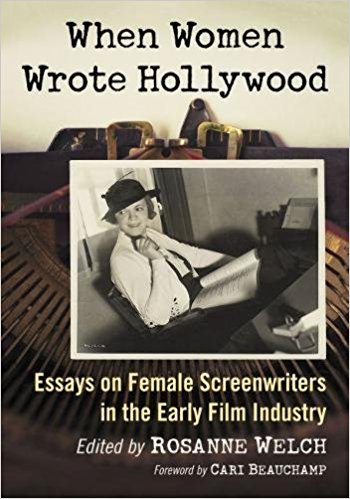
Months of research went into the creation of the essays in “When Women Wrote Hollywood.” Here are some of the resources used to enlighten today’s film lovers to the female pioneers who helped create it.
The adopted son of Cecil B. de Mille traces the life of his biological mother, a screenwriter during the silent film era, and the privileged but uneasy youth he enjoyed in Hollywood while being kept in the dark about his origins.
* A portion of each sale from Amazon.com directly supports our blogs
** Many of these books may be available from your local library. Check it out!
† Available from the LA Public Library
Subscribe to Rosanne’s Channel and receive notice of each new video!
This one allowed me to riff on some of my favorite female science fiction writers across time, whether they be novelists or television writers. It also opened up a good conversation on what art we support and include in our lives – and what that art says to us and about us. — Rosanne
Transcript:
Moves us into the world of Buffy which is part horror/part sci-fi I would say blending and I think really finally a powerful woman though yes she does use weapons but it’s also about her inner strength and her buddy Willow who doesn’t have to be sexy she’s just a cool really smart girl. So we’re trying to get some more normal representations of women. However when they sell the box set, uhhh, that’s a pretty like it yeah, an overtly sexual pose that doesn’t really thrill me, but the series is pretty brilliant and she’s pretty powerful in it and there’s an ending to it — not gonna spoil it — but there’s a choice made in the last episode in terms of how men would take having to deal with their power issues and how a woman decides to save the day. — what she does and it’s a big interesting thing.
* A portion of each sale from Amazon.com directly supports our blogs ** Many of these books may be available from your local library. Check it out!
The Civil War on Film will inform high school and college readers interested in Civil War film history on is-sues that arise when film viewers confuse entertainment with historical accuracy.
The nation’s years of civil war were painful, destructive, and unpleasant. Yet war films tend to embrace mythologies that erase that historical reality, romanticizing the Civil War. The editors of this volume have little patience for any argument that implies race-based slavery isn’t an entirely repugnant economic, political, and cultural institution and that the people who fought to preserve slavery were fighting for a glorious and admirable cause.
To that end, The Civil War on Film will open with a timeline and introduction and then explore ten films across decades of cinema history in ten chapters, from Birth of a Nation, which debuted in 1915, to The Free State of Jones, which debuted one hundred and one years later. It will also analyze and critique the myriad of mythologies and ideologies which appear in American Civil War films, including Lost Cause ideation, Black Confederate fictions, Northern Aggression mythologies, and White Savior tropes. It will also suggest the way particular films mirror the time in which they were written and filmed. Further resources will close the volume.
Makes clear that depictions of the Civil War on film are often mythologized
Analyzes films in a manner that shows students the historical context in which the films were made and viewed
Goes beyond just synopses and historical facts, helping students to develop critical thinking skills
Stimulates debate over the various ways the war was interpreted and experienced
Subscribe to Rosanne’s Channel and receive notice of each new video!
Transcript:
…and of course we have to realize the only reason we know her work and we know Lucy’s work is because Desi was smart enough to have all of their work filmed and he owned the film. He paid for the film and that’s why it is in rerun perpetually. There are so many other shows from that era that we could know as well but all of the stuff disappeared right? It was taped over and all that stuff. So his brilliance is why she gets to be Lucille Ball to us today which I think and around the world. I went to the Lucy Museum at Universal years ago and there were people speaking all kinds of languages and everybody understood Lucy because it was like a silent film. It’s all visual. You could manage that right? So Madelyn Pugh is pretty brilliant.
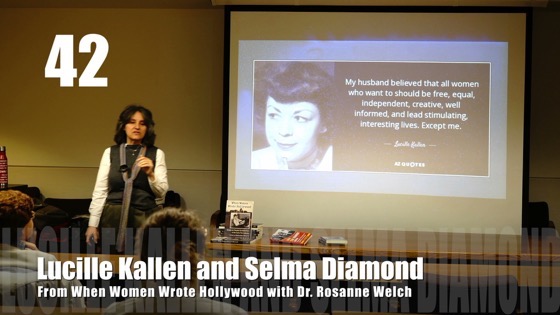
Dr. Rosanne Welch discusses the women in her new book “When Women Wrote Hollywood” which covers female screenwriters from the Silents through the early 1940s when women wrote over 50% of films and Frances Marion was the highest paid screenwriter (male or female) and the first to win 2 Oscars. Yet, she fails to appear in film history books, which continue to regurgitate the myth that male directors did it all – even though it’s been proven that the only profitable movies Cecil B. de Mille ever directed were all written by Jeannie Macpherson film ever won for Best Picture was written by Robert E. Sherwood (who people have heard of, mostly due to his connection to Dorothy Parker) and Joan Harrison.
* A portion of each sale from Amazon.com directly supports our blogs ** Many of these books may be available from your local library. Check it out! † Available from the LA Public Library
Wherever you go, you find Monkees fans and the Denver Popular Culture Con was no different. Amid rooms full of caped crusaders and cosplay creations, I was initially not sure how many folks would attend a talk on a TV show from the 1960s – but happily I was met by a nice, engaged audience for my talk on Why the Monkees Matter – and afterward they bought books! What more could an author ask for?
Subscribe to Rosanne’s Channel and receive notice of each new video!
Transcript
…and of course, the music still matters because two years ago they put on an album on their 50th anniversary that made the top 50 in the Billboard charts. Fifty years after their last top-ten album. No other artists can say that. No other living artists right. If you put up dead people’s stuff then it’ll sell yeah but no other living artists and the people that wrote for them on this album again very major modern songwriters. So I think that’s really really cool Rivers Cuomo, Andy Partridge, Ben Gibbard wrote a beautiful song called Me and Magdalena which is just a very gorgeous song — a Nesmith thing. These are all amazing people today. What they did, the folks at Rhino records went out and asked people from hit rock bands today, if you could write for The Monkees would you and a bunch of them said yes and then they said okay write me a song that sounds like a Monkees song and that was a great challenge for them. They really, really enjoyed it. Ben Gibbard sings the Me and Magdalena when he’s on tour.
A hit television show about a fictitious rock band, The Monkees (1966-1968) earned two Emmys–Outstanding Comedy Series and Outstanding Directorial Acheivement in Comedy.
Capitalizing on the show’s success, the actual band formed by the actors, at their peak, sold more albums than The Beatles and The Rolling Stones combined, and set the stage for other musical TV characters from The Partridge Family to Hannah Montana. In the late 1980s, the Monkees began a series of reunion tours that continued into their 50th anniversary.
This book tells the story of The Monkees and how the show changed television, introducing a new generation to the fourth-wall-breaking slapstick created by Laurel and Hardy and the Marx Brothers.
Its creators contributed to the innovative film and television of 1970s with projects like Bob & Carol & Ted & Alice, The Mary Tyler Moore Show, Laugh-In and Welcome Back, Kotter. Immense profits from the show, its music and its merchandising funded the producers’ move into films such as Head, Easy Riderand Five Easy Pieces.
Months of research went into the creation of the essays in “When Women Wrote Hollywood.” Here are some of the resources used to enlighten today’s film lovers to the female pioneers who helped create it.
Anita Loos (1888-1981) was one of Hollywood’s most respected and prolific screenwriters, as well as an acclaimed novelist and playwright. This unique collection of previously unpublished film treatments, short stories, and one-act plays spans fifty years of her creative writing and showcases the breadth and depth of her talent. Beginning in 1912 with the stories she submitted from her San Diego home (some made into films by D. W. Griffith), through her collaboration with Colette on the play Gigi, Anita Loos wrote almost every day for the screen, stage, books, or magazines. Film scripts include San Francisco, The Women, and Red-Headed Woman. The list of stars for whom she created unforgettable roles includes Mary Pickford, Jean Harlow, Clark Gable, Audrey Hepburn, and Carol Channing.
This collection has been selected by Anita’s niece and close friend, the best-selling author Mary Anita Loos, together with the acclaimed film historian Cari Beauchamp. Their essays are laced throughout the volume, introducing each section and giving previously untold insights and behind-the-scenes stories about Anita―her life, her friendships, and her times.
* A portion of each sale from Amazon.com directly supports our blogs
** Many of these books may be available from your local library. Check it out!
† Available from the LA Public Library
Subscribe to Rosanne’s Channel and receive notice of each new video!
This one allowed me to riff on some of my favorite female science fiction writers across time, whether they be novelists or television writers. It also opened up a good conversation on what art we support and include in our lives – and what that art says to us and about us. — Rosanne
Transcript:
I’m going to go back to my Russell Davies guy because he said something that is really interesting in one of his interviews about what’s wrong with television. He happens to be a gay man — an out, gay man — in England. So he made sure that most of his pieces involved gay men in partnerships because he wanted to see, again, as a child — he wanted to see that that was normal and acceptable, but he also recognized how badly women are represented on television and he wanted to something about that. So, in Doctor Who, when he took it over, he invented a lot of very interesting female companions who had all their different levels of strength. I could do a whole talk on that. I already have, but of course, the great thing about Doctor Who, post the Russell Davies period we’ve now come up with regenerating — so we’re going back to Virginia Woolfe and Orlando — we’re making the male character — who for 50 years has been represented by a male actor — he regenerated into a female character and so we’re moving forward in the Doctor Who universe as well as a female character.
* A portion of each sale from Amazon.com directly supports our blogs ** Many of these books may be available from your local library. Check it out!
Fascinating read about happiness as folks age out of their first careers…especially this point: “teaching is an ability that decays very late in life, a principal exception to the general pattern of professional decline over time. A study in The Journal of Higher Education showed that the oldest college professors in disciplines requiring a large store of fixed knowledge, specifically the humanities, tended to get evaluated most positively by students.” — Rosanne
These words came from an elderly woman sitting behind me on a late-night flight from Los Angeles to Washington, D.C. The plane was dark and quiet. A man I assumed to be her husband murmured almost inaudibly in response, something to the effect of “I wish I was dead.”
Again, the woman: “Oh, stop saying that.”
I didn’t mean to eavesdrop, but couldn’t help it. I listened with morbid fascination, forming an image of the man in my head as they talked. I imagined someone who had worked hard all his life in relative obscurity, someone with unfulfilled dreams—perhaps of the degree he never attained, the career he never pursued, the company he never started.
At the end of the flight, as the lights switched on, I finally got a look at the desolate man. I was shocked. I recognized him—he was, and still is, world-famous. Then in his mid‑80s, he was beloved as a hero for his courage, patriotism, and accomplishments many decades ago.
Wherever you go, you find Monkees fans and the Denver Popular Culture Con was no different. Amid rooms full of caped crusaders and cosplay creations, I was initially not sure how many folks would attend a talk on a TV show from the 1960s – but happily I was met by a nice, engaged audience for my talk on Why the Monkees Matter – and afterward they bought books! What more could an author ask for?
Subscribe to Rosanne’s Channel and receive notice of each new video!
Transcript
Obviously, as I said, the TV Writers, the music writers mattered. I mean, Carole King — how many Grammy’s in her day — and she wrote Some Time In The Morning, which I think is one of the most beautiful love songs ever. Boyce and Hart, as I mentioned were the major songwriters for them in the first couple of years and then it expanded. Neil Sedaka wrote for them. Neil Diamond — how about that young picture of Neil Diamond. Paul Williams, who also — somehow the Muppets and The Monkees — I need a book that connects them because there is a lot that connects them. David Gates from Bread wrote a couple of songs and actually, Micky has an album of — he does a new album called Remember and in that he records Diary which is a famous David Gates song which David wrote and tried to sell to him in the late ’70s and he said no, I don’t think I’m a singer anymore. So he did that later in his career. But that’s how important — and Carole Bayer Sager of course. So they knew that writers were an important thing.
A hit television show about a fictitious rock band, The Monkees (1966-1968) earned two Emmys–Outstanding Comedy Series and Outstanding Directorial Acheivement in Comedy.
Capitalizing on the show’s success, the actual band formed by the actors, at their peak, sold more albums than The Beatles and The Rolling Stones combined, and set the stage for other musical TV characters from The Partridge Family to Hannah Montana. In the late 1980s, the Monkees began a series of reunion tours that continued into their 50th anniversary.
This book tells the story of The Monkees and how the show changed television, introducing a new generation to the fourth-wall-breaking slapstick created by Laurel and Hardy and the Marx Brothers.
Its creators contributed to the innovative film and television of 1970s with projects like Bob & Carol & Ted & Alice, The Mary Tyler Moore Show, Laugh-In and Welcome Back, Kotter. Immense profits from the show, its music and its merchandising funded the producers’ move into films such as Head, Easy Riderand Five Easy Pieces.
Months of research went into the creation of the essays in “When Women Wrote Hollywood.” Here are some of the resources used to enlighten today’s film lovers to the female pioneers who helped create it.
“Among early Hollywood’s most brilliant filmmakers, Lois Weber was considered one of the era’s ‘three great minds’ alongside D. W. Griffith and Cecil B. DeMille. Despite her accomplishments, Weber has been marginalized in relation to her contemporaries, who have long been recognized as fathers of American cinema. Drawing on a range of materials untapped by previous historians, Shelley Stamp offers the first comprehensive study of Weber’s remarkable career as director, screenwriter, and actress. Lois Weber in Early Hollywood provides compelling evidence of the extraordinary role that women played in shaping American movie culture. Weber made films on capital punishment, contraception, poverty, and addiction, establishing early cinema’s power to engage topical issues for popular audiences. Her work also grappled with the profound changes in women’s lives that unsettled Americans at the beginning of the twentieth century, and her later films include sharp critiques of heterosexual marriage and consumer capitalism. Mentor to many women in the industry, Weber demanded a place at the table in early professional guilds, decrying the limited roles available for women on screen and in the 1920s protesting the growing climate of hostility toward female directors. Through her examination of Weber’s career, Stamp demonstrates how female filmmakers who had played a part in early Hollywood’s bid for respectability were in the end written out of that industry’s history. Lois Weber in Early Hollywood is an essential addition to histories of silent cinema, early filmmaking in Los Angeles, and women’s contributions to American culture.”
* A portion of each sale from Amazon.com directly supports our blogs
** Many of these books may be available from your local library. Check it out!
† Available from the LA Public Library