That video is now available on YouTube and the Cal Poly Pomona CEIS Podcast Page. It’s a great way to capture the experience of some of my more expressive and interesting students in the middle of their educational journeys – and to demonstrate the idea of being able to articulate your values and ideas in public, a ‘soft skill’ we all can use for the rest of our lives. I often argue that these soft skills make the difference between acing a job interview (and later the career) and not because everyone who comes to an interview has a matching resume of accomplishment so it’s how they handle those soft skills that wins the race.
Rosanne Welch, PhD, Author of Why The Monkees Matter, presents “How The Monkees Changed Television” at a Cal State Fullerton Lunch Lecture on May 8, 2018.
In this talk, she shows how The Monkees, and specifically their presence on television, set the stage for large changes to come in the late 1960s.
Transcript
Had The Monkees done Sugar Sugar we wouldn’t have the Archie and, of course, the Archie comics — another side tangent — has become Riverdale. The big show right and a big show because you all know him from your own childhood TV watching right? So the grown-up version. So it’s like Circus Boy becoming a Monkee. It just happens over and over again right? All right, you’ve also all known a Monkee song all your life even if you didn’t think you did because in Shrek they use I’m A Believer. So now we’re years behind. We’re thirty years from the show being on the air and a whole run of children know this song right and this is Micky Dolenz closing song in all his concerts. This is his song, right? Breaking Bad in the season before it went off the air did a whole meth — a whole montage of putting meth together to the Monkees song Going Down because Vince Gilligan was a Monkees fan when he was a kid. So his chance to use Monkees music and his own TV show was something exciting for him. Likewise, Mad Men did an episode that used the song for the Monkees. So highly rated Emmy-winning TV shows are airing their music to a whole new generation. I thought that was cool.
A hit television show about a fictitious rock band, The Monkees (1966-1968) earned two Emmys–Outstanding Comedy Series and Outstanding Directorial Acheivement in Comedy.
Capitalizing on the show’s success, the actual band formed by the actors, at their peak, sold more albums than The Beatles and The Rolling Stones combined, and set the stage for other musical TV characters from The Partridge Family to Hannah Montana. In the late 1980s, the Monkees began a series of reunion tours that continued into their 50th anniversary.
This book tells the story of The Monkees and how the show changed television, introducing a new generation to the fourth-wall-breaking slapstick created by Laurel and Hardy and the Marx Brothers.
Its creators contributed to the innovative film and television of 1970s with projects like Bob & Carol & Ted & Alice, The Mary Tyler Moore Show, Laugh-In and Welcome Back, Kotter. Immense profits from the show, its music and its merchandising funded the producers’ move into films such as Head, Easy Riderand Five Easy Pieces.
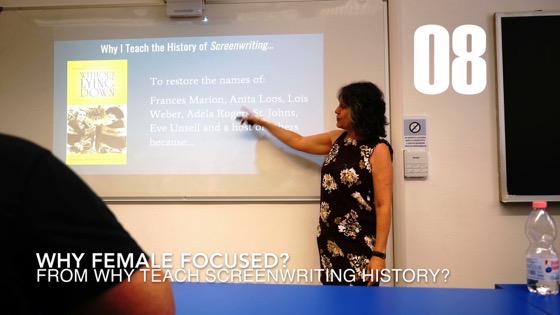
So how I teach it. That’s why I teach I want respect to come back to writers. That seems simple right? How I do it. I start in the very beginning when women were the major writers of Hollywood films. There were 50 percent of the films are in by women if not more and they made more money. This is Gene Gauntier from Ireland, this is Anita Loos and Jeannie Macpherson working with Cecil B. DeMille. She wrote every one of his financially successful films and when they stopped working together, his movies stopped making money. That’s the end of Cecil B. DeMille. How I teach it. I start by asking students very quick questions. What are your first five favourite films? Who directed those films? They always know. Who wrote those films? and the look of humiliation on their faces when they sit in a screenwriting class and cannot name the people who wrote their favorite films is ridiculous to me.
* A portion of each sale from Amazon.com directly supports our blogs ** Many of these books may be available from your local library. Check it out! † Available from the LA Public Library
It’s time for another episode of Monkees 101, which I cohost with the marvelous fellow Phd, Sarah Clark. This one covers the episode “Your Friendly Neighborhood Kidnappers”, written by Dave Evans and directed by James Frawley, who sadly passed away on January 24th. Enjoy hearing our take on one of the classic episodes of the show.. — Rosanne
Drs. Rosanne Welch and Sarah Clark are back for Zilch Monkees 101 S1 E4 “Your Friendly Neighborhood Kidnappers”, the 4th episode of The Monkees to air. We also have a live version of “Let’s Dance On” from 2016 and Monkees News!
This episode is dedicated to James Frawley, a veteran Hollywood director of film and TV projects like The Monkees (32 episodes) and The Muppet Movie, has died. He was 82.
Thank you for making our lives better with your work. Originally aired 1/24/19
A hit television show about a fictitious rock band, The Monkees (1966-1968) earned two Emmys–Outstanding Comedy Series and Outstanding Directorial Acheivement in Comedy.
Capitalizing on the show’s success, the actual band formed by the actors, at their peak, sold more albums than The Beatles and The Rolling Stones combined, and set the stage for other musical TV characters from The Partridge Family to Hannah Montana. In the late 1980s, the Monkees began a series of reunion tours that continued into their 50th anniversary.
This book tells the story of The Monkees and how the show changed television, introducing a new generation to the fourth-wall-breaking slapstick created by Laurel and Hardy and the Marx Brothers.
Its creators contributed to the innovative film and television of 1970s with projects like Bob & Carol & Ted & Alice, The Mary Tyler Moore Show, Laugh-In and Welcome Back, Kotter. Immense profits from the show, its music and its merchandising funded the producers’ move into films such as Head, Easy Riderand Five Easy Pieces.
Rosanne Welch, PhD, Author of Why The Monkees Matter, presents “How The Monkees Changed Television” at a Cal State Fullerton Lunch Lecture on May 8, 2018.
In this talk, she shows how The Monkees, and specifically their presence on television, set the stage for large changes to come in the late 1960s.
Transcript
In the 80s they got a star on the on the Walk of Fame for the TV show not the music. That’s how important the TV show was. That’s their their star right and at this point they end up with a manager. they’d never had a manager before and he started the whole tour thing. So in their 50th year, the Archie comics had the Monkees guest star. This just came out a couple of months ago and that’s a huge “Wow the monkeys are in the Archies” right? The Archies — side tangent — were invented because Don Kirshner the music director of the show would pick their songs and Michael Nesmith didn’t like his taste and he wanted him fired and he was eventually fired over the song “Sugar, Sugar” which was supposed to be a Monkees song but Michael Nesmith refused to sing it and so Don Kirshner invented the Archies because it’s a group he could make do whatever he wanted.
A hit television show about a fictitious rock band, The Monkees (1966-1968) earned two Emmys–Outstanding Comedy Series and Outstanding Directorial Acheivement in Comedy.
Capitalizing on the show’s success, the actual band formed by the actors, at their peak, sold more albums than The Beatles and The Rolling Stones combined, and set the stage for other musical TV characters from The Partridge Family to Hannah Montana. In the late 1980s, the Monkees began a series of reunion tours that continued into their 50th anniversary.
This book tells the story of The Monkees and how the show changed television, introducing a new generation to the fourth-wall-breaking slapstick created by Laurel and Hardy and the Marx Brothers.
Its creators contributed to the innovative film and television of 1970s with projects like Bob & Carol & Ted & Alice, The Mary Tyler Moore Show, Laugh-In and Welcome Back, Kotter. Immense profits from the show, its music and its merchandising funded the producers’ move into films such as Head, Easy Riderand Five Easy Pieces.
So how I teach it. That’s why I teach I want respect to come back to writers. That seems simple right? How I do it. I start in the very beginning when women were the major writers of Hollywood films. There were 50 percent of the films are in by women if not more and they made more money. This is Gene Gauntier from Ireland, this is Anita Loos and Jeannie Macpherson working with Cecil B. DeMille. She wrote every one of his financially successful films and when they stopped working together, his movies stopped making money. That’s the end of Cecil B. DeMille. How I teach it. I start by asking students very quick questions. What are your first five favourite films? Who directed those films? They always know. Who wrote those films? and the look of humiliation on their faces when they sit in a screenwriting class and cannot name the people who wrote their favorite films is ridiculous to me.
* A portion of each sale from Amazon.com directly supports our blogs ** Many of these books may be available from your local library. Check it out! † Available from the LA Public Library
Rosanne Welch, PhD, Author of Why The Monkees Matter, presents “How The Monkees Changed Television” at a Cal State Fullerton Lunch Lecture on May 8, 2018.
In this talk, she shows how The Monkees, and specifically their presence on television, set the stage for large changes to come in the late 1960s.
Transcript
In the 70s they’re still selling 16 magazine. They’re still front page worthy material right? The show’s been off the air for a few years. You can buy a Honeycomb cereal and get the record on the back and you cut the record out and put it on your turntable and it played. It was a plastic over the cardboard and you could play a record that you know that was your free gift on your cereal. Sgain in the 70s based on their reruns Saturday morning. In the 80s MTV ran a marathon and brought them back in their 20th anniversary. It was a one weekend. It was called Pleasant Valley weekend and Rachel Maddow interviewed Peter Tork after Davy Jones died and she said to him “I learned what it was like to be a kid in the 60s from watching those reruns when I was a kid in the 80s.” and he couldn’t believe that she even knew who he was. So even in the 80s now they’re coming to a new group.
A hit television show about a fictitious rock band, The Monkees (1966-1968) earned two Emmys–Outstanding Comedy Series and Outstanding Directorial Acheivement in Comedy.
Capitalizing on the show’s success, the actual band formed by the actors, at their peak, sold more albums than The Beatles and The Rolling Stones combined, and set the stage for other musical TV characters from The Partridge Family to Hannah Montana. In the late 1980s, the Monkees began a series of reunion tours that continued into their 50th anniversary.
This book tells the story of The Monkees and how the show changed television, introducing a new generation to the fourth-wall-breaking slapstick created by Laurel and Hardy and the Marx Brothers.
Its creators contributed to the innovative film and television of 1970s with projects like Bob & Carol & Ted & Alice, The Mary Tyler Moore Show, Laugh-In and Welcome Back, Kotter. Immense profits from the show, its music and its merchandising funded the producers’ move into films such as Head, Easy Riderand Five Easy Pieces.
* Music from Hamilton — Who lives? Who Dies? Who Tells Your Story?”*
“His financial system is a work of genius. I couldn’t undo if I tried and I tried.”
Also a piece very famous for the writer Lin-Manuel Miranda more so than anyone else. Historiography is something we teach in masters programs that we don’t really teach in undergrad and they have to understand who wrote these books and why do we know who why do we have that. I want to teach the history screenwriting these all artists stand on the shoulders of those who came before them be they men or women and we should know who those people were and how they created what we have.
* A portion of each sale from Amazon.com directly supports our blogs ** Many of these books may be available from your local library. Check it out! † Available from the LA Public Library
Rosanne Welch, PhD, Author of Why The Monkees Matter, presents “How The Monkees Changed Television” at a Cal State Fullerton Lunch Lecture on May 8, 2018.
In this talk, she shows how The Monkees, and specifically their presence on television, set the stage for large changes to come in the late 1960s.
Transcript
He was voted the number one teen idol of all time about two years before he died and that’s over all the other guys you can think of David Cassidy who comes after him and the Partridge Family and anybody can think of so that’s a big deal right? After their show was cancelled they appeared on Laugh-In. Look at those great hippie clothes. So they were still considered cool enough to show up on the coolest new show. The sad part of that is the show was canceled because after two years they didn’t want to do a comedy anymore a sitcom a situation comedy. They wanted to do a variety show with rock and roll music and bring in their rock and roll friends and the network said “Oh that’ll never sell” and the next year Laugh-In came, Smothers Brothers came, the Sonny and Cher show came and rock and roll shows were all the rage but because they didn’t let them do it they all chose to quit at that one time which is too bad.
A hit television show about a fictitious rock band, The Monkees (1966-1968) earned two Emmys–Outstanding Comedy Series and Outstanding Directorial Acheivement in Comedy.
Capitalizing on the show’s success, the actual band formed by the actors, at their peak, sold more albums than The Beatles and The Rolling Stones combined, and set the stage for other musical TV characters from The Partridge Family to Hannah Montana. In the late 1980s, the Monkees began a series of reunion tours that continued into their 50th anniversary.
This book tells the story of The Monkees and how the show changed television, introducing a new generation to the fourth-wall-breaking slapstick created by Laurel and Hardy and the Marx Brothers.
Its creators contributed to the innovative film and television of 1970s with projects like Bob & Carol & Ted & Alice, The Mary Tyler Moore Show, Laugh-In and Welcome Back, Kotter. Immense profits from the show, its music and its merchandising funded the producers’ move into films such as Head, Easy Riderand Five Easy Pieces.
Spike Lee is, of course, famous for that. Spike Lee wrote this film — his first film alone but every film after he’s had a co-writer and those co-writers names barely appear on the poster yet obviously they’re necessary to process. Same is true here for Black KKKlansman his new film. The producer Jordan Peel has a bigger credit than Kevin Willmott who co-wrote the film. No one even knows who Kevin Willmott is and he’s written two of Spike Lee’s most important films. Jordan Peele we know and look at his own poster written directed by very big so we are used crediting directors. Some directors are kind enough to tell us, it’s collaborative effort all I can take credit for is the directing. So this is the attitude that I’m trying to instill in my students.
* A portion of each sale from Amazon.com directly supports our blogs ** Many of these books may be available from your local library. Check it out! † Available from the LA Public Library